Stonehenge and Avebury, England
.webp)
Stonehenge and Avebury sit about 25 miles apart in the chalk country of southwest England, and the standard way to see them is together, in one day, from Bath. Tour companies run the pairing all year — ours was organized by Mad Max, which operates out of Bath — and the two sites complement each other so well that if you have the time for one, you should make every effort to do both.
.webp)
They are the same idea executed in opposite ways. Stonehenge is small, precise, carved, fenced and famous. Avebury is enormous, rough, unfenced and free, with a village sitting inside the circle. Seeing them in the same day is what makes each one make sense.
You can also see this video on a separate video page.
Stonehenge
.webp)
Stonehenge is nearly 5,000 years old and it is one of the world's most magical and mysterious places. It is believed that for 1,500 years people were worshiping their gods here, most likely using the site as an astronomical calendar that marked the arrival of the summer and winter seasons.
.webp)
The culture that built it left no written record, so there are many mysteries, which of course is part of the magnetic charm of the place. What was it for? Who built it? When was it in use? Nobody can answer any of those questions with certainty.
.webp)
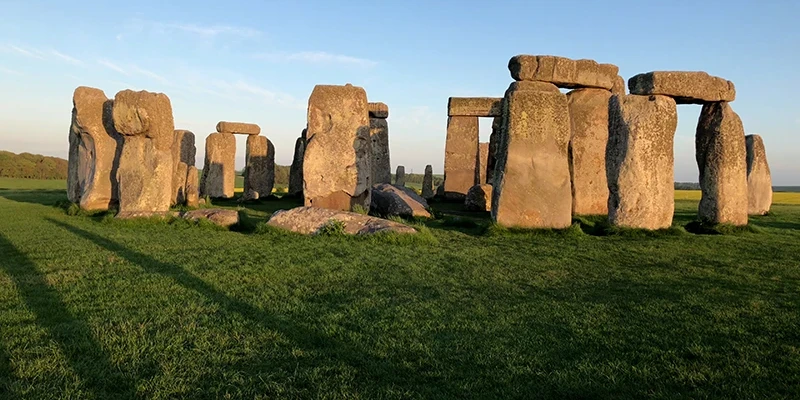
The other reason the site is so compelling is simply the physical beauty of the stones — their elegant arrangement in concentric circles, some of them connected at the top by horizontal lintels, and the massive size of rocks that were carried here from far away.
.webp)
The worldwide interest has made this one site extraordinarily popular. It draws about a million visitors a year, which works out to some 3,000 people a day, and it is twice as busy in summer, when there can be as many as 10,000 in a single day.
.webp)
Even on the normal visitor path you get a very good view. The path circles the monument at a respectful distance, and walking all the way around gives you a proper perspective: first the tall sarsen stones ringing the outside with the lintels joining them across the top, and beyond them, smaller stones — those are the bluestones, arranged in their own circle.
.webp)
In the middle stand the tallest stones of all, the trilithons, pairs of uprights capped by a lintel and arranged in a horseshoe. This may have been the inner sanctum of the temple. Or maybe not — we really do not know what happened here, or what the function of the stones was, other than that this is a colossal megalithic monument, beautiful to see, that probably had an astronomical purpose.
.webp)
It may have predicted the change of seasons and possibly even eclipses, and religious and spiritual ceremonies were undoubtedly conducted here. But a great deal remains conjecture, which makes it all the more interesting to visit, letting your imagination run freely as you wander around.
Building the Monument
.webp)
It helps to look at the arrangement on a map, where the sequence of construction becomes clear. The smaller bluestones came first, then the large sarsens of the outer circle. Years later came the next phase, the giant paired trilithons in their horseshoe. Finally another ring of smaller bluestones was added in the center. All around the outside is an earthen ditch created much earlier.
.webp)
It was a gradual process that took several centuries, finishing about 2000 BC. The site may have been in use for as much as 2,000 years, from roughly 3700 BC until 1600 BC, starting out probably as a wooden structure — a group of tall timbers arranged in a circle — and ultimately developing into the megalithic monument we admire today.
.webp)
The biggest stones are 24 feet tall and weigh up to 50 tons. They were dragged here from about 25 miles away and then hand carved with hammer stones into the shapes we see now. The smaller bluestones came from much further — from Wales, 150 miles distant — and how they were moved remains one of the open questions.
.webp)
When UNESCO designated Stonehenge a World Heritage Site, it described the monument as the most architecturally sophisticated prehistoric stone circle in the world, unrivaled in its design and unique engineering, with huge lintels capping the outer circle and the trilithons locked together by carefully shaped joints. Ever since the twelfth century, Stonehenge has been considered one of the wonders of the world.
Inside the Circle at Sunset
.webp)
There is one way to avoid the crowds entirely, and it is the best thing we can recommend about visiting Stonehenge. For one hour each evening, just before sunset, it is possible to go beyond the barriers and walk among the stones, if you get permission by paying an extra fee.
.webp)
Only 30 people are allowed in at a time on the private twilight visit, and you get a full hour at the site. Demand is extremely high, so you have to reserve well in advance. The cost is roughly twice the regular ticket.
.webp)
Being inside the circle at sunset is an amazing experience. The cameras really mean nothing compared to being here. It is a beautiful picture and it is genuinely astonishing to stand among them.
.webp)
You can walk around the inner circle and the outer circle, move between them, and get views from every angle. Walking inside the site gives you a much better feeling for the overall layout — the outer ring of huge stones, the inner horseshoe of five trilithons, and the circles of smaller stones in between.
.webp)
With an hour to work with you can photograph the last rays of sun striking the stones, and then, if you are lucky with the weather, the sunset itself. We were fortunate — a perfect evening for it.
.webp)
You do not touch the stones. You treat them with the greatest respect. This monument has been standing here for over 4,000 years, and it is a very powerful and spiritual place for many people. There is undeniable magic about it.
.webp)
Up until the mid-1970s it was possible for everybody to walk freely among the stones, because there were simply not that many visitors. In our home movies from the early 1950s there is no admission fee and nobody else in sight — we were able to climb all over the place and jump on the stones. As we have seen, you can still get close. Just do not touch.
Avebury
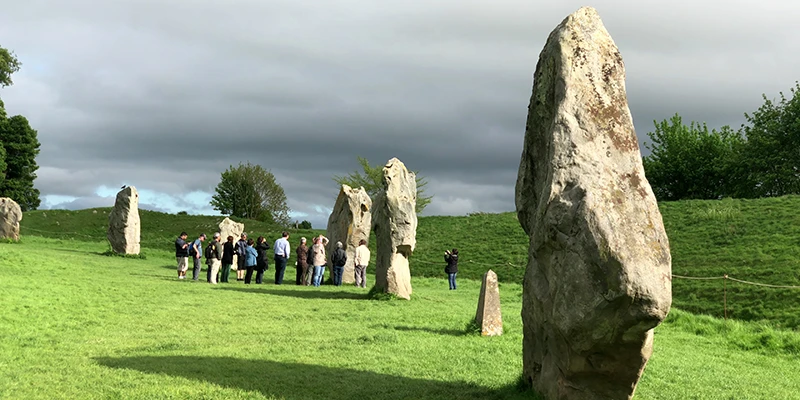
The same tour continues on to Avebury, which has the largest prehistoric stone circle in the world. The circle is about 1,200 feet in diameter, and the scale is the whole point.
.webp)
The stones here are not as big as those at Stonehenge, and they are not carved into shape. These are natural rocks that were hacked out of a quarry and dragged here as they came. The total impression is one of vast size and great beauty.
.webp)
Many of the original stones have been plundered and looted and are simply gone. From the late medieval and early modern periods, over several centuries, people pulled down the standing stones and reused them for building. Enough remains to show the original significance of the site.
What stands today is partly a restoration. In the 1930s the archaeologist Alexander Keiller, who had inherited a marmalade fortune, bought the site, excavated it, re-erected stones that had been toppled and buried, and cleared away buildings that had grown over it. Where a stone is missing entirely, a squat concrete marker shows where it stood, so the circle you walk is a reconstruction of the plan rather than a survival of it.
.webp)
A map shows the circular arrangement of the surviving stones, and you can also see the earthen ditch that ran around the entire site, very similar to Stonehenge but on a far larger scale.
.webp)
Over time, part of the modern village developed right in the middle of the stone circle. Houses, a road, a pub and a church now sit inside a 4,000-year-old monument, which no other site of this importance can claim.
The bank and ditch around Avebury are as impressive as the stones and are usually overlooked. The ditch was originally about 30 feet deep, cut into solid chalk with antler picks, and the spoil thrown up to form the bank outside it. Freshly cut, the whole ring would have been blinding white and visible for miles.
.webp)
The big difference for the visitor is that here you are free to walk around among the stones. There is no admission charge and you can walk anywhere.
.webp)
That freedom changes the experience completely. At Stonehenge you look at the monument; at Avebury you are inside it, and you can spend as long as you like going from stone to stone.
.webp)
Some researchers believe these megalithic circles have some kind of extra energy field, creating a magnetic force in the environment, or some spiritual field like a vortex where you can enter an altered state of consciousness. You might find such claims far-fetched, but others maintain there have been scientific studies with electrodes and readings of magnetic levels that justify it. So who knows. It is a possibility.
.webp)
There is no doubt that you get a special feeling being among these giant stones. Perhaps it is just an appreciation of all the work that was done and the beautiful result. Or it might be something deeper.
.webp)
There are convenient steps going up the small hillside next to the site, so you can stand high and look down across the entire terrain. That view is the one that gives you the true dimensions of the place.
.webp)
Walking right next to these big rocks, as you can at Avebury and on the evening visit at Stonehenge, gives you a far more accurate feeling for how truly colossal and impressive the stones really are.
Practical Details
Stonehenge is run by English Heritage. The visitor center sits about a mile and a half from the stones, with a shuttle bus running between the two, and there is also a marked walking path across the fields if you would rather approach on foot — which is the better way to arrive, since the monument comes into view gradually.
.webp)
Avebury is in the care of the National Trust. Entry to the stones is free and the site is open at all times, though there is a charge for the parking lot, and the village pub and museum keep their own hours.
.webp)
Both sites belong to a single UNESCO World Heritage listing, Stonehenge, Avebury and Associated Sites, and the designation covers far more than the two circles. The surrounding chalk downland is dense with prehistoric monuments — burial mounds, avenues of standing stones, and at Avebury the enormous artificial mound of Silbury Hill, visible from the road, the largest man-made prehistoric mound in Europe and as unexplained as everything else here.
Visiting Both
.webp)
If you have time to visit only one of the sites, either will reward the trip. But make every effort to see both. Each one is profoundly beautiful, and they are beautiful in different ways — Stonehenge for its precision and its fame, Avebury for its scale and its openness.
.webp)
The ideal itinerary combines them: Avebury in the afternoon, free and uncrowded, then Stonehenge in the evening for the private hour inside the circle, arriving as the light goes gold and staying until the stones turn to silhouettes against the sky.