Lyon, France
.webp)
Lyon sits where the Rhône and the Saône come together in eastern France, and the two rivers organize everything about the city. Between them lies a long narrow peninsula holding the modern downtown. West of the Saône, pressed against a steep hill, is a medieval and Renaissance quarter that has survived almost untouched. You can walk from one to the other across a bridge in five minutes and cross five hundred years doing it.
.webp)
This is a large city with a modern industrial base, a full business district and office towers on the skyline, and none of that is what brings visitors. The entire historic center — the old town, the peninsula and the hills on either side — is a UNESCO World Heritage Site, listed for the way the city has kept the physical record of two thousand years of continuous settlement.
You can also see this same video on a separate video page.
.webp)
Arriving by train is the way to come. The high-speed lines run down from Paris in two hours, the track is continuously welded so there is none of the old clicking and knocking, and the trains hold a speed that leaves the traffic on the parallel highway looking stationary. The stations are in the middle of the city, so you step off and you are already there.
.webp)
The riverbanks are where the city presents itself. Tall narrow buildings in ochre, pink and cream stand shoulder to shoulder along the Saône, with the hill and its basilica rising directly behind them. Walkways run along both quays at water level, below the traffic, and they make the easiest and quietest route between the districts.
Old Lyon: The Lanes by Day
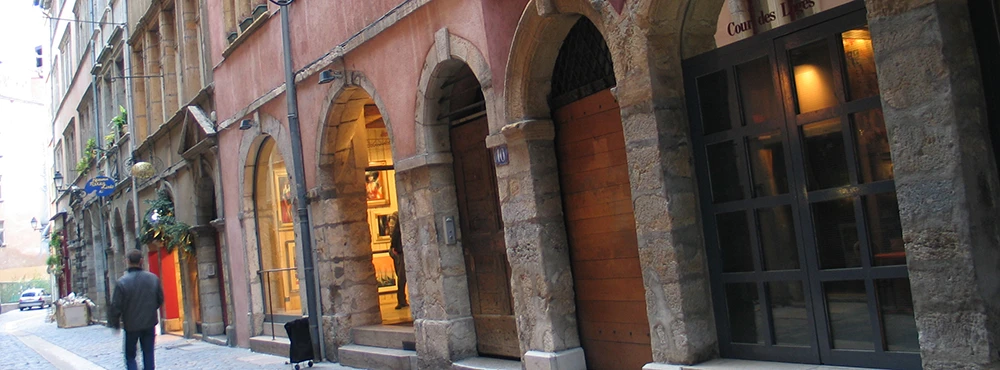
Vieux Lyon runs along the base of the hill for nearly a mile and is about four blocks deep. Within it are five or six main lanes, a set of smaller cross alleys, and a network of covered passages cutting through the buildings themselves. It is the largest Renaissance quarter in France and one of the largest anywhere in Europe.
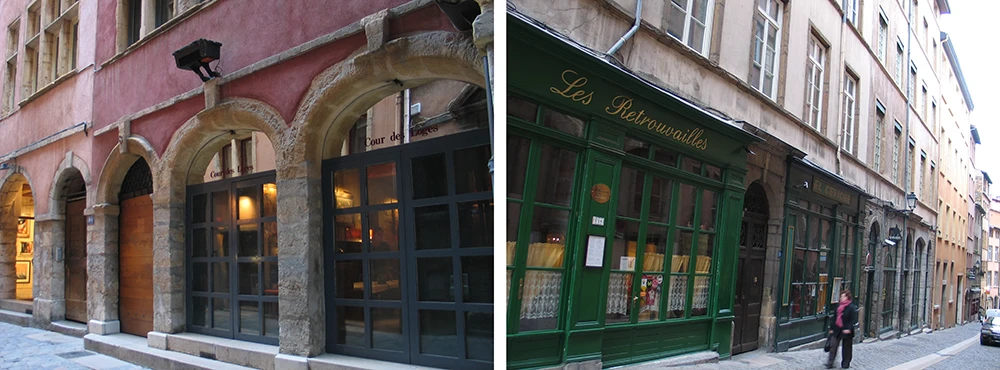
Several of the lanes are pedestrian-only. A few cars come through, along with scooters and delivery trucks in the morning, but by and large this is a quiet and peaceful zone where you can walk down the middle of the street without thinking about it. Some of the buildings date to the Middle Ages and are six or seven hundred years old.
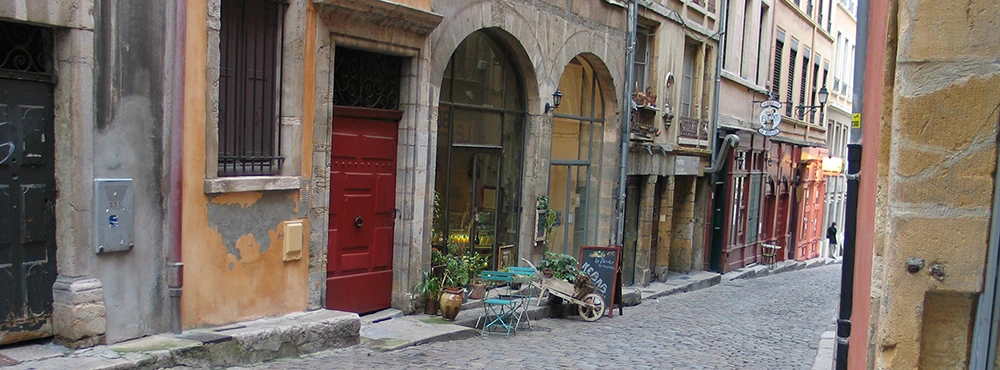
Rue Saint-Jean is the main artery, running the length of the quarter from the cathedral northward. Rue du Bœuf runs parallel one block west, and Rue des Trois Maries connects them. Learn those three names and you have the framework; everything else is discovered by turning off them at random.
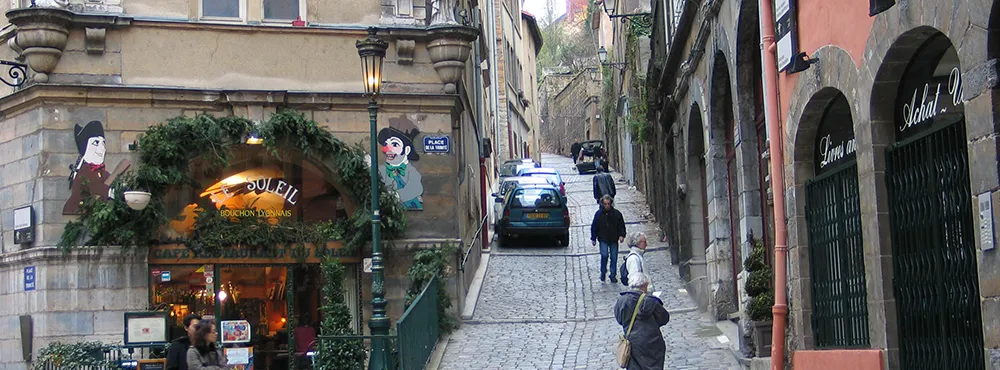
What makes the quarter unusual is not any single building but the absence of modern ones. There are no glass infills, no concrete replacements, no gaps where something was bombed and rebuilt. The facades run continuously in stone, and the effect of several hundred yards of that is something you cannot get from photographs.
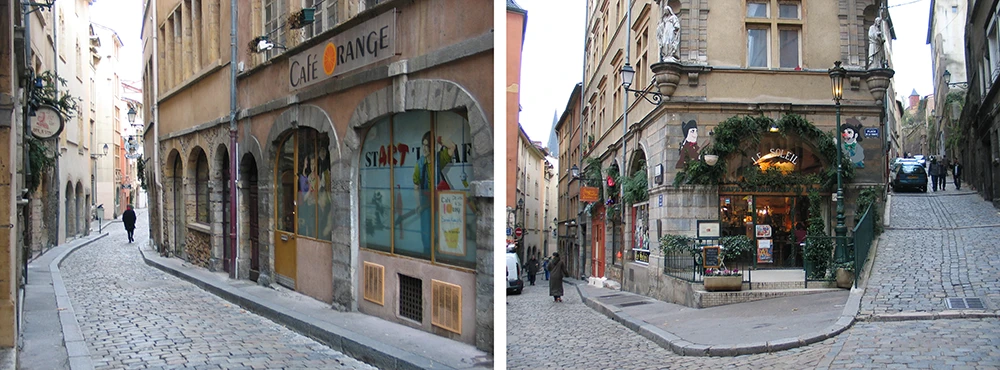
The buildings are four and five stories, tall and narrow, built on the medieval plot pattern where frontage was expensive and depth was cheap. Ground floors hold shops and restaurants, the floors above are apartments, and behind them the buildings run back into courtyards invisible from the street.
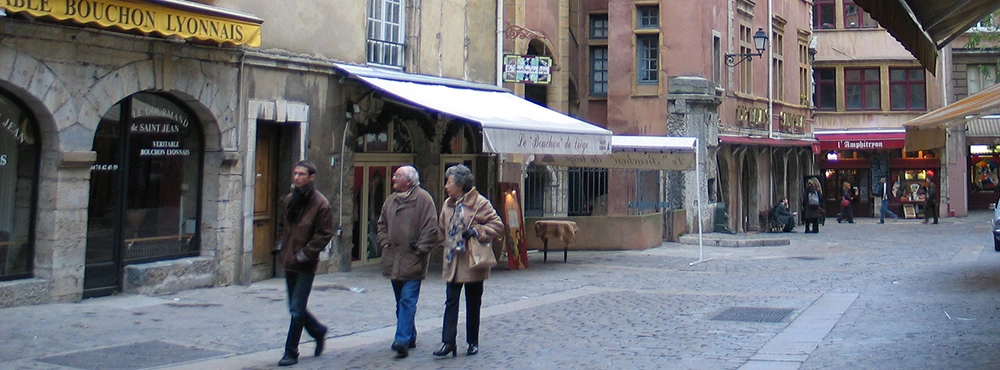
Any time of day is interesting here, but early morning is the one to try. At nine or half past, before the shops have opened, there are only a handful of people about and the lanes are as close to empty as they ever get. The light comes in low along the length of the street, and you have the place largely to yourself.
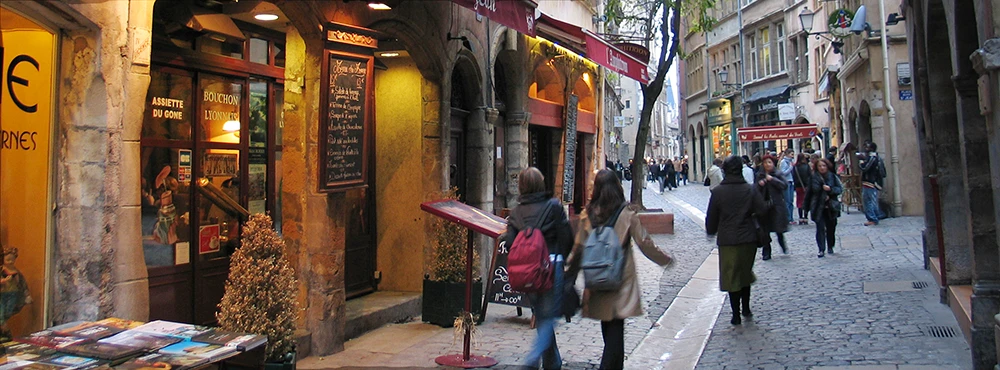
Shops open at about ten and stay open until six or seven in the evening. From mid-morning onward the quarter fills steadily, and by the middle of the afternoon in summer the main lanes carry a continuous stream of people. It never becomes unpleasant, but the early hours are noticeably better.
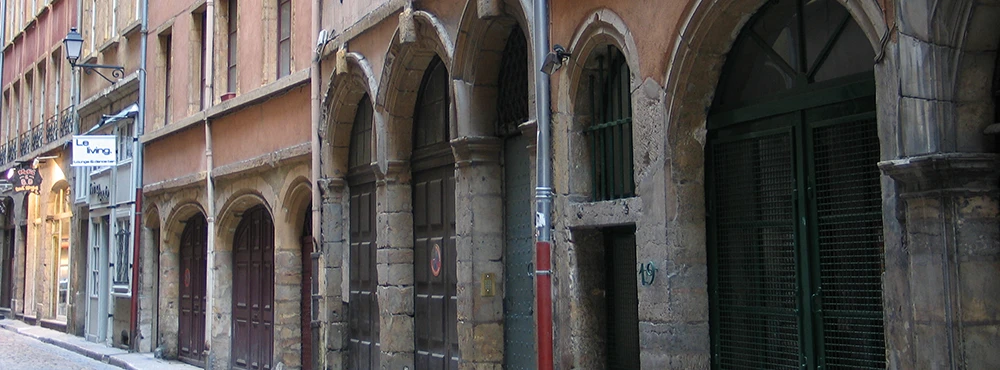
Doorways are worth looking at throughout. Many are original, carved with the arms or initials of the merchant who built the house, and a good number of them are the entrances to the covered passages that run through to the next street. Once you know what you are looking for you start seeing them everywhere.
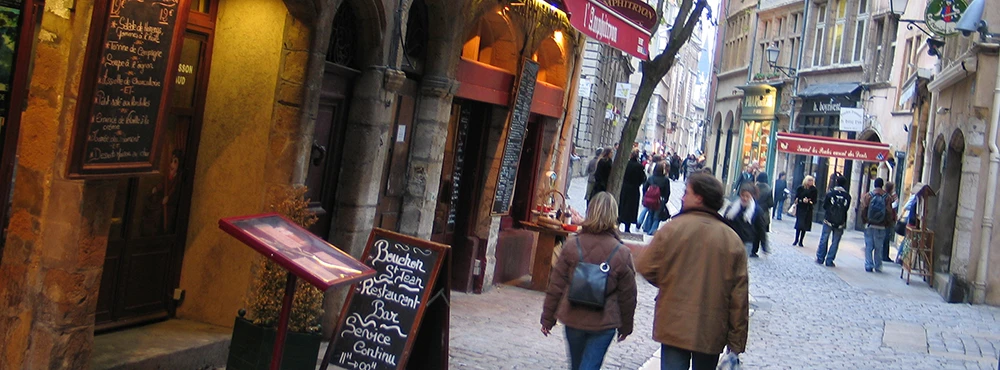
The shops are art galleries, antique dealers, bookstores, and a great many restaurants, bars and cafés. Menus go out on chalkboards by the door at about eleven. Restaurants serve lunch from noon to two and dinner from seven until half past ten, which is the standard French pattern and worth planning around.
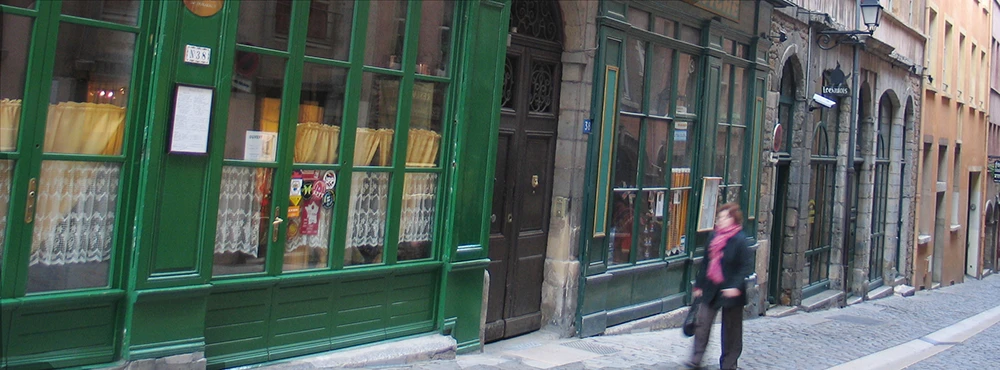
Between those service hours there are cafés open all day, along with brasseries and crêperies that will serve a light meal at any point between noon and midnight. In practice you can eat whenever you want here; you simply have to know which kind of place to walk into.
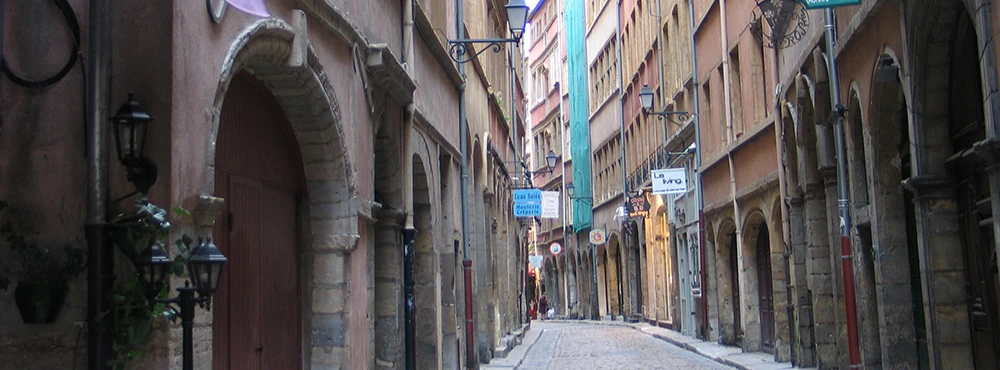
The narrowest passages between buildings are barely wide enough for two people. These are genuine medieval dimensions, laid out before anyone imagined a vehicle, and they are the reason the quarter feels enclosed in a way that most preserved historic districts do not.
.webp)
Mostly what you do here is walk. There is shopping and there is eating, but the real activity is strolling and looking at the historic character of the alleys. It is a medieval and Renaissance experience of a kind that survives in perhaps a couple of dozen places on the whole continent, and this is among the largest of them.
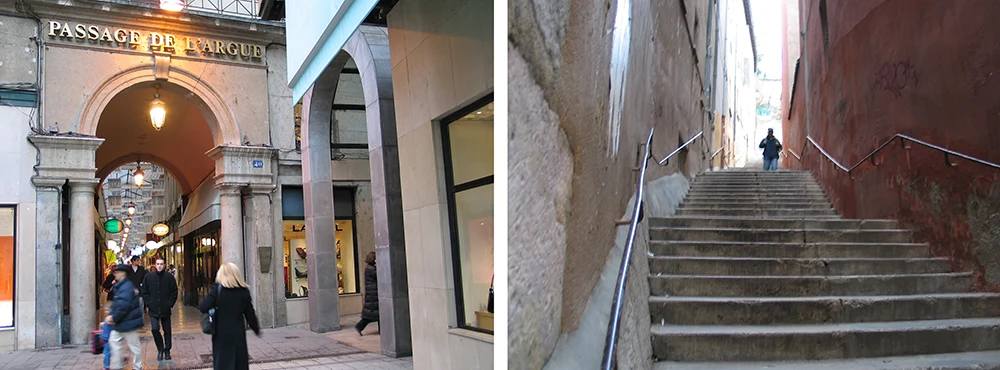
The Traboules
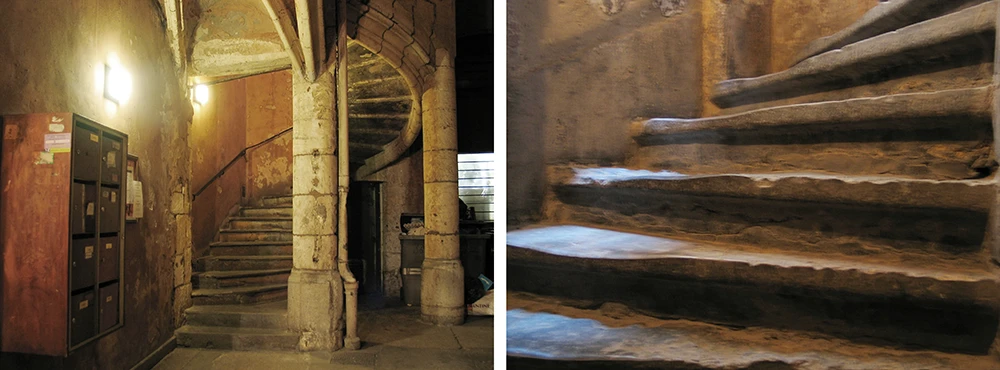
The particular thing that belongs to Lyon and to nowhere else is the traboule. These are covered passageways cutting straight through the middle of a block, running from a door on one street, through the ground floor and inner courtyards of the buildings, and out onto the street behind. There are around four hundred of them in the city.
They are semi-public. You are allowed to walk through as a public right of way, and roughly forty are officially open, marked with a small plaque. Some entrances stand open and you can see the passage from the street. Others are behind a plain door that is closed but unlocked, and you push it and go in.
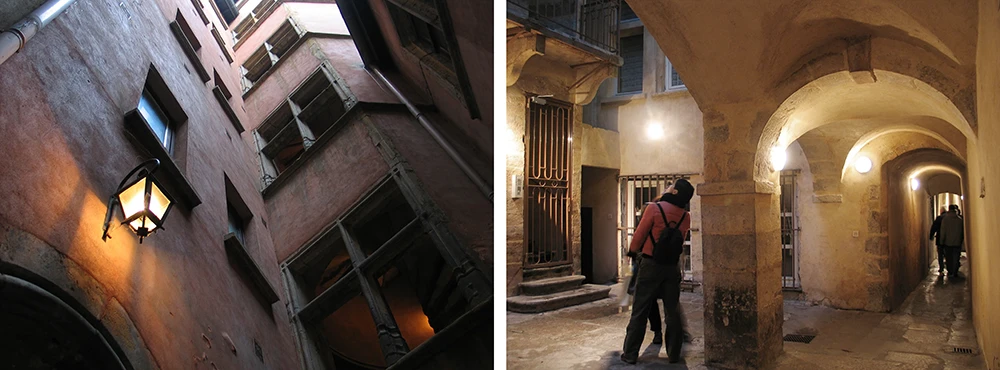
Finding them is a bit of a trick and part of the charm. There is no obvious marking on most doors and the only reliable method is to try the ones that look plausible. A tourist office map lists the open ones, which is the sensible starting point, and after two or three you develop an eye for it.
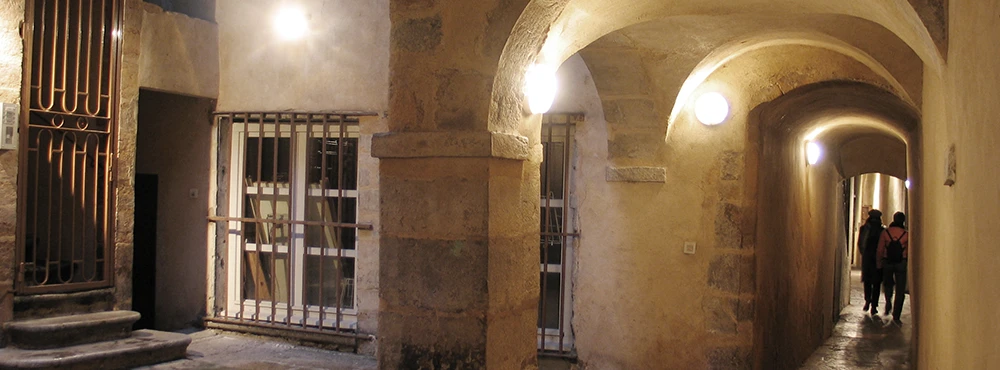
Inside, the passages are stone-vaulted, dimly lit and often surprisingly long, opening partway along into a courtyard before continuing. People live above them and around them, so keep the noise down — these are the front halls of somebody's apartment building, not a monument.
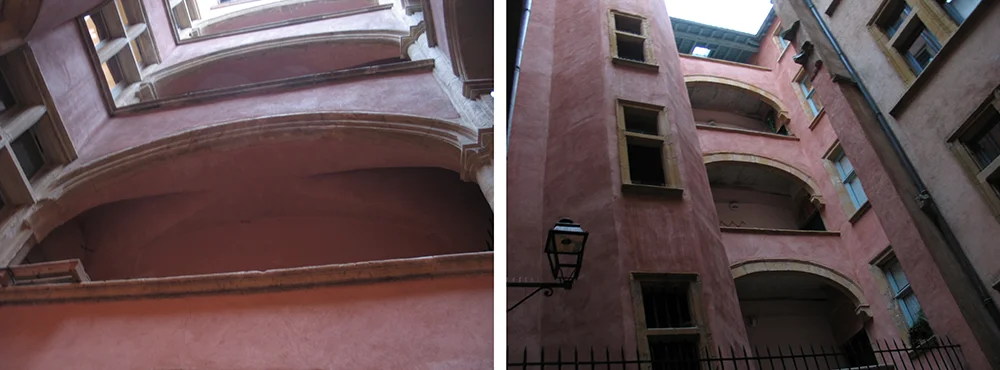
The courtyards are where the architecture shows itself. Renaissance merchants built galleried courts behind their plain street facades, with tiers of arcades running up three or four levels and spiral staircases in the corner towers. From the lane outside there is no hint that any of it is there.
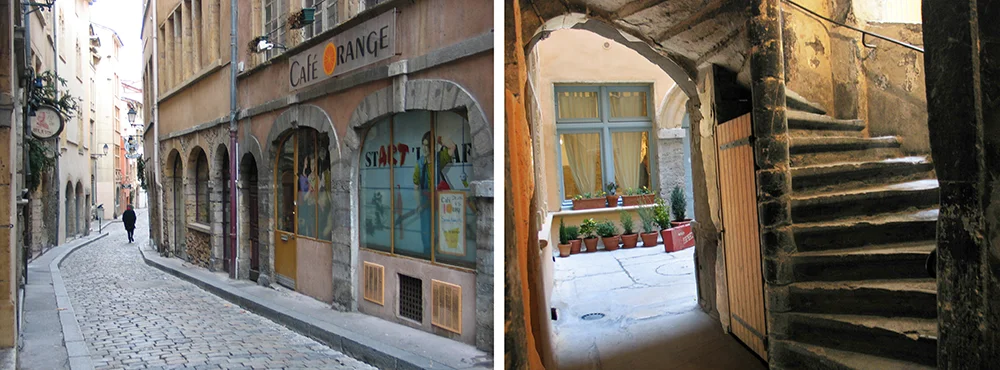
The spiral stairs in the towers are the signature detail, cut in stone and lit by narrow windows. Several of the finest are in Rue Saint-Jean and Rue du Bœuf, and one of them, in a courtyard off Rue du Bœuf, is the single most photographed interior in the quarter.
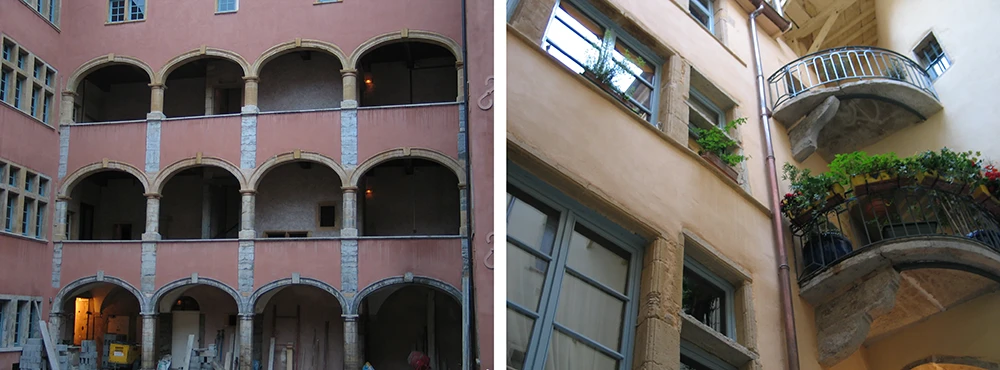
The passages are usually explained as a practical invention: a way to get from the hillside streets down to the river for water without going the long way around, and later a way for the silk workers on the Croix-Rousse hill to carry finished cloth across town under cover, out of the rain. Both accounts are probably true.
Saint-Jean Cathedral
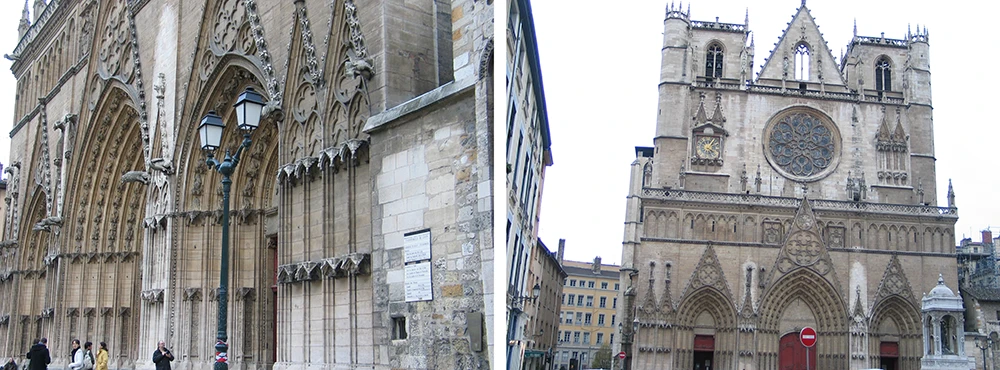
The cathedral stands at the southern end of the old town and the quarter grew up around it. Building began in the twelfth century and continued through the fifteenth, with work still going on into the seventeenth before it was finally called finished. The result is a mix of Romanesque at the east end and Gothic at the west, which is normal for a building that took four hundred years.
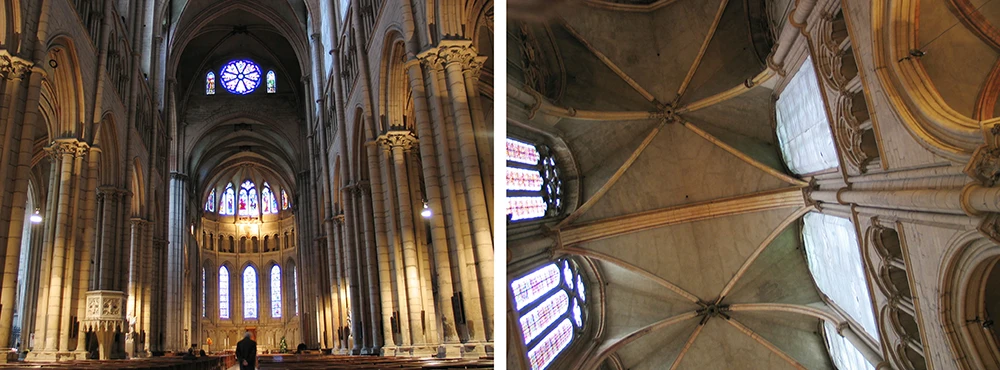
The interior is high and comparatively plain, with thirteenth-century glass surviving in the apse and the rose windows. Damage over the centuries has been considerable — the Protestants in the sixteenth century, the Revolution in the eighteenth — and much of the sculpture on the west front was destroyed and never replaced.
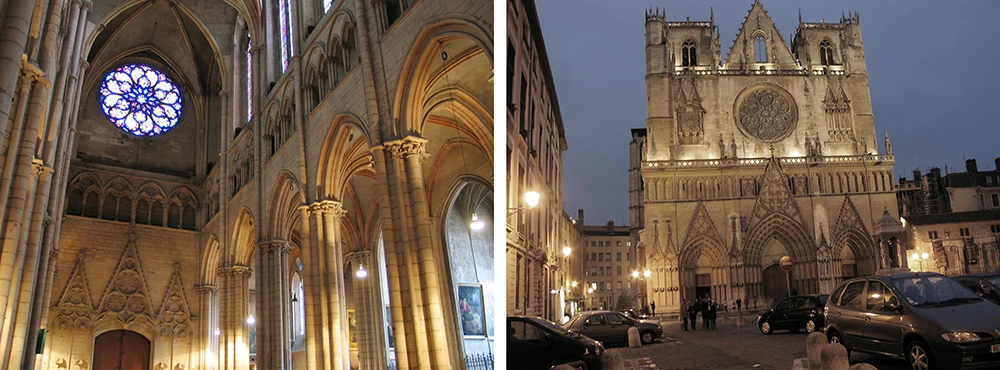
The astronomical clock in the north transept is the piece most visitors come to see, a fourteenth-century mechanism that shows the date, the positions of the moon and stars over Lyon, and the movable feasts of the church calendar. It still runs and still performs at set hours through the day.
Old Lyon at Night
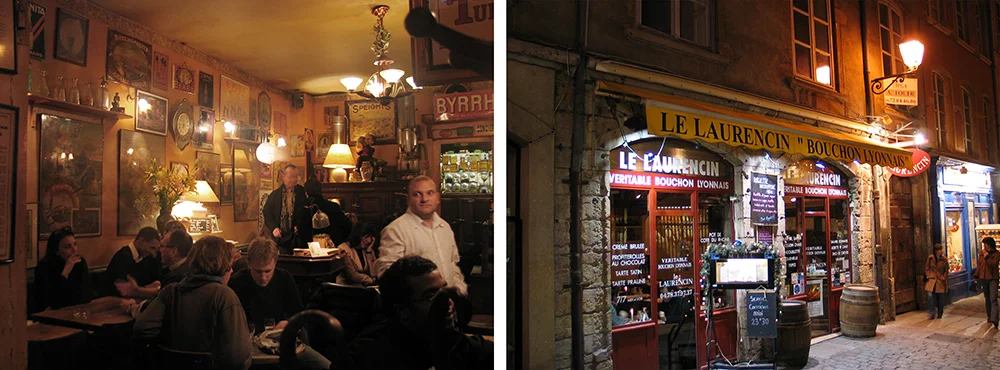
The quarter changes completely after dark. The restaurants fill, the lanes carry light out through their windows onto the stone, and the same streets that were empty at nine in the morning become the busiest place in the city.
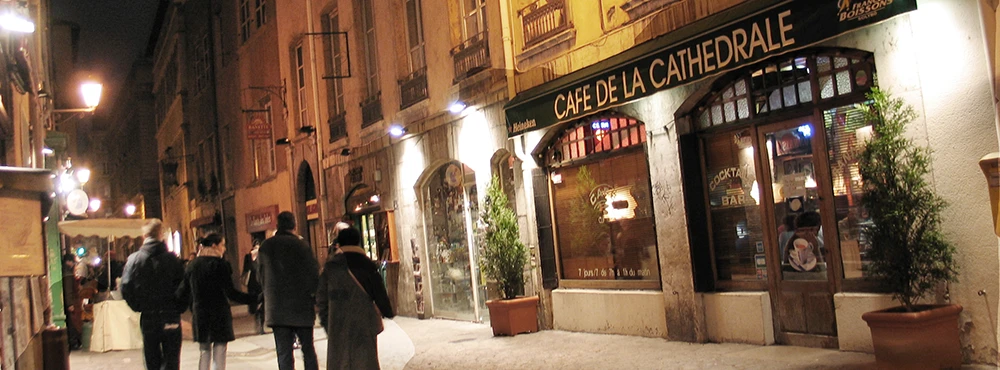
Because the lanes are narrow and the buildings tall, the lighting is contained and the effect is theatrical without anyone having intended it. Lyon takes its lighting seriously as a matter of civic policy, and the major buildings and bridges are lit to a scheme rather than floodlit at random.
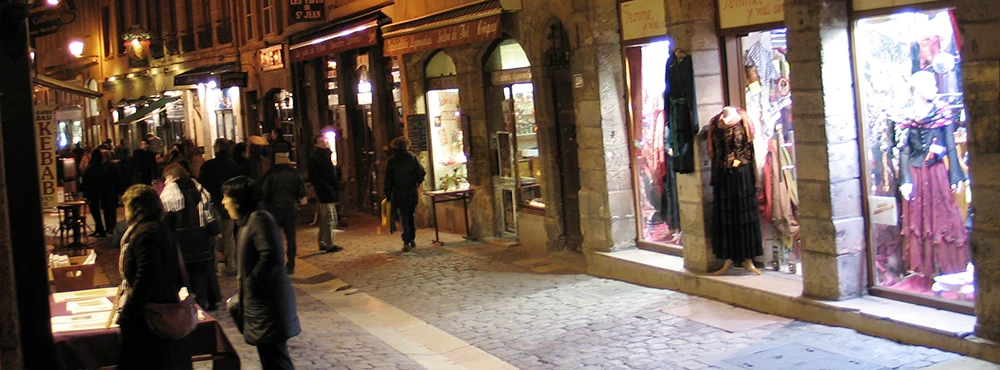
Shops stay open later in the evening than the posted hours suggest, particularly in summer and in the weeks before Christmas. Window shopping after dinner is a normal thing to do here and the streets stay populated well past ten.
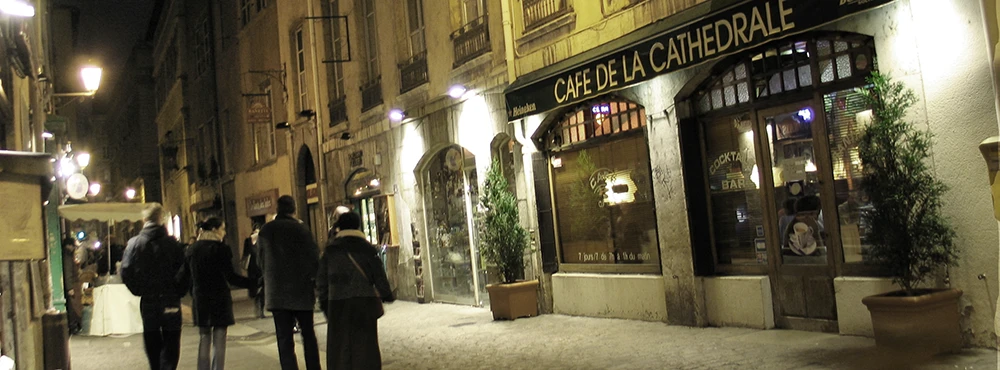
The signs are worth noticing. Many are old ironwork brackets, and the modern ones have been kept to a restrained standard by the rules that come with the World Heritage listing. There is no illuminated plastic anywhere in the quarter.
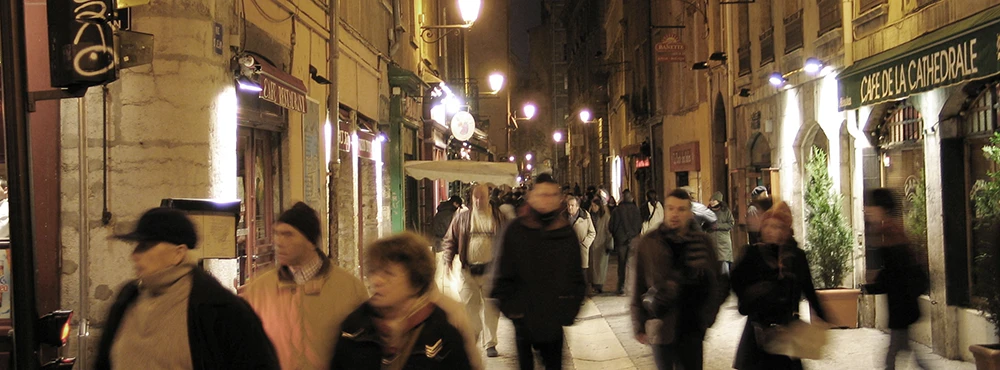
Weekend evenings bring a crowd, and the lanes between the cathedral and the middle of the quarter can be shoulder to shoulder. If that is not what you want, the cross alleys a block away stay quiet, and the quays along the river are almost empty.
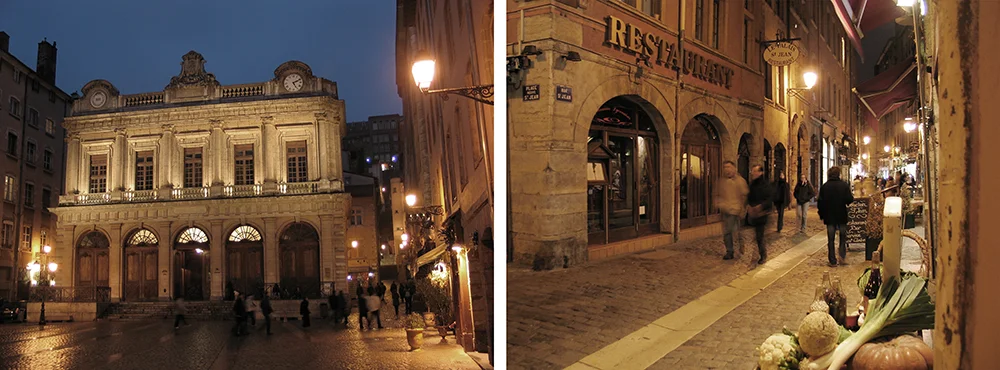
Dusk is the best of it, the half hour when the sky still has color in it and the lamps have already come on. Stand at one end of Rue Saint-Jean and look down its length at that hour and you have the reason people come to this quarter in a single view.
Fourvière Hill and the View
.webp)
The hill rising directly behind the old town is Fourvière, and the white basilica on its summit is visible from most of the city. A funicular runs up from the old town — the locals call it the ficelle, the string — or you can walk up through the gardens on a series of paths and staircases if you would rather earn it.
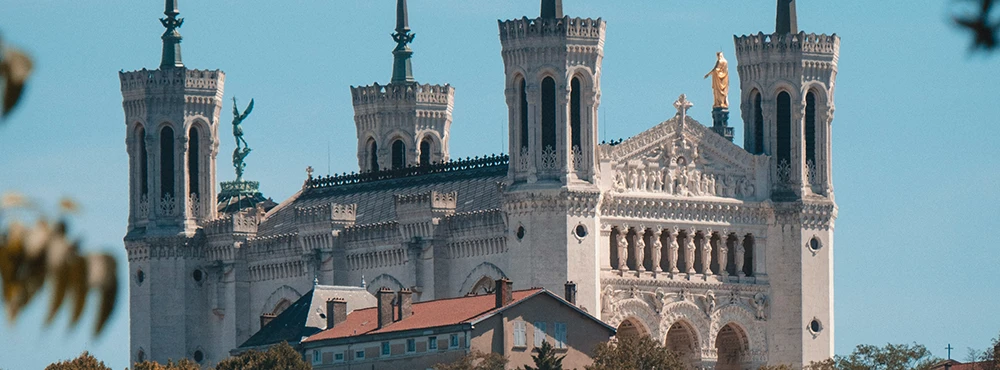
The basilica is much newer than it looks, built between 1872 and 1884 on a vow made during the Franco-Prussian War. It is Romanesque and Byzantine in style rather than Gothic, heavily decorated inside with mosaic and gilding, and the contrast with the plain old cathedral at the bottom of the hill is instructive.
.webp)
The metal tower next to it is a nineteenth-century imitation of the top third of the Eiffel Tower, built as an observation platform and now carrying broadcast antennas. It is not much loved locally but it is a useful landmark, since between the two structures the hill is identifiable from anywhere.
The terrace beside the basilica gives the view the climb is for: the old town directly below, the two rivers, the whole peninsula between them, and the modern towers beyond. On a clear day the Alps show on the eastern horizon, and Mont Blanc with them.
.webp)
Sunset is the hour to be up here. The light comes from behind you across the hill and runs east over the whole city, and the terrace fills with people who have made the same calculation. Come twenty minutes early if you want a place at the railing.
The Presqu'île
.webp)
Across the Saône from the old town lies the Presqu'île, the peninsula between the two rivers, and this is the modern heart of the city. The most interesting section is the stretch between the rivers where the great civic buildings stand, the seventeenth-century Hôtel de Ville among them, with the opera house and the fine arts museum nearby.
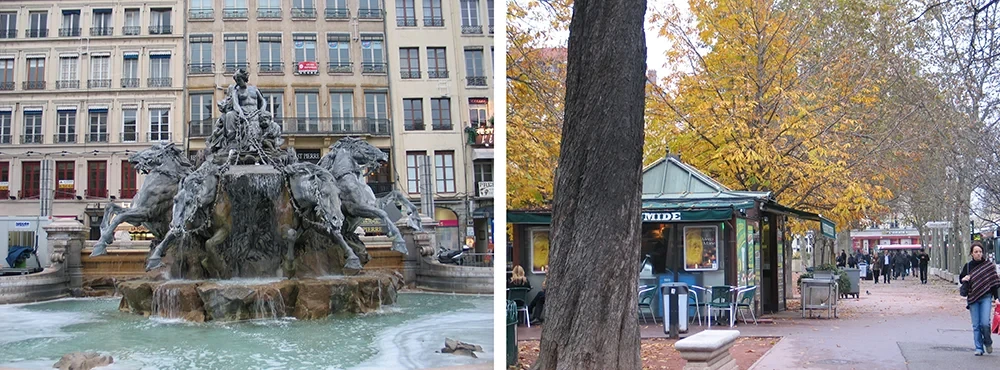
Place des Terreaux is the square in front of the city hall, and its centerpiece is a monumental fountain of four horses charging into the sea, cast by Frédéric Bartholdi — the sculptor of the Statue of Liberty. It was made for Bordeaux, which could not afford it, and Lyon bought it instead.
.webp)
There are several handsome plazas with fountains along the peninsula, Place des Jacobins and Place de la République among them, and each of them punctuates the walk from one end to the other. Place Bellecour further south is one of the largest open squares in Europe and is used for events all year.
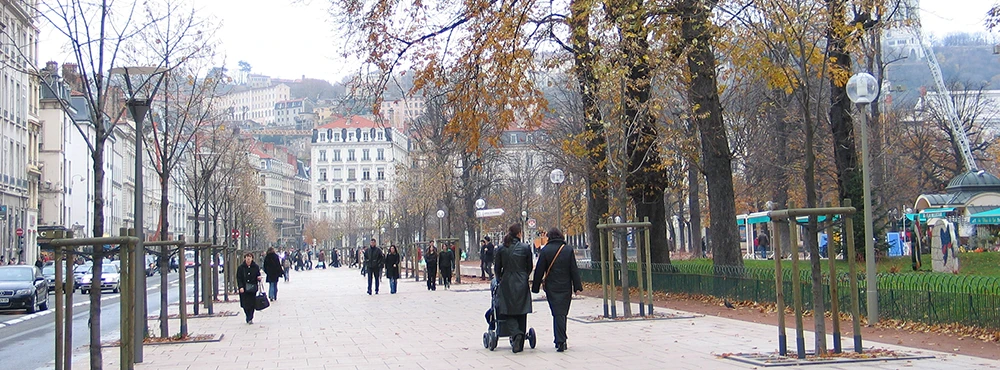
Rue de la République runs the length of the peninsula as a wide pedestrian promenade lined with department stores and modern boutiques of every kind. It is the main shopping street of the city and a complete change of register from the old town across the river, which is exactly why it is worth walking both in the same day.
Markets and the Table
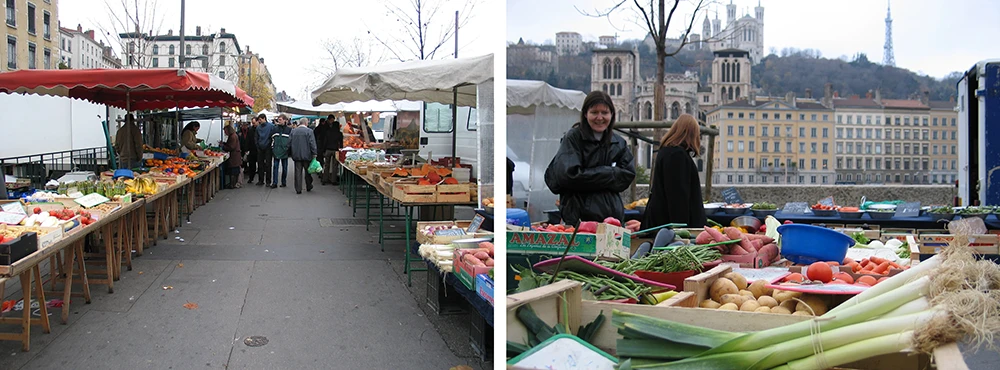
Lyon has a long-standing claim to be the gastronomic capital of France, and it is not an idle one. The city sits between the farms of the Rhône valley, the poultry of Bresse, the beef of the Charolais, the wines of Burgundy to the north and the Rhône vineyards to the south. Everything arrives within a couple of hours.
Open-air markets run along the quays several mornings a week, and the covered market named for Paul Bocuse holds the specialist traders — charcutiers, cheesemongers, fishmongers and pâtissiers, mostly long-established businesses. It is worth an hour whether or not you intend to buy anything.
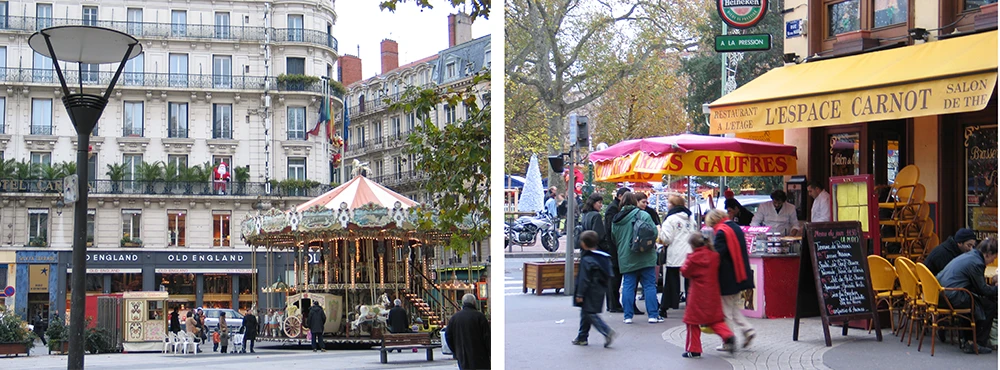
The traditional restaurant here is the bouchon, a small place serving the local dishes — sausages, quenelles, tripe, pork in various forms — at communal tables with a jug of Beaujolais. There are also more restaurants of every other kind than you could work through, and a number of inexpensive hotels; the Hôtel des Artistes, a three-star in the middle of the new town, is a pleasant example.
The Christmas Market
Watch these same videos on dedicated pages: Lyon - Video 2.
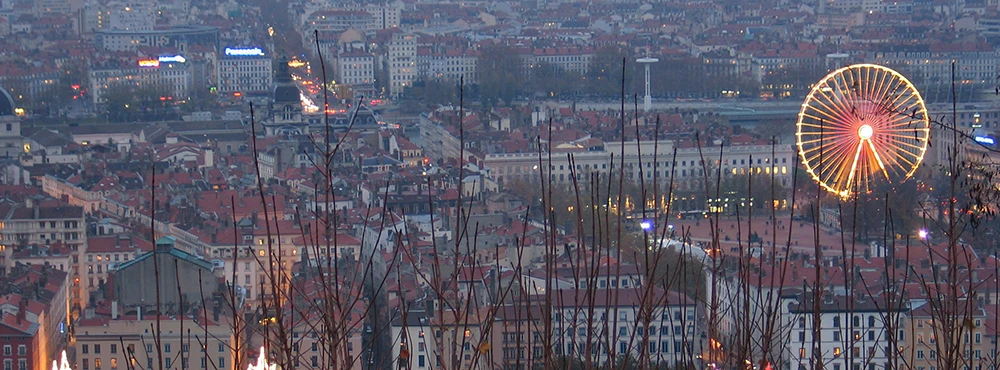
Through December the city puts on a Christmas market in the squares of the Presqu'île, with wooden chalets selling food, mulled wine and craft goods, and a Ferris wheel on Place Bellecour that gives a view over the whole center. It runs alongside the Festival of Lights in the second week of the month, when the whole city is illuminated and several million people come to see it.
Parks and Rivers
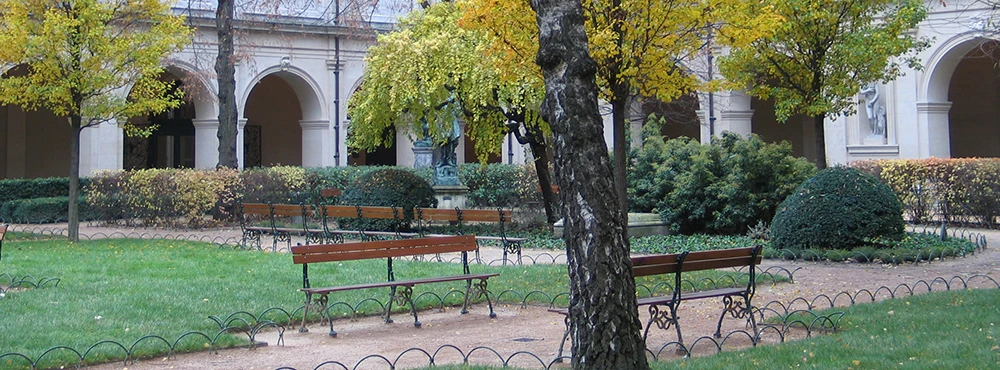
Lyon is well provided with parks, and the largest of them, the Parc de la Tête d'Or on the left bank of the Rhône, is among the biggest urban parks in France. It has a lake with boats, a botanical garden, glasshouses and a free zoo, and it is where the city goes on a Sunday.
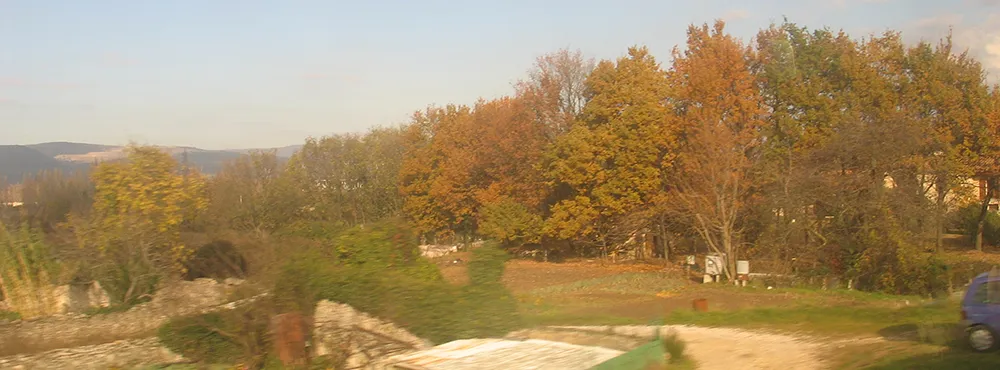
Autumn is a good season here. The plane trees along the quays and in the parks turn together, the summer crowds have gone, the restaurants are easier to get into, and the light on the rivers in the late afternoon is the best of the year.
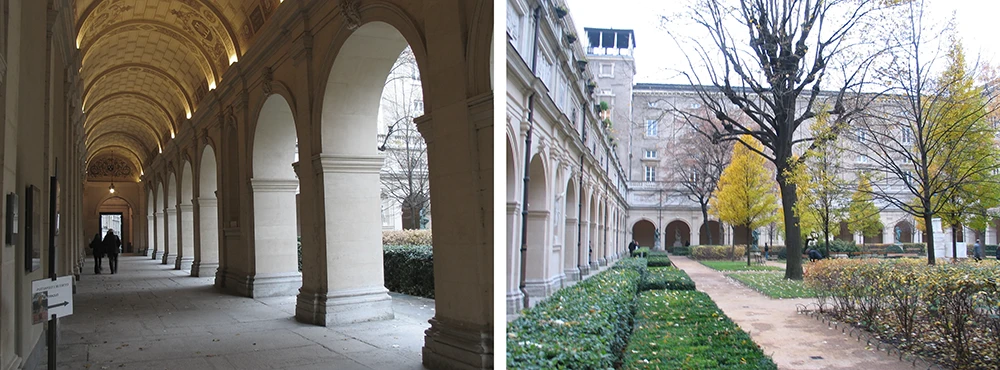
The riverbanks themselves have been rebuilt over the last two decades, with the parking lots along the Rhône replaced by a continuous park and cycle path running several miles. Walking or cycling the quays is now one of the better ways to see how the city fits together.
Roman Lyon and How the City Began
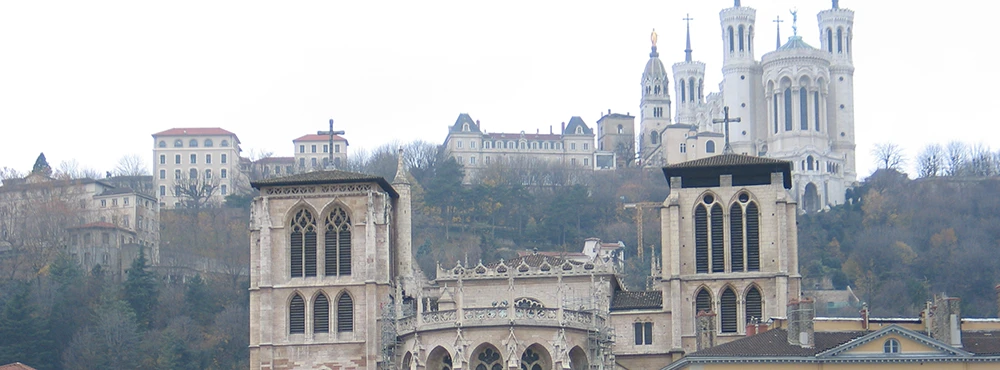
The oldest part of the city is on the hill. Lyon was founded in 43 BC as Lugdunum, a Roman colony planted on Fourvière, and within a generation it had been made the capital of all Gaul — effectively the administrative center of what is now France, Belgium and a good part of the Rhineland.
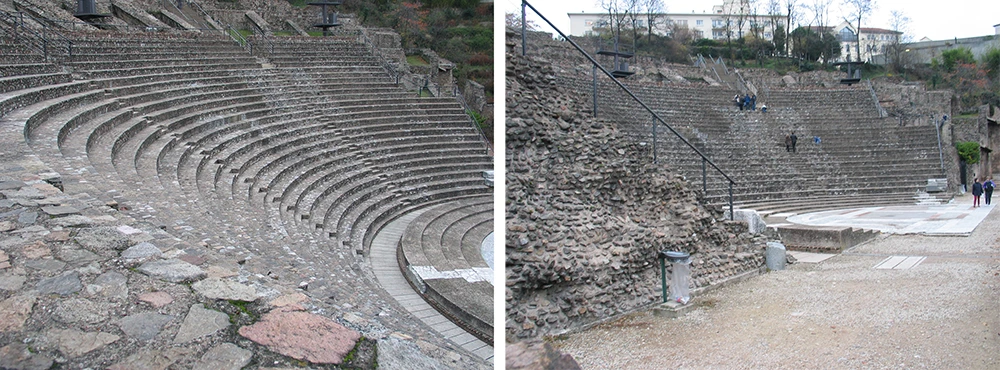
The Roman theater on the hillside is the oldest in France and remains so well preserved that it is still in use, hosting concerts and performances every summer. A smaller odeon stands beside it, and the museum built into the slope behind holds the mosaics, inscriptions and bronze tablets found on the site.
The city was substantial by any measure — two emperors, Claudius and Caracalla, were born here — and it kept its importance after Rome fell, first as a religious center and then, from the fifteenth century, as a center of banking, printing and above all silk. That trade paid for the merchant houses of the old town and their hidden courtyards.
The silk industry moved uphill to the Croix-Rousse in the nineteenth century when new looms proved too tall for the old buildings, and the weavers who worked there built the second great network of traboules. The industry declined in the twentieth century, and by the 1960s the old town had fallen far enough that the city proposed clearing part of it.
Public opposition stopped the demolition, and in 1964 Vieux Lyon became one of the first protected historic sectors in France under a new national law. The listing led to decades of restoration, and in 1998 UNESCO inscribed the whole historic center. What you walk through today exists because that argument was won.
More Lyon videos: Lyon and Annecy