Chester, England
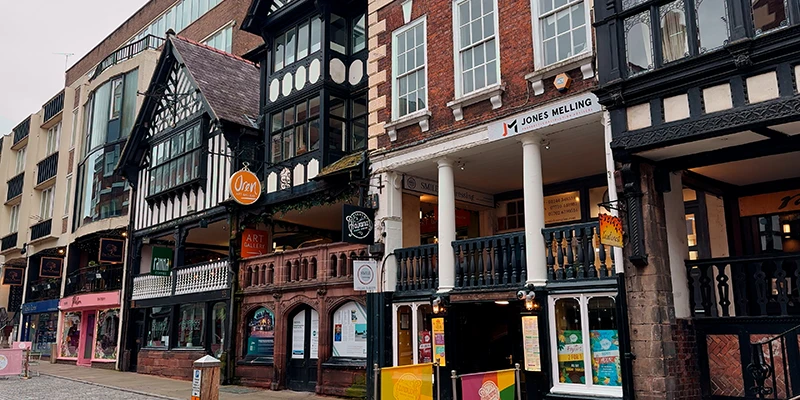
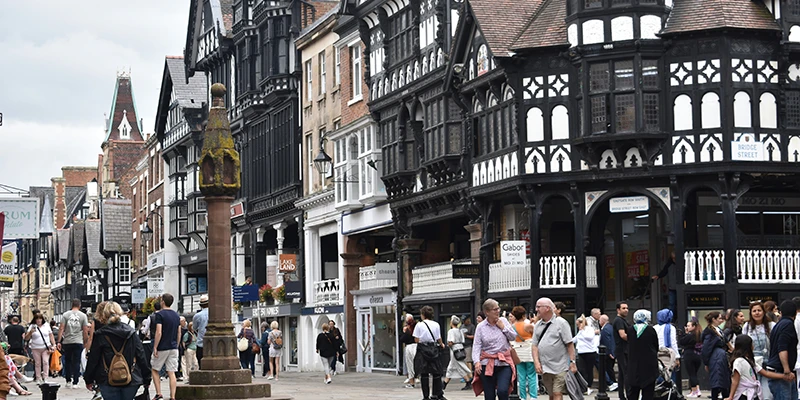
Chester has two shopping streets stacked on top of each other. At ground level the shops open onto the sidewalk in the normal way, and directly above them runs a second continuous row of shops fronted by a covered walkway, reached by stone steps at intervals along the street. They are called the Rows, they have been here for something close to seven hundred years, and there is nothing else quite like them anywhere in Britain or in Europe.
The city is small, walkable, and closed to cars in the center, so the whole visit happens on foot. It also has a complete circuit of defensive walls, nearly two miles around, that you can walk the entire way — the most complete set in Britain. Add a Roman amphitheater, a cathedral that began as a Benedictine abbey in 1092, and a canal running through what used to be the Roman defensive ditch, and Chester packs more into a small area than almost any city in England.
Video From the Archives
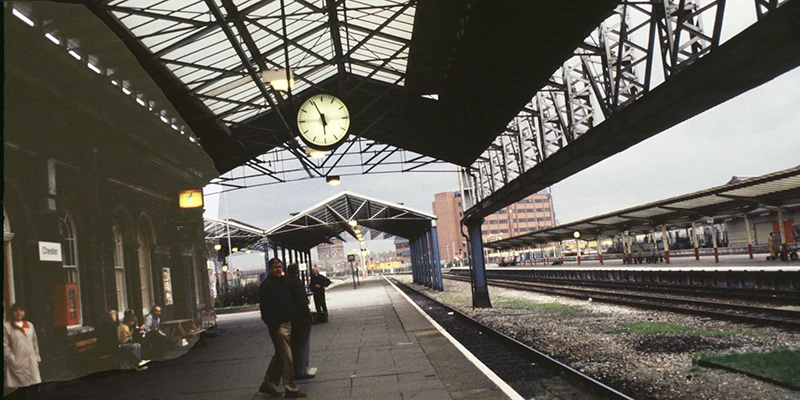
It sits in the northwest, close to the Welsh border, and it makes a straightforward day trip from London. The intercity train takes about two and a half hours each way, which is a long day but a manageable one, and the station is a fifteen-minute walk from the center. Liverpool and Manchester are both under an hour away, which makes Chester an easier day trip from either of those.
The Rows
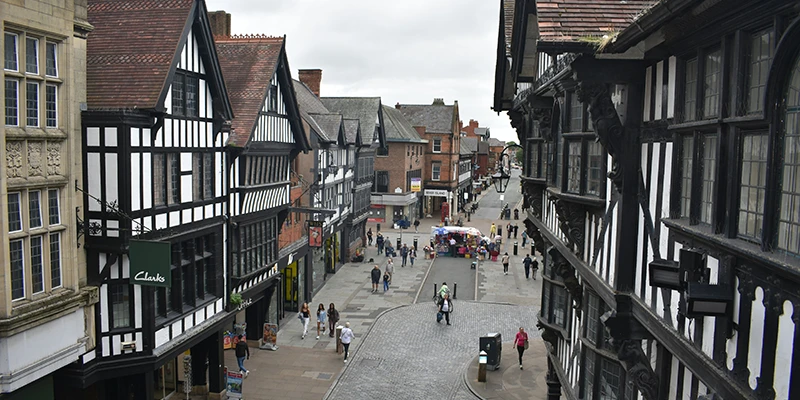
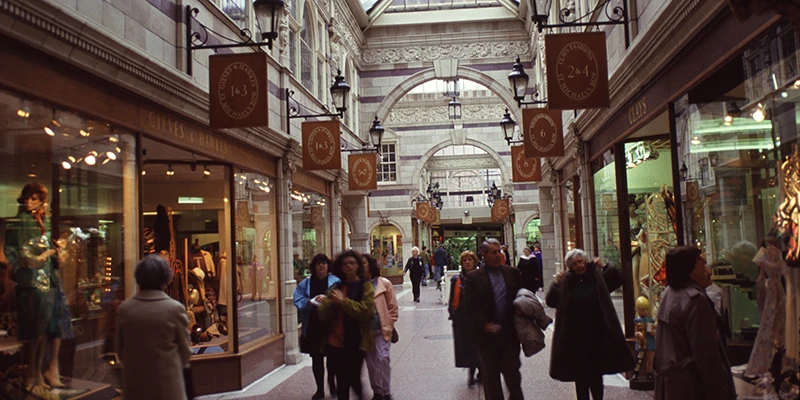
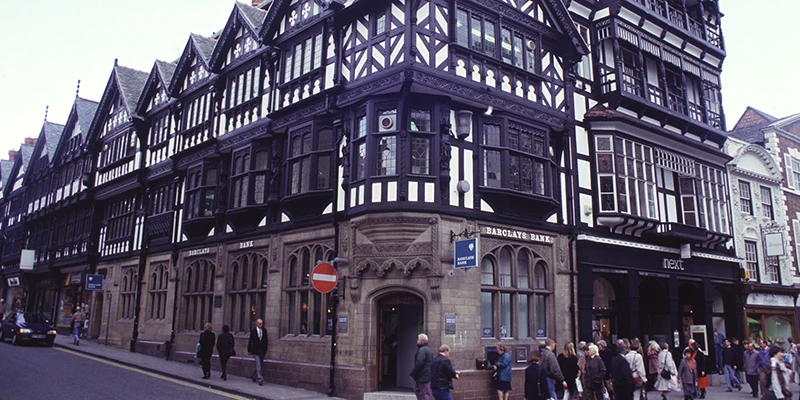
The Rows are the thing people come for, and the first sight of them is confusing. You are walking along a normal street when you notice that the black-and-white timbered buildings above the shops are not solid — there are people up there, walking behind a wooden railing, in front of another line of shop windows. A flight of worn stone steps runs up from the sidewalk, and you can simply climb it and continue walking at the higher level.
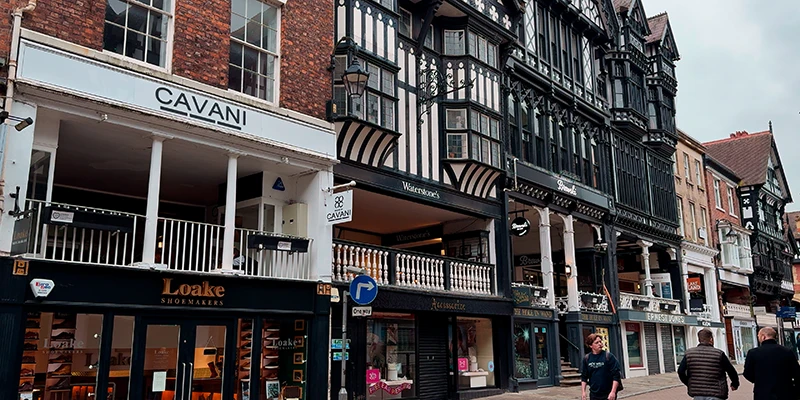
Nobody knows for certain when the Rows were built or why. The earliest references are from the late thirteenth century, and the most common explanation is that medieval builders put their premises on top of the rubble of collapsed Roman buildings, which raised the ground floor and left the older cellars usable below. Whatever the reason, the result is a medieval split-level shopping street that has been in continuous commercial use ever since.
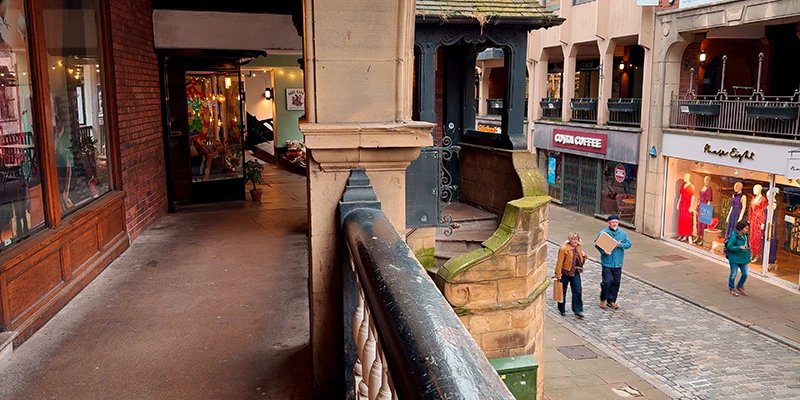
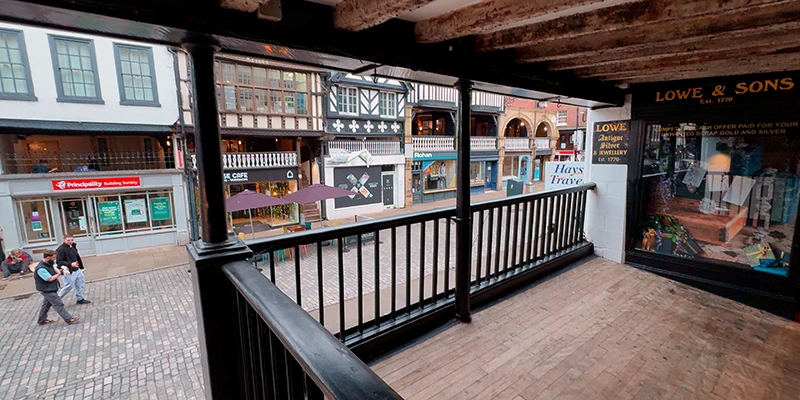
The upper walkway is covered for its whole length by the overhanging floors above, so it stays dry in the rain, which in this part of England is a practical advantage rather than a theoretical one. It is timber-framed and low-beamed, with shopfronts on one side and the railing on the other, and you look down onto the street traffic and across at the buildings opposite at their own second-floor level.
The four main streets — Eastgate, Northgate, Watergate and Bridge Street — meet at a central crossroads simply called the Cross, and the Rows run along stretches of all four. That crossroads is the same one the Romans laid out, and the four streets follow the lines of the roads that ran out of the fortress gates.
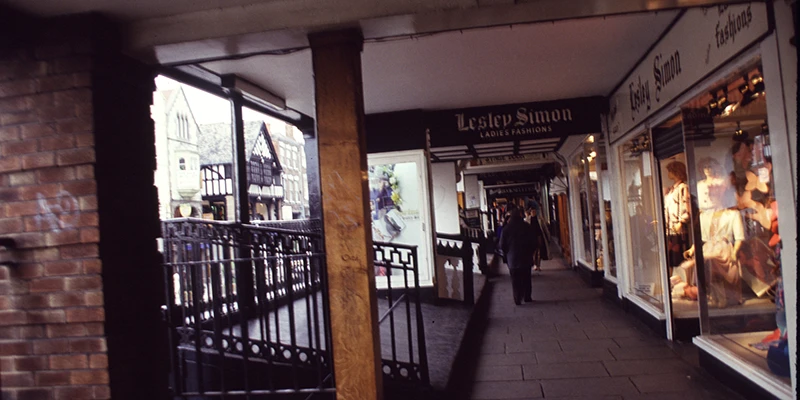
Walking the upper level and the lower level gives you two completely different experiences of the same street. The lower level is busy and open to the sky. The upper level is quieter, darker, more enclosed, and full of small independent shops that could not afford a ground-floor frontage. Do both, in both directions.
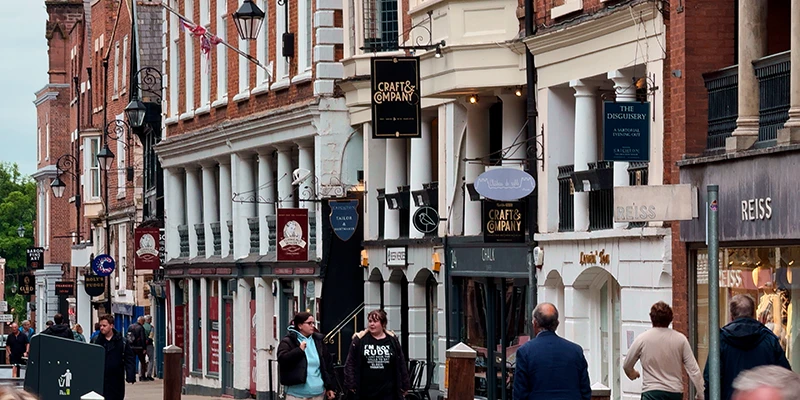
Some of the covered stretches are genuinely dark, brick-vaulted passages where the shopfronts recede into shadow and you can see the medieval structure of the building around you. Others have been opened up and modernized behind their old fronts. The mix is typical of Chester, where a great deal of what looks ancient is Victorian and a great deal of what looks Victorian is medieval underneath.
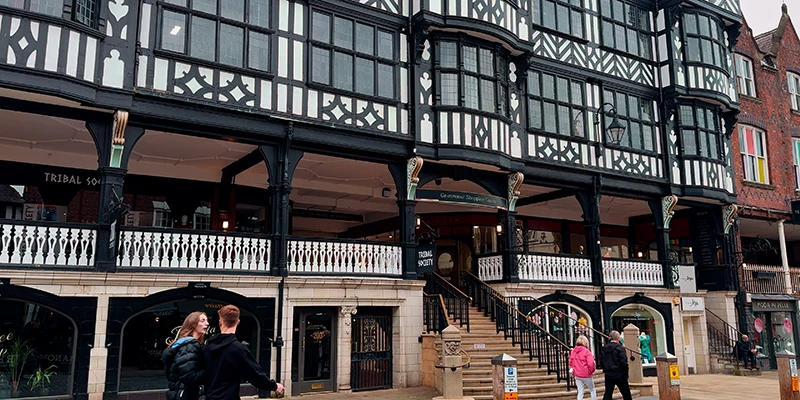
The steps up from the street are the other distinctive feature, sandstone slabs worn into shallow dips, some of them steep and none of them uniform. They appear every fifty yards or so along the Rows, and each one is slightly different from the last.
Eastgate and the Clock
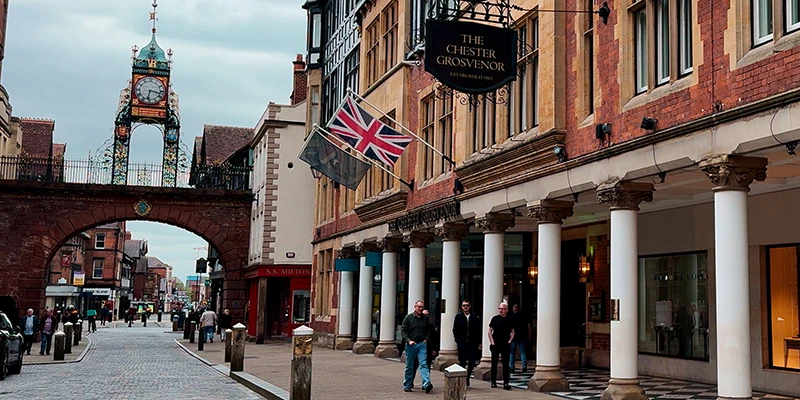
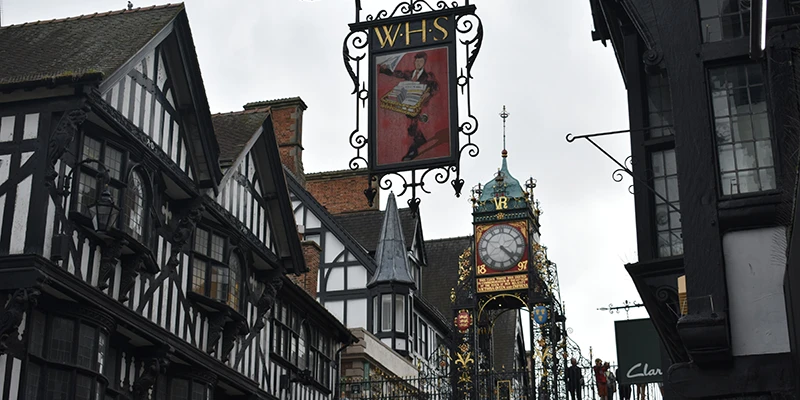
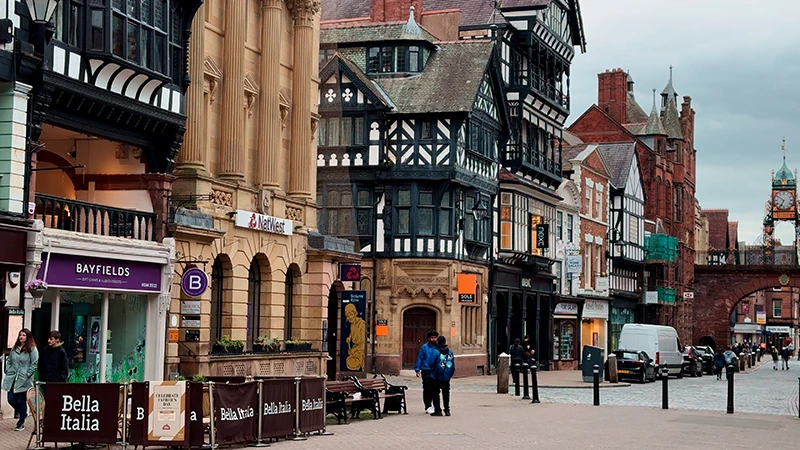
The Eastgate Clock is the emblem of Chester and, after Big Ben, the most photographed clock in England. It stands on an iron gantry above the arch of the Eastgate, and it is not old. It was put up in 1899 to mark Queen Victoria's Diamond Jubilee two years earlier, the ironwork painted and gilded, and it looks Victorian in the best sense — ornate, confident and slightly excessive.
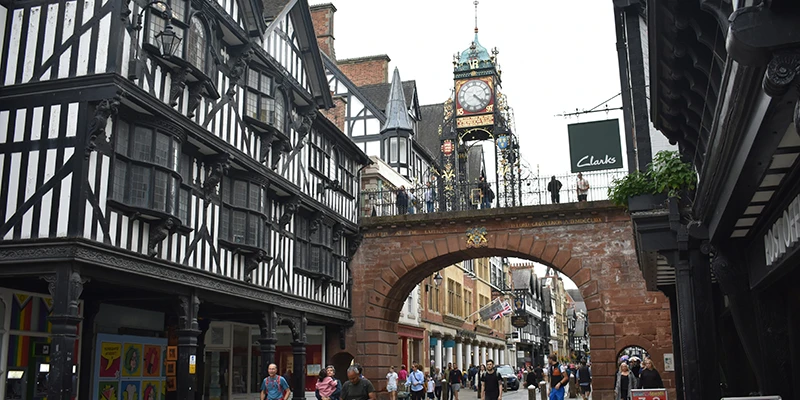
The gate underneath it is a rebuilding of 1768, replacing a medieval gatehouse that in turn replaced the Roman one. In Roman times this was the main gate of the fortress, and the arch was double, two openings side by side, each slightly wider than the single arch that stands there now. The street it opens onto was the fortress's main road and was considerably wider than the shopping street you see today.
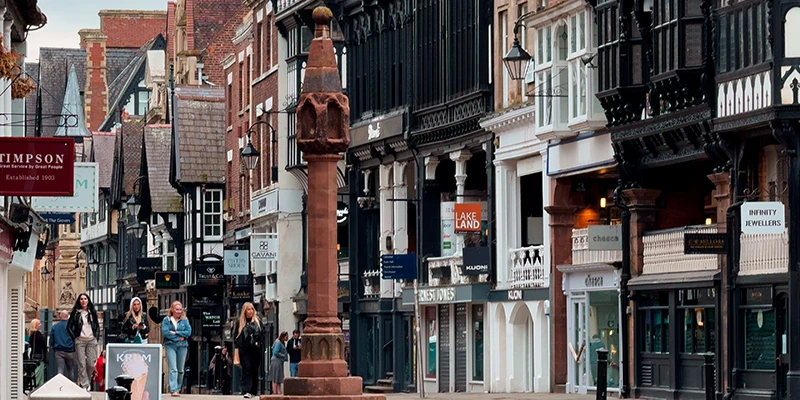
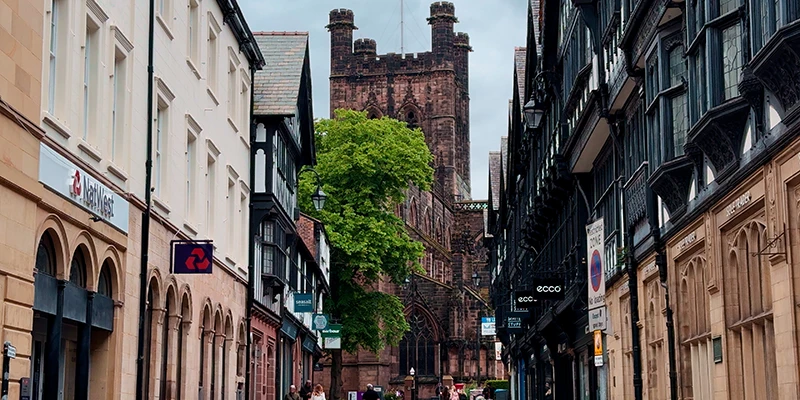
The best view of the clock is from the walls, because the walkway crosses directly over the Eastgate arch and puts you at the clock's own level. From below, standing in the street with the timbered fronts closing in on both sides, it makes the other classic Chester photograph.
Walking the Streets
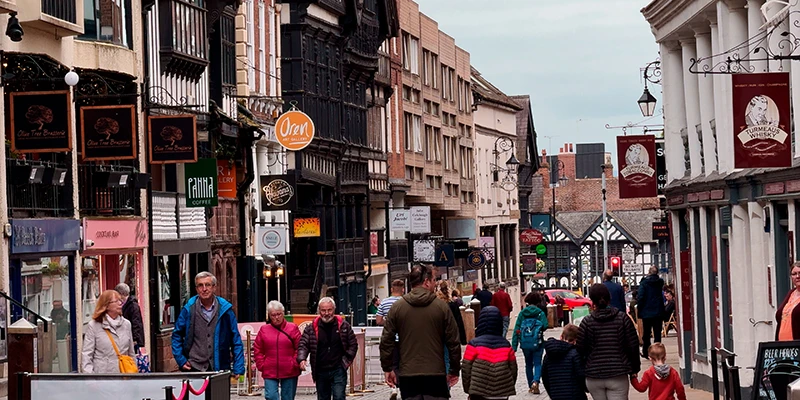
The city center is closed to private cars, so the streets belong to pedestrians, buses and taxis. That single decision is what makes Chester as pleasant as it is. You can stand in the middle of Eastgate Street to look at a building without being run down, and the sound of the place is conversation and footsteps rather than engines.
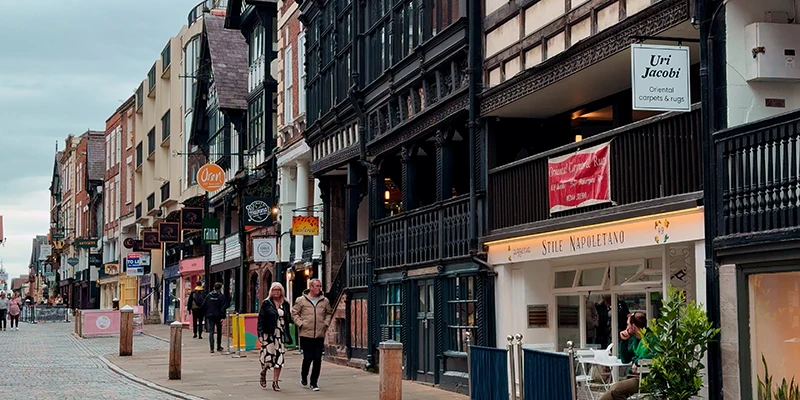
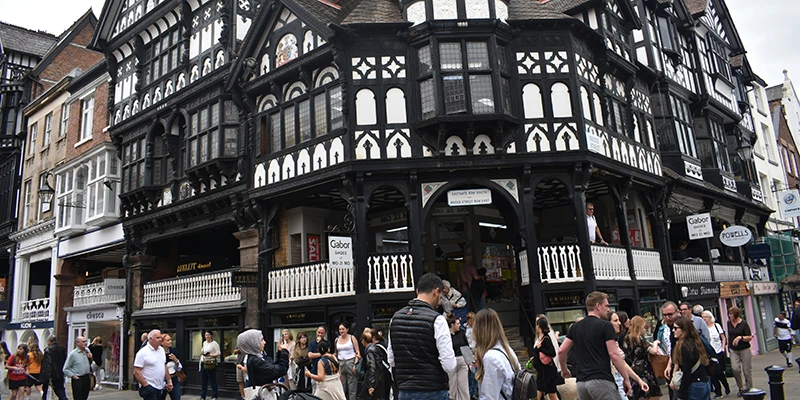
The architecture is a blend that takes a while to sort out. There is genuine Tudor timber framing, genuine Georgian brick, and a great deal of Victorian work built deliberately to look Tudor. The Victorians of Chester were unusually committed to this: the buildings across from the Cross, dating from the 1890s, are black-and-white half-timbered from top to bottom and were new when Queen Victoria was on the throne.
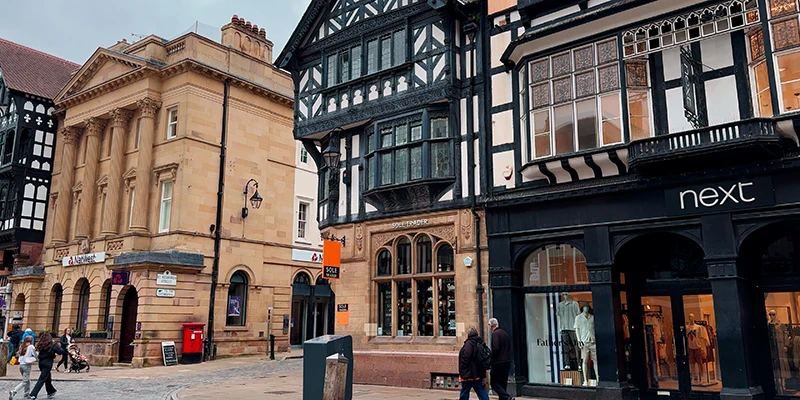
Chester also has a specialty in false fronts. After the Civil War a great deal of rebuilding took place, and in many cases only the street facade was taken down and replaced while the older structure behind was left standing. So a building can present a flat Georgian front to the street and be a fourteenth-century timber-framed house from the second room back. Several in Abbey Square are exactly that.
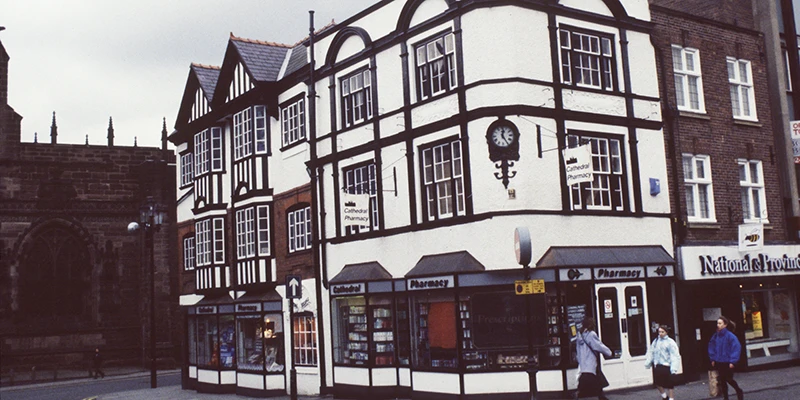
The Bear and Billet on Lower Bridge Street is the real thing — a four-story timber-framed townhouse of 1664, one of the last of its kind built in England, with a huge expanse of glazing on the upper floors that was an extravagant display of wealth at the time. It was the townhouse of the Earls of Shrewsbury and is now a pub.
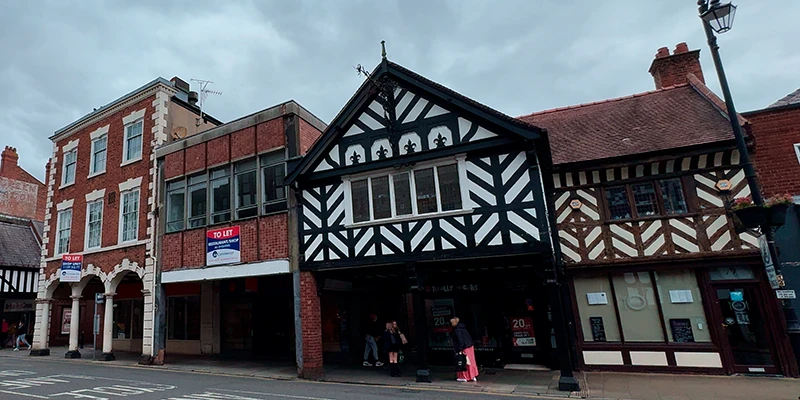
The Nine Houses on Park Street were a row of almshouses run by the city parishes, where retired people of the parish were housed and looked after. Six of the original nine survive. They are small, low, black-and-white, and still in residential use, now under the care of the local authorities rather than the church.
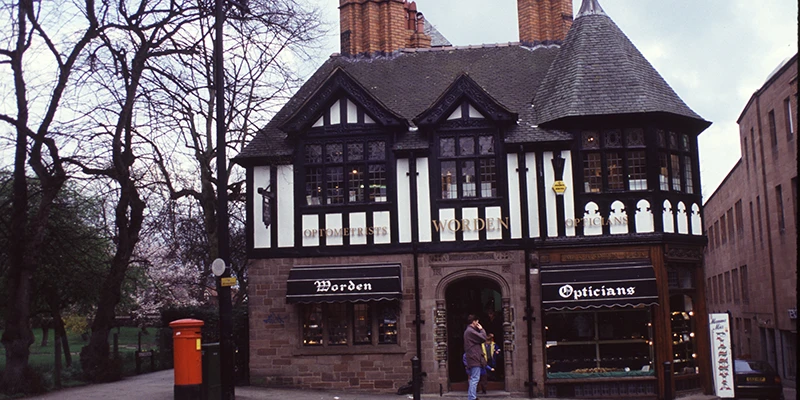
Albion Street, tucked in behind the walls, is a terrace of small brick houses built just over a century ago for the artisans and craftsmen of the railway companies. The city gutted and modernized the interiors some decades back while leaving the exteriors alone, and the result is a genuine residential community inside the city center. The Albion Inn on the corner is the last true village pub in central Chester.
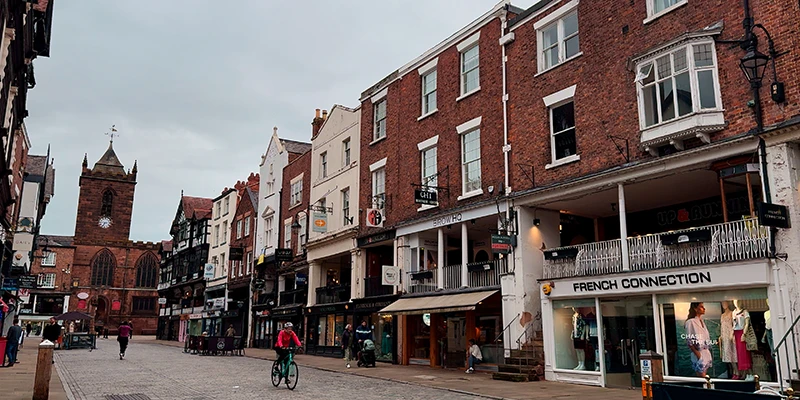
The Town Hall on Northgate Street is Victorian Gothic of 1869, replacing an earlier building that burned down on New Year's Eve 1862. The ground floor was originally the city police headquarters, with the magistrates' courts above it, the council chamber above that, and the Lord Mayor's apartment at the top.
The City Walls
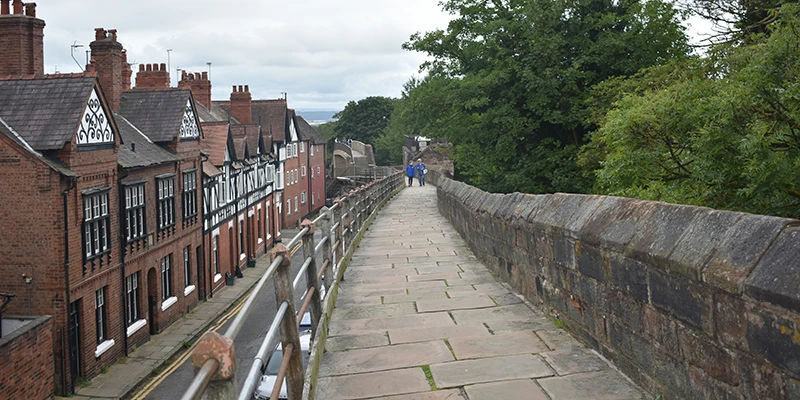
The walls are one of the best two-mile walks in any English city. The circuit is essentially complete, which no other walled city in Britain can claim, and the walkway runs along the top for the whole way, crossing over the gates on bridges and passing through towers.
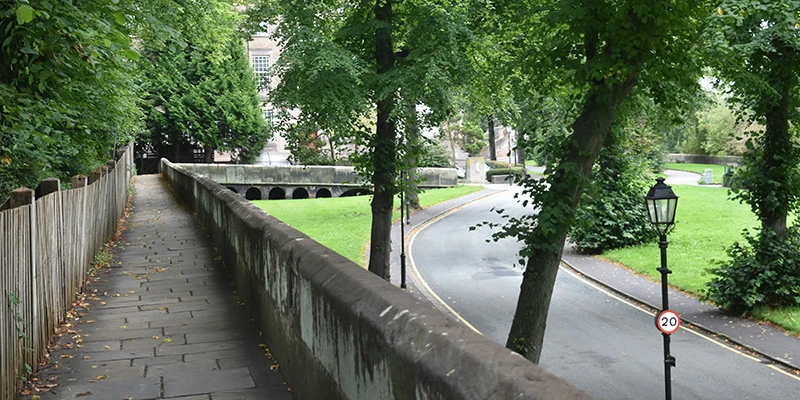
The walls are not all one age. The Romans built the first defenses here, and the original was not stone at all but an earth rampart faced with turf and timber; the stone wall came later, built in front of the turf one, and parts of it date to around 200 AD. There is a surviving stretch of the original earth mound visible from the walkway on the north side. The Saxons extended the circuit around the year 900, and the Normans and medieval city extended it again to enclose more ground.
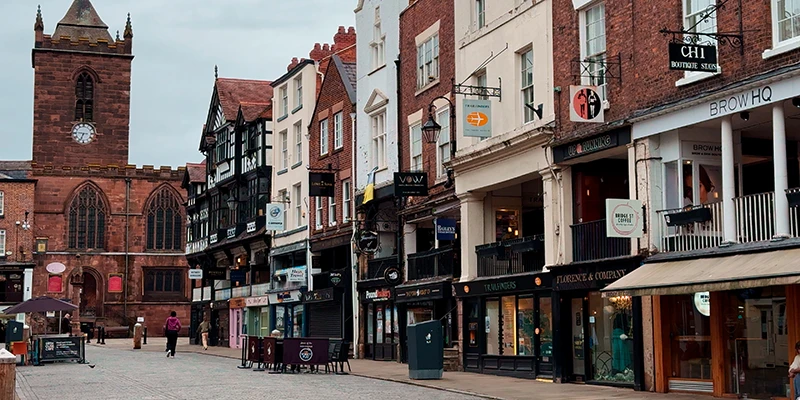
The whole city sits on a bed of red sandstone about fifty feet above sea level, and the walls are built from it. The Romans chose the site because the River Dee looped around three sides of it, making it defensible on almost every approach, and because it commanded the crossing point into what is now Wales.
The King Charles Tower, also called the Phoenix Tower, stands at the northeast corner. Charles I is said to have stood on it in September 1645 and watched his army destroyed at the Battle of Rowton Moor, two miles outside the city. Chester was a royalist city and held out through a siege that lasted from that September until the following February, surrendering only when the population had run out of food.
Walking the circuit takes about an hour and a half at an unhurried pace, less if you keep moving. There is no admission charge and no gate — you go up a set of steps at any of several points and walk. The walls are also a popular running route, though the city has discouraged it, since the repeated pounding damages the stonework.
The Canal
On the north side, the walls look down into a deep cut with a canal at the bottom, and the cut is Roman. It began life as the defensive ditch outside the fortress wall, about twenty feet wide and nine to twelve feet deep, dry, with sharpened stakes set in the bottom. In the 1700s the accumulated rubbish of fifteen centuries was dug out of it and the trench was converted into a canal.
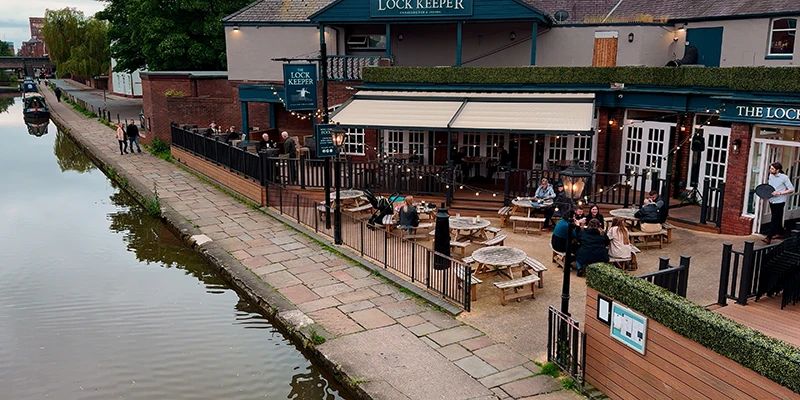
It is a branch of the Shropshire Union, running from Llangollen in North Wales, through Whitchurch in Shropshire and Chester, and down to Ellesmere Port on the Mersey. It carries holiday boats now rather than cargo, and it is only three or four feet deep, which is why the water always looks brown.
The towpath makes a good level walk out of the center in either direction, with the wall rising on one side and the backs of old warehouses on the other. There are canalside pubs with tables out along the water, and the section immediately below the walls is the most dramatic, with the sandstone cliff face of the cutting on both sides.
The Roman Amphitheater
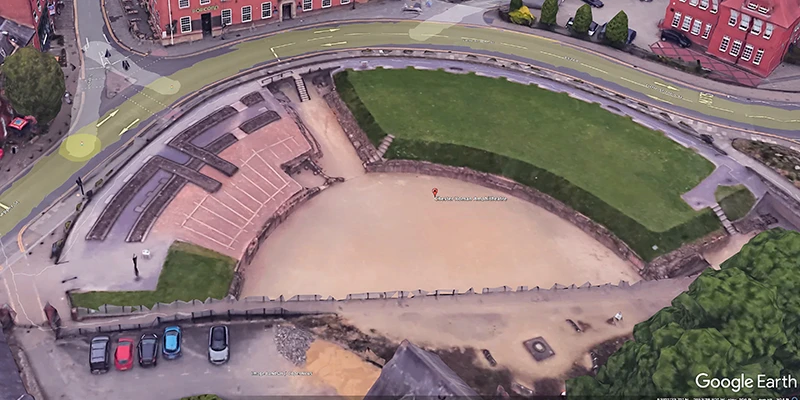
Just outside the walls on the southeast side is the largest Roman amphitheater ever found in Britain, seating around seven thousand people. Roughly half of it has been excavated and is open to view; the other half lies under later buildings. What you see is the lower courses of the outer wall, the arena floor, and the entrance passages.
The Roman city was called Deva, and it was a legionary fortress rather than a market town, with accommodation for six thousand troops. Archaeology in recent decades has established that there was also a substantial civilian settlement outside the walls, perhaps another seven thousand people, with workshops and shops of their own. Parties of soldiers were sent north from here to build Hadrian's Wall.
As for what happened in the amphitheater, the honest answer is sports, drill and combat displays — racing, javelin throwing, wrestling, and probably gladiatorial contests. There is no archaeological evidence whatsoever for Christians being thrown to lions here, and local guides are firm on the point.
Roman material turns up all over the city, and some of it is still where it was found. Several shops and cellars in the center contain Roman remains, including hypocaust heating systems, and the owners will generally let you look if you ask. A collection of Roman columns, capitals and bases recovered from various sites around Chester is arranged in the Roman Gardens beside the walls, along with a reconstructed hypocaust.
Eating and Drinking
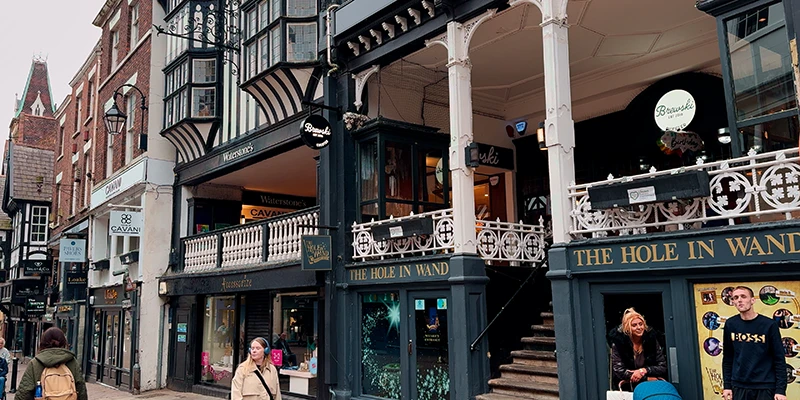
Chester is a pub city, and always was. It grew wealthy on trade, farming and travelers, and it was a major coaching stop, which is why the center still has so many old inns. The Blue Bell on Northgate Street was first licensed in 1494 and is one of the finest surviving buildings of its period in the city; the old records show that a room there cost a penny a night, with no bed and no chair, and you shared it with whoever else came off the coach.
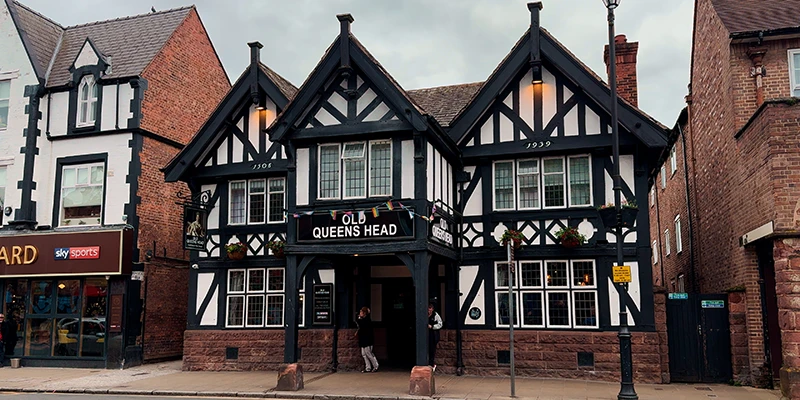
The Falcon, the Boot Inn, the Old Harkers Arms on the canal and the Albion are the ones usually named, and several of the Rows-level premises are bars and restaurants with a view down onto the street. Eating tends to be concentrated in Watergate Street and Northgate Street rather than the main shopping stretch.
The Cathedral
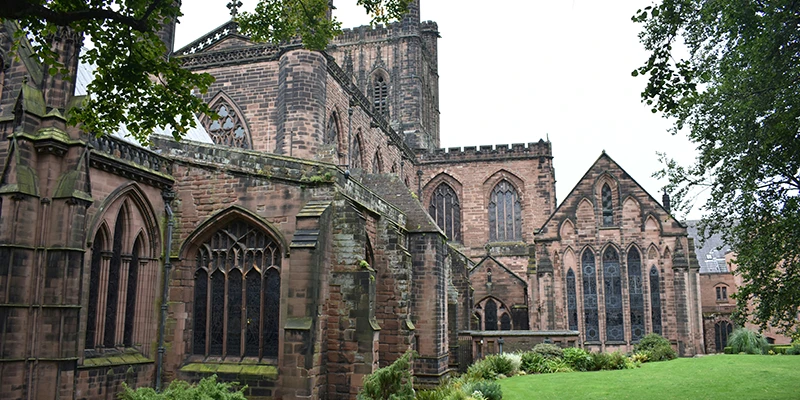
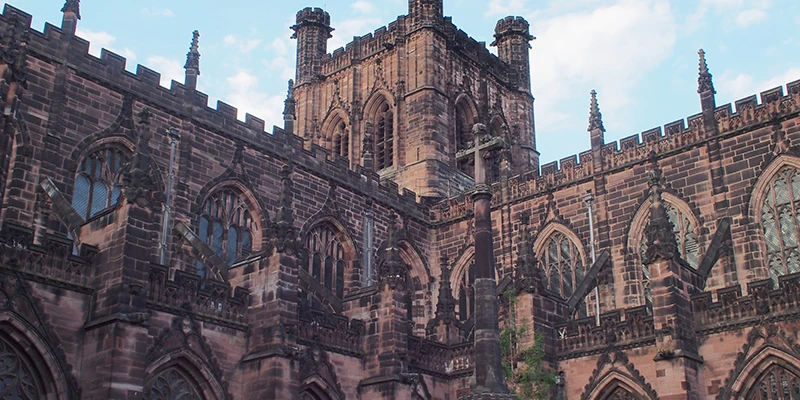
Chester Cathedral is built of the same red sandstone as everything else, which gives it a warmth that gray-stone cathedrals do not have, and it is a working building rather than a monument. It stands just off Northgate Street behind a fourteenth-century abbey gateway, in a square of Georgian houses — some of them, in the Chester manner, only Georgian at the front.
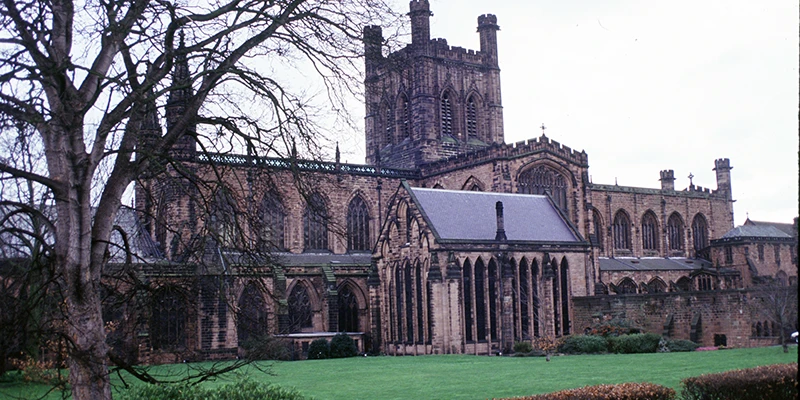
The building began in 1092 as the Benedictine abbey of St Werburgh, and there was a church on the site before that, from 907, so Christian worship has been carried on here continuously for well over a thousand years. It became a cathedral only in 1541, when Henry VIII dissolved the monastery and made the abbey church the seat of a new diocese, which is why the layout is monastic rather than cathedral-like.
What makes it unusual is how much of the monastery survived and how much of it is still doing its original job. The refectory, where the monks ate, is a dining room again and serves visitors. The chapter house, where the monks held their daily meetings, is still where the dean and chapter meet. The cloister is intact, with elaborate fan vaulting extending into the outer doorways, and it remains what it was built to be, a quiet enclosed walk.
The architecture is layered rather than unified. The core is Norman, from the 1092 foundation, but the monks modernized repeatedly through the 1200s and the late 1300s and at one point absorbed a neighboring parish church to enlarge the complex. The overall effect is English perpendicular Gothic sitting on Norman foundations, and the building took roughly three hundred years to reach its final form.
The choir stalls are the single finest thing in the building and among the finest medieval woodwork in the country. They date from the late fourteenth century, carved in oak imported from the Baltic because the monks were in a dispute with the king and the local lords over how much timber they could take from the Cheshire forests. The canopies above them are extraordinarily elaborate, and they were built for a practical reason as much as a decorative one: there was no heating and very little glass, and the canopies gave the senior monks some shelter during services that ran through the night.
Under the seats are the misericords — hinged ledges that let a monk rest against something while technically remaining standing through a long office, the name meaning an act of mercy or pity. Chester's are famous, and every one is carved with a scene: animals, monsters, folk tales, domestic arguments, and moral lessons. One shows a figure with a clergyman's head and the cloven hooves and haunches of a devil, the point being that too much drink turns a priest into something else.
The History
Chester exists because of a river crossing. The Dee looped around three sides of a sandstone outcrop fifty feet above the water, and the site controlled the lowest practical crossing point on the river. There was a local population here before the Romans, but it was the Roman army that made it a place of consequence, founding the fortress of Deva around AD 79 as the base of the Twentieth Legion.
Deva was one of the three great legionary fortresses of Roman Britain, alongside York and Caerleon, and at around sixty acres it was substantially larger than the standard plan — large enough that some archaeologists have argued it was intended as a provincial capital. It was garrisoned for the better part of three hundred years.
After the Romans withdrew, the Saxons took the site and rebuilt the defenses around 900, extending the Roman circuit. The Vikings raided the city and some of them subsequently settled in it. Then the Normans arrived, and from 1092 Chester was effectively an independent state, an earldom held directly and run as a buffer between England and Wales.
That border position shaped the city's laws, and they were not gentle ones. No Welshman was permitted to remain inside the walls after the curfew bell; any found in the city afterward were arrested, and three or more together were deemed to be plotting against the Earl of Chester and could be executed. One of the gates, variously called the Wolf Gate, the Pepper Gate and the Newgate, was ordered locked and barred in the early 1500s by an alderman of the city after his daughter eloped through it — the city records state it was to stop any other scurvy knave running off with a gentleman's daughter.
Chester was a working port through the medieval period, its wealth built on trade with Ireland and beyond, but the Dee silted up progressively and the port trade shifted to Liverpool. Chester merchants continued to own ships trading to the new world; they simply sailed them from the Mersey instead. The Old Dee Bridge remained the only crossing of the river here until 1833, and every trader and traveler going to or from Wales — the border is about six miles away — came through the city, where the tolls were collected.
The Civil War was the disaster. Chester declared for the king, was besieged from September 1645, and surrendered in February 1646 after the population had been reduced to eating anything with flesh on it. The city was badly damaged, heavily fined afterward, and its trade collapsed. The rebuilding that followed is why so many medieval buildings in the center wear later fronts.
Recovery came slowly through the Georgian period and then quickly in the Victorian one, when the railway arrived and Chester reinvented itself as a place worth visiting. The Victorians restored, rebuilt and in places invented the black-and-white city that visitors photograph today, and they did it with such conviction that separating their work from the original is a specialist job. During the Second World War the city hosted large numbers of American troops; General Patton was based at Peover Hall, a few miles outside, and the American flag still flies there.
What Chester has now is a remarkably intact small city where all the layers are visible at once — Roman wall, Saxon extension, medieval Rows, Georgian terrace, Victorian black-and-white — inside a circuit you can walk in ninety minutes.