Bergamo Lower Town
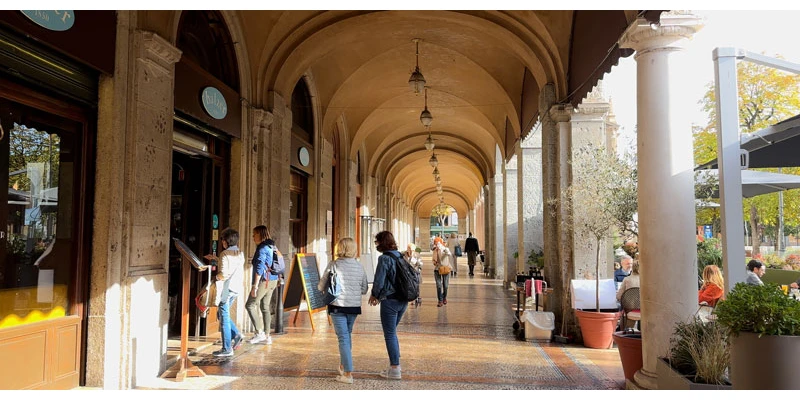
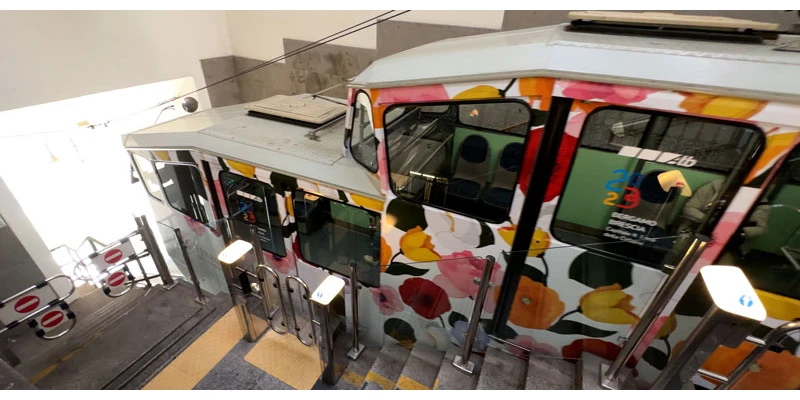
We have one more part of the city to explore, the Lower Town, the modern city spread across the plain below the medieval hilltop. It is often skipped by visitors who come only for the Old Town, but the Città Bassa is a handsome and lively place in its own right, with broad avenues, elegant early twentieth-century buildings, busy shopping streets and a steady flow of local life. You could walk down from the upper town or ride the city bus, but taking the funicular from Piazza Mercato delle Scarpe is the most enjoyable way to descend, gliding down the hillside with views opening out over the rooftops toward the modern center.
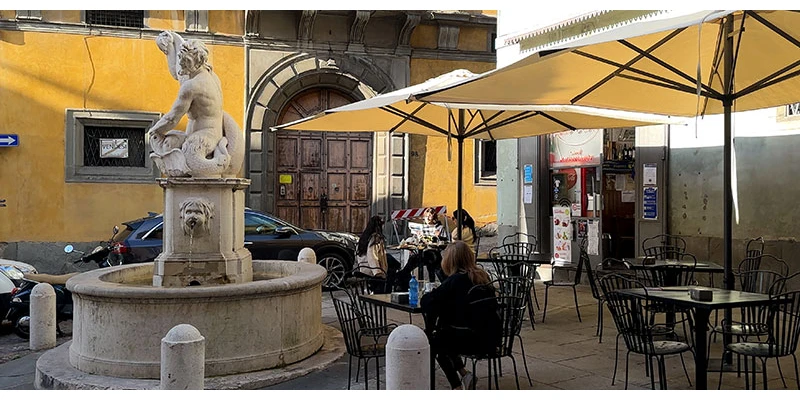
Wandering through the lower town, you might come across the Fountain of the Dolphins beside a cozy outdoor cafe, one of many small squares where residents pause for a coffee or an aperitivo. The Città Bassa grew rapidly in the early 1900s, and much of its center was laid out in a deliberate, spacious plan, so the streets feel open and well-ordered compared with the tight medieval lanes above.
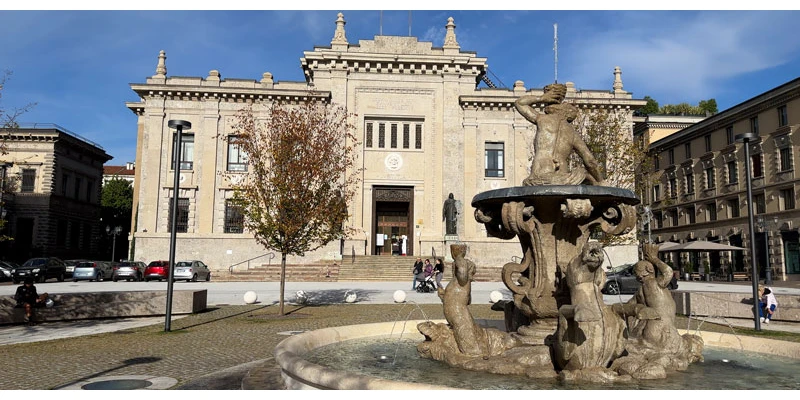
Piazza Dante and the Sentierone
The heart of the lower town is Piazza Dante, a grand open square that holds the best collection of monumental buildings in the modern city. It was created in the early twentieth century as part of an ambitious plan to give Bergamo a dignified new center to match the historic splendor of the upper town. The square is framed by imposing structures, including the Palace of Justice, the city's main courthouse, a large and stately building that anchors one side of the space. Around it spreads a garden park with benches and trees, a pleasant place to sit and rest in the middle of the city.
Adjoining Piazza Dante is the Sentierone, a wide tree-lined promenade that has been the main gathering place and walking street of the lower town for generations. It is bordered by the Quadriportico, a long covered arcade with porticoes sheltering shops, cafes and restaurants, so you can stroll comfortably in any weather. In the evening the Sentierone fills with people out for the traditional passeggiata, the leisurely walk before dinner that is such a fixture of Italian town life. Nearby stand the Donizetti Theatre, named for Bergamo's great composer, and several churches and civic buildings that give this part of town its sense of occasion.
This whole ensemble, the square, the promenade and the arcades, was the work of the architect Marcello Piacentini in the 1920s, and together they form one of the most coherent pieces of early modern town planning in Lombardy. It is worth lingering here to appreciate how the lower town balances the medieval city above, the two halves of Bergamo each complete in its own style.
Porta Nuova and the avenues
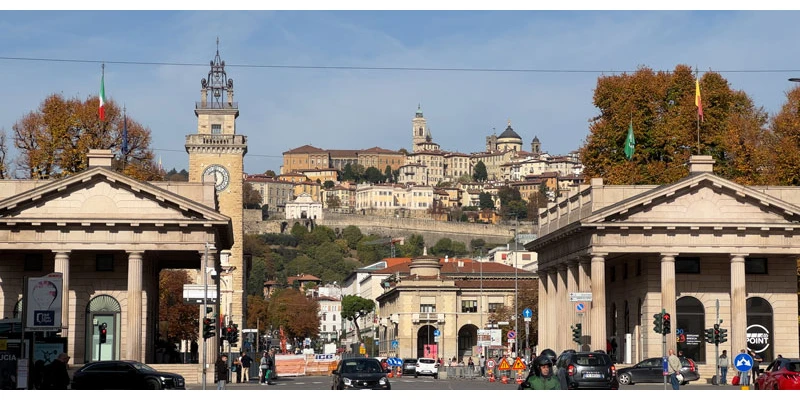
Walking through the center you reach Porta Nuova, marked by two matching neoclassical buildings that stand like a ceremonial gateway into the city. Known as the Propylaea, these twin pavilions were built in the nineteenth century and frame the view back toward the upper town, with Bergamo Alta rising majestically on its hillside in the distance. The contrast is striking, the quiet stone towers of the medieval city floating above the traffic and energy of the modern streets below.
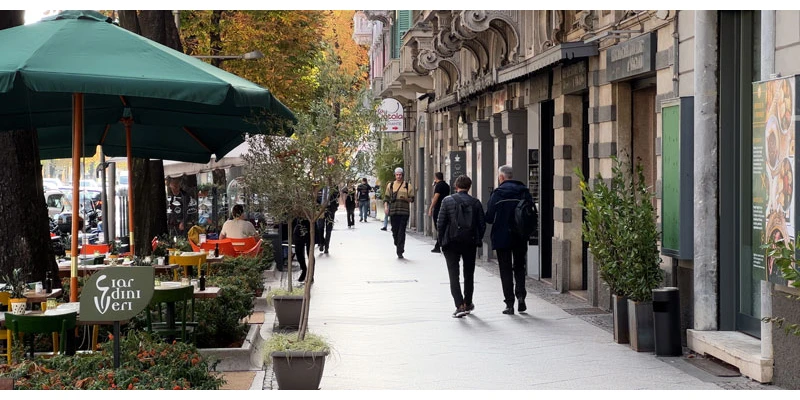
From Porta Nuova the main avenue leads on toward the train station, lined with shops, banks and cafes. This is the commercial spine of the lower town, busy with shoppers and commuters, and a good place to feel the rhythm of everyday Bergamo away from the tourist crowds of the hilltop. It is a fine time to pause for a spritz and perhaps an inexpensive sandwich before continuing on, and it is always a good idea to bring some food aboard the train, or simply eat as you walk.
The shopping streets
The main street continues as Viale Roma, which changes its name partway along to Viale Papa Giovanni XXIII. This is the central axis of the lower town, an unusually wide avenue laid out in the nineteenth century to link Porta Nuova with the railway station, and the whole stretch is lined with shops, cafes and restaurants. It is the busy heart of downtown Bergamo, where much of the city's daily commerce and street life takes place, with the medieval upper town always visible on its hill at the far end.
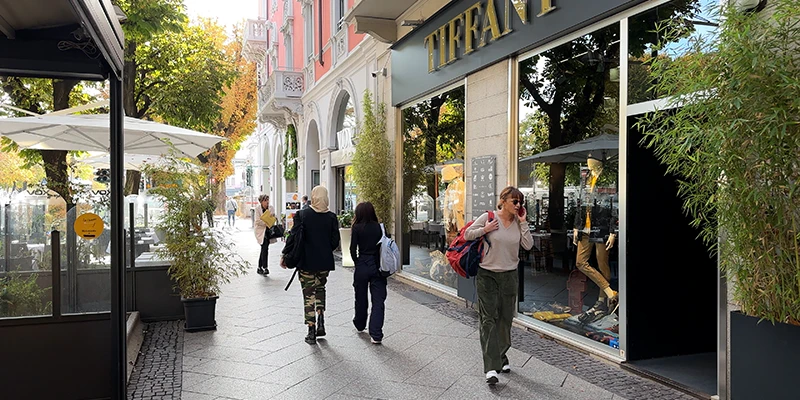
Off this main avenue opens a whole district of shopping streets and squares well worth exploring on foot. Piazza Matteotti adjoins the Sentierone promenade at the center of the lower town, a broad open space lined with cafes and historic buildings. Branching from this area are the city's best shopping streets. Via Sant'Alessandro follows the old route toward Milan and has long been a lively commercial street. Via XX Settembre is the one not to miss, a handsome pedestrian street closed to cars and lined with boutiques, bookshops, pastry shops and cafes, always animated, especially in the late afternoon when locals come out for the passeggiata, strolling among the shop windows. Together these streets form the fashionable shopping quarter of the lower town, leading down toward Piazza Pontida, a historic square ringed with old porticoes that was once the meeting point of the roads from Milan, Lecco and the surrounding towns.
Bergamo Station and onward connections
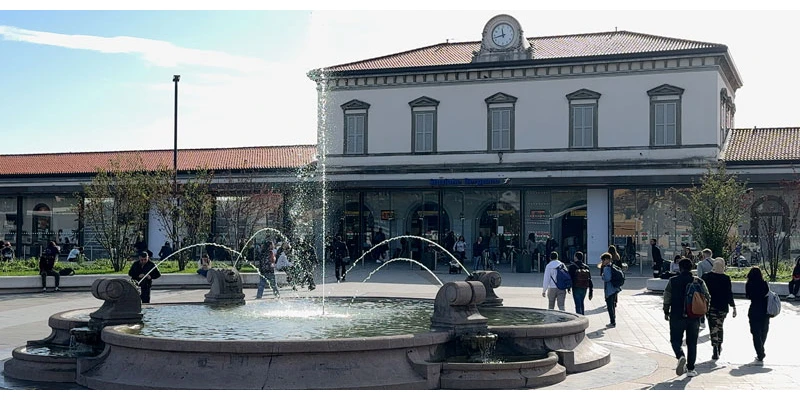
The avenue ends at Bergamo's railway station in Piazza Guglielmo Marconi, the gateway for journeys out to the rest of Lombardy. The station opened in the 1850s and remains a busy regional hub, with frequent trains running throughout the day. Even if you are not catching a train, it is worth understanding the connections, because Bergamo's central position makes it an excellent base for exploring this corner of northern Italy.
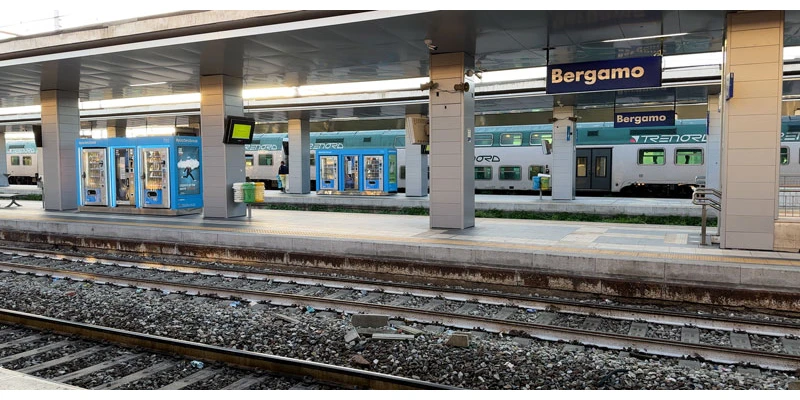
Milan is the most frequent destination, reached by direct regional trains in about fifty minutes, with services running several times an hour, so a day trip to the big city is easy. Brescia lies in the other direction, also about fifty minutes away by direct train, a handsome city with Roman ruins and the rolling Franciacorta wine country nearby. Lecco, at the southern tip of Lake Como, is around forty minutes by direct train, and from there the lakeside towns open up.
The lakes are the great draw of the region, and several are within easy reach. For Lake Como, take the train to Lecco and continue along the eastern shore to Varenna, one of the prettiest of the lake villages, from where ferries cross to Bellagio and Menaggio. Lake Iseo, the quieter and less crowded of the Lombard lakes, lies only about thirty kilometers east, shared between the provinces of Bergamo and Brescia. Lake Garda, the largest in Italy, is a little further on beyond Brescia. With Verona reachable in around an hour and a half by changing at Brescia, the choices for excursions are wide, and many travelers use Bergamo as a calm and affordable home base from which to range out across the region.
To reach the upper town again from the station, the ATB bus line 1 runs every few minutes to the lower funicular station, where the cable car carries you back up into the medieval city. However you choose to end your visit, Bergamo leaves a strong impression, a city of two halves, ancient and modern, each rewarding in its own way.