Schwerin
Schwerin is the kind of place that surprises people who have never heard of it. Its centerpiece is a castle that sits on its own small island, ringed by water and gardens, looking so much like an illustration from a storybook that it is often called one of the most beautiful in Germany. For a small city, Schwerin delivers an outsized amount of scenery, history and easy walking, and it remains far less crowded than the famous names on the tourist trail.
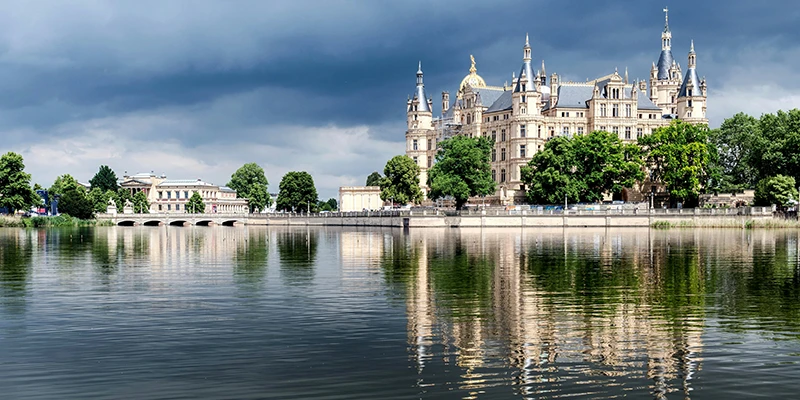
The city is the capital of the state of Mecklenburg-Vorpommern, in Germany's northeast, set among a cluster of lakes about 35 minutes by train south of the Baltic coast and roughly an hour from Hamburg. Water defines the place. The old town sits between the large Schweriner See and several smaller lakes, so nearly every walk ends at a waterfront, and the interplay of lake, parkland and historic buildings gives Schwerin a calm, green character unlike the busier industrial cities of the north.
Schwerin Castle, the Schloss, is the reason most visitors come. Built in its present romantic form in the mid-19th century on the foundations of much older fortifications, it served as the residence of the grand dukes of Mecklenburg and today houses the state parliament along with a museum of opulent royal rooms. The building rises straight from its island in a fanciful composition of turrets, domes and golden details, reached by a bridge from the old town. Around it spread formal gardens, the Burggarten on the island and the larger Schlossgarten beyond, laid out with avenues, canals and a baroque parterre that make for an unhurried hour of strolling.
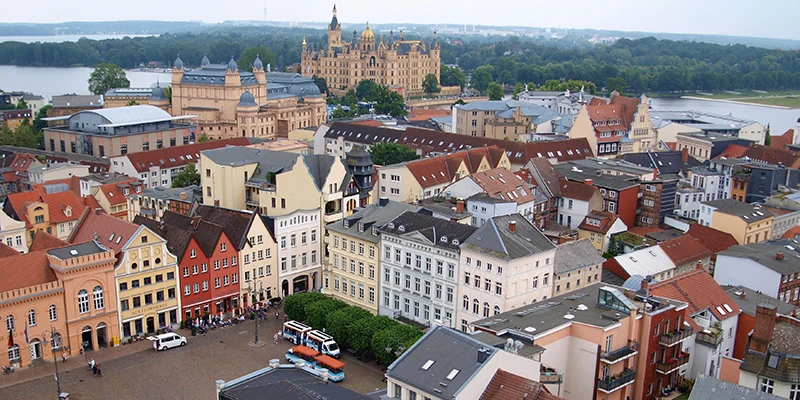
From the castle the old town is a short walk across the water. At its heart is the Markt, the market square, framed by historic facades and overlooked by the Schwerin Cathedral, the Dom. This is a genuine Gothic structure of brick, the characteristic building material of northern Germany, and its tower can be climbed for a wide view over the rooftops, lakes and the castle in the distance. The cathedral's soaring, austere interior is a reminder that Schwerin's history reaches back to the 12th century, when it was founded by Henry the Lion as a bishop's seat, making it one of the older towns in this part of Germany.
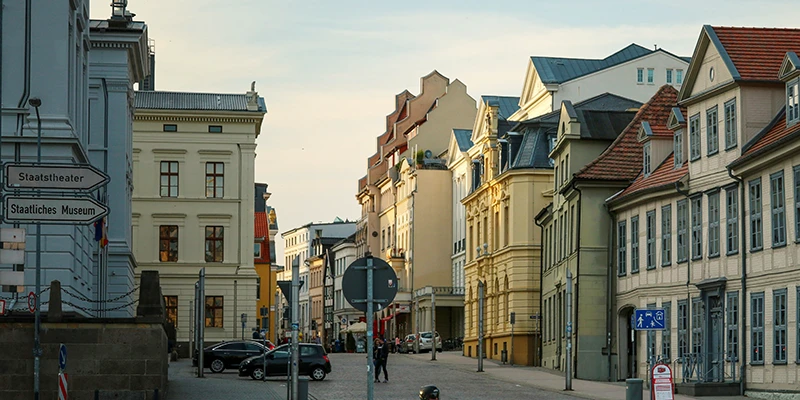
The pedestrian core is compact and pleasant. The main shopping streets, including Mecklenburgstrasse and the lanes radiating from the market, are largely traffic-free and lined with a mix of independent shops, cafes and the usual German retailers, set among restored townhouses painted in soft colors. Because the center is small and flat, it is easy to cover on foot in a few hours, drifting from the market square down to the lake promenade and back. The Schlachtermarkt and the surrounding squares fill with market stalls and outdoor seating in the warmer months.
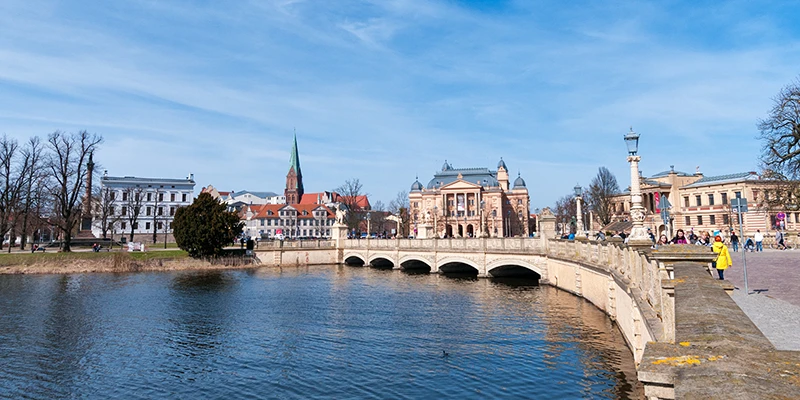
Schwerin's appeal lies in combining these pieces within a short distance. You can stand in the cathedral square, walk ten minutes to the castle island, wander its gardens, then follow the lakeshore promenade where small boats come and go in summer. Lake cruises depart from the waterfront and offer a relaxing way to see the castle and city from the water, the angle from which Schwerin looks its absolute best. The Pfaffenteich, a smaller ornamental lake right in the center, is ringed by handsome 19th-century buildings and crossed by a little ferry, adding another scenic set piece within easy reach.
Beyond the obvious highlights, the old town rewards slow exploration. There are quiet residential lanes of restored houses, the state museum near the castle with a respected collection of Dutch and Flemish paintings, and the old government buildings that reflect Schwerin's long role as a seat of power. The scale never overwhelms; this is a city you experience at walking pace, where the next attractive view is always close by.
Getting to Schwerin is straightforward. It sits on the main rail line between Hamburg and the Baltic, with frequent direct trains, and the station is a short walk or quick bus ride from the center. For travelers building a northern German route, it makes an easy and rewarding stop between Hamburg and the coast, or a relaxed base for a day or two. The official Schwerin and Mecklenburg tourist information offices provide maps, opening hours for the castle and cathedral, and details on lake cruises and seasonal events.
What stays with most visitors is the sense that Schwerin punches well above its size. A storybook castle on an island, a brick Gothic cathedral, formal gardens, a walkable old town and a setting laced with lakes add up to one of the most photogenic and least hectic capitals in Germany, a place that feels like a discovery rather than a checklist stop.