Oldenburg
Oldenburg wears its history lightly. A former grand-ducal residence city in Lower Saxony, it carries the trappings of a capital — a palace, broad squares, an old town laid out for promenading — without the crowds that come with bigger names nearby. The pace is unhurried, the centre compact and walkable, and the overall impression is of a prosperous regional town that has kept its good bones and put them to everyday use.
The Official Tourist Information website has a large amount of information about the city and surroundings, including sights, accommodations, dining, tours, scenic routes, free brochures, maps and more.
unpx.webp)
The town lies in the northwest of Lower Saxony, roughly between Bremen and the North Sea coast, on the Hunte river and the canal network that once made it a trading hub. It is the third-largest city in the state after Hanover and Braunschweig, though it does not feel large. The historic core is ringed by what were once fortifications and is now a belt of parks and water, so the transition from old town to modern city is gentle and green.
The Schloss, the former residence of the counts and later grand dukes of Oldenburg, anchors the centre. The building grew over several centuries, which shows in its mix of styles, from Renaissance elements to later baroque and classical additions. It now houses the Landesmuseum für Kunst und Kulturgeschichte, the state museum for art and cultural history, whose collections run from old master paintings to regional decorative arts and period rooms. The palace gardens behind it, the Schlossgarten, were laid out in the English landscape style and remain one of the town's most-used green spaces.
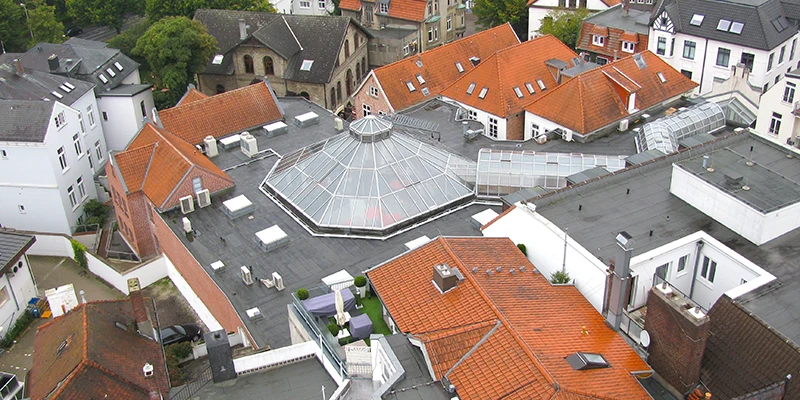
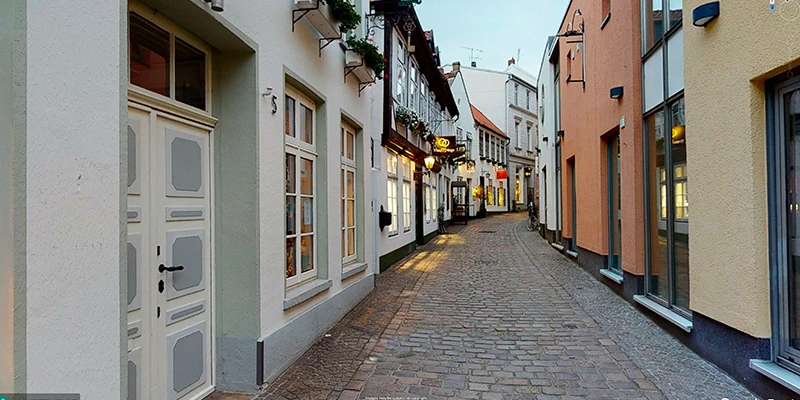
From the palace, the Schlossplatz opens into the pedestrianised shopping streets that form the commercial heart of the old town. Lange Strasse is the main spine, lined with a mix of historic facades and contemporary retail, and it connects to a network of smaller lanes and squares. The Lappan, a freestanding tower that is the surviving belfry of a demolished medieval hospital chapel, has become an informal symbol of the town and a standard meeting point. Nearby, the weekly market on the Rathausmarkt brings produce, flowers and stalls into the square beneath the neo-Gothic town hall.
The Lambertikirche, the town's principal Protestant church, sits at the centre of the market square. Its exterior is conventionally neo-Gothic, but the interior is unexpected: a circular, domed classical hall, the result of an early nineteenth-century remodelling that wrapped a rotunda inside the older Gothic shell. The contrast between the spired outside and the rounded, columned inside is one of the more distinctive architectural surprises in the region.
Oldenburg's museums extend beyond the palace. The Augusteum, a separate gallery building, shows older paintings from the state collection. The Stadtmuseum occupies a group of historic villas and covers the town's own history, while the Edith-Russ-Haus focuses on media art. The Horst-Janssen-Museum is dedicated to the graphic artist Horst Janssen, an Oldenburg native whose drawings and prints made him one of the better-known German artists of the later twentieth century. For a town of its size, the concentration of museums is notable and reflects its former status as a court city.
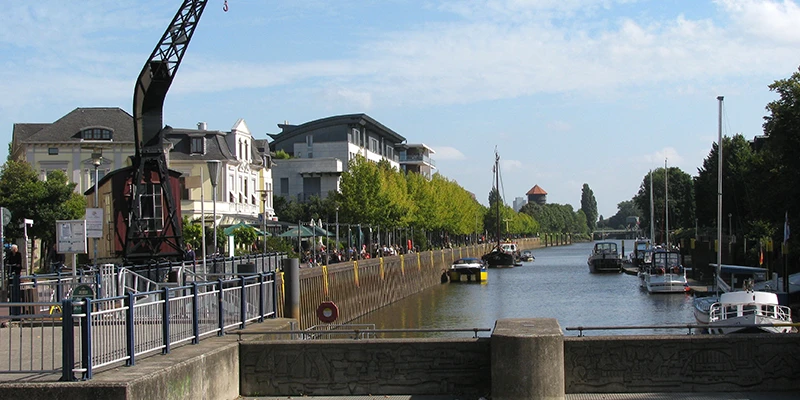
Green space is a defining feature. Beyond the Schlossgarten, the town is threaded with parks and the Hunte and its canal, and the surrounding landscape is the flat, open country typical of the northwest German lowlands. The Schlossgarten in particular, with its mature trees, ponds and rhododendron plantings, draws large numbers in spring and is treated by residents as an extension of the town centre rather than a destination apart from it.
The university gives Oldenburg a younger population than its grand-ducal architecture might suggest. The Carl von Ossietzky University, founded in the 1970s, brings students into the town and supports a café and bar culture, particularly in the streets around the centre. The result is a town that combines the dignity of a former residence city with the everyday energy of a student town, neither element overwhelming the other.
Oldenburg is well connected by rail, sitting on lines linking Bremen with the East Frisian coast and beyond, which makes it a practical base for exploring the northwest. Bremen is a short train ride away, and the North Sea, the East Frisian Islands and the open marsh landscapes of the coast are within easy reach. For visitors, the town works both as a quiet destination in its own right and as a calm, well-served stopping point on a wider tour of the region.
What Oldenburg offers is a particular kind of low-key appeal: a walkable historic centre, a genuine palace and its gardens, a strong run of museums and a relaxed atmosphere, all without the pressure of mass tourism. It rewards a slow visit rather than a checklist, and tends to leave travellers wondering why it is not better known.
Oldenburg Google Map
This interactive Google My Map shows locations and hotels with information that can be displayed by clicking on the symbols. It has sidebar index and displays best in full-frame by clicking the box in top-right. The map can be used on your phone or tablet when visiting a city, showing you where to go and describing the sights. You are welcome to make a copy as described here.