Osnabrück
Osnabrück carries a large place in European history for a city of its size. It was here, together with nearby Münster, that the Peace of Westphalia was negotiated in 1648, ending the Thirty Years' War and reshaping the map of Europe. That heritage as a city of peace still defines Osnabrück's identity, and visitors find a walkable historic center of restored squares, churches and a fine cathedral, set in green countryside at the edge of the Teutoburg Forest.
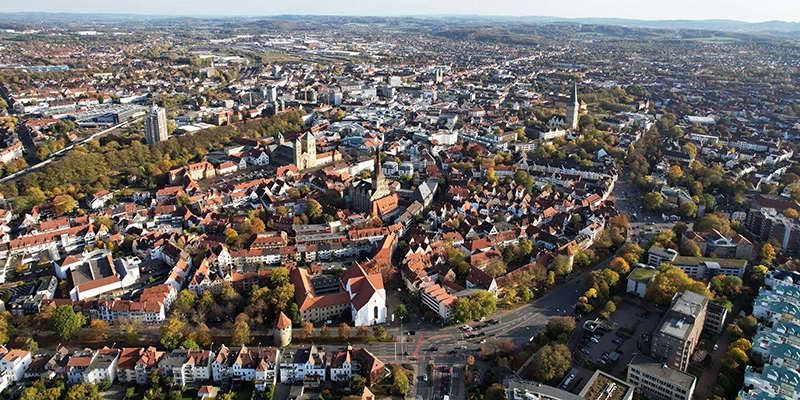
The city lies in the west of Lower Saxony, in northwestern Germany, near the border with North Rhine-Westphalia, and is reached by direct trains from cities such as Hamburg, Hannover and Cologne. It sits in a gap between hills where the Teutoburg Forest meets the lowlands, a setting that gives the surrounding area walking trails and nature parks within easy reach of the center. Osnabrück was founded by Charlemagne around the year 780 as a bishop's seat, making it one of the older cities of the region, though much of what stands today reflects rebuilding after wartime damage, done carefully to restore the historic look.
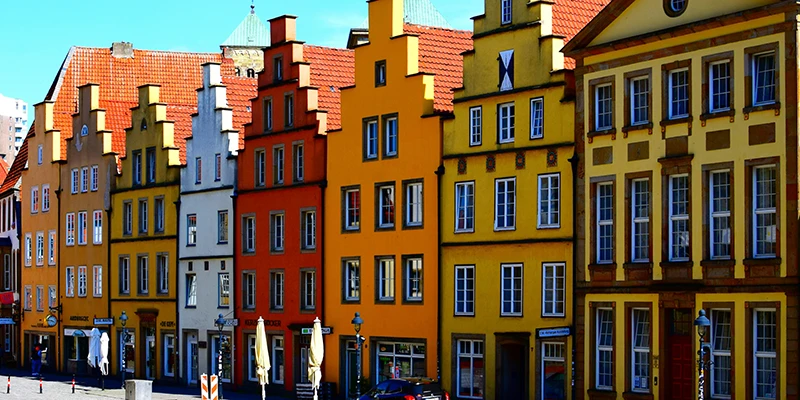
The heart of the city is the Markt, the market square, an attractive ensemble dominated by two landmark buildings. The Rathaus, the town hall, is where the Westphalian peace was signed, and inside the Friedenssaal, the Hall of Peace, hangs a series of portraits of the envoys who negotiated the treaty, a room that draws visitors for its historical weight. Beside it rises the Marienkirche, St. Mary's, a Gothic church with a richly gabled front, while the curved row of merchant houses around the square, with their stepped gables, completes one of the most photogenic spots in the city.
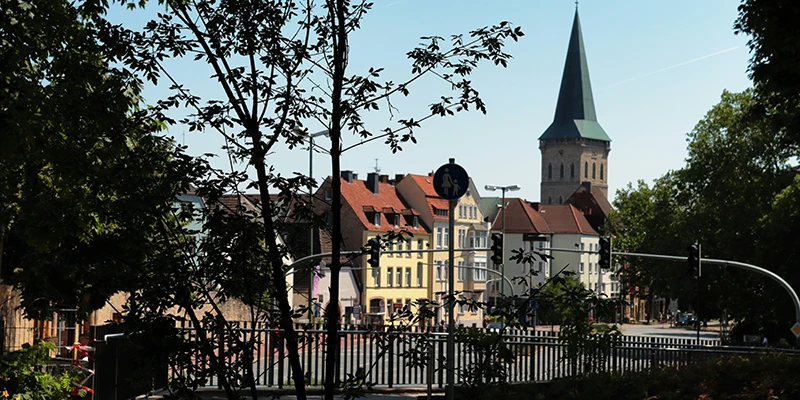
A short walk away stands the cathedral, the Dom St. Peter, a substantial medieval church combining Romanesque and Gothic elements, with two unmatched towers and a treasury of religious art. Around it the old town spreads in a network of lanes, some lined with the half-timbered and gabled houses typical of the region, others rebuilt in keeping with the historic character. The Bierstrasse and Krahnstrasse are among the prettiest streets, their colorful facades making for a pleasant wander.
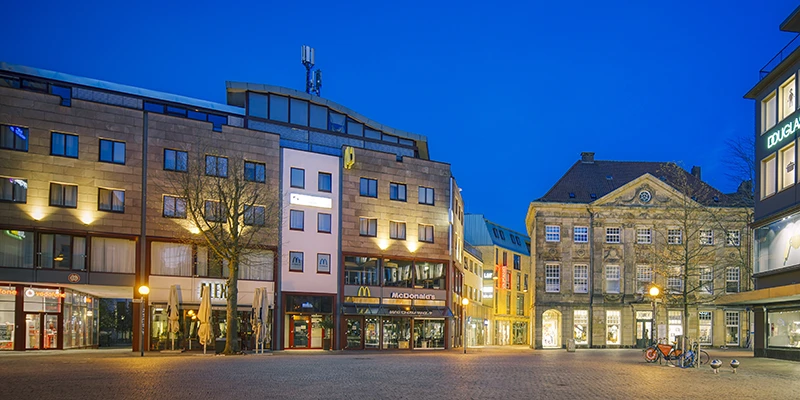
Osnabrück's shopping is concentrated in a pedestrian zone that threads through the center. The main lanes, including the Grosse Strasse, are traffic-free and busy with shops, cafes and department stores, linking the market square and cathedral area with the more modern retail streets. Because the center is compact and largely flat, it is easy to combine the historic sights and the shopping in a single unhurried circuit on foot.
The city has a notable cultural side. It is the birthplace of the artist Felix Nussbaum, and the Felix-Nussbaum-Haus, a striking museum designed by architect Daniel Libeskind, displays his work in a building that is itself an attraction. The Erich Maria Remarque Peace Center honors the author of All Quiet on the Western Front, who was born in Osnabrück, continuing the city's association with the theme of peace. These museums give visitors substance beyond the historic squares.
The surrounding landscape adds another dimension. Osnabrück sits within a UNESCO-recognized geopark, and the Teutoburg Forest on its doorstep offers walking and viewpoints, including the nearby hills where, in Roman times, Germanic tribes famously defeated the Roman legions. For visitors with extra time, the green setting makes a natural complement to the urban sights.
Getting to Osnabrück is easy, with a main station served by direct trains from across northern and western Germany, a short walk or tram ride from the center. The compact old town is best explored on foot. The city tourist office on the market square provides maps, opening hours for the town hall and museums, and information on walks in the surrounding hills.
Osnabrück suits travelers who appreciate history with real weight, delivered at a human scale. The Hall of Peace, the cathedral, the gabled market square and the easy pedestrian shopping make it a satisfying stop, and its setting at the edge of the Teutoburg Forest gives it a green, unhurried character distinct from Germany's larger cities.