Quedlinburg
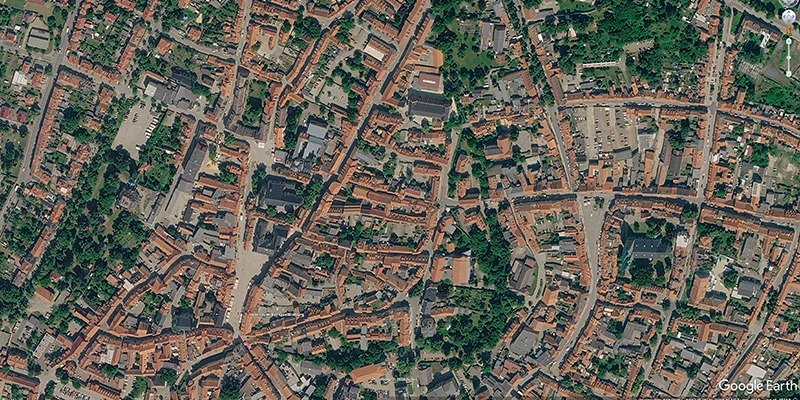
Few towns reward a wanderer the way Quedlinburg does. Set down in this small Harz-foothill town and you find yourself inside one of the largest and most complete ensembles of timber-framed architecture anywhere in Europe — more than two thousand half-timbered houses spread across a medieval street plan that has barely shifted in eight centuries.
The Official Tourist Information website has a large amount of information about the city and surroundings, including sights, accommodations, dining, tours, scenic routes, free brochures, maps and more.
My hotel choice in Quedlinburg: Hotel Zum Bär
.webp)
Map of Quedlinburg
Our annotated map marks the squares, buildings, hotels, shopping streets, and the prettiest pedestrian lanes and cobbled alleys.
The pleasure here is not a single monument but the accumulation of thousands of small ones: a leaning gable, a carved corner post, a sunlit lane that bends out of sight, a square that opens unexpectedly from a tight alley. You come to Quedlinburg to walk, to look up, and to lose track of time.
.webp)
The view from the Schlossberg, the castle hill at the town's edge, gathers the whole place into one frame: an undulating sea of red and brown tiled roofs punctuated by slender church spires and the long dark ridge of the collegiate church above the rest. From up here the scale of the old town becomes clear — there is almost no modern intrusion, no concrete tower or glass box to break the rhythm. It is a townscape that looks essentially as it did before the industrial age, and the climb up the sandstone outcrop is the best way to understand why the entire old town carries UNESCO World Heritage protection.
The market square and the Rathaus
The heart of Quedlinburg is the Markt, a broad cobbled square that serves as the town's living room. Cafés set out tables under the trees, market stalls appear on certain mornings, and the wide expanse of paving gives the surrounding facades room to breathe. The square is large enough to feel generous but still framed tightly enough by its buildings to feel enclosed and intimate.
.webp)
The dominant building on the square is the Rathaus, the town hall, a handsome stone structure with a steep slate roof and a Renaissance portal. In autumn its facade becomes one of the most photographed sights in the Harz: a dense curtain of wild Virginia creeper turns flaming scarlet and climbs the whole front of the building, framing the windows and the carved doorway in red. Below it stands the Roland statue, the medieval symbol of civic freedom and market rights that you find guarding town squares across this part of Germany.
.webp)
Around the square the buildings shift register from stone to timber, and the variety is remarkable. One corner is anchored by an elaborate house whose upper floors lean gently outward, its timbers painted and its plaster panels decorated; further along, a long ochre-washed building with a deep arcade — the Sparkasse — gives the square a more formal, almost Italianate edge. Strung between them are gabled merchant houses in pink, cream, and pale grey, each one a slightly different height and angle, so the rooflines step and jog along the whole perimeter.
.webp)
HOTEL ZUM BÄR is over 250 years old, in the heart of Quedlinburg's old town. Harmoniously integrated into the ensemble of the old market square, it has recently been restored to its former glory, which has made it famous far beyond the borders of the half-timbered town of Quedlinburg since 1748. This traditional family-run hotel has managed to preserve its originality and independence with clever new ideas and innovations.
Hotel-Zum-Bar.webp)
Pedestrian lanes and shopping streets
What makes Quedlinburg so absorbing on foot is that the squares are only the openings; the real character lives in the lanes between them. The main shopping streets radiate from the Markt and are almost entirely given over to pedestrians, their cobbles worn smooth and their narrow widths keeping the pace slow. On a sunny day these lanes are some of the most cheerful streets in Germany — the buildings lean in close overhead, hanging baskets spill flowers from upper floors, and shop signs project on iron brackets the way they have for generations.
.webp)
The shops themselves are a pleasure precisely because the town has resisted becoming a chain-store strip. You find independent design boutiques, bookshops, galleries, small fashion stores, jewellers, and craft workshops, many of them tucked into ground floors whose original beams and low doorways are part of the experience. There are cafés and bakeries every few doors, so a shopping stroll becomes a pleasantly interrupted thing — a few windows, a coffee, a few more windows. Because the lanes curve, you never see the whole street at once; each bend offers a new composition of gables and a fresh spire framed at the far end.
.webp)
The colours are part of the spell. Quedlinburg's houses are painted across a whole spectrum — soft greens, terracotta, ochre, blue-grey, deep red — and the contrast of the dark timber framing against the bright infill panels gives every street a graphic, almost storybook quality. The town has been a centre of restoration craft for decades, and the care shows: facades are maintained, beams are sound, and the painted decoration on the finest houses is kept up rather than left to fade.
.webp)
Quiet corners and the canal
Step a street or two off the main shopping routes and the town goes quiet almost instantly. The residential lanes are where Quedlinburg feels most like a place out of time — long terraces of timber houses, some immaculately restored, others wearing their age in pleasingly crooked windows and weathered beams. There is no traffic to speak of, just the sound of your own footsteps on the cobbles and the occasional café murmur drifting from a corner.
.webp)
One of the most atmospheric pockets is where a small watercourse threads through the old town, crossed by little bridges with iron railings. Here the half-timbered houses come right down to the water's edge and a quiet, almost village-like calm settles over everything. It is the kind of corner you stumble on by accident and then return to, because it distils the whole town into a single small scene.
.webp)
Several of these small squares are organised around a single great tree, with café tables ranged beneath the canopy and a corner house turned over to a restaurant or wine bar. The combination — old timber, deep shade, a spire glimpsed over the rooftops, a glass of something local on the table — is Quedlinburg ambience in its purest form. There is no urgency here; the town invites you to sit as much as to walk.
The castle hill and the Münzenberg
Above the old town rises the Schlossberg, the sandstone hill crowned by the castle complex and the Romanesque collegiate church of St Servatius. The approach is half the pleasure: a cobbled path winds up between timber houses and bare outcrops of pale sandstone, the rock and the buildings growing out of one another. In autumn the slopes turn gold and russet, and the climb feels like leaving the town for a wilder, older landscape even though you are only minutes from the market square.
.webp)
Facing the castle hill across a dip is the Münzenberg, a second hill that was once the site of a monastery and is now a tangle of tiny houses built into and around the old ruins. The lanes up here are some of the narrowest and most irregular in town, and the views back across to the Schlossberg and the rooftops are superb. It is a neighbourhood of crooked charm — small cottages, courtyard gardens, the odd surprising survival of a much older structure absorbed into a later house.
.webp)
Tucked among these upper lanes are courtyards that preserve the working fabric of the old town — among them a remarkable raised timber granary projecting on a single stone pillar, the kind of structure that has vanished almost everywhere else. Details like this reward the curious; the more side gates and open courtyards you peer into, the more of them you find.
Architecture worth slowing down for
Quedlinburg is, in effect, an open-air museum of timber-frame construction, and walking it with even a little attention turns into a lesson in how the craft evolved. The oldest houses, some dating back six or seven centuries, show simple, sturdy framing; later ones grow more elaborate, with carved beam-ends, decorative brackets, and the rosettes and fan motifs of the Renaissance worked into the timbers. Many facades carry painted inscriptions and dates, and the finest are picked out in colour so the carving stands proud of the wall.
.webp)
One particularly fine group stands on the small square below the castle, where some of the town's grandest timber houses present a row of decorated gables side by side. Here you can see the full range in a single glance: plain whitewashed framing next to an exuberant carved front next to a house whose panels carry geometric painted ornament. It is the kind of street that makes you walk its length twice.
.webp)
The rooftops themselves are part of the architecture. Seen from any of the high points, the dormers, chimneys, and steep tiled pitches step across the hillside in a dense, organic pattern, with the occasional grander roof — slate rather than tile, with rows of little arched dormer windows — marking a former noble house or institution among the merchants' homes.
.webp)
Things to do and an easy pace
Beyond simply wandering — which could fill a full day on its own — Quedlinburg offers enough to structure a visit around. The collegiate church and castle on the Schlossberg hold the town's treasury and historic interiors and are worth the entry. There are small museums devoted to the town's timber-frame heritage and to the Bauhaus-linked painter Lyonel Feininger, whose graphic work suits the angular townscape perfectly. The independent shops make for genuinely good browsing, and the town's cafés, bakeries, and wine bars reward an unhurried lunch.
.webp)
What stays with you, though, is the ambience rather than any single attraction. Quedlinburg is small enough to cross on foot in twenty minutes yet rich enough to keep you occupied for two days, and its great pleasure is the way ordinary movement through it — turning a corner, climbing a lane, sitting under a tree on a square — keeps delivering small visual rewards. It is one of those rare places that has kept its whole self intact, and walking its cobbles is as close as you can come to stepping inside a medieval town that is still, comfortably, alive.
Google Earth Map of Quedlinburg