Germany by Train
Ten Towns from Würzburg to Berlin plus 10 daytrips
This is a train journey through central and northern Germany, running from Würzburg up to Berlin, taking in 10 base towns over 28 days, with 10 day trips along the way. It is a large itinerary, and the route can be shortened, slowed down, or reduced to fewer towns to suit the time available. The pages that follow describe each place in detail, with photographs, maps and links, so the plan can be adapted for individual interests.
The trip is planned around Germany's Deutsche Bahn rail network, with most connections direct and under two hours. Ticketing will be done on the Interrail website, which has information on the Interrail German Rail Pass, timetables and fares. The focus is on smaller towns with well-preserved historic centres and pedestrian zones, together with several larger cities. The route runs south to north, beginning with Würzburg and ending in Berlin, from where there are direct connections to the airport for departure.
This is not offered as the single "best itinerary" for Germany, but rather a plan to see less-visited places. Aside from the famous cities of Berlin and Hamburg, the destinations on this route are wonderful places that do not draw huge numbers of visitors, and so keep a special authentic quality. You will find all the other main cities of Germany covered elsewhere on our website. This trip might suit travellers who have already seen the famous, major German cities and are looking for something off the usual path.
See the detailed itinerary with train distances on this page.
The journey, town by town
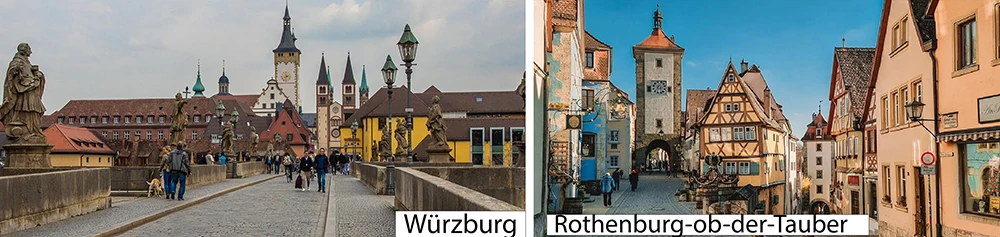
The journey begins at Würzburg, in Franconia on the Main, reached by direct train from Frankfurt Airport in about an hour. Würzburg is known for its baroque Residenz, a UNESCO palace with a large Tiepolo ceiling fresco, and the Marienberg fortress above the vineyards and the old bridge over the Main, where the town drinks its Silvaner at the end of the day. Two nights.
Next is Rothenburg ob der Tauber, an hour and a half away via Steinach — a walled medieval town on the Romantic Road, with more than 4km of ramparts, 42 towers and the Plönlein, the most photographed corner in Germany. It fills with day-trippers from mid-morning, which is the argument for the overnight stay: the town is at its best early and late, once the coaches have gone. One night.
Leaving next morning, the route calls at Nuremberg en route — time for the Kaiserburg above the old town, St Lorenz and the Hauptmarkt before moving on — and reaches Bamberg in the evening.
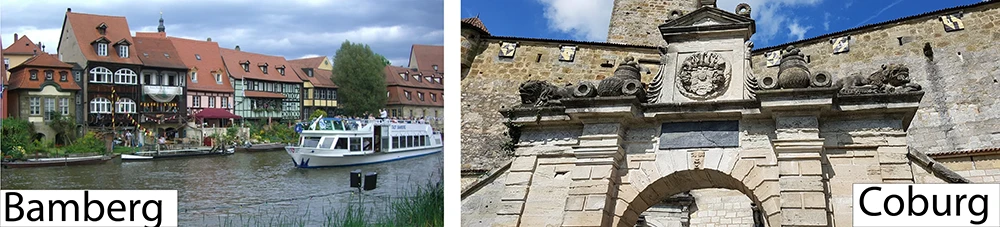
Arrival is at Bamberg, a UNESCO World Heritage town built across seven hills and the Regnitz river, known for its Old Town Hall standing on a bridge, the row of former fishermen's houses along the water, and its smoked beer. Three nights here allow time for a day trip to Coburg, about 45 minutes north, where the large Veste Coburg fortress stands above a ducal town of grand squares and gabled houses.
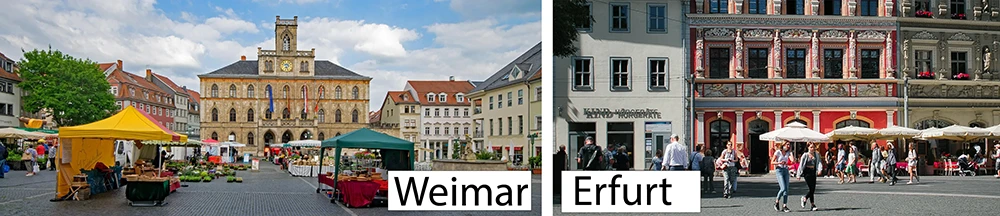
Next is Erfurt, the capital of Thuringia, whose medieval centre includes the Krämerbrücke, a bridge lined with houses, and rises to the cathedral and St Severus church above the market square. Three nights allow a day trip to Weimar, about 15 minutes away, a small town of outsized cultural weight as the home of Goethe and Schiller, the birthplace of the Bauhaus, and the site of the Weimar Republic, with house-museums, parks and the ducal library.
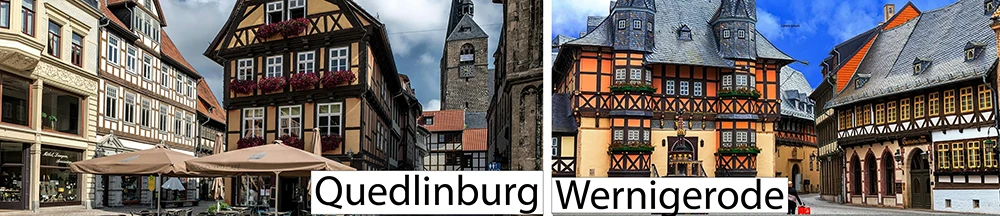
The route enters the Harz at Quedlinburg, a UNESCO World Heritage town with over 1,300 half-timbered houses spread across several centuries of building beneath its castle hill and collegiate church. From here it is a short hop to Wernigerode, as an en-route day trip, with its timber-framed Town Hall, lanes of leaning houses, and a turreted castle above the town. Wernigerode is also the terminus of the narrow-gauge steam railway that climbs the Brocken, the highest peak in the Harz.
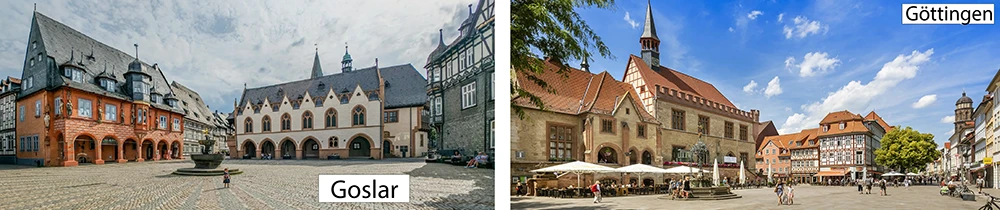
The route continues to Goslar, a former mining town on the northern edge of the Harz, with a UNESCO-listed Imperial Palace and a market square ringed by slate-hung and half-timbered houses. Two nights allow a day trip to Göttingen, about 40 minutes away, a lively university town whose old centre gathers around the Gothic Old Town Hall and the Gänseliesel fountain, traditionally kissed by graduating students.
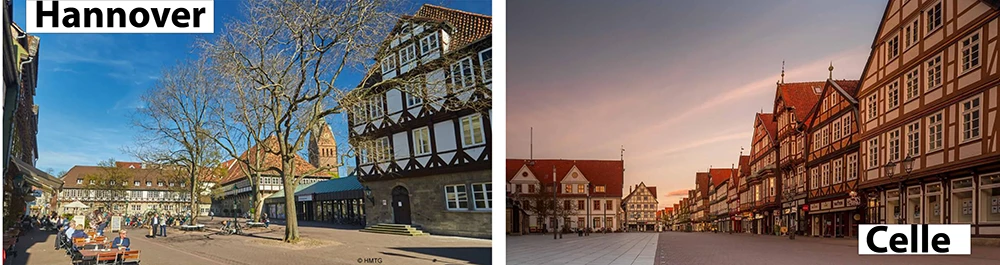
Next is Hannover, the regional capital, known for the baroque Herrenhausen Gardens and the New Town Hall. En-route from Goslar there is time to stop for a quick look at Hildesheim for a few hours.A day trip from Hannover next day runs to Celle, about 25 minutes away, whose old town has several hundred half-timbered houses gathered around a ducal palace.
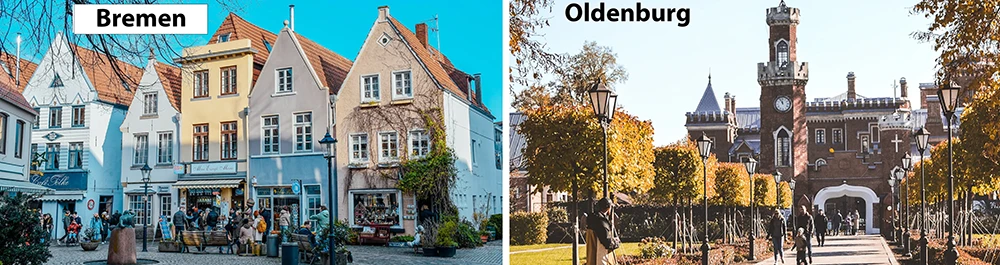
The route turns north-west to Bremen, a former free city and Hanseatic centre. Its UNESCO market square holds the Town Hall, the Roland statue and the bronze Town Musicians, and the nearby Schnoor quarter and Böttcherstrasse have lanes of small houses and craft workshops. Three nights allow a day trip to Oldenburg, about 30 minutes away, a former grand-ducal residence town with a palace, a pedestrian old centre and a ring of parks along the line of the former ramparts.
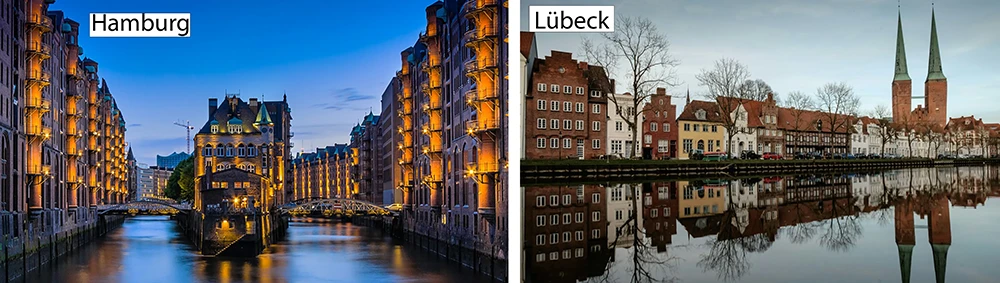
The route moves to Hamburg, a port city on the Elbe, with its harbour, canals, and the red-brick warehouse district of the Speicherstadt. Four nights allow several day trips. The first is to Lübeck, about 45 minutes away, whose island old town of brick-Gothic churches, gabled houses and the Holstentor recalls its role as a leading Hanseatic city.
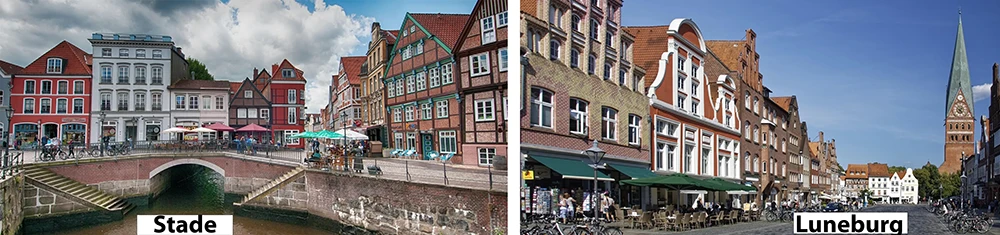
Two more day trips run from Hamburg. Lüneburg, once wealthy from salt, has a townscape of stepped gables and brick facades, several visibly leaning from centuries of subsidence. Stade, reached by the S3 S-Bahn, is a small former Hanseatic town with a preserved old harbour lined by 17th-century facades and half-timbered houses.
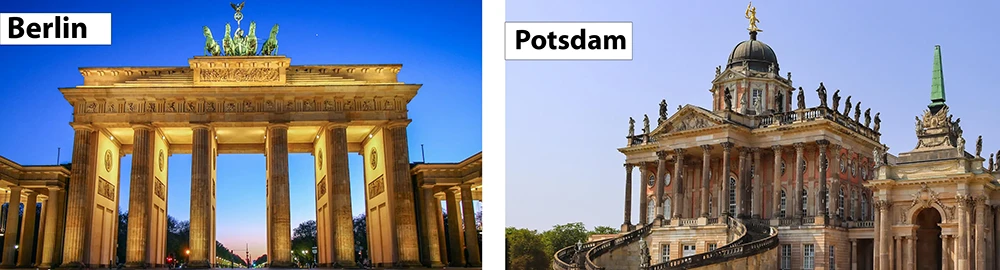
The journey ends at Berlin, the capital, with five nights to cover its government quarter, museums, and sites connected to its divided past. A day trip reaches Potsdam, the former Prussian royal seat, where the palaces and landscaped parks of Sanssouci and the New Palace lie a short train ride from the city. From Berlin there are direct connections to the airport for the journey home.
- Würzburg, 2 nights
- Rothenburg ob der Tauber, 1 night; Nuremberg en route to Bamberg
- Bamberg, 3 nights; DT Coburg
- Erfurt, 3 nights; DT Weimar, Mühlhausen
- Quedlinburg, 2 nights
- Goslar, 3 nights; DT Göttingen
- Hannover, 3 nights; DT Celle
- Bremen, 2 nights; DT Oldenburg
- Hamburg, 4 nights; DT Lübeck, Lüneburg, Stade
- Berlin, 5 nights; DT Potsdam
Each of these places is described in full on separate pages, as linked in this story. The official Germany tourist information website has further material on sights, accommodation, scenic routes and city links. The detailed outline of this itinerary with train distances can be found here.
You can enlarge this map in its own page by clicking the square symbol in the upper-right corner.
The Google My Map above outlines the route with locator pins. There are similar maps for each destination on the following pages, marked with sights and hotels, with links to hotel websites. These can be used on a mobile device while travelling, as described here.
Personal note from Dennis: I designed this trip to offer an alternative way of seeing Germany, getting beyond the famous cities to the smaller, less-visited towns that I find so rewarding, reached entirely by train. Along the way I will also be shooting video for this website and my YouTube channel, and those videos will be edited and uploaded here.
After leading about 80 group tours in Europe by train, a trip at this pace is manageable for me, though some travellers would prefer to slow it down. The information on these pages is organized by city to help in planning an individual itinerary, with photos, text, maps and links.
The route was planned using Interrail, which sells the Interrail German Rail Pass and has information on ticketing and timetables. Germany's rail network is among the most extensive in Europe, connecting more than 1,000 towns and cities. High-speed Intercity Express (ICE) trains link the major cities, while regional trains reach the smaller towns.
Stations are generally modern and accessible, with frequent departures and connections to local transport. Trains have seating, and most long-distance services have Wi-Fi and a bistro or dining car. Rail travel allows flexible planning and day excursions without the need to drive.
For details of the routing, journey times and the list of towns with day trips, see this page.