INTRODUCTION
This is the story of my first adventure in Europe -- an exciting-six week journey into the heart of the continent visiting London, Paris, Vienna, Rome and many points in between: spectacular places, beautiful people, monuments, priceless art-complete satisfaction achieved!
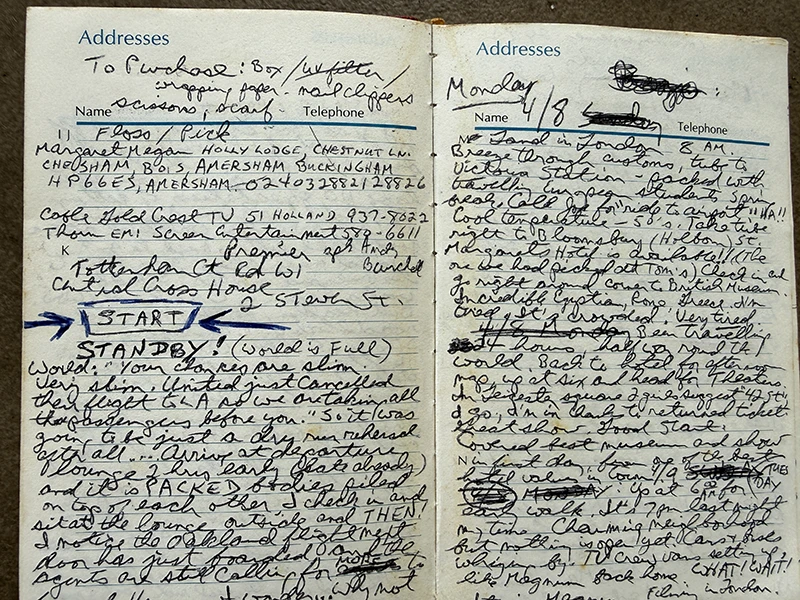
During the trip I scribbled a few sentences in a diary every day and when I got home planned to merely transcribe it, but got carried away typing a flood of memories unlocked by those sketchy notes and ended up with this travel book. Although majoring in English in college, I had no plans to become a writer or journalist, but that is what happened as a direct result. This turned out to be a long story, but the sidebar provides a table of contents.
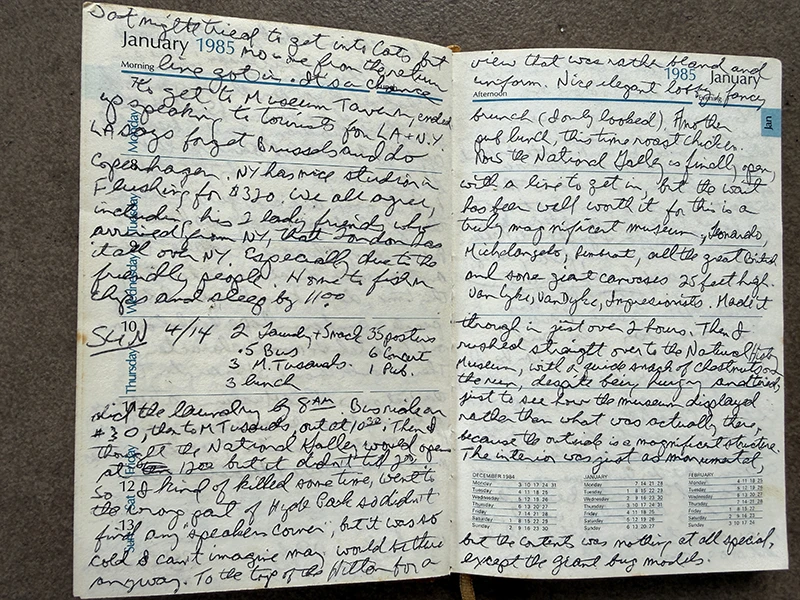
Somehow that experience unleashed the wandering journalist inside me and I have been creating travel stories in print, photo and video ever since. I wrote 55 travel stories for my local paper about how to cover Europe’s main cities with three-day walking itineraries, assisted by the memories in 3,000 slides I shot on that fateful journey. I then grabbed a newly-available small video camera in 1987 and have been shooting movies ever since, creating 1,400 travel videos for YouTube, with about 53 million total views. And now, this website, where my scribbled notes have exploded to about 1,000 web pages, filled with the equivalent of 10 travel books.
I discovered that Europe is the best place to visit and have gone back 80 more times leading group tours by train to all the great cities.
Although it was written in 1985 and is based on a theme of super-cheap travel with a strong dollar, typically spending $20 daily for room and board, it is still timely if you merely add another $300/day. Despite increasing crowds, the places have not changed much and the spontaneous strategy can still work.
Our history, culture, cuisine, technology, architecture, philosophy, social structure and way of life mostly got started in Europe and continue developing in so many amazing ways. Along with their wonderful past, the 'living history' created by Europeans every day is inspiring and entertaining. If you are wondering, no I did not have reservations anywhere or a rigid schedule, but I certainly had in mind all the many, many places I hoped to cover on this trip and the quick pace that would be needed to make it happen. Therefore, I went at top speed all the time.
Almost everyone can get something out of this tale, especially those of you who would like to visit Europe. For those who have been there already this can help you re-live it again and come up with new destinations. For those who could care less about Europe, maybe this will get you interested in going or at least thinking about it.
Don't worry about terrorists and bombs. Go for it. They're not going to get you. It's still more dangerous to walk around in America or drive down your familiar streets. Travel is fun, and while it has some actual worries, like not losing things and struggling with being lost half the time, it is worth it.
This essay provides a different approach than most guidebooks. Rather provide give a huge catalogue of 10,000 things you could do and see while traveling, it cuts things down to a manageable size. Let's face it, in two weeks or even two months you can only cover so many things, so here is one good version of what an experienced traveler has selected for the most interesting places and sights. I read lots of history, and studied dozens of guidebooks before this six week trip. This is the result -- not a complete guide but rather offer a selective focus. Indeed, you should buy several popular detailed guidebooks before you go and pore over their lists of places to visit. They are especially useful in finding hotels and restaurants in your price range. This approach will help you save money while getting more out of the experience.
I traveled primarily by train on a Eurail Pass from one major city to another, with occasional side trips to little towns and the countryside. Most of each day was spent walking in the cities, covering the important sights in the least amount of time, map and guidebooks in hand, taking frequent moments to pause and soak it all in. An experience worth one million dollars, but--only cost four thousand for the six weeks, and could cost you proportionally less on a shorter trip. Of course your interests will differ somewhat from the paths chosen here -- so this journey provides an outline rather than all the answers....
A Tale of Seventeen Cities (Or Was it Twentyfour?)
It was the best of times...the most exciting six weeks ever spent, and well worth every franc, mark, pound and lire. We're talking about Europe in the spring of 1985 (not much has changed!), full speed ahead with both barrels blasting, hurtling along on the road to everywhere... London, Vienna, Amsterdam, Dublin, Cannes and as many points in between as can possibly be crammed into a rapidly shrinking schedule.
When an agent offers one of those extra cheapo standby tickets to the other side of the world, and you have some extra vacation time coming with no particular plans, and you've also managed to save a little money, how many seconds does it take to jump at the deal?. About this long.
Preparations are made immediately for rapid departure, only to run into a two-month delay waiting for seats on the cheapest flight to become available. An ominous warning perhaps of many difficulties to come as one blunders along to places unknown? No, it turns into a valuable time for getting ready, studying the travel books, brushing up on 'sprechen sie deutsch', arranging to sublease the apartment, and letting winter turn to spring.
Finally, the 'cheap' ticket arrives , but all of a sudden I’m in a rush because this flight is leaving tomorrow. I'm skating on thin ice, because I started this trip a week earlier than expected (calling my boss from London on a Monday morning, "hey George, guess what, I left already, I'm over in England so I won't be in this morning, see the planes were full next week but I was able to get on now so I went and I hope it's OK").
Here are the main places we are about to visit in this journey, starting with the best city in the world, London, and then continuing on to--take a big breath: York, Edinburgh, Dublin, Kilarney, Rouen, Paris, Brussels, Brugge, Amsterdam, Heidelberg, Munich, Innsbruck, Salzburg, Vienna, Venice, Rome, Florence, Nice, Cannes, Luzern, Zurich, Interlaken, and Frankfurt. Then return home and sleep it off.
ENGLAND
LONDON
Our smooth jet lands in London at eight o'clock Monday morning (what a way to start a week!) The adventure begins. Customs is a breeze -- I walk past a dozen agents who all look like Commander Whitehead, their steady gaze searching for suspicious profiles, but somehow allowing me to slip through without a search.
A very convenient train brings me right to Victoria Station, its huge concourse packed with people and baggage carts. Bang! All of a sudden it really hits me that I am actually in England! Surrounded by British accents and faces, this is no longer a dream, or an anticipation, or a landing, or getting there. The wonderful realization of being here is one of those rare once-in-a-lifetime peak experiences of intense delight. To further crystalize that intoxicating feeling I telephone several friends back home, playing with the dichotomy of being here-not-there, shouting to them over the boisterous background noise of this busy station.
The subway, the "tube," delivers me to Bloomsbury, where I emerge from underground to a surprise--the streets are deserted! It turns out this is Easter Monday, their second biggest holiday of the year, so absolutely nothing is open and no one is around. How bizarre! I've come six thousand miles to see people and action, but come out of this hole in the ground to find a ghost town. This disorientation is worsened by strange triangular intersections that totally confuse my normally strong sense of direction; and then it starts to rain. With a little help from a stray pedestrian I walk to Bedford PI. and find the St. Margarets Hotel, which Tom and I had agreed back home sounded like one of the best bed and breakfast deals in the London guide books. Yes, it looks great and they do have a room. Feeling somewhat like as astronaut who has landed precisely on a target that was selected from many worlds away, I check in. I fight off the exhaustion of my 24-hour sleepless trip through the eleven time zones, which has turned my body clock inside out -- I walk around the corner for a brief look in the British Museum, gazing upon mummies, sphinxes, treasures of empire, and then, standing in a darkened gallery of Turner watercolors, I very nearly fall asleep on the spot. It's time to crawl back to the hotel for a much-needed deep nap.
Wake up in a strange land, that eerie excitement of where am I? It's just six in the evening so I head out the door hoping to start the adventure with a night in the famous London theater.
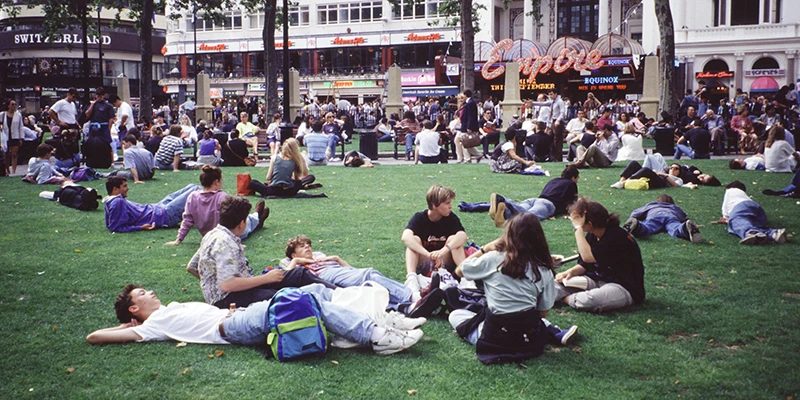
I get to Leicester Square, navigating on the subway with my dormant New York skills, to find the discount ticket booth closed hours ago--but this park is filled with life! Fascinating people all around, looking good. London in full swing, unusual clothes, wild hair styles, lots of activity, and two friendly girls who suggest I can get seats for the big hit "42nd Street" by going to the box office and (here I go again) waiting on the standby line. The lobby is crowded, but since I'm a single I am allowed ahead of various groups, and get right in to the show. As promised, this show is a nonstop razzle-dazzle musical extravaganza--the first big play I have seen in fifteen years. My seat in the balcony only cost $45 a typical taste of the almighty dollar and low prices I will find for the next six weeks. I take a few photos from my seat, quietly without flash, but the clicking apparently bothers a lady who scolds me after the show, saying that "photos are not allowed in any of our theaters here in London"; and then the young usher stops me and says "you've caused a bit of a scandal," politely advising me to beat it before someone raises a fuss. This brings me back to earth as I vow to be more discrete with the 3000 photos I plan to take on the trip. I head back to the hotel for a good sleep.
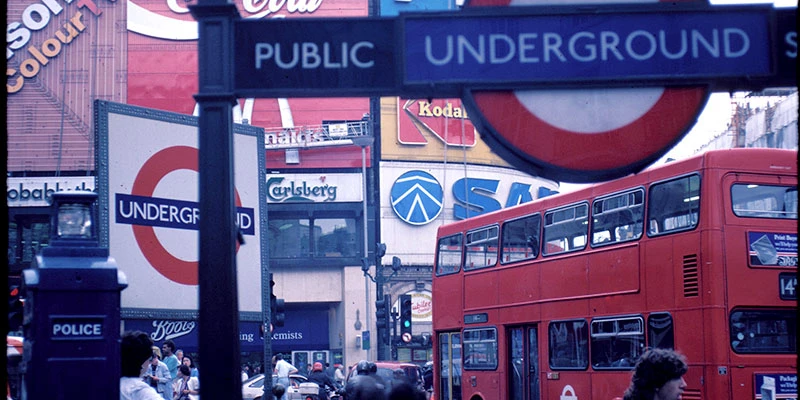
Next morning I head downtown for the two hour bus tour from Piccadily Circus. We get a native Londoner tour guide on this nice ride around in the double-decker red bus, providing an overview for the beginning of my stay here. Then I stroll to Regent Street, one of the two most-major shopping roads in town, for terrific window shopping and people watching. Fabulous people! I get some good photos of these interesting Brits walking past, most of them impeccably groomed, dressed much differently than anyone in Hawaii. Right away I am hit with the biggest surprise of the entire trip--these people in Europe look much different than Americans... a certain style that I never expected.
Nap time.
By 2:00 pm I am completely exhausted, still suffering severely from a jet lag that would stay with me five more days. It's a triple barrel assault on your energy, because you're quickly walking all over the town to see everything, plus not sleeping real well because of incredible culture shock excitement, and worst of all 2:00 pm here is really 2:00 am for my body. Snoresville for a couple hours then bounce up at six and go for another big show, this time try "Starlight Express," the number one hit of London. It's sold out for the next four months, so you figure keep the lucky streak going and try for standby. But, as the scalper points out, the long standby line isn't moving, so to see the show you pay the scalper. He hustles me through the door for a Great Show; thanks to friends back in Honolulu for urging me to see it. A play done on roller skates about the great race to find the fastest train, won by the underdog. Too bad there's a fat ugly lady, sniffling and coughing down my neck. I turn on her during intermission to tell her to blow her nose, and she fires back in ugly cockney "I've paid my bloody money just like you," but blows her nose and finally stops sniffling. Meanwhile I've been thinking how tired I am and how my resistance must be rock bottom to all these foreign bugs broadcast by lots of other coughers in the audience, but luckily during this whole trip I don't get sick at all, despite nose blowers around me at all times. Good night.
Wednesday morning, head for Ruislip, my old home town in the suburbs, taking the tube to the end of the line, then the double-decker bus through various neighborhoods and villages, going toward my old house, Little Manor Farm. Being there is like some fantasy brought back to life, confirming vague recollections from when I was seven years old there. Naturally the house seems smaller, but it's still a nice beautiful historic residence. I have fond memories of being in London in those early days with my big brother and parents.
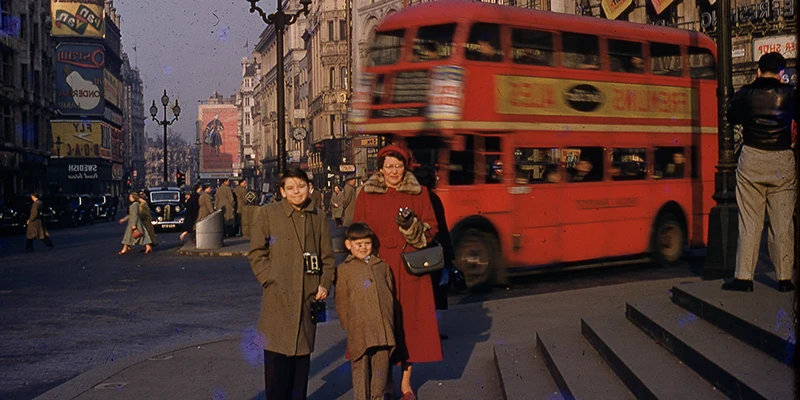
Got to get right back to town and change hotels since my b&b is booked up for the rest of the week. London is so vast it's a good idea to change hotels anyway to get a broader perspective on the place, so I head for Sussex Gardens near Piccadily Station on the recommendation of Frommer. Indeed many b&b's are concentrated here so I walk around for a half hour to find a decent room for $15, then head for the Tower of London, which is on everyone's list of the top five things to do here. Amazing, built by William the Conquerer around 1080. Eat and head for the theater, "Daisy Pulls it Off," hilarious British farce about triumphant underdog: snooty private school girls reject a poor scholarship student, until she becomes heroine, saving the school from bankruptcy, winning hockey games, tutoring friends, rescuing lost hikers, vindicating favorite teacher, etc, etc. My back row seat is very comfortable in this small theater, but I am so tired, struggling for consciousness, heavy eyelids, nodding head. Fresh air and coffee at intermission helps me fight it off. After the show I rally and head for a giant disco, The Hipodrome, filled with beautiful new wavers, big video screen, monster light show, run into TV reporter originally from Honolulu.
Out the door by seven Saturday morning for early walk to Edgewater Road, and a revealing chat with racist old newstand lady. As we talk a well-dressed black man comes along and buys a tabloid from her and walks on, "Shall I tell you something now my lord" she says, "see the kind of person they are." Dumb because he bought "The Star." Then she goes on about how the blacks are ruining England, when along comes this scruffy old white guy with baggy clothes and a three day stubble, buys "The Star," and she's friendly as could be. "Here's your change my lord." She tells me "he's a business gentleman," and inquires about his wife's health. "Are you with me now?" she keeps asking as she goes on and on about the undesireables taking over London. I get a smile for buying The Guardian, as I break away for breakfast.
Portobello Road on Saturday is the longest flea market in perhaps the whole world, going about four miles, starting in antiques, shifting to fruits and vegetables, then tools and hardware, then clothing and finally busted up old furniture and accessories. I walk the full length, buying a Swiss army knife.
And then, perhaps the most interesting afternoon of the entire six weeks--King's Road. Trendy new-wave people crowding the sidewalks in their flamboyant fashions, showing off their stuff. This is great. I shoot lots of pictures, which come out Ok, but cannot begin to capture the electric feeling of being here in one of the world's most contemporary scenes. It is so interesting I just can't get over it. The surrounding neighborhood is Chelsea, a very classy place steeped in literary history and Victorian architecture. Wouldn't it be nice to live in one of these lovely row-houses?
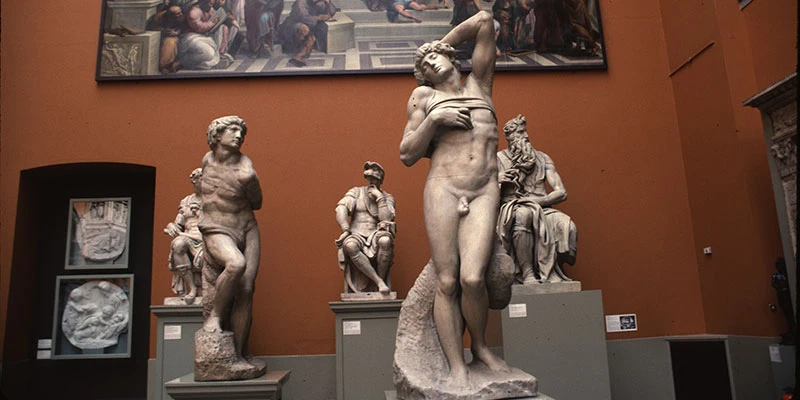
After a pub lunch .here of shepherd's pie and ale I take a long walk through South Kensington to the Victoria and Albert Museum--a treasury of sculpture, jewelry, glassware, and some painting masterpieces, especially the huge Raphael murals.
This place is big -- 6 miles of corridors through 10 acres of exhibits! I never even heard of this museum before. For me the most amazing room is the hall of giant statues, reproductions of the greatest works in Europe all in one gallery.
Once again I try unsuccessfully to get into "Cats," leaving me no time to get to another play so it's a good chance to go to the Museum Tavern that Joe liked so much he spent nearly every night in London there. Although I'm eager to meet some locals I end up speaking with some interesting American tourists from LA. and NY. One tells me "forget Brussels and go to Copenhagen, but I reject the advice. It's good to seek opinions on these things, but you've got to make up your own mind in the end. The New Yorker rents a nice studio in Flushing for $320, which sends my travel fantasies crashing and reeling back to possibilities of making it there, but no, let's stick with London for now. We all agree that London is better than NY or LA.
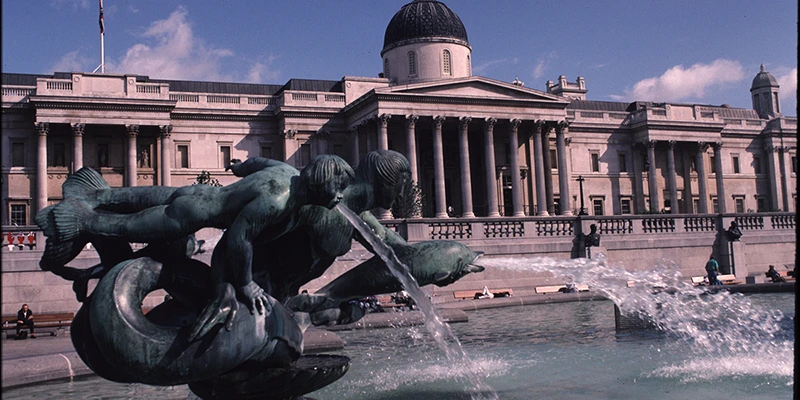
Why do we feel so strongly for London, you might wonder, and again we agree: "It's the people," she says. "They are the most polite considerate people I ever saw," the NYer adds. "London is definitely classier than LA. It's just incredible that the buildings are so old hut perfectly preserved," reports the West Coaster. After a couple hours of beer and talking I head home towards some fish'n chips and bedtime.
Mundane chores of traveling catch up with me already: the laundry. This Sunday morning I'm up so early the deli owner opens his laundromat especially for me, and I'm finished by 8:00 am. One of the few things happening at this hour is Madame Tausauds famous wax museum, so there I am right at the opening bell charging in with the crowd, having a great time meeting the royal family and many Hollywood stars, out by 10:30. Heading for my religious monument, the National Gallery, which I thought opened at noon but doesn't until 2:00pm, so I kill a couple hours walking around. I look for the "speaker's corner" of Hyde Park but end up in the wrong area. It is so cold and windy today I can't imagine any speakers out there anyway. I mean it is bitter cold, right here in the middle of April. Off to the top of the Hilton for a view that is rather bland, park on one side, low buildings on the other. They put on an elaborate expensive brunch which I only look at since mine was already covered back at the b&b, and they have a very elegant lobby, which I enjoy walking through and out the door back to reality. Heading back to the great art museum, I stop for another pub lunch of roast delicious chicken for some energy to power through these hallowed galleries.
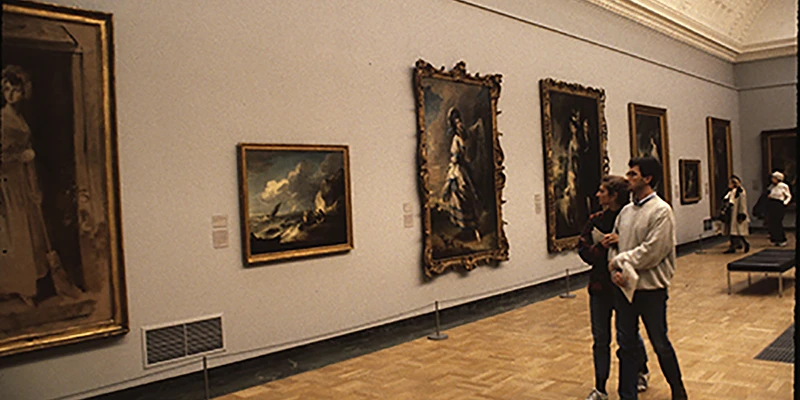
Now the National Gallery is finally open, with a long line to boot, but the wait has been well worth it for this is a truly magnificent museum, Leonardo, Michelangelo, Van Dyke, Rembrant, Van Eyke, some giant canvases 25 feet high, all the class painters, plus impressionists and some modern. It seems at least equal to America's three great museums, the Metropolitan, the National Gallery, and the Art Institute. I make it through in high speed in just over two hours... Iknowlknow that's a stupid short shrift to give such a major place, but there are too many places yet to see on this six week, no, now it's a five week trip...days are disappearing already. I'm paying attention, soaking as much in as I can, eyes wide open and thinking all the time. But now it's time for another museum.
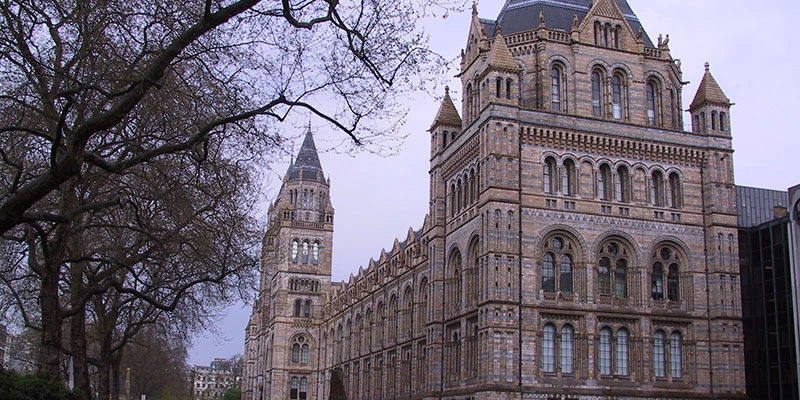
Stuffed animals and chunks of meteorite are OK stuff but I wasn't going to go out of my way to see them, until I noticed the outside of this amazing Natural History Museum. It looks like a mile-long castle, so I had to go inside to see how things were displayed, rather than what was displayed. The entry hall was immense and immediately made this stop worthwhile, but the rest of the museum was geared more for kids than me so I was gone in under one hour. Their best exhibit was the giant bug models, rich in gross details.
I get home at six only to find out I'm being evicted again, as the "regular business customers" have the rooms taken all week. This is good because my room had one disadvantage -- a sagging mattress so bad I had to put it on the floor. Despite the color TV and shower in the room, I am glad to move on, and a ten-minute walk in the neighborhood finds me a better place. Without a nap (this almost leads to disaster) I head straight out to the Royal Festival Hall at the Barbican to hear the London Symphony do Mahler. God I got so sleepy... I have never been this tired in public. The concert includes work by avant garde minimalist composers whose notes can be barely heard, as I am nodding off from total exhaustion….
Next morning is Monday and already I am in London longer than planned. There is so much to see and do here I end up staying for ten days instead of the five I had in mind, already busting my vague schedule in half at the first stop. Will I ever make it all the way through Europe? (YES).
London has about fifteen interesting "downtown" centers covering a vast area, filled with so many fascinating streets, shops, pubs, and places that even I could not begin to see it in five days.
Start out with a walk in Piccadilly Circus, and meet two blonde Swedish beauties, who say that no-one has been very friendly to them here. "Americans get special treatment 'cause they've got the dollars," she says. Oh, the sweet sorrow of meeting warm attractive people for ten minutes...you want to spend days together but separate destinations rip and squash those desires.
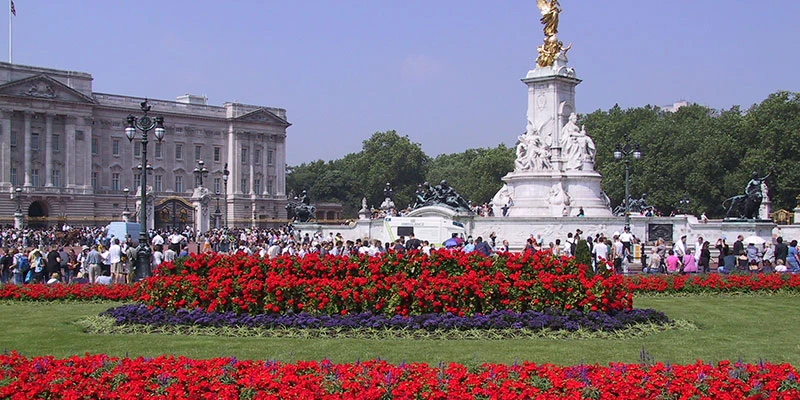
Been riding the double-decker bus a lot today, which is far more interesting and scenic, yet slower, than the tube. After one covers the essential sights of a place, you can relax a little more and just let the city roll past randomly. It's a good day for a walk in "the city," one square mile at the heart of town, along The Strand, down Fleet Street, past the elegant old Law Courts, pubs, shops, and St. Pauls Cathedral. Hop the bus to Buckingham Palace for the changing of the guards, pulling out a dog-eared newspaper clipping showing me were to stand for the best photo, which I get despite the rude gang of old French ladies who barge in front of me. Nearby St. James Park makes for a beautiful stroll, with its ponds, gliding geese, playing kids and nannies. Then on to yet another classy neighborhood, Pall Mall, complete with horse carriages, art galleries, palaces, embassies, and a shop with 300 kinds of cheese (you can smell them all). Aquascutum, a posh men's store, provides an amazing shopping experience, as eight different gentlemen clerks offer to help as I walk through the departments. Then I buy a pair of Clark's shoes at another Regent St. shop, but they still don't help my suffering feet.
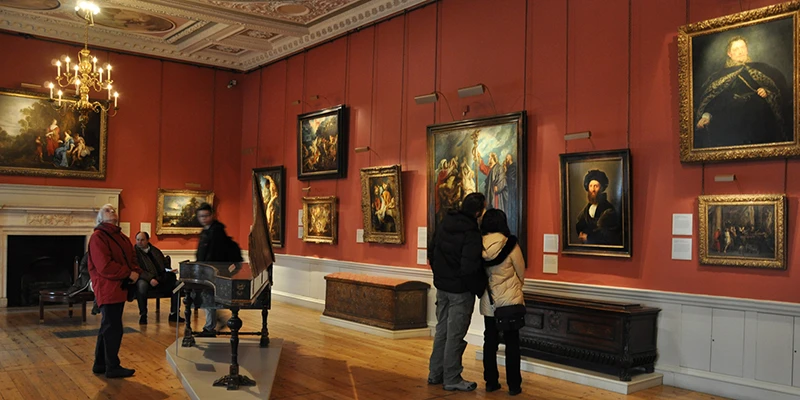
Lunch for one dollar at a deluxe sandwich shop in a Victorian arcade, then head for one of the small hidden treasures of town-- the Courtauld Institute Galleries. Although it has less than one hundred paintings on view, nearly every one is a masterpiece, especially the impressionist collection of Manet, Monet, Gaughin, Seurat and others. The space reminds one of four large rooms in a mansion, with comfortable furniture to relax on while enjoying the great art.
My seven day transit pass, which cost about $10, is paying for itself as I zigzag around town "by train and "bus to catch up with those little odds and ends I want to do, like seeing Harrods, the "world's greatest department store." Arriving just as a store closes could be frustrating, but I turn it to my advantage by enjoying the parade' of shoppers and clerks streaming out the doors, while vowing to get back here earlier tomorrow. Early evening is a great time for a stroll in the nearby mews and back streets of Knightsbridge, a very fashionable residential area that is amazingly quiet considering it is just blocks away from some of the busiest streets. These townhouses are in a ' nicer setting than the best parts of NY's Greenwhich Village. Cobblestone streets, lush little gardens, corner pubs with fires blazing, friendly hellos from passersby--this has to be as good as urban living can ever get.
Walking along I meet this sensual, well-dressed old lady and we chat a while about things, and she mentions her husband owns a theater, so I ask "what's a good play to catch?" She says "we usually don't care for Tommy Steele but his new play is marvelous. You should go." It's a musical comedy, "Singing in the Rain," after Gene Kelly's movie. I head straight for the theater and get a decent seat for $8, which get even better after intermission when I move up to the front rows. Somehow they make it rain indoors for that famous scene with the lampost, which is but one of many fascinating sets as the play goes from London high society to way out west in Hollywood, telling a story of the first talking pictures. The arrogant silent screen star is replaced by the innocent lovable young girl, who marries the hero and all ends well for everyone.
Finally I seem to be adjusting to jet lag, having been here a week, as I am able to enjoy the play without feeling tired. That delicious fish 'n chips dinner just before the show at the Stage Door Cafe around the corner helped keep the old energy up too. If I had only slept a little on the plane coming over it might not have taken seven days to adjust, but now my body feels normal and ready for five more- weeks of excitement.
Tuesday. This is the last full day in London so it's time to fill in a few gaps-starting back at Harrod's, especially since I just read .their news ad for "simply the finest walking shoes ever made," which I need desperately because my doggies are barking in pain, real pain, screaming agony, death on the hoof. I mean, it hurts.
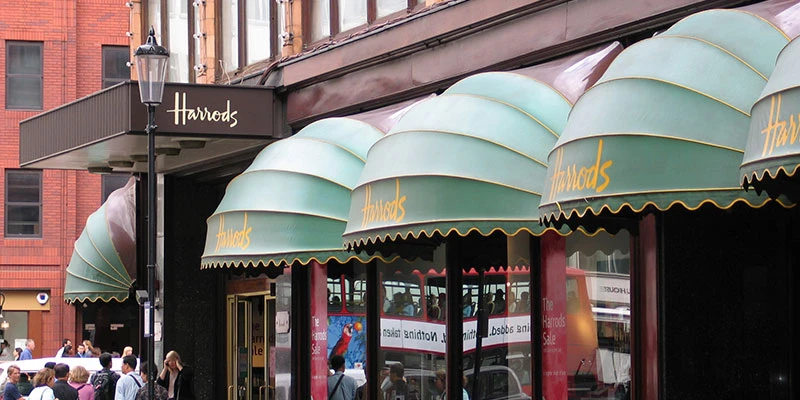
Yesterday I got here after they closed, today I'm at Harrods before they open, somehow coming full circle. Down the street is a decent espresso, cafe which keeps me quite satisfied with newspaper and muffins until opening time. Harrods seems nearly as big as Macy's, yet much nicer, especially in their famous food section which has all kinds of treats to eat on the spot. Stocking up on picnic supplies, I head for the shoe department and fall sucker to the hype for these "Mephisto" walkers, despite the idiot clerk who didn't know anything about them. It cost me $60 and turned into the biggest waste of money of the trip--a painful coup de grace for my dying feet. My journal says "I hope these shoes work out." Hah.' Famous last words. Anyway, I hobble along ignoring my feet, enjoying the wonderful shopping neighborhood around Harrods, filled with classic little boutiques and eateries.
Today I walk for miles, from one end of town to the other, through Mayfair, suggested to me yesterday by a pretty young lady on the bus, and well worth it. Mayfair is a very old part of this old town, with narrow crooked streets and hardly any traffic. A most incredible sight was rounding a corner past Dickensian buildings and seeing this group of elegant "r well-dressed fellows standing outside a pub, having their pints of bitters for lunch, with lots of friendly conversation. Continuing the walk, the long walk in my new shoes, I get to Oxford Street once again, filled with shoppers galore. It is real nice to go back a second time to such an interesting place, because then you're almost a regular and it really starts to s ink in.
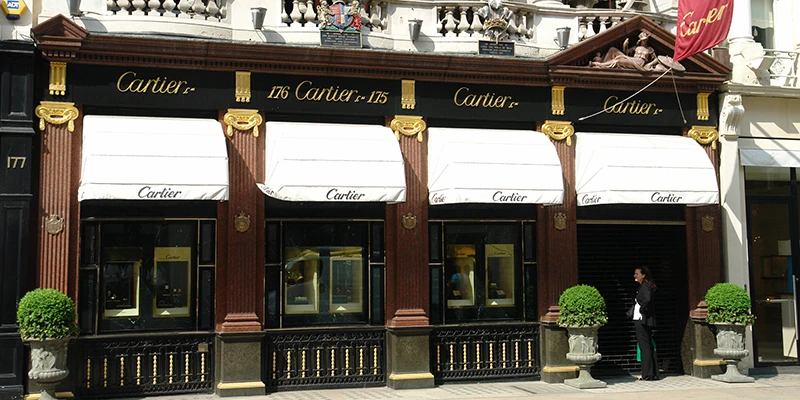
This leads me to Bond Street, which is the last major shopping area I have yet to explore. Very posh, Cartier, Polo, Hermes, Pateg Phillipe, and the Irish Tourist Board where I pick up some information--about the only thing I can afford on this street. I have a nice talk with two guys who are only too glad to stop their work digging up the sidewalk to gab with me for fifteen minutes. Super guys, one from East London, the other from Ireland, ripping up the paving to plant flowers. Back to Piccadilly Circus, heading towards Leicester Square to find Foyle's, the world's largest bookstore, but I end up in a kind of tenderloin district where I get several friendly offers. Instead, I browse in the bookstore where they have not one, not two, but three photo departments and similar coverage of all topics. The half-price ticket booth is nearby so I get a good seat for "No Sex Please, We're British," the world's longest running comedy. This town is filled with superlatives.
Before the show I have to dash home to get two packages in the mail, and what a hastle. By the time I find wrapping paper I'm in such a rush I end up doing the wrapping in the post office lobby, since they are about to close, and I forget my pen, and the paper doesn't quite fit the box. Finally I'm the last person there, with three clerks waiting for me so they can go home to the family--I hurriedly fill out the labels and pay the $28, but by the time I'm out of there I'm not even sure if the right address got on the packages. (It did. They arrive two months later, one box burst open but everything still inside.)
Cambridge and York
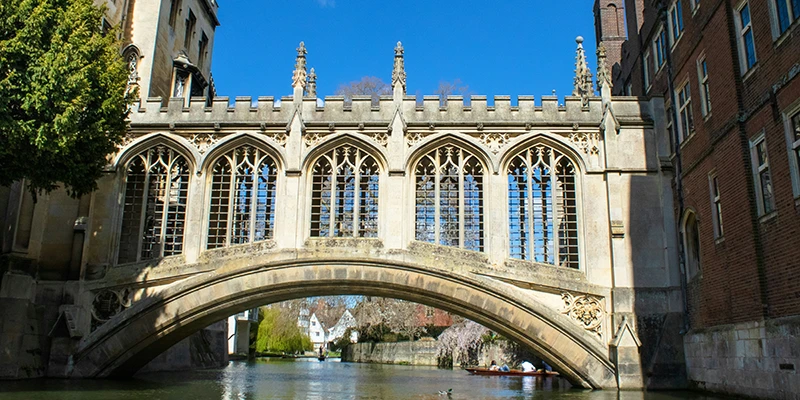
Finally, reluctantly, I say goodbye to London, catching the 8:30 train Wednesday morning from Liverpool Station heading north, to Cambridge, York, and Edinburgh. As a connoisseur of college campuses, I thoroughly enjoy seeing where it all began, on this 800-year-old commons at Cambridge. Some students are "punting," rowing their boats on a special little river next to the old stone quadrangles. I'm so happy being here, and glad the photos I take fully capture the peaceful feeling of this magical river. The gothic cathedral was built by Henry VIII and soars over the campus. Inside you can see why it is listed as one of the ten major churches in all Europe, with its acres of stained-glass windows and lofty fan vaulting holding up the ceiling. Cambridge town is charming, with many bicyclists, young and old, pedaling about on their daily rounds. True to medieval form, next to the town hall one finds the open-air marketplace selling clothes, books, carvings, produce, and hundreds more items, complete with old ladies milling about with their shopping bags.
Leaving Cambridge, I take the three-hour train ride north through pastoral landscape to the walled ancient town of York, a very old city indeed. I get a terrific first impression right at the train station, which is a huge masterpiece of Victorian steel architecture, and has a reception office with friendly ladies who find me an excellent inexpensive bed and breakfast room from their listings. As I step out of the station--there is the huge wall of the city with its embankment covered in millions of daffodils, their yellow elongated trumpets blowing in the wind. My first walled city! Narrow walk-ways lined with antique shops, crooked little streets, sagging timbered buildings, Roman ruins, Viking traditions, and lots of friendly people, including many British tourists. Lots of highlights here. I saw the Viking museum, complete with archaeological digs; had a nice talk with an anitque shop propietor who claims he taught Lord Tallyho Blears how to wrestle; fish'n chips dinner sitting next to an older couple from Kent, which they say is nicer and more historic than York, but they love Paris and Switzerland most of all.
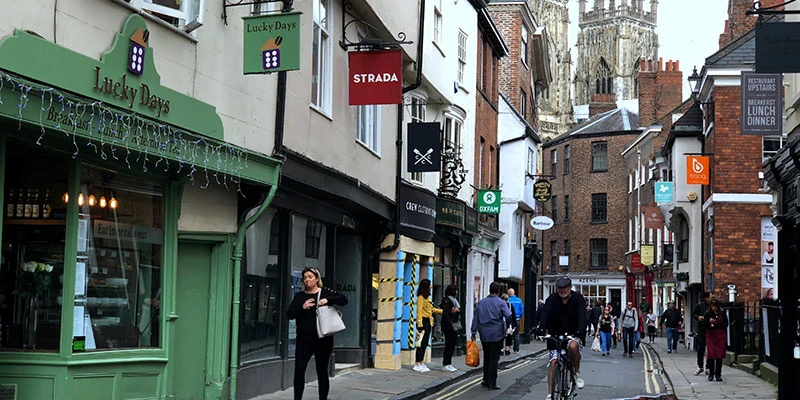
Perhaps the three most exciting attractions here are, the giant cathedral, second largest in Britain, splendid in its gothic details, and the castle museum, which takes you back in time as it re-creates street scenes complete with store-fronts and merchandise from hundreds of years ago, much like the total reconstructions inside the Smithsonian, and finally, the wall which goes for miles encircling the town, You can walk along it looking down into the charming town, which is in itself a huge open air museum.
That night I attend a Shakespeare play in a grey stone theater that actually dates back to the time of the bard. Small and cozy on the inside, this is the real stuff, a perfect setting for "Comedy of Errors." While following the action in this madcap tale of mixed identities in two sets of twins, I'm reminded of the Shakespeare-watching advice from the gentleman at dinner, "Just watch how they move in pantomime to follow the plot. Don't worry about understanding all the words" and yes, that does help a lot. During intermission I realize the glass- walled cafe has been built onto what was the outside of this
Eilzabethan-era theater, so that you get a close look at the gargoyles and masonary details of the structure, turning what had been an inacessible wall into a vertical sculpture.
After the show I walked several miles through the now- deserted town, continuing beyond the fortress ramparts towards my b&b. The neighborhood pub proved to be just as friendly as my host said it would be, for as I sat at my table enjoying a pint of Cameron bitters two chaps came over and asked to join me, so we talked for an hour. They are both educators and said the schools haven't gotten the finances they need. Both showed a great interest in the cost of living in America, and wages, and general state of the economy, so we compared prices. In York a one bedroom apartment rents for about $150 per month, or as they put it "twenty eight pounds a week," and wages for a retail shop manager are about $2.50 per hour, with a typical average income in York of $8,500. All in all it seems our economies are similar when you consider the lower costs here They also emphasized the contrasts between the poor north and wealthier south of England. "You must see the beautiful country side we have here in Yorkshire," the older man said, urging me to "drive west for an hour to the Lake District. It's the prettiest part of Britain." But alas, I have neither time nor auto. So close but too far away, as some of the limitations of my whirlwind trip come crashing down around my table in this charming pub. Since reading Wordsworth in high school I have always wanted to see the Lake District, "a few miles above Tintern Abbey," but I have other priorities this time, with my volition leading me to Scotland instead, and then on to Ireland, and then I have to get to the Continent, which is still the main goal of this journey. I have a long way to go.
The next morning I eat what turns out to be the best breakfast of the trip, the ultimate British country starter, with eggs, sausage, bacon, backed beans, toast, marmelade, ham, and tea, all included in the price of the $11.50 room. Town is an easy twenty minute stroll from here so I head iiV~to spend the morning walking these fascinating alleys once again, seeing different shops than yesterday, and even more historical exhibits. After a "ploughman's lunch," which turns out to be rather plain cheese, bread, and salad, washed down with potent mead at the Black Swan pub, I make ready to catch the afternoon train to Edinburgh, north to Scotland.
SCOTLAND
Edinburgh
Choo-chooing past more green fields with sheep, we get to Edinburgh just as the tourist office room-locator closes, and I feel helpless because I don't have any guide books for this town, which pervesely makes me appreciate my solid preperations for the rest of the destinations. All the shops are closing, and the only lodgings I can see from here are big expensive- looking hotels, when along comes this rather seedy character and offers to help me find a place. "No thanks" I proudly say and walk off rather indignantly, only to come crawling back 15 minutes later to ask if he still had something. "Certainly mate, just wait here with me for the proprietor to come along. He'll give you a ride in his station wagon," and now I'm wondering how far out of town this mystery man is going to take
Things turn out extremely well, for the driver shows up and gives me a small tour through town on the way to his nearby home, which has about ten guest rooms, easy walking distance from the town center, with breakfast, all for $12. I head right out that evening for my big night in Edinburgh, and quickly find the street with all the pubs. Glancing in several windows, I pick the most Victorian looking and dive in to mingle with the crowd, striking up a conversation with two local guys, one a city planner, the other a factory broker. Nice chaps with just what I wanted to hear, strong Scottish accents--they insist on buying me several rounds, on top of the two pints I had already put away. I tell them about Hawaii, and they speak with pride about Scotland, with its tradition of quality education, and new developments in high technology. By now I'm half in the bag and it's late, so I have a lovely wobble home walking for nearly an hour past more pubs, restaurants and hotels, until I finally reach what I thought was my guest house. I know I'm on the right block anyway, it looks like the right building, and my key fits the front door, but I can't seem to get into my room. I use the bathroom down the hall then try my key in several more rooms, confused in the dark, when a lady in curlers and bathrobe opens the door I'm fumbling with and says "you've got the wrong guest house, bud. 'That key looks like it belongs next door."
Startling news---puts me back on the street, where I try again. It turns out that when these little guest houses have no vacancies, they pull down their signs and disappear.' My key opens another front door, which this time leads to the right room where I have a good laugh at myself.
Up at 7:30 for a big breakfast and a walk to town for the 10:00 am bus tour. Seven of us are waiting on the double- decker machine looking forward to a quick drive through Edinburgh, when the driver tells us the tour is cancelled because not enough people have showed up J "Come back again this afternoon," he says. "Maybe we'll go then...."
No problem, there's plenty of other ways to explore this new place in what becomes a very long day, filled with discoveries. I head right for one of the main reasons I have come to Scotland, The National Gallery, a surprisingly important art museum which certainly lives up to the description in my pocket guide to the world's museums. It has the refined atmosphere one wants in a great institution, and among its many paintings four of them really stand out for me-a Turner seascape, which was until yesterday the world's most expensive painting; the prettiest Chinese-Tahitian face ever in a Gaughin; a perfect Constable, "The Yale of Denham"; and a gigantic watery "Niagra Falls" by my favorite 19th century American, Frederick Church, confirming my hunch that if any American were represented in Europe, it would be him. This is one of the few paintings by an American I find on the whole trip, which will eventually include visits to over 30 museums!
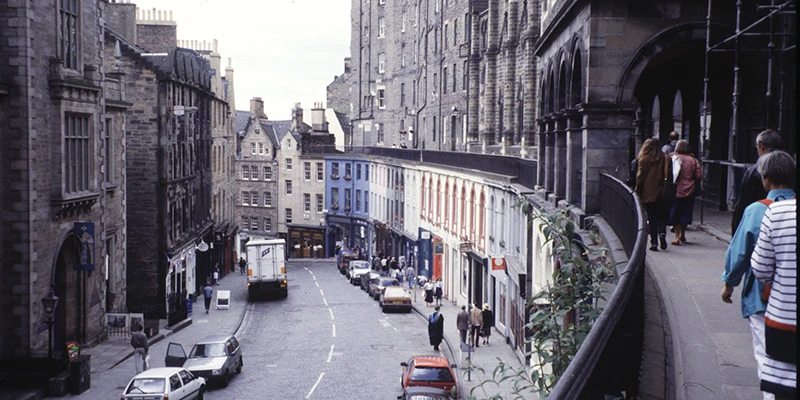
Most of this afternoon is spent walking around and getting slightly lost in the "back streets of this town. The guidebook leads me down streets which it says hold some of the world's finest Georgian architecture, "but it looks rather plain with flat facades of long row houses, fronted by iron fences and railings. Crossing the river by an interesting complex of old mill-workers housing being renovated into trendy condos, I enter a park that has no exit so must climb a big fence to get out. By now several hours have passed and I'm ready to try the bus tour again.
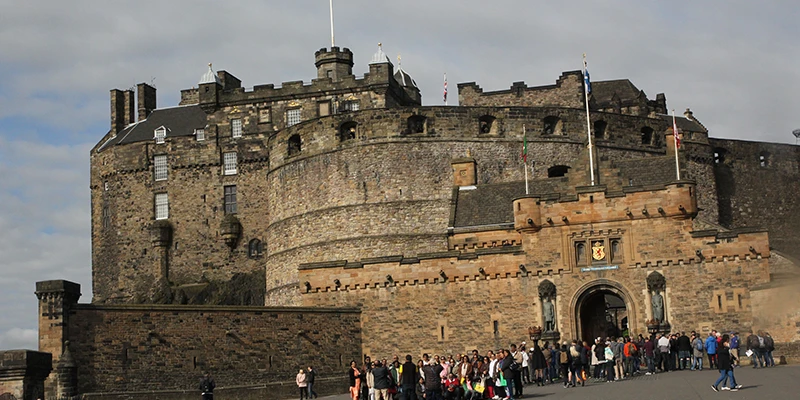
This time enough people show up so off we go, first stop the imposing castle up on the extinct volcano overlooking Edinburgh. Most of us are Americans, including a Jewish family with heavy NY accents sitting all around me. It's a little weird being back "in" the USA, but at least there are two good looking girls on board who I team up with for the rest of the day. The castle is quite fascinating, parts of it dating back 600 years, but disappointing to hear it was never used in battle even though it did change hands a dozen times. It's such a windy day that as we ride the "royal mile" from the castle to the palace we see a big postcard rack blow over and send hundreds of pictures flying through the air, with the clerk and pedestrians running around trying to catch them. Our guide walks us through the palace, with a few tales of regal intrigue, and that's the end of the "tour." Back in downtown, one of the girls and I decide to climb the monument to Sir Walter Scott, a gothic needle 200 feet high with a spiral staircase that gets so narrow I can barely squeeze-through it. The wind is blowing ten times harder up here, as I flash on images of me as a postcard blowing away, so we hang onto each other and get back down, which leads me to ask her to dinner. But no, she's got to get back to the college an hour's train ride away, where she says a popular dinner is to* tackle five potatoes and a little cheese.
I'm on an Italian food kick in this Scottish town. Last night I had pizza, Scottish style, served with a "large whole potato right in the middle and eaten with knife and fork. Delicious. Tonight it's lasagne, without potatoes, at a little restaurant in a neighborhood filled with eateries. The waiter looks Italian and the food tastes great with wine, for $7.
After dinner it is late enough to just walk home, since I have to get up early tomorrow to catch a train for Ireland, and I do not want to repeat my confused beer-soaked hunt for the right hotel. Sitting in my room, making notes in the journal, I hear what seems to be horses trotting past, clipity-clop on the cobble stones, but when I look out the window I see all that sound is coming from a few people, walking very fast. As I noticed in London and later in Ireland, walking is a basic means of transportation here, so people use their legs differently than Americans. As I listen to the rapid clicks of leather soles it occurs to me that life itself can be lived faster, fuller, just as these people are moving quicker than I ever imagined practical. Without going into a frenzy about it, one can do more if you push and move along, like those two punker chicks who zoomed past me back in the Baltimore airport and got me going quick enough to get my seat. My stream of thought is rooted in practical logistics, as I must wake up early for a big day that will take me from Scotland to England to Northern Ireland to Ireland, travelling by bus, train, snip, bus, train, bus, and yes, walking fast* getting me to Dublin just before the shops close.
One of the essentials I forgot to pack is a portable alarm clock, so I end up tossing and turning, waking nearly every hour, worried about catching the 7:00 am train which is mandatory for the day's extensive schedule. In one troubled dream, I find myself back home already with the vacation over.1 What a disappointment, but how nice to awaken and find I still have one month to go. The toss and turn "technique" is effective, anyway, getting me up at 5:00am. Waiting at the bus stop in front of the b&b for a 20-pence ride to the train station, I notice it is much warmer than yesterday, although they say it snowed here two weeks ago. Northern British weather.
It's a three hour train ride through green rolling hills to the ferry landing, including a change of train stations in Glasgow where I get to walk for a quick half mile through the heart of town. Without being too judgemental on this early Saturday whistle-stop, Glasgow does seem to be as undistinguished and industrialized as the proud Edinburgh natives described it.
IRELAND
Anxiety, terror, oppression. The evil spirit of British occupation in Northern Ireland is manifest on the ferry ride across the Irish Sea, for this ship is bursting with 1,000 commandoes in full battle gear, back-packs and rifles strewn everywhere, smoke hanging thick in the air, absolutely nowhere for me to sit, a line of 3°0 waiting for chow. I feel like I've been inducted into an invasion of poor old mother Ireland. This is disgusting, but at least the upstairs lounge is relatively vermin-free, since it's a non-smoking area. Escaping the rubber bullets, I put on the walkman--armed with Puzo's "Godfather," the three hour ride passes quickly across smooth seas.
The Irish reputation for perplexity comes true as soon as I get off the ship looking for my luggage. Four different agents and constables give me conflicting directions, but I find the bags anyway and hop the shuttle bus for the Belfast train station. The city is vibrant with Saturday shoppers, allaying my shipboard apprehensions.
Dublin
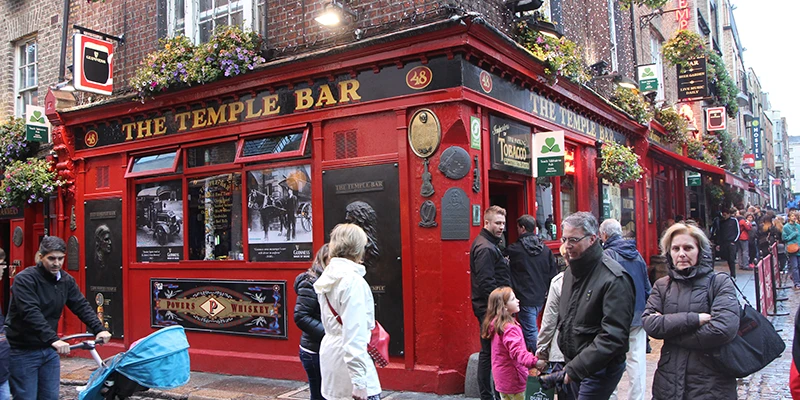
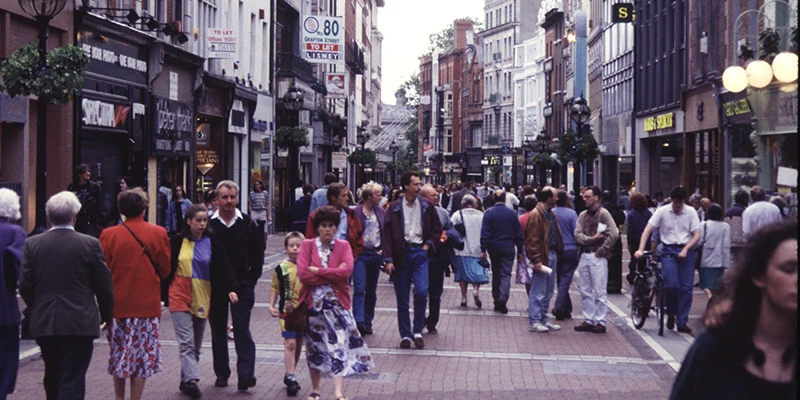
Dublin! Back to my roots! Right away a seedy taxi driver is trying to hustle me to a hotel near the train station in what turns out to be the worst part of town, but I politely turn him down and get on the phone to Mrs. O'Brien's guest house, one of the nicer-sounding listings in the "Let's Go" guidebook. "Yes" she says, "I'd love to have you come over. It's just a twenty minute bus ride from O'Connell Street." I get the directions and walk along a cluttered street with a lovely lass, who warns me, "I hate to say it about my country, but you've got to watch out for thieves, especially in this lousy neighborhood" where the taxi driver was sending me. In minutes I'm at the bustling heart of downtown Dublin at rush hour on the attractive O'Connell Street, one of the widest boulevards in Europe. An extremely friendly shopkeeper changes some of my British pounds to Irish (they call them "punts") and I have a nice talk with a lady at the bus queue, giving me a feeling already for that world-famous Irish trait--hospitality.
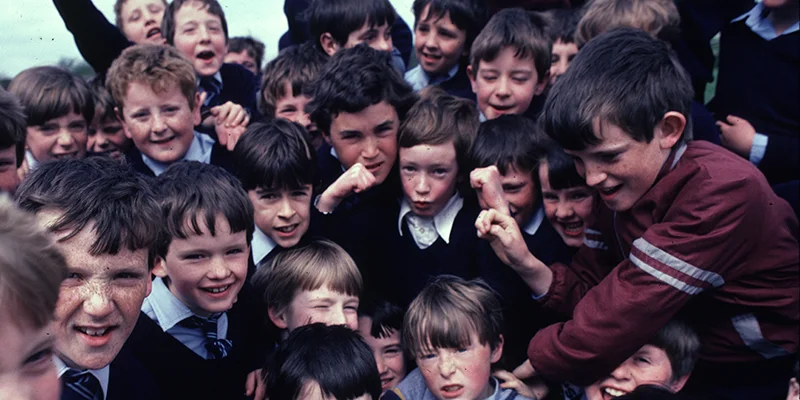
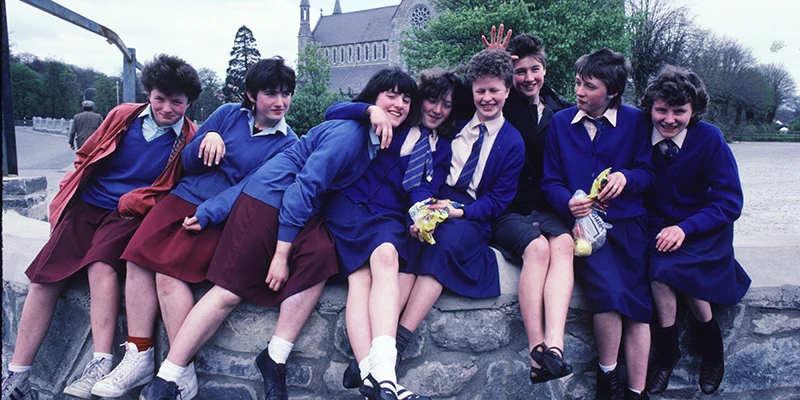
I ran into some energetic young lads happy to say hello in a big way. Indeed, I find that in all of my travels, Ireland does turn out to be the friendliest place I've ever been. Perhaps its because there is not a whole lot of other things to do in this simple land except enjoy and appreciate other people. Friendly girls were happy to greet me, dressed for school wearing jackets, ties and skirts.
Mrs. O'Brien is a quiet, but warm and gracious lady, who's guest house is in a peaceful neighborhood of row houses, called Rathmire, with six pubs in walking distance. I eagerly set out in search of my first true Guiness, going into this pub packed with young people in their 20's, and order the long-sought pint, They draw it slowly and let the head settle for a minute before filling the glass with this incredibly thick rich brown treasure. "You can only get the real Guiness right here in Dublin," the old man at the bar tells me, his eyes lighting up as I explain this is my first sip of the god's nectar. Ahhhhh...what deep flavor...what creamy texture! I drink it down and order another.
Meanwhile, I look around the crowded bar and notice I'm the only guy wearing a tie. In Britain, the men wore ties nearly all the time, and so did I--but Ireland is far more casual, almost sloppy. So I yankoff the tie and dive into mingling with two attractive girls at a small table, but after a short chat they split. I hang around for one more pint, then take a walk along the village's commercial strip, past more pubs, cafes, grocers, McDonalds and Wendys, newstands and no shortage of pedestrians on this lively Saturday night. One more Guiness gets me home as I reflect upon what a great tragedy it is that America, except for a few classy bars in major cities, does not have this brew on tap, so different from the watered-down bottled version we find in supermarket shelves.
A nice big Irish breakfast of eggs, sausage, ham, toast, porridge, and coffee, in Mrs O'Brien's kitchen where I seem to be the only guest in her house. This was a splendid deal for $10. My head is not even foggy from all those Guinesses last night, so I'm loaded with energy, ready to see Dublin. After dropping off the luggage at the train station, I board the city bus and come upon a funny, typically Irish scene: the bus driver's eight year old son is sitting behind the wheel, gunning the engine while the bus is waiting, opening and closing the power doors as quickly as he could, turning on the wipers and signals, spinning the steering wheel, and bouncing madly up and down on the seat, his daddy smiling with pride. He takes over and we head for town, while this old lady in front talks non-stop to the conductor about her medical misfortunes, spiced with some gossip about another driver's wife.
Sunday morning is the worst time to see Dublin, since everything is shut down except the one fancy hotel and a few newstands. I need a camera battery immediately, and follow a trail of leads to an old chemist, who rummages around in a deep musty drawer and apologizes for not having them,but then I spot a pack of just the right kind. What luck, back into photo-action: I head for the Municipal Art Gallery (at least all the museums are open today). Many of their paintings have no labels at all. You have to read the oil signatures on the canvas to find out who painted them! They do have some very nice stuff--Monet's "Waterloo Bridge," Degas, many Corot's, small Constables, Manet, a grand Renoir with paint peeling off the walls around it, and some contemporaries.
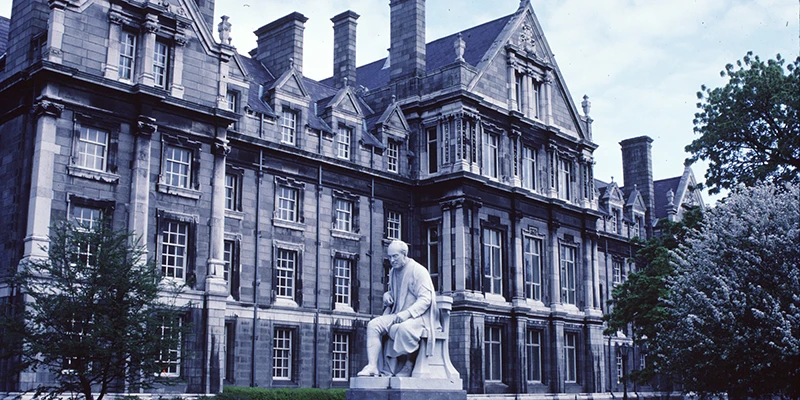
O'Connell Street is quiet today as I walk its full length through town to Trinity College, a slightly grimy but impressive collection of old grey classic architecture. This campus, along with the Post Office, the Bank, and the Parliament are among the few notable structures in town, including also my next destination, the National Gallery.- This holds a fairly large collection in a wonderful building, but unfortunately the British rooms are all closed for renovation, and a splendid little gallery for modern painting is shut so a movie crew can do some filming, but I get in anyway for a quick look, on my way to the cafe. Lunch is delicious beef goulash, washed down by red wine, in a wonderful art-garden setting. Then it's time for a quick walk through the other galleries, which hold mostly big old Italian paintings, on my way to the old museum next door, the Museum of Anitquities. It is really just one big room, with mezzanine, containing a lot of good old archaeology: Celtic crosses and gold jewelry, Neolithic stone molds for iron works, earlier flaked stone hand axes, and more recent jewelry and glassware. Next stop, the Dublin Castle (closed), the oldest building in town. Past a photo gallery,looking for The Brazen- head Inn, the oldest bar,in. Ireland. This place is hard to find. Even some locals I ask don't know where it is, but I finally get there and enter a charming scene, complete with a fiddler and a mandolin player. It's a small dark room, holding maybe 25 people, walls covered in recent posters and announcements of concerts and boxing matches. The barkeep claims this room is 400 years old, although I later read it is "only" 30° years since the first malt was poured here. The two college girls seem reluctant for a moment to have this American join them, but we quickly get friendly and have close conversation for an hour. One reminds me of my Boston cousin Arlene, and she suggests that "perhaps we're all related." Comes time to break up our huddle and catch the train to Kilarney, so they decide to walk the mile with me to the train station and kiss me goodbye.
Kilarney
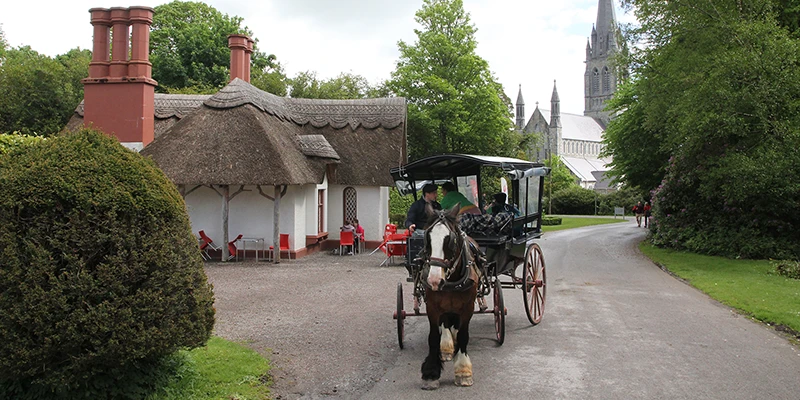
The slow train takes a long four hours to reach this legendary lake country. Three old geezers pull out bottle after bottle of Guiness from their baggy overcoats, gabbing away, burning a pack of cigarettes in this non-smoking Irish coach. As we pull into Kilarney at 11pm, everyone gets off and fills the platform with commotion, greeted by family and friends- then suddenly--they vanish into a black void, leaving me stranded, alone. In this disorienting quiet darkness, the town seems many miles away, although I later discover it is just 100 yards down the road. The friendly young stationmaster offers to help find lodgings for this solitary traveller, who is thrilled by such hospitable goodwill. But, several calls on the official black phone produce no results.
I thought I had no guidebook on Kilarney, but now start - digging around in my travel files and discover on the end of a Dublin page in "Europe on $25 a Day" the following Kilarney teaser: "The most delightful stay I had in any pension or hotel in Europe was at the Aisling House (phone 064-31112) on Countess Road, which runs parallel to the train station, but," and there it ended, my one hope for telephone reservations. So of course I borrow the official black phone and make the call, approaching midnight. She answers in a cheery brogue and says "Yes, we have room, and it's just ten minutes walk from the station on the other side of town, come on over," happy greetings. It's an Irish 10 minutes which means 25 on my watch, but soon enough I arrive and hit the sack. Only ten bucks a night.
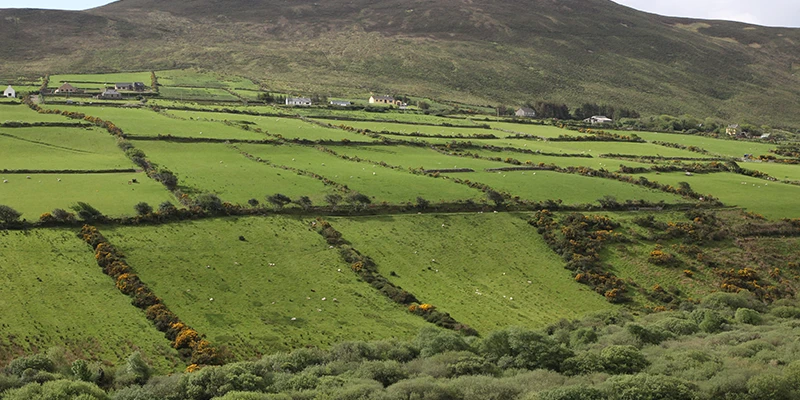
Up to a delicious Irish breakfast at the Aisling House, and a nice talk with a teacher lady and an elderly gent in residence here, where I get filled in on some local stories. Then I spend seven hours on the "Ring of Kerry" tour in a small van with eight other friendly tourists, including a couple from Long Island. This passenger sat in the front seat next to the lively driver, getting the best views and lots of extra conversation with the guide. Our tour brings us through five little villages, one of which has a busy cattle sale going on, with lots of flea market booths and hundreds of people milling about, offering a great place for lunch, but no, remember we are on. a guided tour and must move on to the pre-arranged semi-rip-off cafe for stale sandwiches. The rest of our ride is quite nice, passing through green fields bounded by endless stone walls, stopping at a sandy shore of the Atlantic, noticing the original houses of "The Wild Colonial Boy," and the great patriot, 0'Connel. A fine ride indeed.
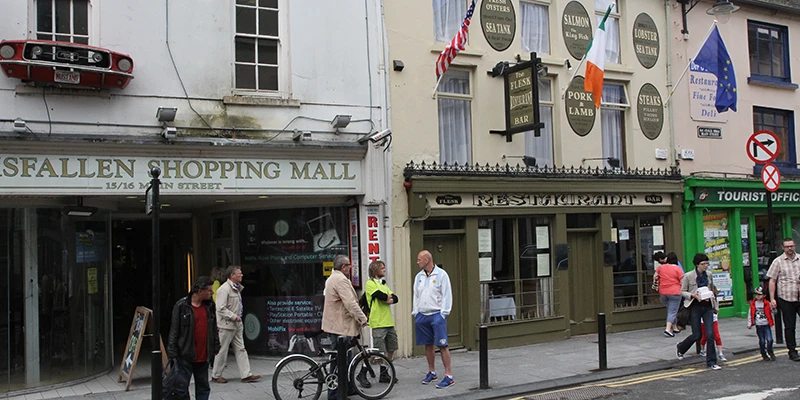
After the van tour I decide it's finally time to fix my feet by purchasing a pair of running shoes from the local sporting goods shop on the second floor. Immediately the feet feel rescued. Like a fool, and despite advice from friends at home, I had "been avoiding running shoes in hopes of feeling well-dressed, '.and not looking like a tacky American tourist. But when you are walking ten hours a day, often carrying heavy weights, this is the only way to fly. Now the paws are' floating on Adidas clouds, ready to charge into the next month with new gusto.
Despite these super-feet, I figure the best way to see this area, with it's spectacular lakes and forests, is to rent a bicycle. Peddling along I begin to feel like a native in this two-wheeled community, navigating the narrow roads, swerving around the constantly double-parked trucks, and covering five times the distance I could handle on foot. Cycle home for a delicious fresh salmon dinner, but expensive at $15, then after a rest roll back into town covering the mile this time in just minutes, searching for traditional Irish folk music.
Sleepy little Kilarney surprises me with a fascinating night in the front rooms and back rooms of Danny Man's pub. A. young electric trio is making a passable stab at folk music in the bar, which has about twenty people in a room for 130. Passing up the empty tables, I sit down right next to two good looking ladies who are a bit cool and defensive, but open right up in a warm funny conversation as we laugh about Ireland together. They are tourists from Connecticut, surprisingly, mother and daughter, even though they look about the same juicy age. I buy them a couple moE beers and we crack up again about the Irish and their quaint ways. When they leave some local lads call me over to the bar, real eager to talk with me, super friendly guys. But I can hardly understand them-Kilarney has the most amazing way of talking. They speak in a rapid sing-song chatter, which is quite melodious but, oh!-hard to follow. "It's not really English" said our van driver earlier today, "maybe it's got remnants of the gaelic." This is a grand priceless experience, talking through a dense linguistic web, communicating over pints of Guiness. They wouldn't let me pay for anything as the rounds keep coming. We talk about politics, about the surrounding towns, and about Hawaii, which they seem to be very interested in. Closing time arrives and we are politely shouted out the door by the barkeep, but just as this front room closes, the back room opens.
It's a disco, packed with Irish youth. Even in the dim light these celtic faces look quite white. True to the fashion of this rural island, the clothing is very plain, slightly baggy, frumpy. Except for two or three, the girls in this pulsating room tonight are sweet country girls. This town is full of them. Funny thing about the bar service on this Sunday night: no drinks are served after 11pm, but then the bar re-opens on "Monday," that is, midnight, whereupon there is a big crush of bodies five-deep waiting for those mugs to fill very slowly with the brown gold. I drink mine and head home.
This morning I tried calling the Irish Ferry to confirm that they have a boat tomorrow leaving for France, but they don't answer the phone: A small travel agency in Kilarney assures me the boat will sail as scheduled. I won't believe it until I get there.
Well, this is the last day for Kilarney, a time to relax and pedal around to see the area, but first I need to do the laundry. The town's one laundromat has been closed for the last two days, and now when I get there at opening I find the owner is using every single machine for a hotel job. He makes room for me, I finish up, and poke around town on my handy bicycle. The cathedral, old buildings, cute houses, and back alleys keep me fascinated, but I'm kind of biding time 'till noon so I can try and photgraph these adorable little Irish kids during their recess. Pedalling to the school near my b&b at noon, I feel a bit shy about approaching this gang of twelve year olds running around the yard, but as soon as they see my camera they take over-charge I am nearly trampled as the boys each push to get in front for the picture, going into a frenzy--piling on top of each other, with crushed little guys crying on the bottom. After I fire off 30 quick shots, some of which turn out to be my favorites of the trip, the boys settle down and huddle all around me filled with'friendly questions. "Where are you from? Do they break-dance in Hawaii? Do they do head spins in Hawaii? Do you have children?" On and on, curious as could be. As I pedal away five of the lads run along with me to see rce out the gate, waving and yelling goodbye. What a touching scene. I want to stay forever.
The Old Kentucky restaurant in the middle of town is filled with lunch customers, all with strong local accents, so this is definitely the place to eat. I'm served a gigantic portion of corned beef, with turnip greens, and three.' big potatoes, washed down of course by Guiness . Fortified, I'm ready to begin the day's major event, a pedal to the lake.
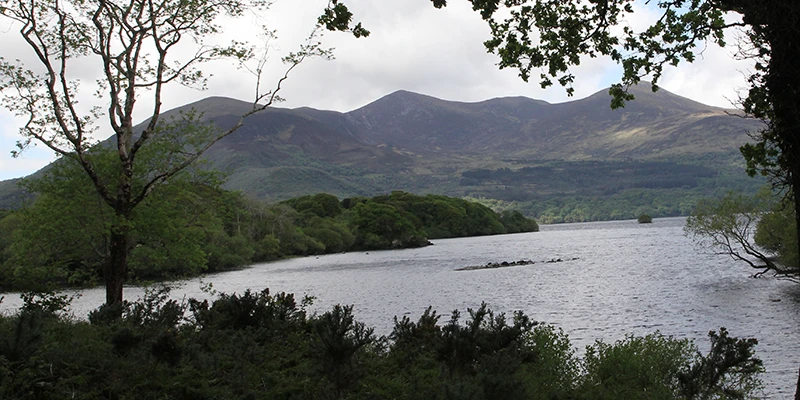
The upper, middle, and lower lakes of Kilarney are so gorgeous that people come here from around the world to get a glimpse. Surrounded by green fields and forests, it is quite and tranquil. No cars are allowed on this little path reserved especially for the horse-drawn jaunting carts, but today it's just me and my bicycle out in this neck of the woods. I wish there was a full day to ride the full 26 miles around the middle lake. Instead, the Muckross House awaits me, standing above the lake with its pretty red and yellow tulip gardens, and historic collection inside of the life of Kilarney over these past thousand years. Nearby I find the haunting ruins of a 15th century abbey, it's gothic arches and courtyard intact but most of the roof gone. Narrow stone-lined halls and spiral stairs lead to small, dark musty rooms, used by medieval monks before America was discovered (by the Irish of course). I was hoping to see many ancient ruins of castles and churches in Ireland, but this is the only one I get to, so it is very satisfying to be sitting here, quietly contemplating ancient history.
A quick pedal brings me to the scenic Lake Hotel, on my way back to town where I must pick up a jacket from the cleaners and return this bicycle, in a rush, because if the cleaners close I either abandon the jacket or wait three more days for the next boat to France. Well, the cleaners are open, but the post office isn't, so I'm dragging this giant package all over town for nothing. The wonderful owner of my b&b offers to take the package in tomorrow for me after I leave, but who knows how much postage is needed, so I end up carrying this box all the way to Dublin.
This is my last night in Kilarney, and it turns into a good one, starting with a movie, which I would normally never waste time at while travelling, but this one is special--"The DaWn." It was filmed here in Kilarney back in 1935 starring local residents, all of whose relatives seem to be packed into this small movie house, "ah look, Sarah, thar's me daddie oop thar." Considering this was one of the first talkies ever made, with all amateur actors, it told a fairly plausible story of love and deception during the historic rebellion, where the apparent traitor is revealed to be a great hero. Before the show began, this audience patiently sat through forty minutes of commercials! Every product and service within fifty miles must have been advertised up on that screen, in an eternal series of crude still photographs with what sounded like the same narrator for all of them. One bright spot was the twenty minute ad for Guiness, which was the documentary shown in the tour I missed of the Guiness Brewery. Significa: along with being the most popular product, they are the largest employer in Ireland.
One terrific national thirst gets whetted every night at the local pub, which I find bursting with animated conversation in this incredible local dialect. The three lads I join for an hour's talk are here for the lambing seasons--"the little bastards" they complain, twisting what had been my image of cute fluffballs of sheer innocence in the hills. These guys, from Dublin, London, and Cork, are a lot of fun--smart working class chaps who have done lots of travelling and seen most of Europe. It's heartening to know they can hardly understand this rapid-fire sing-song local accent either. The well-dressed crowd in this classic pub leaves me with a wonderful last impression of Kilarney.
My friendly b&b lady gets up an hour early so that she can make me another giant breakfast and then drive me to the train station! I feel like I arrived in Kilarney as a pauper in the middle of the night, and now am leaving as a king with his own chariot and retinue. Come as a stranger, leave as one of the family. I really could see spending one's entire life right there at Aisling House, the best b&b of the trip. Two of the guests seem to be doing just that: one an elderly gent who filled me in on places to see, the other an attractive teacher who I hoped to see more of after that first breakfast together, but never saw again.
It's the start of a big day--and a fine clear morning it is here at the Kilarney train station, waiting to catch a six hour ride via Dublin to the ferry landing for the boat to France. A group of thirty local high school kids shares the platform with me, talking incomprehensibly in thick accent about their one-day excursion to Dublin. This train backs (!) into the station, we clamber onto the crowded carriage, and chug along.
The empty seat next to me is quickly filled at the next station by a tall elderly Irish gent. As he squeezed in, I foolishly thought "oh rats there goes the space," but then we got to talking and had a wonderful chat. He's a friendly warm typical Irishman, telling me about the most scenic areas of the country. "Aye lad, Galway's the finest. Ye moost git thar soom daiy," in his thick but understandable Tipperary accent. "Oh, boot son, oy looves ta listen ta Americans tawkin. They speek. The feeling is mutual as I thoroughly enjoy his lovely brogue.
So, the train took me on a big dog-leg back to Dublin, doubling the length of the trip to Rosslaire for the ferry to France. The bonus is a two hour stopover for lunch in a busier sunny Dublin, streets filled with the noontime shopping crowd. Irish stew for lunch, too bad mutton's not yet in season, then on to the streets for 20 minutes of good people pics, buy a couple Irish tapes, and walk back to Connoly Station for the three hour ride to the ferry. I'm still kind of wondering if the boat is really there, but there's a hundred other ferry- seekers on board so it's looking good.
Yes, we get to the docks and there it is, big as an ocean liner--everyone scrambles on and in no time we are steaming away across the channel. The ship is quite nice, about 2/3 the size of our Independence, built to hold 1,800 passengers, but there's only 100 of us aboard so we all have lots of room and no lines. The ticket's included in my Eurorail pass, and for only more I get a cabin, which is going to come in handy since this is a 24 hour boat ride! ! ! It will take as long as flying half way around the world, giving me a handy time to catch up on rest with the best night's sleep yet. There's also some good activities on board, like Karen, a cute semi-hippie American.
She's going to marry Herman the German. "We've been living in a little town in the south of Ireland for a year, making native crafts, knitting and pottery mostly," she says, happy to be living here.
The pub is by far the most popular activity--a final round of Irish drinking complete of course with the dark nectar, capital G. About half the passengers are hanging out here, leaving the, yes, disco, completely silent and empty. "Police Academy" is playing at the box office, a total riot which I'd never seen, and then for dinner I decided to splurge and have the monster buffet, five kinds of fish, salad, meat, chicken, etc., wine, desert, etc...for $15 well spent. All of which brought on the sleep of the briny deep.
PART II: THE CONTINENT
FRANCE
Normandy and Rouen
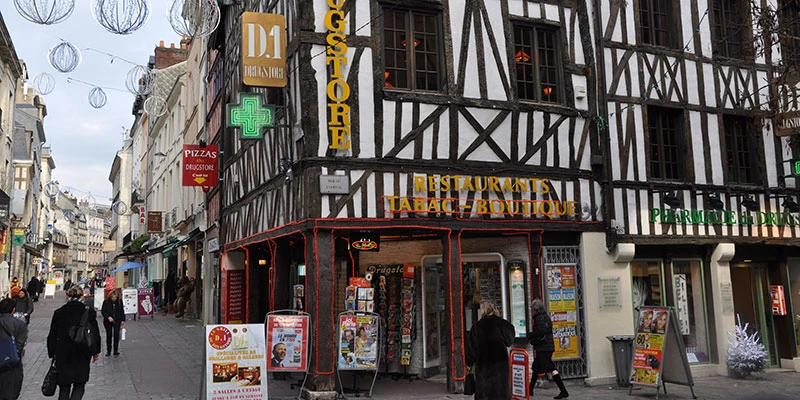
I have a great awakening, in total darkness floating with no idea of what the time is, and just as I open my cabin door a loudspeaker voice says "good morning, breakfast now being served in the dining room." This early start gets me into the showers first and up and about the decks. Little do I realize how this fine morning will lead into a near disaster tonight in Paris.
We dock in the afternoon at LeHavre, a crowded harbor with miles of huge drydocks, activity everywhere. Grand feeling to stand on the Continent! Bus takes us to train station, I rush down my first French street to change money at the bank before a three-hour ride to Paris, jogging to beat the closing hour.
The comfortable train zips through rolling farmlands and little cities as the light fades into night--and still I don't suspect the difficulties waiting for me in Paris. I have my list of accomodations, so what could go wrong?
But, the problem is, as I discover when I get there, is, you see, well, there are no hotel rooms available in the whole darn city. Whoops! I call about 30 places to learn my first French word, "complet," no vacancy. OK, so I walk around the neighborhood of the St. Lazare train station, ready to pay any price for a stupid room, three star, four star, who cares! "Complet." The lady at the tourist office tells me over the phone to "leave Paree! -- "There are no wrooms ahnyweah tonaght! " Every place is full, and it's getting late as I sit here at the train station cafe, disappointed at my first exprience in France, wondering where to go. "There ees no wroom at anee pwice."
One of the ticket clerks speaks a fraction of english, and suggests I go to Rouen, the nearest city, about 90 minutes back along the way I just came. There's only one more train there tonight, leaving in about five minutes, so without thinking I rush on board. Where am I going? The businessman in my compartment assures me "you weel 'av a wroom in Rouen tonight." Famous last words. I get a sinking feeling as I leave the Rouen train station, because they lock it behind me, no more trains out tonight. It's almost midnight. There are three small hotels right here on the main square so I march right around and find they too are yes, complet. Oh oh! The only place open is a cafe so there I go, but no-one speaks any English. They do seem interested in this homeless creature who has washed up on their stoop, perhaps, these natives might be friendly.
A busboy knows just barely enough english to figure out my predicament, and spreads the word to the bartender, who gets right on the telephone to help me find a place. Astounding helpfullness! This fellow's attitude was so good it permanently wiped out my bias about French rudeness, which of course does exist but not here. However, my hopes begin sinking again, for nice as he is there are still no rooms to be found. Really, he calls about a dozen places for me during the next twenty minutes as I sit with visions of finding a park bench to crawl under. He keeps calling, calling, and then it happens--a room, a taxi driver at the end of the bar, a very fast race through a darkened deserted city, and voilla! a charming room above a bistro, the end of a very long day. Major adventure.
Totally exhausted, I fall into a deep warm sleep, wrapped in this comfortable bed in Normandy...deep...sleep. But then! The tensions of the day reach into my slumber with not one, but two nightmares!
Two strange dreams about heights: first, I'm walking along the outside corridor, up in a low-rent Hawaiian highrise, when a vicious ugly pit bull terrier rushes out of a door and attacks me, almost pushing me over the railing, which has been greased by his malicious saliva. A Hawaiian family steps in to save me, but they too have a dog, ten feet tall. Tossing and turning, I shift into another dream where I'm walking along on some kind of elevated sidewalk with a large rush-hour crowd, when I turn the corner and find the sidewalk has become a narrow tightrope. There is no turning back, since the crowd is pushing along behind me, but all of a sudden I'm holding onto a small magical bag, which is making a whizzing sound and contains some strange shells and metal scraps. The mana of this bag gets me through the tight spot in good shape.
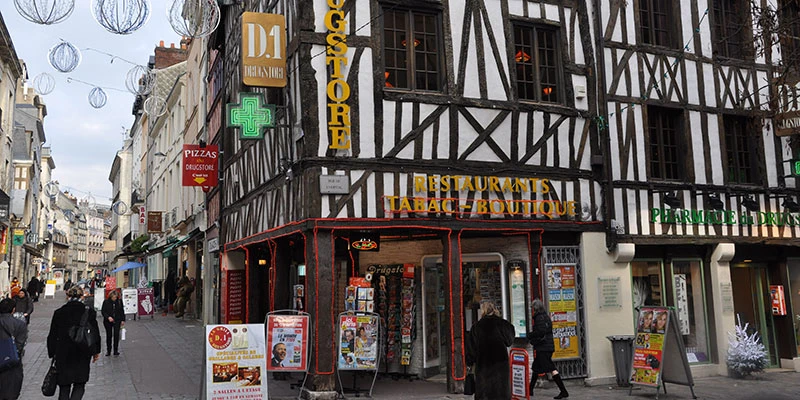
Waking early from these bizarre messages, and jumping out of bed before any more hit me, I decide to head into the town of Rouen and have a look around. Yesterday's near-disaster becomes today's serendipity, as Rouen turns out to be a very fascinating place, "the city of art treasures" filled with France's biggest concentrations of medieval timber-framed buildings, and several of the most important Gothic cathedrals.
The bus stop is just across the street from the hotel, but of course the directions are in french and no-one speaks English, so I just hop on the first bus that comes along without knowing exactly where it is going. Luckily it goes right into the town center, where I hop off and make note of the bus number and street names, so I can find my way back home on the bus later.
It's about eight in the morning, nice and early, which gives me the chance to walk around and watch the town come to life as the shopworkers lift the shutters and sweep the walks. A cool clean morning, wandering through narrow alleys lined with ancient half-timbered buildings. I cover the town center in about three hours--visiting the Joan of Arc Monument, where she was burned at the stake--the famous clock tower which straddles the wonderful pedestrian mall--the cathedral, painted . many times by Monet--the St. Maclou Church, built in the peak of Flamboyant Gothic style--the Musee des Beaux-Arts, one of the most important in France, with a dozen Monet's and many others--and the Palais de Justice, the medieval parliament building, dripping with flying gargoyles and buttresses.
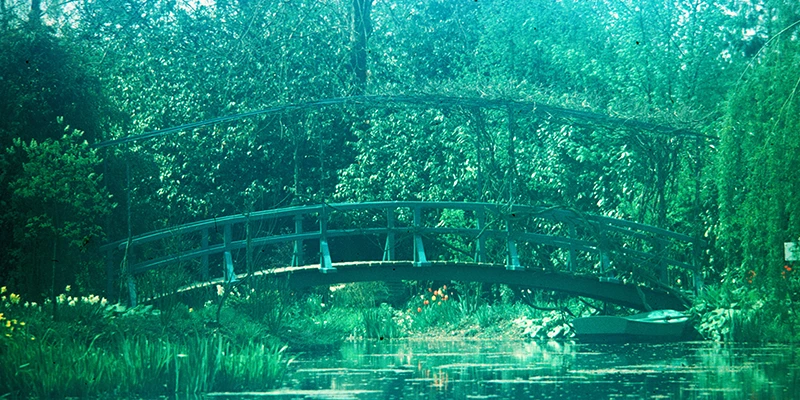
One of the best things about Rouen is that it is near the home of Monet, at Giverny, so I spend the afternoon on a pilgrimage to the house and gardens of this greatest of all the landscape Impressionists. A fifteen-minute train ride (from that dreaded station I was locked out of just the night before) gets me to the cute little town of Vernon, from which a bus was supposed to go to Giverny, but no, no bus. The taxi flies me there in ten minutes, and since the gardens are closed for mid-day I have the occasion for a relaxed luxurious French meal the country cafe recommended by the cab driver, L'Auberge du Vieux Moulin. The walls are hung with beautiful modern Impressionist landscapes a la Monet, but with much more brilliant fresh colors, whetting my appetite for the real thing. I order two of the specialties of Normandy, mussels, followed by a tripe stew. Normally I don't care that much for tripe but figure this is the best place to enhance my appreciation for this delicacy, and it is. Washed down by a half bottle of "Prince Noir," followed by salad and creme pie, all for just $12.
"It's the prettiest garden I've ever seen," says one lady as we stroll about the grounds. Monet's house is a large pink stucco structure, demonstrating the fame and wealth he enjoyed as the aging master. The recently restored grounds are blooming with thousands of tulips and purple forget-me-nots, with pretty trellises scattered along the pathways. And guess what is the centerpiece of the estate, perhaps the most important place in all of nineteenth century art? The lily pond, that's right, with the graceful Japanese bridge. I shoot about two rolls of film here, slapping on all kinds of filters, and breathing on the lense to try and re-create the feelings of a painter. Being here is truly like walking in a great painting.
There is no bus or taxi back to Vernon, so I add one more kind of transit to my journey and stick out my thumb. This is too easy, the very first car picks me up. A charming older Belgian couple who also just visited the gardens, they drop me off at the station, but since I have an hour I walk around Vernon for a while and eat another snack. Nice little place.
Back in Rouen, I watch the town close down for the evening and have another walk around the main high points. Then I settle into what seems to be a classic French cafe for some soup and wine. People are casually sitting around, reading newspapers and talking, drinking wine or coffee. I have major difficulties just telling the waiter to bring un vin rouge and soup du jour, but we finally figure it out. I find my bus stop that takes me back to the little hotel, the Auberge du Grand Turc. The downstairs cafe is active with a few patrons, so I stop in for some nightcaps, and tell the madame who runs the place about my day. She speaks no english but nods agreeably as I rattle off the names of the places I saw in my busy tour. I turn in early so I can be up at 5:15 to catch an early train, heading back to Paris! This time I want to take no chances of a room, so I vow to get out of Rouen on the first train to get first crack at the hotels of Paris.
Paris
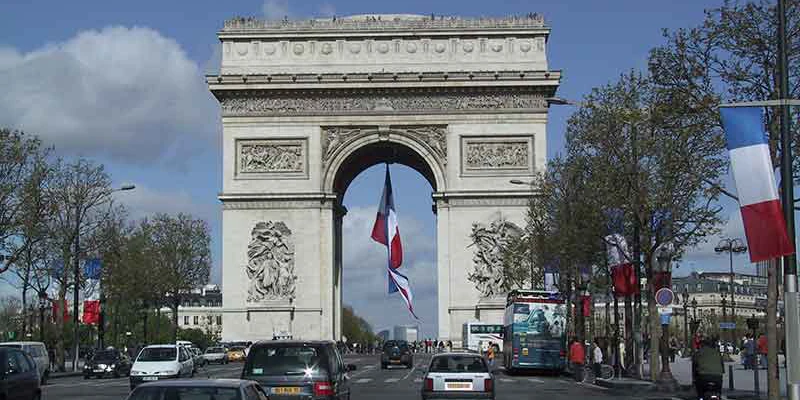
Many knowledgeable travellers call her the world's most beautiful city, but without getting into that debate let's just say that Paris did not disappoint. It is intimidating to try and describe this amazing place in a few pages, in a few words...the diversity and grandeur are overwhelming, a delight for all the senses. Art, food, shops, pretty people, grand boulevards, serene parks, music of all kinds, trees and flowers, classical architecture, ultra-modern trends, extreme pride, an amazing history, profuse panoramas, monuments, fascinating neighborhoods for walking around, quick transportation, cafes for leisurely conversation...in other words, everything you could possibly hope for in a great city.
No wonder I couldn't find a room here the other day. Everyone wants to come to Paris. This time I play it smart and arrive by train around eight in the morning, which gives me a good head-start for getting a decent room. My friend in Honolulu, Jean-Jacques, recommended the Hotel Grand Excelsior over on the Left Bank, so I hop the metro cross-town, ending up at the wrong station on the other side of the large Luxembourg Gardens, but this makes for a nice walk through the park as one of my first Paris impressions. Soon enough I find the hotel, nestled into a side street of the Latin Quarter next to the Sorbonne--places I have dreamed about and can hardly believe I am now possessing. But, there's no rooms at the hotel. No problem--this neighborhood has plenty of small hotels and pensions. Instead of telephoning bunches of hotels from a stack of guide books, my usual technique, I just have fun walking from one possibility to another, finding that even this early most of the places have no single rooms. But soon enough I return to the Hotel Cujas, which is right next to the Grand Excelsior, and still has the room they mentioned earlier. The room, however, is up five flights of narrow stairs, and the shower is in the basement. Then I discover that for one dollar more there is a room on the second floor with a shower, which I grab. It's a quiet room at the back of the building, even though we are located half a block from the bustling Boulevard St. Michel. At nine dollars per night this could be the best bargain of the trip.
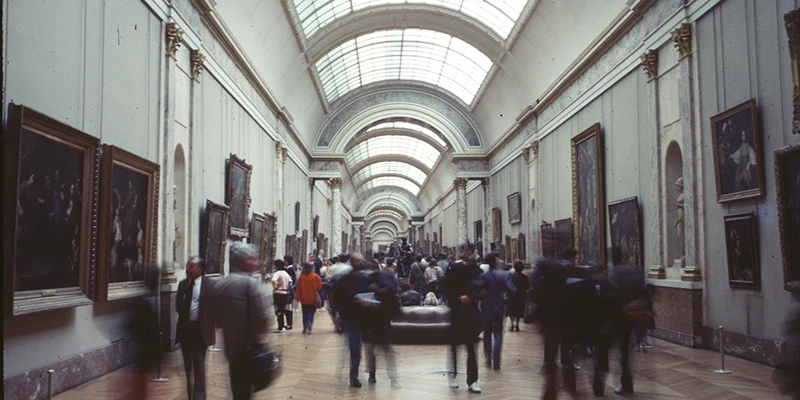
The Louvre is my first real destination, perhaps this planet's most famous art museum, with ten miles of galleries, the acres of floor space, the Mona Lisa, Venus, Winged Victory, incredible sculptures from all the great civilizations, and my favorite, the Grande Gallery stretching 350 yards, the longest in the world, lined with an all-masterpiece show! The greatest sculpture of all is the building itself, formerly a palace of Louis XIV. Certainly one of the grandest baroque monuments of history, with nearly every inch of its ceilings and walls carved in the most interesting ways. Most of all, the paintings will impress, many looking familiar from the numerous pale reproductions one has seen in books and posters. Even the gift shop provides major stimulation to the senses.
You could easily spend three days looking around inside the Louvre, but since that's how many days I have to see all of Paris, I escape from the big art house after a few hours and head for the Champs-Elysees. This grand boulevard is the "backbone of Paris, with its broad tree-lined expanse culminating in the Arc de Triomphe. But after walking up and down the street, which my invaluable Michelin guidebook calls "the heart of the nation," I feel a bit disappointed. Car dealers, souvenir shops, movie theaters, travel agencies, and fast food places somehow clash with the romantic notions one has developed of this strip. Why isn't Jean Paul Belmondo still here looking for Jean Simmons, selling her International Herald Tribunes like they did in "Breathless?" Meanwhile, my bladder is beeping at me. I have not yet learned the trick of popping into the nearest restaurant, so I ask this newslady "ooo ser troove la lavaboo" which I don't even understand so perhaps it's normal for her to mutely turn her back on me, totally ignoring my growing plight. This rudeness pisses me off, so to speak, so I turn the corner and find a back alley in which to relieve myself and vent my feelings.
Feeling tired and hungry after so much walking and excitement, I glide on the metro back to my little hotel, where my friendly concierge tells me in good English "oh yes, we have food shops just around the corner--a bakery, the wine shop, and next door the cheese and fruits." European style, I go from one store to another accumulating dinner supplies. This is a good time to try goat milk cheese, which proves to be stupendously fresh and delicious. A French wine shop! The friendly knowledgeable merchant fixes me up with several excellent bottles at three dollars each. Heading back to my room laden with groceries I feel I have found a piece of heaven in this little food block on the Left Bank. Everything tastes so good, I have lots of it. Even the soft bread, a sweet, yellowish, bumpy topped loaf, is so nice I eat the whole thing. The plan is to have a nap from six to eight, then jump up for a night on the town. Hah! No such luck. I wake up at 2am, roll over and go back to sleep for some needed rest.
Out the door by 8am next morning ready to take on the whole city, but the street is empty and the shops all shuttered. It seems my schedule is not quite in rythm with everyone else. So I have espresso and read the Trib at a nice empty cafe on the Boulevard St. Michel, then take a stroll down the narrow twisting lanes of the Latin Quarter past the ancient buildings, past the fruit stands and still-quiet intersections, coming up on the beautiful rear view of Notre Dame, bright in the morning light.
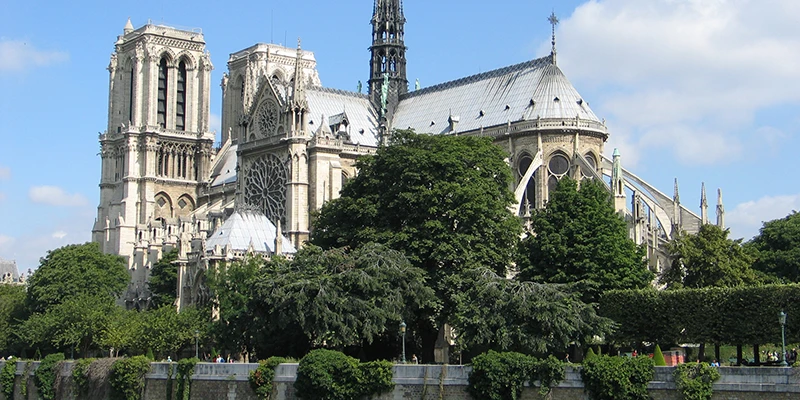
Conveniently, this is Sunday morning and the interior is alive with worshippers creating a most reverential atmosphere. I am suitably amazed by the famous stained glass, and surprised at the amount of sculpture all over the exterior of this 800 year old Gothic masterpiece.
Next destination is the Bueauborg, with it's radical modern art museum, the Pompidou Centre, clad on the outside with huge tubes and girders painted bright blue--an "honest" statement of contemporary architecture that doesn't hide behind false walls. Walking there from Notre Dame, I wander around the right bank for a dozen blocks, passing the memorable Hotel de Ville, the old town hall built in Neo-Renaissance style, its gleaming white front sparkling with 150 statues. The large plaza in front is flanked with two beautiful fountains and makes a fine framework for the very pretty hotel'.
A small crowd of fifty people is waiting for the Pompidou to open so I think oh boy there must be a decent show of modern stuff happening here. As the doors open I blindly follow the crowd, which is fueled by more bodies coming in other doors. We all rush up the escalators as I feel the excitement building. Everyone shuffles into a big room on the second floor, but wait a minute, there's no art here--this is the library! We're all rushing to get first crack at the books, scrambling for the card catalogues. Not me. I don't want to do any studying here. Where's the art? Well, it turns out the entire museum is closed this week since a new show is being installed, except for one strange exhibit, which I pay to get into after all this anticipation. It is an ultra-modern assemblage in darkened rooms separated by hanging black burlap walls, a mish-mash of high technology, video installations, old paintings, scale models, dancing mannequins, computer terminals everywhere, all accompanied by -- weird sounds coming through the headphones I rented. Well, it was different, and there is a good view across town to the Eiffel Tower from here, which is my next stop.
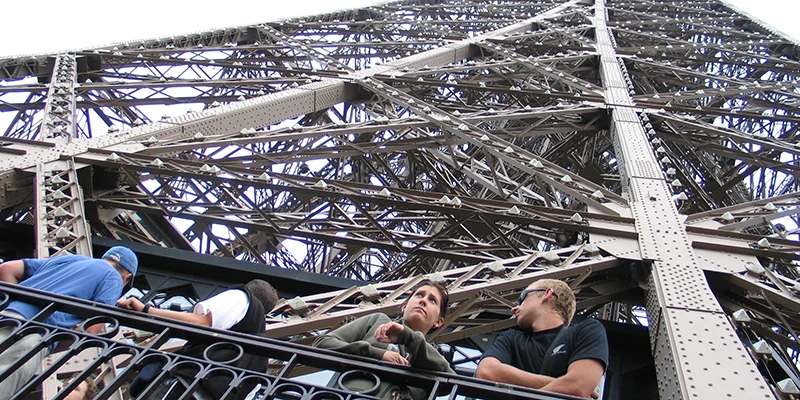
It's a funny feeling when you finally come face-to-face with one of the world's most famous monuments, sort of like artifical deja vu, as if you are so familiar with the piece even though you've never really seen it before. There it stands, towering way above, fifteen times higher than anything for miles around. At 1,000 feet it was the world's tallest structure for fifty years. I struggle for interesting and unique camera angles, shooting a whole roll at and from the beast, but don't get anything that hasn't been done ten thousand times before. Such a popular place. The sky is blue today and the view from the second platform is quite clear, all of Paris laid out below. Too bad the top level is closed today, but this does just fine.
From the tower I spy the Musee de 1'Homme just across the Seine in the sweeping curved arms of the Palais de Challot, so I walk right across to visit this great anthropological treasure house, filled with the artifacts and costumes of one hundred major world cultures. Back to the past, a terrific display that is like a mini-tour of mankind's last thousand years, packed into two floors of this slightly old fashioned gallery.
Hop the metro for the flea market, looking for mislabeled masterpieces in bronze, but end up with trinkets, T-shirts, a cheap African carving, and a roll of I hope good photos. It's a big mixed crowd picking over the 2,000 stalls, with everything imaginable for sale. Certainly worth the trip to the end of the metro line to get here.
By now it's late afternoon and I'm ready for another nap, back to the hotel, but this time I do manage to get up refreshed, ready for a little night life. As the sun is setting on the Seine, I'm rushing hack to Notre Dame for a view of the front portals with the last orange solar rays lighting up the Gothic sculptures for my eyes and lens, catching some pleasing photos.
Tonight I want to see the sleazy nightclub strip around the Moulin Rouge, then go up the "art hill" of the Montmartre. This action is along the Boulevard de Clichy--one sex show after another, with greasy barkers out front promising a good time. Shielding my virgin eyes, I merely walk past peeping at the posters and dazzling lightbulb marquees, not wanting to spend time or money inside...I toss down an espresso at one of the funky stand-up cafes and split from this honky-tonk Times Square atmosphere, seeking the hill-top artist quarter.
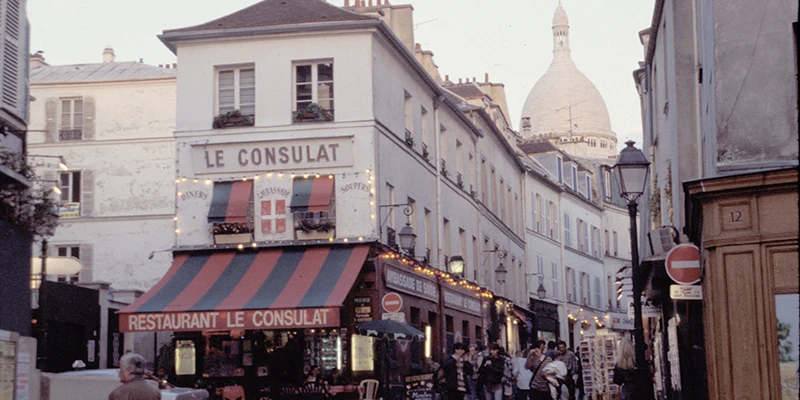
One guidebook has walking directions from this sleazeball neighborhood up to my destination at the Place du Tertre, but these narrow streets are mighty dark and deserted, and who knows what kinds of perverts and cutthroats hang out in these alleys behind the sex shows. I push on, up the steep streets, heartened by the sight of pedestrians here and there. Turning a corner, I have suddenly arrived--well, so have a bunch of other tourists as we all peruse the postcard racks in front of yet more souvenir shops. Not quite the bohemian atmosphere of the last century of course, but still some feeling remains in these old buildings painted so many times by Utrillo and his beret-clad cronies. A dozen painters have set up displays for sale in the plaza and small lines wait to have their likeness sketched for ten dollars. The place does look something like the many postcards which have immortalized it. I duck into a lively cafe to listen to a couple of guitarists and sip some rouge. Home by midnight.
Wake early Monday on a slightly drizzly grey morning, which turns out to be the perfect atmosphere for a walk all around the back streets of the Left Bank, over by the Rue de Seine, Rue Bonaparte, and Boulevard St. Germain. It is, not to wear out the word, charming -- old grey buildings with wrought iron railings and potted flowers, little shops, cobblestone streets, seen through a cool mist. I am glad it's a little rainy for a change of pace.
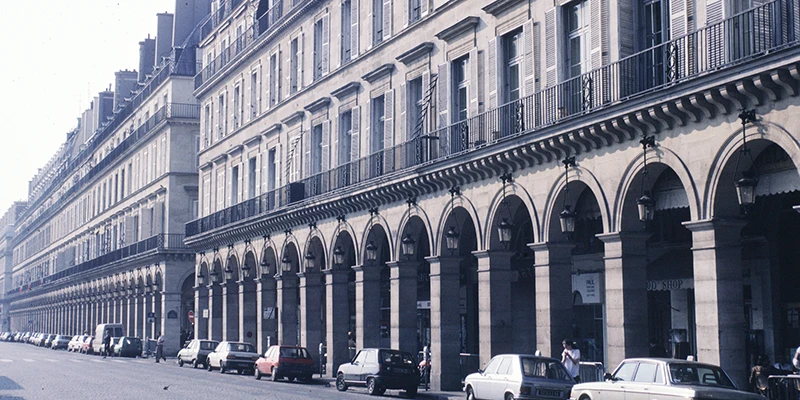
More walking--now I'm over on the Right Bank along the classy arcade of the Rue de Rivoli with many fancy stores selling high-priced tourist stuff. Oh, oh, here comes the little gypsy bastards another traveller warned me about, right on schedule with their newspaper shoved out at me to shield these skinny little fingers on a journey into unsuspecting pockets and purses, cleaning you out in fifteen seconds. I growl at them and raise a fist like I'm going to start swinging, which sends them scurrying to the next sucker. France has a foolish law that prohibits sending any minor to detention, so these monster kids cannot be stopped.
It has taken about six years to reach the next destination, the Jeu de Paume gallery, which holds the greatest collection of Impressionist masterpieces in the world. Ever since I settled upon this school as my favorite art, and learned they are not held in the Louvre but in a separate building nearby, I have needed to get there. To really heighten the mood for these paintings one should approach the gallery by walking through the adjacent Tuileries Gardens, a large park with statues and fountains--like walking into a Monet. A peaceful misty morning. You will probably find a line waiting to get in, but it is well worth the twenty minute wait. Go ahead and build up your expectations-you won't be disappointed. Inside it all comes true, two floors filled with these amazing hundred year old French canvases. Two rooms each for Monet, Manet, and Degas. Walls filled with Pissaro, two tiers high. A big space for Gauguin's Polynesian beauties, making me homesick for Hawaii. Renoir's crowning achievement, "Le Moulin de la Galette" painted at an outdoor dance hall in the Montmartre -- an amazing burst of color, light vibration, and happy people, illustrating his belief that "painting should be something pleasant, joyful, and attractive, even pretty."
The slight crowd in the museum is no problem, for it is quite wonderful to be among so many fellow-lovers of this collection. I strike up a conversation with this perfectly beautiful blond, who looks European, but is actually a student at Skidmore spending her junior year in Paris looking into the different phases of Renoir's development. She loves it. Ripping myself away, I head for the next museum nearby, the Orangerie, famous for the huge oval gallery who's walls are filled all the way around with Monet's giant water lily mural, "The Nymphea."
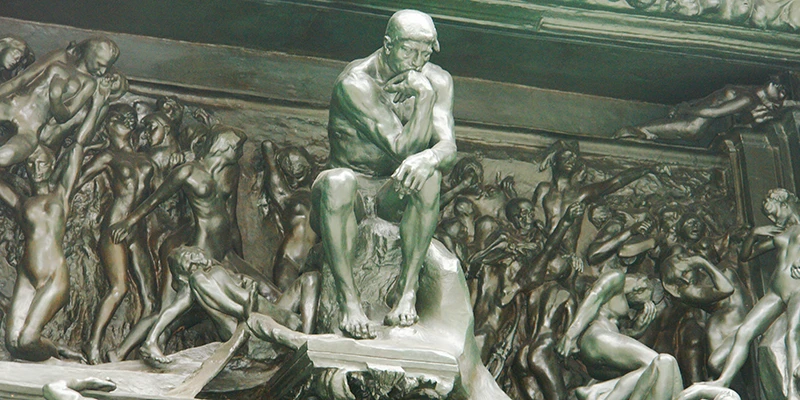
Still not museumed-out, I travel cross-town to the Rodin Museum, housed in the very chateau where this great sculptor lived. Some of these pieces get an 'R' rating for their powerful sexual imagery. How nice to see so many original marble masterpieces instead of the bronze castings one can find all over. In one piece the stone is so paper thin it is translucent, adding delicate living energy to this sensual pose. A large garden viewed through leaded windows offers the perfect framing for these pieces in the house, and invites one for an outdoor stroll past "The Thinker," "The Burgers of Calais" and the "Gates of Hell."
Hungry. Looking around in this neighborhood near the Church of St. Sulpice, an area my concierge had recommended for shopping, and find a crowded little bistro filled with French chatter and the heavy smoke of Galloise--the right atmosphere for a real meal. So what if the place isn't in my Frommer guidebook, and it costs twelve dollars instead of eight for a complete feast. The beef and legumes in broth are tasty, with wine and lots of bread, surrounded by animated incomprehensible conversations.
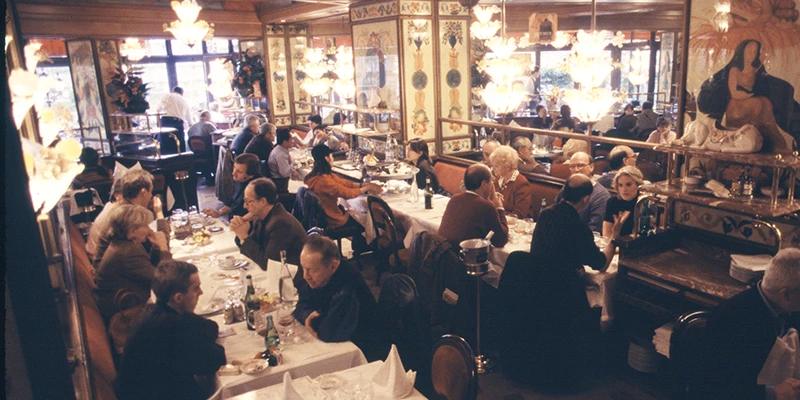
French is my favorite cuisine, for the occasional rich treat rather than a daily staple, but this presents a dilemma in this gastronomic capital of the world--should I splurge for a major feast? Considering it would cost over $100, with three more weeks of major spending on a finite budget, and considering that while I don't mind eating alone, doing it in an ultra-deluxe establishment is something else...I chicken out. I decide to eat merely well, in a few decent restaurants and with tasty bread, cheese and fruit carry-outs. In retrospect, I should have splurged. Next time in France I will have to make up for it in grand style. Actually, yesterday's lunch, in a large airy casual second floor place where you share tables, was quite good, despite one minor embarrassment. Not reading any French, I ignorantly peruse the menu and settle for the "Suggestion du Jour," featuring braised beef and carrots, appetizer, dessert, and wine for under $5. I ask the waiter if I can keep the interesting one page menu, he agrees, so I slip it in my notebook, when along come two gentleman who join me at the table and start looking for a menu which I assume the waiter will bring, but when they ask him for it, he points at me! "But I thought you said I could keep it?" trying to put the eye on him, but he says "yes, yes, after they see it" (you stupid American). Oh, well. He writes my tab in pencil on the paper tablecloth, I pay and slink out with my menu, once the gents make their choices.
This is my final day in Paris, so after lunch I take the metro to what is probably the last major neighborhood I have time for, all around the Opera Quarter, from the Place Vendome to the Palais Royal and up to the magnificent Boulevard Houssman. I guess this is the heart of the city. There are fascinating things going on everyplace you look--luxury shops for jewelry, leather, clothing; giant department stores which I don't even have time to enter; swank hotels and elegant people; many sidewalk cafes; flower shops and patisseries; monumental obelisks and statues; classic architecture with old arcades; 17th century mansions and courtyards; antiques galore in stuffy little stores; window displays with hundreds of items on view; headquarters for big business and major banks; street musicians... all swirling around in some kind of too-good-to-be-true dream world. Everything one could possibly want to find at the center of the world's most beautiful city is right there.
After three hours of walking around in all of this I'm in ecstasy. If this place doesn't put you into a daze of delight, you might as well pack your bags and head home. Rising as the centerpiece" of this area is the magnificent Paris Opera House, the world's largest and perhaps most beautiful. The exterior is clustered with statues paying homage to music, dance, and poetry, and the most amazing lamp-posts in the known universe-- beautiful nude women in bronze. Looking at the posters outside, I notice there is a "Soiree de Ballets" happening tonight, starting in about one hour. I wasn't planning on going to the opera, but here I am, mulling it over as I walk around enjoying the outside of this stupendous building.
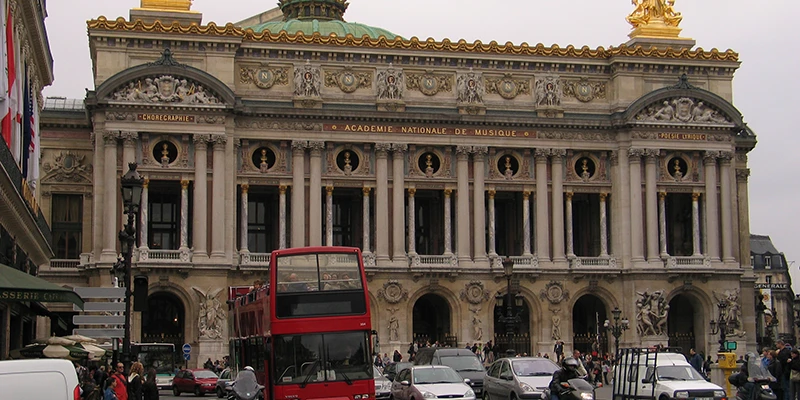
Well OK, I decide to try the ballet, and walk inside only to discover the show is sold out. By now I really want to get in, so I head for the ticket booth anyway and there stands a lady holding up one ticket for sale, a seat in the top balcony center, which I grab for $7. The performance of course is very good, with a short preliminary ballet in elaborate costumes a la Louis XIV, then on with the main event-Swiss alpine setting, peasant girl meets prince, love and death follows, bring up the violins and fly away. I thought it ended after 2 1/2 hours, but the cloakroom lady is telling me in pantomime French, "no you cannot have your camera back yet," thoroughly confusing me. So I ask this cute Chinese girl what is going on and she explains it's just another intermission with the finale yet to come. Her name is Shoo-Hui, from Taiwan, studying violin in Paris for this year. For the next hour the spirit of our Swiss girl rises and dances with spirits of the forests, all garbed in ethereal white gowns, glowing in the blue light, until finally the prince shows up and they dance into eternity, ending the four hour show.
Shoo-Hui and I go for a late walk after the show, down the lively Boulevard des Italiens, one of the main spokes radiating out from the Place de 1'Opera. It is lined with cafes and theaters and bright lights, buzzing with people even on this late Monday. She wants to show me the other opera house, the smaller Opera-Comique, down a quiet side street. We stand in the dim light of a small plaza looking at the old building, me thinking this is a good spot for some smooching, at last, an embrace in this romantic city, but no, Shoo-Hui wants to get home, so we have a nice walk back to the Opera metro station, au revoir.
In a few minutes the train brings me to the Place St. Michel, the most vibrant nightime plaza on the Left Bank, lots of hustle after midnight. Stopping at a cafe for a half bottle of Beaujoulais to study my new book, the "Thomas Cook Continental Timetable" for trains, which becomes my new Bible, a couple sitting at the next table strikes up a conversation with me. A most friendly Dutch couple, we talk past 1:30 learning about each other's worlds. They are delighted I know the name of their queen, Beatrice.
Since Holland is my next stop this is a good preview for me, but Mieke says, "don't bother with Amsterdam, it's a big dirty city. Come visit us in Leiden, we'll show you all around. It's a quaint old university town." This clashes with my plans, but I make note of their address just in case.
Get to sleep by 2:15 and wake up at 5:30 to catch the early train to Amsterdam. Arrive at station 1/2 hour early, so grab bites in cafe across the street, asking for coffee and croissant--waiter brings me a full basket, which I assume is all for me and dig in. Five rolls later I realize you're only billed for those you eat--costing me $4.50 for this gluttonous lapse. What the hell, it's my last taste of Paris, make it good. Anyway, my five days in France have been a bargain, costing only $250, about the price of one deluxe meal for a typical tourist couple.
Leaving Paris with mixed emotions, happy to be getting on with the journey. It seems that now things will finally get going at a faster pace, hurtling me along to about ten cities in the next ten days. This is the exact mid-point, leaving a paltry sum of three weeks to see all the infinite wonders of Europe. Faster, faster, faster.
BELGIUM
This train taking me to Amsterdam passes right through Brussels, one of the question marks on the itinerary. Don, a friend at home scoffed at the idea of Brussels, "a big dirty city. Nothing to distinguish it," he said, yet another friend, also named Don, calls it the most civilized place he's ever been, and used it for his headquarters on a recent vacation. Everyone has different tastes, even if they have the same name. Mulling things over, speedreading my Belgium guidebooks which I brought just in case, and lured by thoughts of medieval canals meandering through the nearby town of Brugge, I come up with a compromise: get off in Brussels and make some quick phone calls for a cheap hotel room. If I score a good deal, fine, stay for a day, if not, hop on the next train for Amsterdam 3° minutes later.
Bingo, the first call on the Frommer's list lands a room for $5.50, one block from the train station. The front desk is actually the bar of a cafe cum pool hall, but the small room looks fine, so I drop off my bags and head back to the train station for a day-trip to Brugge, saving Brussels for this afternoon.
Brugge
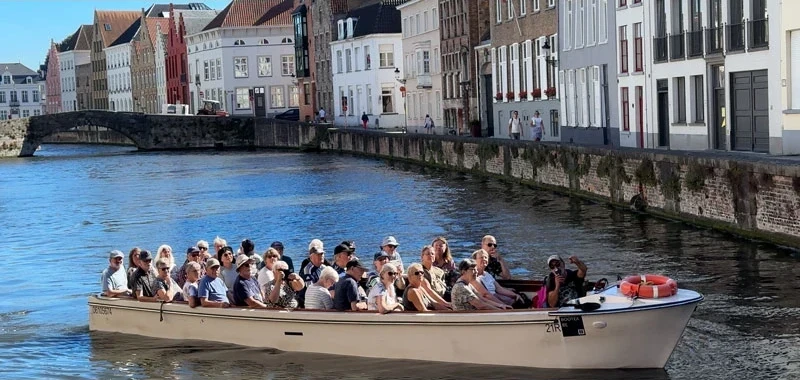
An hour train ride through lovely flat farmlands makes me wonder how this land can be one of the most densely populated on earth. I see only a few scattered villages among the cow pastures, built in an old-fashioned way, houses clustered tightly together. At times it is real foggy with hundred foot visibility, and I hope it clears just a little so I can see this fabled town through a romantic misty atmosphere. There are dancing trees twirling past the train windows! Huge trees with bare branches seem to turn slowly as the train curves along creating this psychedelic illusion of moving, criss-crossing branches. Must be the fog playing tricks on me.
Brugge is almost as good as the brochures said it would be. "The most romantic city in the world....The Venice of the North." Well, it is indeed beautiful and breathtaking. Very old brick buildings in the Flemish style of zig-zag slanting roof lines, cobble stone pathways, horse-drawn carriages for the tourists, and best of all, the canals, the tranquil canals. Brugge was left behind in the backwaters of history 400 years ago, and has not changed much since then. It used to be a harbor connected to the sea, but the river silted over and trade went elsewhere, allowing little Brugge to rest in peace. Undisturbed. A time capsule from the Middle Ages.
One floats back in time, walking these narrow lanes next to ancient brick fronts, following canals into the murky mist. The drizzle has stopped and the fog is lifting, revealing one picturesque sight after another. Fortunately there's only a handful of tourists this early in the season, so the mood is not shattered, and the impossibly narrow sidewalks are passable. An absolutely stunning, gorgeous local blond tells me it's nicer in the summer with all the flowers blooming, but her face is the only flower I need on this gray spring day... Many pretty girls on bicycles in this small town, providing a delightful first taste of the fabled Dutch-Scandanavian beauty miracle.
Hungry for some native food, I drop into a little cafe and order Belgian waffles, piled high with strawberries and whipped cream--a fantasy I've associated with this nation since 1964 when we used to frequent the New York World's Fair, eating this dish at the Belgian Village, a pretty good imitation of a town like Brugge. Nothing beats the real thing, which I had in front of me moments ago but somehow it has vanished, washed down with dark black coffee. Later I enjoy another of the famous local items, "pomme frittes and mayonaise," thick french fries with a sweet, rich bernaise-type buttery sauce. Yummy.
Following the map through these irregular streets proves to be too tricky and I become totally lost in the more modern residential back part of town. Wandering here I feel part of the real life of the place--kids pedalling home from school, old ladies sitting in dim front parlors behind lace curtains, and one old guy right out of a Van Gogh painting riding his bicycle over a little bridge across the canal towards his ancient home.
Brussels
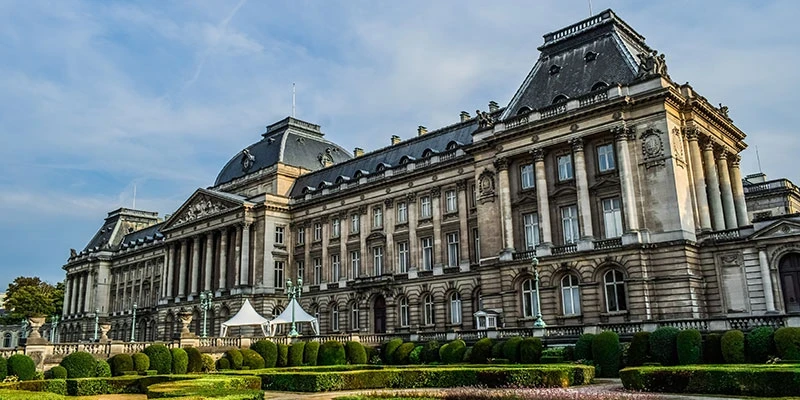
Heading back to Brussels, I can't get over how clean these trains are, and very smooth, quiet, soothing. Washing up, I notice the toilets are spotless, unlike the Irish trains where piss gets right on the toilet seat. What a treat to get off the train cleaner than when I got on. I'll have to really start using this Eurail Pass during the remaining time, which seems to be running out much faster now that it's more than half over. The sense of urgency builds as the train speeds along. At least I am covering two cities at one time today. That's quick!
Fortunately, I arrive in Brussels with enough time to spend an hour in the brand new Museum of Modern Art, which just opened a few months ago. I had never heard of this gallery before but have since learned it is one of the best. The art is presented chronologically through the different phases of 20th century development, descending eight floors belcw the surface in a magical spiral journey. The works look familiar, since they illustrate so clearly the various modern movements, but none of the artists are familiar to me because they are all Belgian! his relative anonymity liberates one from the tyranny of labels, so you can stop wondering who, and just enjoy the piece for itself.
Surprise-Brussels is a major, modern city! It looks like an extension of Paris, with lots of newer buildings thrown into the architectural mix. Shops and cafes are everywhere. Probably the most famous tourist item here is chocolate, and lots of it--so delicious it deserves the reputation as the world's finest, especially those little gems shaped just like the fruits they are filled with, grape cream, strawberry cream, coconut delight, into the belly (out of sight).
Parts of the city are five hundred years old, particularly the most famous "Grand-Place," the medieval market place surrounded by the guild halls and town hall. This is a living post card, some say the most beautiful plaza in the world. Constructed in the flamboyant gothic and later baroque styles, clad in statues and gold gilding, it really throws you back in time. I'm here late in the day when the yellow light brings up the golden atmosphere of ages past, money made, deals conceived and blown, a million tales spin with the evening dust.
Another good thing about the Grand-Place is that neighborhood behind it filled with restaurants--not MacDonalds or Denny's here, but quality French, Italian, Beligian--easily one hundred eateries packed into narrow pedestrian malls along ancient cobble paths. I stop for a beer in a darkly panelled bar, but the bartendress ignores me, then starts washing a pile of glasses despite my call for some suds, so I walk out a little frustrated like an insulted tourist. Despite this minor incident, I have to agree with my friend Don, later back home, when he says "Paris and Brussels are the most civilized places, where you can just sit at a cafe and have lovely conversations, and meet people in a relaxed atmosphere." He doesn't care as much for the pub scene of London, "too crowded, nothing but booze, cigarette smoke thick in stuffy clouds." I can see his point, but I still like those pubs, as well as the cafes.
What fun to get increasingly hungry while browsing past restaurant windows, checking menus posted outside and looking for the right interior. Then I notice an attractive lady also looking at a menu, so here goes, "does that place look good?" I say, and she smiles. "You speak American too," she replies, in her California accent. We have a delicious Chateaubriand together, with lots of bernaise sauce and wine, making one of the best meals of the trip. She's travelling alone, but "happily married." In talking we make a funny discovery, that has earth-shaking implications, which is just this: so far our vacations have followed the same general route, and our plans for the next few weeks are similar. Here I thought that my itinerary was so crafted for my special tastes, but most everybody does the same thing, so I guess I'm just one of the masses after all. I walk her back to her hotel and offer to show her up to her room, but she graciously declines so I walk on alone for another mile back to my five dollar hotel, ready for the big trip to Amsterdam tomorrow morning. (Later I find many people with the same itinerary-so as you read this, it could be your trip too!)
Well, it was Tuesday, and that was Belgium. A whole country in a day boy this trip is speeding up all of a sudden but that is OK because I really did get a taste of what Brussels is like and the side trip to Brugges will stay with me forever! This one day experiment in quicktripping is a success and gives me hope that I can see many more places in the coming three weeks. My one big regret in leaving so fast is that I was right on the very doorstep of a major attraction, the Museum of Classic Art, which I later find out has the world's greatest collections of Rubens and Brueghel, but I didn't have time or inclination to go inside. Actually I didn't appreciate the paintings of Brueghel until a week later when I came upon a large room filled with his funny macabre works in the big museum in Vienna--but that gets us ahead of the story.
Meanwhile, back in Brussels it is early Wednesday morning and I get trapped in the doorway of the hotel! I got up before everyone to catch the first train to Amsterdam, so no-one was around to hear me yelling and banging--what happened is the inner doors locked behind me but the outer doors would not open in front of me, so there I was, stuck with my bags in the ten square foot doorway, claustrophobia and mild panic settling in. Stupid me, I just wasn't pushing hard enough on the old outside doors. Bingo, I'm free, and walk across the street to the station.
HOLLAND
It's only a forty-five minute train ride to Amsterdam, boosting my feelings of rapid progress. The Central Station is a bustling electric place, and right away I am impressed by how good looking the Dutch are. They are gorgeous--blond hair, fair skin, blue eyes, high cheeks, slender builds, mmmhh! I even get a wink from a cute conductor. My second impression is that these people are very friendly, for as I stand there with my head turning around a local fellow stops to ask if I am looking for something--just a small spontaneous gesture, but one that really impresses me. "Where's the telephone" I ask, since my first task on arriving anywhere is to call around for a room, using the guidebook lists that I prioritize on the train.
On my way to the phone I am besieged by several "agents" for various hotels, all flashing impressive brochures and promises of "the best deal in town." One guy drags me out the hack door to point out the boat hotel, one in a row of many along the docks at the rear of the station. "There's chicks and parties all night" he says, but I get images of cramped bunk beds in a rocking noisy clam shell. Busting away, I finally get to the phone and ring up a room for $13/night, a fifteen minute tram ride away from the station. Several more hotel hustlers accost me when I leave the phone booth, but I am determined to stick with the guidebook lead. As it turns out, my room is fine, except for the long-haired carpenter across the courtyard who's buzz saw screams all afternoon and into the night.
Oh, Amsterdam
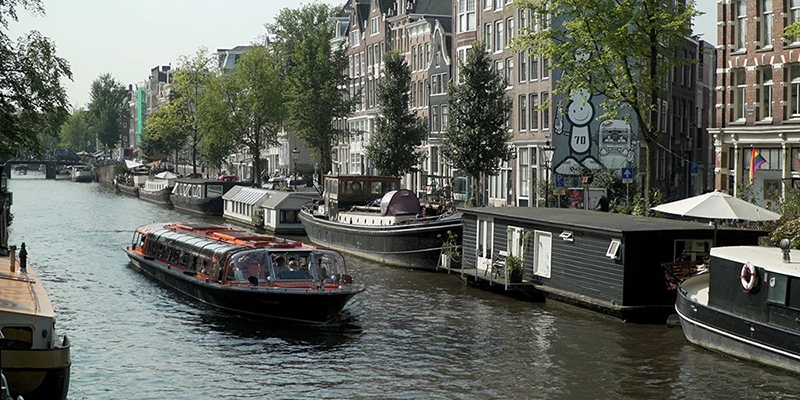
Legendary Amsterdam! They say
in the sixties it was the wildest place on earth
love-ins, sleep-ins, drug-outs, hair to there-- demonstrations for peace
anarchy
graffiti
hashish
rock 'n roll another one
But does the "beast still live?
What a place! It is casual, it is relaxed, it is different. The young people are keeping the freewheeling spirit going, yet more subdued in these changing times. The only European city now with abundant graffiti, storefront prostitutes, streetcorner hash sellers, and rumours of a drug-dealing disco. Yet this is just a fringe element in a modern hip city, who's real story is told in the lively, compact urban center. The charming tree- lined canals and pedestrian shopping malls make this one of the best cities to see on foot- but watch out for the hectic traffic, narrow sidewalks, and constant reconstruction found in many places.
Everyone here seems to be well-educated and speak good English, perhaps better than back home in Hawaii. "We have a live and let live attitude, yes" one museum guard tells me, "and we are genuinely friendly people," which summarizes the heart of Holland. The guard and I have a long revealing talk about life in Amsterdam and Hawaii, finding similarities, like how boring the place one lives can get after a while, no matter how interesting it seems to the visitor. "Some of us have travelled throughout Europe and some haven't gone anywhere. I don't know anyone who has been to Hawaii, but we've all seen Magnum on TV" he said.
We were talking outside "Barney's Beanery," the only exhibit that is open in the big Stedelijk Museum of modern art. I am totally thrilled and amused at finally seeing this whimsical installation, which I had read about many years before. You walk right in to this tiny coffee shop counter, inhabited by half a dozen mannequins with clocks for faces and strange clothing, coffee cups with half-finished plastic meals, full ash trays, coat racks, all accompanied by the weirdest sounds of conversation that changes from the front of the room to the back. Kleinholz, the American artist, specializes in these environmental pieces, and for some reason this museum has several of his most important works.
Unfortunately, the rest of the museum is empty, for I have just missed the most important modern art retrospective of the year and perhaps the century, "La Grande Parade." I knew, two months ago when planning the itinerary, that I would miss it by a week. At least, the girl at the counter makes me feel better when she says "it was a total madhouse for the last month here, with huge lines waiting hours to get into crowded galleries."
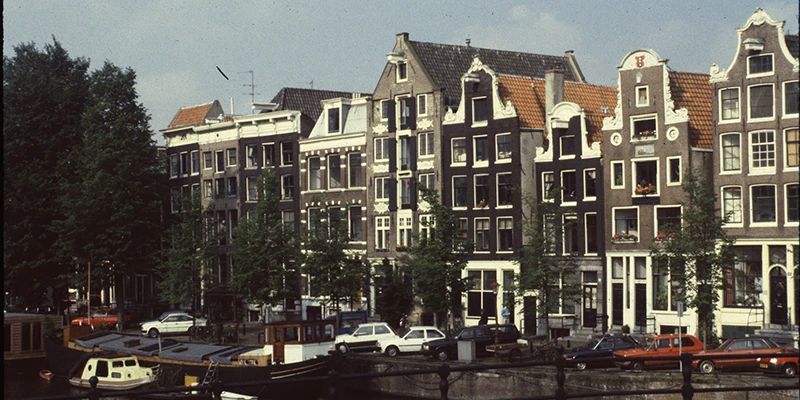
Amsterdam is a great city for walking around. And around and around, following these fabulous canals along their horseshoe shaped route through town. These watery passageways lend a certain beauty to this place, which combine with the distinctly Dutch architecture of narrow buildings with roofs peaked at the center in graceful curves or jagged zigzag steps. It creates a definite statement -- this is Amsterdam, a city with strong personality and specific character.
In the midst of the old, the antique, the buildings three and four hundred years old, comes the future right now: ultra modern people, trends, fashions. It seems like they know things we haven't learned yet, about peace, about social justice and education, and high technology (the home of Phillips Corporation, inventors of audio cassettes & video disks). Peace and understanding. For a small nation of fourteen million people, carved mostly out of the sea, they have done some amazing things.
However, one simple thing I can't find in this efficient town, with its capable, English-speaking sales clerks, is a simple small three-ring looseleaf binder. You see, the first thing I did here, back at the train station telephone booth, was lose my binder that I keep all the guide book stuff in. It turns out that Europeans do not use three-ring binders. I had a great system, which you are going to find out about in some detail right now, but must make modifications because of no more binder. Here goes-
Back home in Hawaii I prepared for this speedy jaunt by purchasing five best-selling guidebooks for Europe and reading through them. Then I ripped them apart one chapter at a time, and rearranged the information by combining all the chapters for one place into one folder. In this way I could walk around sightseeing in a town carrying lots of information, and leave the chapters for other cities back in the hotel room. As one mails packages home periodically, you can send off the information for places you have finished with, lightening the load. So I would be walking along with my little three-ring binder in one hand, and a map or two in the other hand, having a wonderful self-guided tour filled with meaning and descriptions-- until I lost the irreplaceable little binder. From this point I used the loose pages stuffed in an envelope, which still worked OK but not as precise, not as pretty. Really, the system of collating different books worked so well I strongly recommend it to anyone who wants to learn as they travel anywhere. The few dollars you spend for a couple of extra paperbacks is nothing compared to the thousands you are spending on the trip. (I cheaped out and bought mine in a secondhand book sale.) You do want to squeeze the most possible out of your travels, don't you? So buy this book already!
Meanwhile, back in Amsterdam I'm walking, walking, and doing some more walking. When your feet get tired, this place has a wonderful alternative-the trolley! I had never seen one before I got here. They are so quaint, and yet so modern and efficient.
Next morning, it's Thursday already and kind of rainy, I have breakfast at the little hotel with two girls from Galway, Ireland, who just got here last week and have jobs already as hotel maids at a big fancy place across town. Gee, I just got here too, the mind is spinning in a quick fantasy of finding a job and staying -- if they can do it, why not me. If not here, maybe some other country. No, I have Hawaii waiting for me, so --merely be the tourist for now. Hawaii, slow, but still the best.
This is my last day and night here, so I figure half a day walking all around, afternoon in three museums, and tonight hit some bars. Despite the light rain I do spend the a.m. like a pedestrian, and by lunch I figure I have seen nearly all of the main areas I missed yesterday in central Amsterdam. The big purchase of the morning is a set of special effect filters for the camera -- good ones, but kind of a waste of $45 since I've hardly used them since.
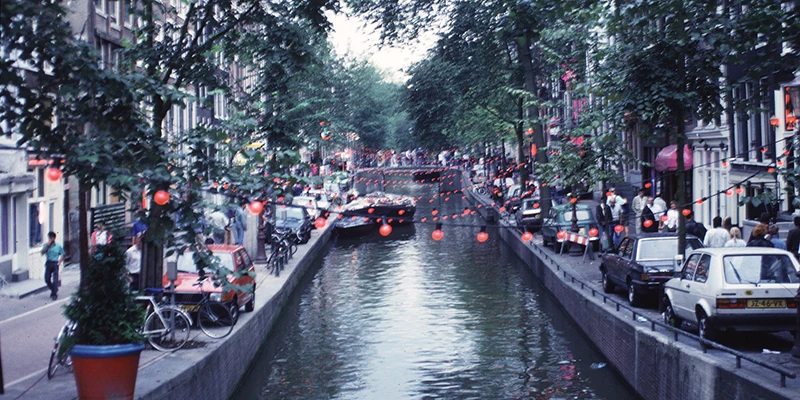
Not just raining, it is cold out here. By now I have wandered over to the "red light" district and sure enough, there they are sitting in the windows, wearing practically nothing, looking very warm and comfortable on this chilly afternoon. They really don't want to be photographed but sure would like some business, mmm?mhhh?hh, thanks anyway. Ironically, this neighborhood is really the most charming part of town in terms of a quiet, well-preserved historic section, with narrow canals and beautiful trees.
Moving on, I head for the Van Gogh Museum, housing the biggest collection of his paintings under one roof (I assume, although I just read that the Art Institute in Chicago has more French Impressionists than the Louvre). Of the 50 canvases here, half a dozen strike me as total masterpieces and the rest are nice to look at. One of the guards is real articulate and he's giving a dynamic talk about "The Potato Eaters," attracting a small crowd with me in it. "Look at the steam rising from the potatoes," he says, pointing out details I would have never noticed. This is the kind of little discovery one likes to find in art.
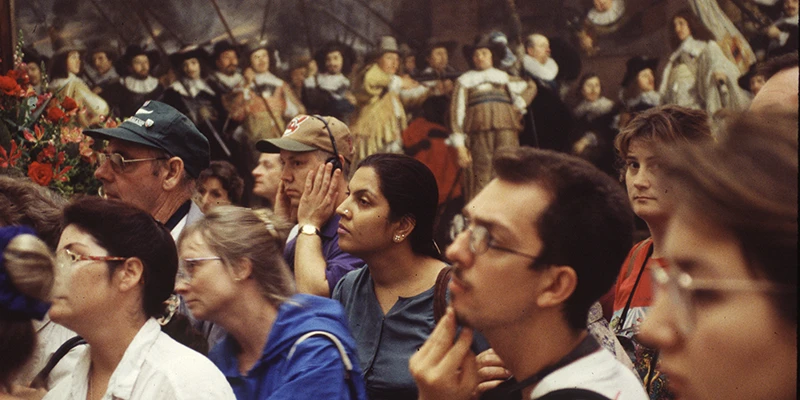
The final museum I hit in Amsterdam, and by now I'm moving pretty fast, is the massive Rijksmuseum, which Frommer's calls, in the exciting hyperbole of their Europe on $25 a Day "certainly one of the greatest (if not the greatest) art museums in the world." Granted, I am seeing it in a blur, and it is very impressive, but it cannot rank in my personal top ten. There is one unquestioned highlight in these many hallowed halls--"The Nightwatch" by the greatest of Dutch masters, Rembrandt. A giant painting, thirty feet across, fifteen feet high, almost 3-D in its use of light and space, showing a life-like pack of soldiers uniting behind their captain and lieutenant. Toss in three more big rooms of Rembrandts, and countless more galleries of world art. You've got quite a museum here.
After a quick rest and dinner bite, I go looking for action. Some of the old buildings along the canals are lit up at night, which makes for some good photos, as I head for the Leidseplein plaza, which various guidebooks say has the best clubs and discos for meeting people. Sure enough, I bop into one place and spend an hour talking with two very nice blondes, over the loud rock music. It sounds like, and my conversation affirms, Holland and America are listening to the same music, which is also true for the whole western world. The girls are friendly, speaking typical good English, but respectfully decline my playful suggestion that we go home together. So I head home to get some sleep, because tomorrow is another early day, leaving this city, and I still don't have an alarm clock.
Rats! I wake up late, missing my train that was to connect me with the boat down the Rhine, and I'm a little pissed at myself, but then check the schedule in my Cook's bible, and find a train one hour later that might still get me to the train on time!
Good thing I missed that early train, because on the next one I meet two terrific gals, Linda and Rollie from Denver, who are also heading for the boat down the Rhine. So we team up. Nice to have people to talk with and share experiences of the trip so far, and what's to come. They too are planning to visit Heidelberg and Munich, so we do the next five days together. They have another month left on their trip, but my clock is screaming now- I only have about two weeks to go! Rats! I'm having too much fun and the time is disappearing fast.
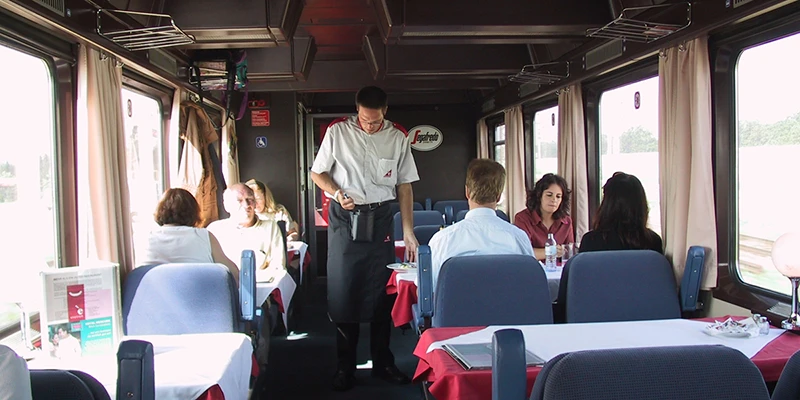
GERMANY
Koblenz and the Rhine
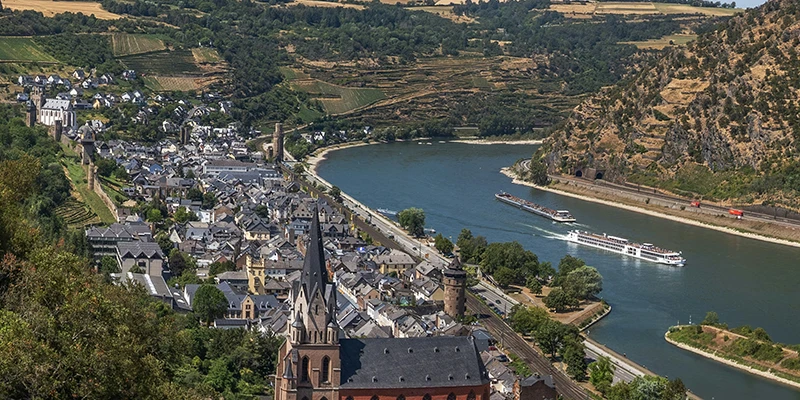
The train gets us to Koblenz in time to quickly grab a hotel near the station and call a taxi to speed us to the boat ramp. "Velkommen nach Deutschland" or something. This should be interesting because now I can try and speak the language. Jah, ich habe fur drei jare im hochschule studiert. I'll spare you the details, but it feels much better than knowing zero French.
Our taxi driver refuses to budge, muttering something I can't understand, until we realize he is saying "buckle up," a good strict law here. Off we go, to arrive moments before the excursion boat on its trip down this scenic waterway, the longest river in Europe. We are going the four hour stretch from Koblenz to Mainz, supposedly the most popular portion, lined with vineyards and sprinkled with castles.
I can wholeheartedly recommend this boat ride to everyone! Magnificent hillsides, cute little wine villages, stately old castles, seen from a comfortable uncrowded boat. We spent much of the time in the dining room drinking the local product, Riesling. One learns some of the history too, about how these castle dwellers were robber-barrons who drew heavy chains across the river to force all boats to pay a toll. Now most of the dozen castles are hotels or youth hostels you can stay in, but some will take you only if you arrive by bicycle. We get to Mainz just after dusk, have a quick beer, go to the wrong train station--where a friendly Londoner and his shy German girlfriend tell us to catch the next local to the main station. Soon enough we are on the right track and arrive back in Koblenz ready for a good night's sleep.
So much for Koblenz. We take a short twenty minute walk after breakfast for a quick peek at the town, but the train is leaving for Heidelberg at 9:30. There is just time to stop at a bakery to purchase the blackest bread I have ever seen-so hearty it tastes as if made from sticks and pebbles, but I love it.
Several thousand parked bicycles surround the train station, which for me is a very important message about efficient transportation. Honolulu, like most big American cities, has a chaotic traffic problem caused by single-occupant cars. Doesn't it make better sense to pedal to a near-by transit station? Except for the giant cities of London and Paris, I have seen tons of bicycles everywhere, and plenty of mopeds. Granted, American roads are not designed with two little wheels in mind, but maybe that could be changed. This journey is partially a search for such improvements we could adapt at home, including a hunt for business ideas I might transfer to Hawaii. We could certainly use more outdoor cafes, more pizzarias, more pedestrian malls, and more interesting clothing.
Heidelberg
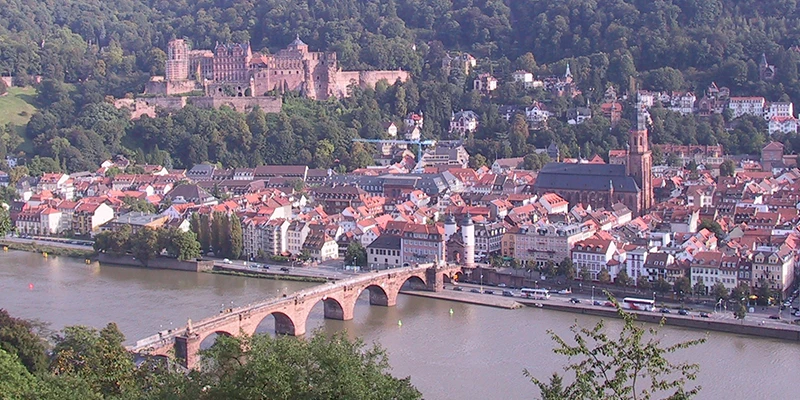
Anyway, back at the train station, we climb on board and two hours later arrive in the well-preserved medieval town of Heidelberg famous for its 500 year old university, home of the "Student Prince" We get a bit lazy and have the tourist bureau find a hotel room, paying a few dollars more than if we looked ourselves, but it's a good place, walking distance from the station and near downtown.
Rollie insists that our first project should be to look at the town from across the river at what is called "The Philosopher's Way." So Ok, we walk up the steep little lane for a mile and get a picture postcard view of the Old Town, with the Neckar River in the foreground, and the massive Heidelberg Castle background, framing in dramatic fashion the reddish-brown walls and roofs of this ancient place.
A very old bridge, dripping with historic statues rich in mythology, leads us into the heart of town, which turns out to be a long pedestrian mall lined with attractive shops and jam-packed with thousands of people. This is the "Hauptstrasse" which we walk up and down several times, stopping for coffee and rich pastries at some handy outdoor tables, perfect for people-watching. It appears that most of the tourists who are here are Germans, which is true to the pattern I notice throughout the trip--that is, most tourists at any place seem to be natives of that country. One more advantage of travelling in the off-peak season, as this is still early May.
I get in the shopping spirit and buy two beer steins shaped in the form I've seen in the various German bars, but with some touristy decal that says "Heidelberg." Clothing fashions on people walking by are very interesting, especially now that we are getting some of, the warmest, weather yet, in the 60's. They say it was snowing here two weeks ago.
We hit the big castle overlooking town--a huge castle, partially blown away. A short cog railway carries us up the 500-foot bluff to the restored ruins, which sure heats climbing the umpteen steps. Only one room is open free, containing "the biggest" wine keg 30 feet high. There's a pretty view from here of the old town's red roofs, and river behind followed by rolling hills.
Looking for food and sustenance, we head for "Zum Roten Oxen," a 500-year-old university tavern -- "the oldest," dark wooden walls, hung with many old photographs--yet seems a bit empty and touristy. We have a taste of historic brew and walk on, checking the guidebooks, and quickly finding in "Let's Go" a lively restaurant just five doors down. This place is packed with many young Germans feasting,.and more waiting in a group of about fifteen people at the bar. Feeling too hungry and choosy to wait, we turn, but the host suggests it is worth the short wait. Right he is. Quickly fitting into the room, its 20 tables filled with lively diners, we score great seats at a counter watching the master chef fly, grilling steaks and vegetables, fish, soup and personality thrown in too. Delicious.
After dark, walking back to the hotel, Rollie and I feel like staying up a while over some beer at quiet local bar nearby, so Linda goes off the sleep while we have a few. That night in my notebook I'm already writing about how to find rooms in Florence, which is strange because that is five cities and ten days away. Munich and Austria come first.
Rothenburg and Dinkelsbuhl
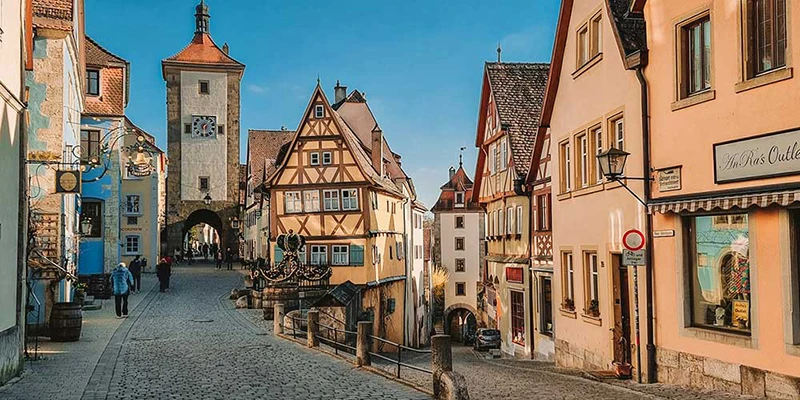
Next morning we leave on the 7:30 train to Frankfurt, just to make a quick connection with an all-day bus tour through the "Romantic Road," or "Romantische Strasse." This visits several medieval walled towns, beautifully preserved from olden days with cobble walkways and ancient architecture. Many shops for knickknacks and fast food in this classic old town of Rothenburg.
Rothenburg has some truly fascinating sites, with its old towers and gables dating back about 500 years. "No other German medieval town rivals the fame of Rothenburg" says the official tourist brochure, which has an excellent topographic map of the whole route.(Another one of hundreds of useful free items gained by sending many postcards out to the various government travel agencies beforehand. Often, these complementary maps I got in the mail were better than maps selling in local shops. A. few months before you go, send lots of postcards to the national tourist bureaus listed in most guide books, and be sure to mention that you want maps, and list as many cities as you plan to visit. You'll receive a ton of colorful information.)
In the heart of Rothenburg, at the town square, we walk right into a noon hour concert by a big brass band! That is lots of fun. I listen briefly to the tubas and trumpets, the trombones and drums, but want to get a picture of everything from above, from a tall tower of the adjacent old Town-hall, the Rathaus. Leaving the concert prematurely, instead of just hanging out and enjoying it, I climb the bell tower but get delayed by small crowd ahead of me. The narrow steps of our skinny tower are one-way, so we have lots of waits on every landing for people coming down. Arriving at the top fifteen minutes later--the concert is over but the aerial view of this old burg makes the climb worthwhile.
Rothenburg is like some kind of fantasy world, asleep for 500 years, to wake up and find one thousand tourists tramping around, including me. It's reassuring that this classic town, and many others like it, survived the firebombing of WWII completely untouched. A brisk walk atop the surrounding wall provides a fine look down upon the narrow alleys and rooftops, a symphony of orderly clay bricks and slate shingles. This is just my second walled city, after York in England, and they really are fascinating! A friend once mentioned their special quality, and since then I have looked forward to finding these preserved islands of time gone by. The wall. It created an internal unity of design, and repelled the onslaught of modernization. Even if there are many touristy trinket joints, and some fast-food slop inside, it maintains genuine charm.
There is a fabulous little museum here, specializing in torture devices and other bizarre criminal displays. Put the "Medieval Criminal Museum" on your list. See how they made punishment fit the crime, like the jaw-binding metal mask one had to wear for gossiping, or the huge fine you must pay for wearing clothing reserved to a higher social class. Your tailor also had to pay. Learn about life here in the dungeon.
After two hours clambering around, we're back on the bus heading for Dinkelsbuhl, another walled wonderland. Our bus guide is a mildly informative and friendly madchen, who lets us know this town is just a short stop, so we're soon on our way to Munich.
Munich
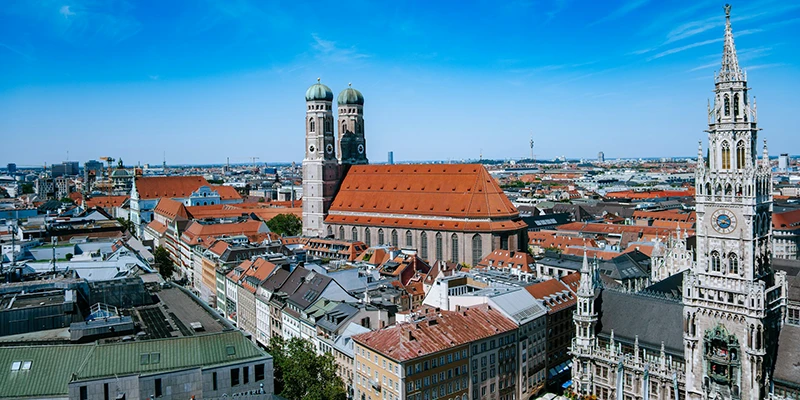
Beer drinking capitol of the world, with the highest per-capita consumption and most delicious brews, this is my major Germany destination. Southern Germans know how to enjoy life, especially here in the heart of Bavaria. Sausage, roast veal, dumplings, Leberkas -- liver cheese, bread, and beer!
Our tour bus drops us off at the Hauptbahnhof, main train station, at 7:30pm, ending a long day and especially tiring final two hours along the boring freeway. Despite rumours of conventions filling Munich's hotels, our first call scores what sounds like the best room deal in town--ten bucks each for a quiet spot one block from the station. We stay three days.
That first night, after resting an hour, Linda and I leave a sleeping Rollie behind--we're gonna hit the town. So where is the absolute best place to go on your first night in Munich? That's right, the biggest beer cellar you can find, which in our case was the most famous of all, The Hofbrauhaus. Magical things happened for us there.
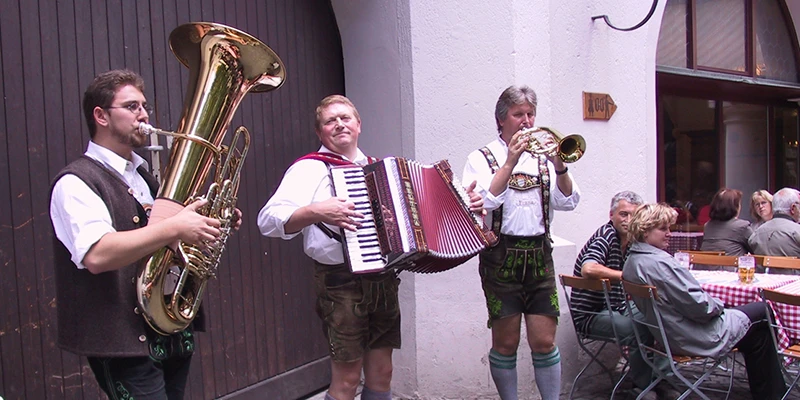
Ooom-pah-pah is playing, loud and lively from ten brass horns, hundreds of people half filling the cavernous rooms, many mugs at a_time transported through the smoky air. We are kind of dazed by this amazing place...sit with two locals, for one of the trip's best conversations -- in German! Friendly guys in their late forties, telling us about the war, and about now. The best part is that one fellow spoke no English, so he and I got by in German, me struggling mightily but having immense fun. We communicate, with frequent help from his pal who speaks a bit of English and is real interested in Linda, telling her lots of stories. Hours fly by.
Can you believe the beer glasses hold a quart? Huge steins are just the norm here, consumed in multiple numbers on suge a night. My German friend keeps saying "Deutschland und Amerika muss sussamen schtanden," over and over, "our two countries must stick together.... We are your best defense against communism." He's convinced that if Germany "went communist" the rest of Europe would follow. Disaster lurks at the frontier... ominous black clouds encircle.
He might well be right. We also had fun, light-hearted conversation about stuff like Hawaii; how much to tip, what to see in Munich - but then came back around for more revealing talk about WWII and the Nazis, who got started in this town's beer halls, its board rooms and army barracks. "Germany was the strong est country in the world by 1941. We were beating all the big powers at the same time--Russia, France, England, and America. No-one could stop us," he said with a fierce pride. "Hitler was not totally bad," he adds. I start squirming then singing "Deutschland Uber Alles" but he quickly stops my foolish move. He discusses how the war was a giant mistake, costing his nation over half of their territory. But "Hitler was a good man, a strong man." Oh well, finally it's aufwiedersehen time. Linda and I walk a half mile back to the hotel, along a nearly-deserted major pedestrian mall through the heart of town, from the Marienplatz to the Karlsplatz. Even in this dark, late hour, one can see Munich is a big impressive place.
Eager for the morning, I wake early and spend the whole day walking all over town. Rollie and Linda have other plans, like their laundry and some shopping, at a leisurely pace.
I head for the famous science museum, walking back along the same malls as last night, and a half mile further, arriving at this large building on an island in the river, which holds many technology wonders. The high point is an actual V-2 rocket and related buzz bombs -- awesome weapons which might have won the war for them. Mostly, this place is famous for working models of machines and laboratory experiments, enough to make you hair stand on end.
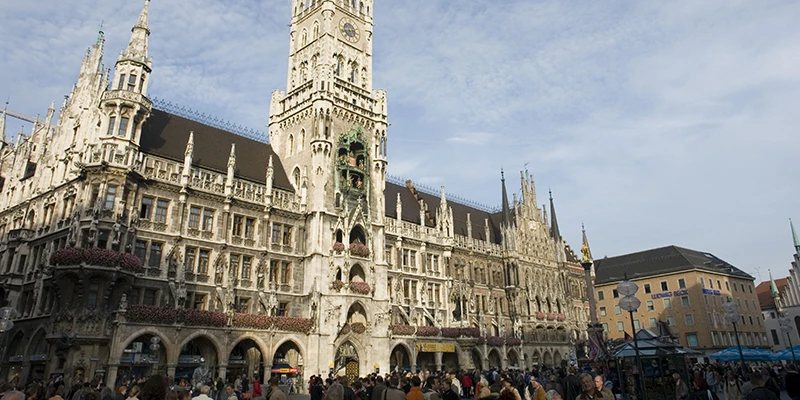
Back on the mall, it's time for a stand-up lunch of two delicious "weiswurst," white sausages served with bread on the side. Infinitely yummy and unique. Then out pops the glockenspiel, clanging bells, knights jousting, in the tower of the Rathaus, or town hall. Lots of visitors watching it on this warm mid-day, enjoying some early-Spring sunshine. I walk through a big open air vegetable market and beer garden, then catch a trolley and bus through the big park to Schwabing, the university section.
Now this is really my kind of place -- lots of sidewalk cafes, filled with university types enjoying a warm sunny afternoon, animated conversations flying between the tables. I walk along the wide boulevard, Leopoldstrasse, window shopping and looking for a girl sitting alone at a table. Take your pick: "Oh, guten tag. Kan Ich hier setzen, bitte?" She smiles, "Ja, naturlich." Hilga, an attractive madchen from Lindau originally, loves Munich. This is her big city -- "It has everything you could need," she says in pretty good english. I want to use my broken German and she is glad to help me, correcting the mistakes in a way that quickly teaches some basic phrases that help in the coming week. It's a thrill, because this half hour is the first time in my life I have actually conversed in a foreign tongue. This definitely intensifies the experience of being there -- being part of the place rather than just looking.
Later, I walk through the large urban campus and down narrow back roads, coming upon a small camera shop. Not really planning to further stuff my already crowded camera bag, but curious about the store, I go into the small spot. Several bored young clerks ignore me, then out comes the enthusiastic proprietor, who does a great selling job on me by discovering my tiny interest in small tripods. He launches into a full demonstration in German of the handy features of a nice model that collapses down to ten inches. I'm sold.
The hotel is a couple miles away, so I hoof it, passing many beautiful monumental buildings and statues, surrounded by parks and plazas. It's hard to believe that Munich was practically knocked flat by allied bombing during the war-then rebuilt in the old-fashioned way, using many of the same bricks, so you can't even tell the difference.
Take a rest back at hotel. Read more guidebooks. Get ready for big excursion to the all-night laundromat. Clothes, quite dirty. Dreamy afternoon nap. Re-supplies energy for big evening.
Munich's very efficient trolley system delivers me across town to the laundromat, located next to a tavern which helps the hour pass. That done and dropped off back at the room, I visit a few more of the major ratskellers, the big beer-halls Hofbraukeller and Lowenbraukeller. Wonderful old places of many rooms, but kind of quiet tonight, so I leave without ordering to search for more action.
My guidebooks all say Schwabing is the place to go at night for lively clubs and entertainment, so I head back to the scene of my nice afternoon. The boulevard is much less busy at night. Disappointing at first sight, but then I follow guidebook directions to the small streets nearby. Sure enough -- bars, discos, jazz ads, people on the sidewalks milling around. Not bad for a Monday night, but hardly the avant-garde scene of poetry readings and heavy political rapping mentioned in one guide. It's getting late, so after a beer at just one of the couple dozen attractive places, I'm gone, back to bed by 12:30.
Tuesday, the final morning in Munich is a mad dash through three museums, mail package, eat several great meals, catch train, visit Garmish and Oberammergau, and by evening arrive in Innsbruck, Austria. Things are speeding up.
Giving Munich full credit, it's a great city. This last day starts with breakfast at the train station cafeteria, highly recommended in Frommer for the liver-cheese "wurst" sandwhich. Fascinating to watch these Bavarians at breakfast, even now drinking beer.
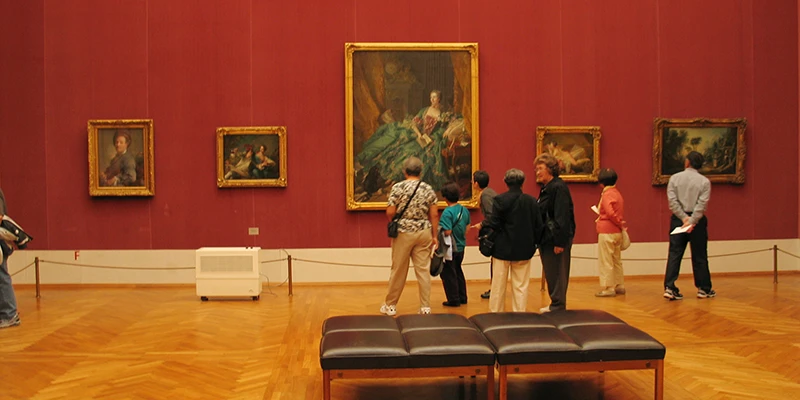
I get to the first museum by 9:15--the Neue Pinakothek. It has a wonderful chronological display, 23 galleries leading one through the nineteenth century with special attention to german artists: romanticism, neoclassicism, secessionists, and a good spread of french impressionists. Then across the mall to the Alte Pinakothek, for a 25 minute sprint past much older paintings, some of which are 25 feet high reflecting a grand baroque spirit you can throw yourself into. Too bad we have so little time for appreciating these masterpieces...now I literaly run to museum three, but Linda and Rollie can't keep up so we make plans to meet in one hour at the train.
The modern art museum, Staatsgalerie moderner Kunst, is well worth the rush, for it presents a quick ride through the 20th century in paint and sculpture. Walls lined with good pieces by Picasso, Braque, Kandinsky, Miro, Klee, Magritte, Dali, deChirico, and a nice chunk of American pop, Warhol, Stella, Rauschenberg, Segal, pulsating neons, rhomboid rumbas. A group of seven intense graduate-student types huddles in a cubist corner, locked in debate. I run away.
Hop a bus right back to the hotel in a big rush. Dash across the plaza, through the underground modern shopping mall to the train station with ten minutes to spare. It's lunchtime, so I visit the station cafeteria Frommer has been raving about-- pork cutlet, dumpling, potatoes, beer, very tasty and inexpensive , eaten quick while standing at a counter looking out the window for Linda and Rollie. There they are, we're heading south.
Oberammergau and Garmisch
On the way to Innsbruck, we stop a few hours at Oberammergau and Garmisch-Partinkerchin. The former is "alpine picturesque" with pretty houses on back streets, flowers blooming, apple orchards, mountains all around, fantastic painted church interiors, many trinket shops, but only a few tourists. I purchase several little wood carvings for which this town is famous. Also famous for the passion play, which is not on this year.
Garmisch is a small town, higher in the Bavarian alps, so you might like to think of it as some kind of peaceful village, but our strange train ride quickly dispelled that notion. We're in the same car with a bunch of thirteen year old boys and girls heading home from school--a band of screaming, wild, obnoxious monsters on the rampage. They are yelling, kicking, laughing hysterically, throwing things, piling on top of each other, practically wrecking the train. The conductor passes through and ignores them. So much for the tranquility of the mountains. We move to a quieter carraige.
Garmisch is bigger and not as old-fashioned as Oberammer- gau, so our plan for a one hour quickie here makes sense. We try, very unsucessfuly, to get a good start by collecting maps and brochures from the tourist office, but they are the most unfriendly "hosts" I ever saw, giving us absolutely nothing but a hard time. We push- blindly - into town for a fast walk that feels real good, and in less than an hour we're rushing back to the train station. Funny thing, a train is sitting there but it's ten minutes early, so we figure it's not for us we relax, hang out, buy sodas at the station snack bar, kill some time, use the bathroom--then realize at the last second hey wait that is our train, it's another mad dash.
Hurry up and wait, then rush again. We did it earlier that same day on the way to Oberammergau. After leaving those monster kids we found the dining car -- lovely, elegant, not crowded --a European experience. Ordering coffee, a dark aromatic brew, we decide to capture the delight on film, so I take some minutes setting up camera-and by the time it takes the picture, we're pulling into the station totally unprepared. Our bags are one car back, and we've hardly tasted the needed coffee--which is left steaming while we dash for suitcases and platform! A frustrating but funny and memorable little event. You try and learn not to do such things, but they happen all the time. It keeps moving along.
AUSTRIA
"Passport please." Crossing international boundaries again, this time into Austria, heading for Innsbruch, Salzburg, then Vienna--which many feel has Europe's finest architecture and music, accompanied by a sophisticated lifestyle which blends old and the forward edge of new. Real class. A great country, even if it has only 8 million people.
Notable aspects of Austrian history: saved Europe from a major barbarian invasion led by Turks, in 1683; brewed first coffee, from beans captured from said Turks; Mozart; Habsburgs, one of the largest royal families, starting in 1276 and continuing up through Franz Josef and Maria Theresa; birthplace of Hitler and first country to fall to Germany in WWII; currently neutral with a healthy mixed economy. Their biggest accomplishment was probably controlling the massive Austro-Hungarian Empire in the 19th century, dominating most of Europe. Don't forget Strauss family waltzes; grand opera; and high culture!
Most of this action is centered in Vienna, but before we can get there we're visiting Innsbruch and Salzburg for a couple days, on the way through beautiful alps--snow-capped peaks surrounding mountain valleys which lead us to those classic Gothic/Baroque towns. Each has a well-preserved "old city" comprised of original buildings with narrow cobblestone walkways, dating back about 500 years. Fantastic walking for many blocks in these pedestrian-only historic zones, lined with quality tourist shops and many fine eateries. Medieval signs of wrought iron, gilded and glistening from the late afternoon sun, hang out from each shop.
Innsbruck
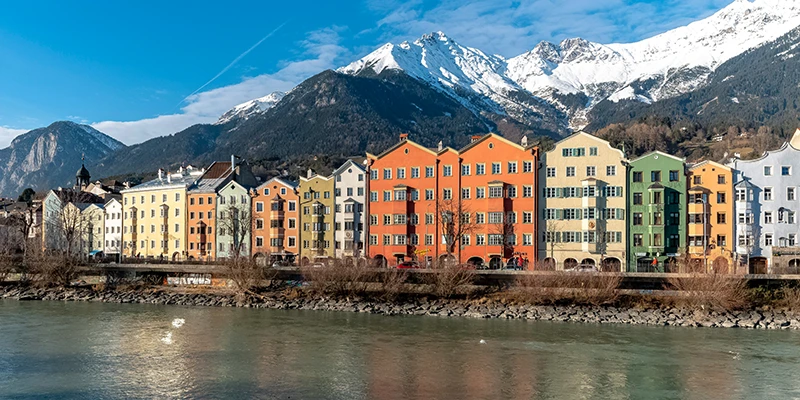
At Innsbruck, our first phone call lands a very nice small hotel, where the proprietor takes a break from his kitchen chores to check us in. The crooked passageways of this 400 year old building lead to my little room in the attic, a nine dollar bargain. We deposit our bags, then walk along the bridge over the River Inn to the heart of the medieval "old town." It's the best collection yet of ancient structures, built four and five centuries ago and still looking remarkably fit. Shops and restaurants carry on their lively tradition in spaces that opened before America was even discovered.
Our twilight walk through these narrow cobbled lanes is a journey in a different zone of being. This very plaza was the scene of medieval jousting tournaments--knights smashed off their horses, swordsmen clanging steel, wrestlers heaving and grappling--as depicted in relief sculptures on these surrounding walls. Kings and emperors watched from the royal gilded balcony, entertained as well by clowns and open-air theater. Nothing such is happening now, but it's fun to imagine over coffee and appelstruddle in a cozy tavern on the plaza.
Linda and Raleigh are ready to turn in, but when we get back to the hotel I join a lively gathering in the dining hall -- fifteen excited guys are watching a major soccer game on TV, Austria against Turkey! This is like the ancient battles fought all over again through the national sport. Only one of them speaks a fraction of English, so I get to try out my German during breaks in the game, telling these interested guys a little about myself and listening to some funny stories. Gallons of beer are consumed in the process of a night that keeps on going till Austria wins, 4-0. It was the next best thing to being at a packed stadium live, which unfortunately I can't make time for during this six week blitz into other priorities. Just one more important thing to do on a future trip. You cannot do everything at once, as much as I seem to be trying, so don't regret anything you miss. This attitude helps you appreciate more fully the experiences you do fit in. Of course that's obvious but it can bring a smile when you remind yourself.
Tomorrow is another whirlwind: Innsbruck, Salzburg, and Vienna, spanning the entire nation in one day, and saying goodbye to Linda and Raleigh. I'm still accelerating. Such nice people and places, I wish each could stick around longer. Sad to leave so quickly, but then something new keeps happening that seems even better. Take this one day for example.
Breakfast by eight, then a solo morning walk again through the "Altstadt," where I buy two souvenir wall platters of alpine scenery in relief, just like I always wanted, and some little knickknacks. Now with the bright daylight I can better see the amazing steep mountains that rise straight up from this town, which have made the place famous for hosting several winter Olympics. I wish I had time to ride the cable car for a spectacular view from the glaciated peaks. Instead I walk to the train station, through the more modern part of town alive with many shoppers, to meet Linda and Raleigh for the two hour ride to Salzburg.
We have an excellent train ride further into the Alps through several long valleys, passing a few scattered small villages -- traditional Swiss houses clinging to steep hills which rise into glacier-covered peaks. Strong sunshine is burning through thin high clouds, casting a beautiful light on this fine scenery. I take fifty pictures and get five good ones, including some with a strange yellow fuzzy border around them, created with yellow Vaseline on the filter. Gimmicks like that, and other special effects, can help jazz up a photo to make it different or at least unusual. Various color filters can enhance the mood of a picture, intensifying the effect on your eyes and feelings such as--warming up a mediocre sunset with an orange tint job...using a polarizer to deepen blue skies...a fog filter for artificial mist...a prism filter for multiple images. All of these need to be used, but in moderation accompanied to back-up straight photos without the special effects, to make sure some good images get made. There are many, many other tricks, like blur pans with slow shutter; creative use of flash, for bizarre colors, or as fill-in flash to complement the existing light. You can play with these techniques and be as bold or subtle as you wish.
The train car is almost all ours, shared with a nice couple from Australia who are looking for jobs here at some mountain resort. "We've already been working around here for a year, eh, as waiter and hotel maid, so we're just backpacking it until we lands us another job, mate," he says in that thick Sydney accent.
Salzburg
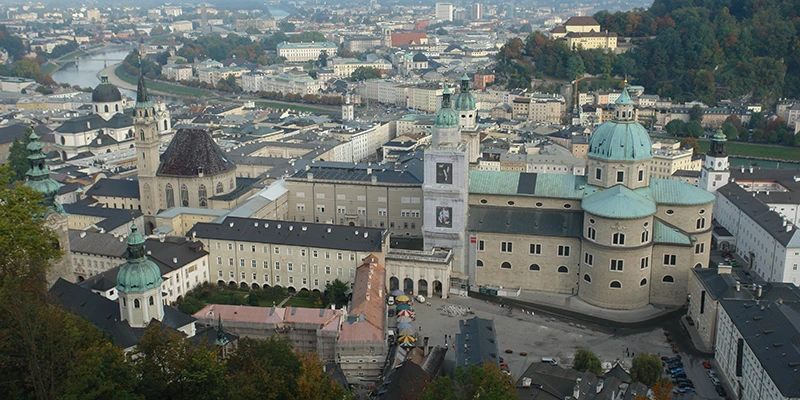
After two hours of rails we arrive in Salzburg at midday. Sadly, this is when Raleigh and Linda part company with my schedule, and we reluctantly split up. They're going to spend the night here, but I'm tentatively planning to just stay for the afternoon and catch a night train for that magic metropolis of Vienna! At this point I want to move much faster, because I've only got 10 days, compared to their twenty days remaining. In that brief time I plan to cover Venice, Rome, Florence, Cannes, Nice, St. Tropez, then finish up with Switzerland--Zurich, Luzerne, and Interlaken. An impossible task? We'll see. Therefore I don't have much time today to hang around Salzburg, unless something really interesting develops...and it almost does!
Salzburg is another grand old city, with a preserved medieval center twice as big as that in Innsbruck, and much grander--royal palaces, home of Mozart, a city overshadowed by the massive fortress "Hohensalzburg," and by the huge "Dom" cathedral at the center of the old town, "Altstadt." There is an all-pedestrian zone for many blocks here, its smooth cobblestone paths lined with fascinating shops in 400-year old buildings. Medieval iron signs hang above most of the shops, adding to the "time machine" impact of this historic town, almost like living in the past--except for the hundreds of very contemporary European tourists walking around, enjoying this place.
My schedule here in Salzburg is "slightly flexible" which means I might stay overnight if I can get a ticket to the opera or symphony. This is one of the world's most important places in the history of classical music, and it would be nice to experience the feelings firsthand--but such is not the case today. Both concerts are sold out. Oh well, it's a beautiful place to walk around in anyway, so the next few hours are wonderful.
The most exciting thing is meeting this nice Jewish girl from Houston, a jeweler on vacation with some bucks. We have a good time walking, talking, coffee, some laughs--it was probably the best chance in the trip for a ribald night, but she's too big and I'm too short of days remaining, with Vienna looming on the horizon. Aloha my golden lady, it was a lovely temptation but I'm outahere. Five hours in this little city proves to be enough, so I advance my tentative departure time from a ludicrous 1:45am to a more sensible 7:10pm. The rail ride to Vienna takes 3 1/2 hours, which is too quick to use it for an overnight sleeper, but just right for getting me there before midnight on the earlier train.
Leaving her, I hasten to the station and board a luxury car with a plush compartment I have all to myself, for a moment, when along comes this older Viennese couple to join me. While it is nice to have an empty compartment for relaxing on such a ride, it turns out infinitely better to share the trip with them. We talk for three hours--in German! This is a real highlight for me!! Good thing I caught this train.
My German is still very poor but their English is practically non-existent, so we get by "ins Deutsch." He talks slowly for me in simple language, and I can understand most of it! They are so gracious-the embodiment of what you might hope for on your way to Vienna. She kindly says I speak very well, which gives me a big thrill, but I sure wish I had spent twenty more hours back home brushing up on the vocabulary. They give me useful suggestions on what to see in their grand home town, and I talk about beautiful warm Hawaii, about my vacation, about how happy I am to be with them. The Berlitz phrase book comes in handy throughout our conversation. We share some of my wine and the 3 1/2 hours disappears.
lO:4Opm, arrive at the large WestBahnhof train station, alone again, here in Vienna!
VIENNA
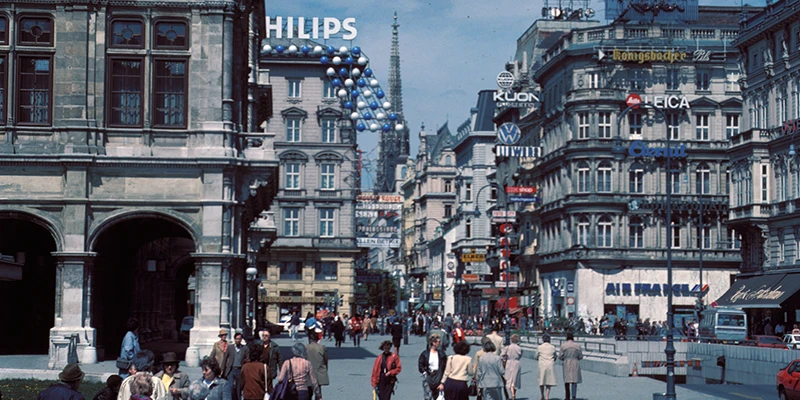
First chore, of course, find a hotel. Because it's so late I don't care too much about price for this first night in town. Frommer comes through again, with a list of places near the station that produces a good deal on my second phone call. A big hotel located right across the street provides my finest room of the trip--a double which I get for the price of a single, only $15- Feeling tired from a long happy day, but I've got to take a late walk. Have a peek at this urban legend... fabulous Vienna.
Slightly bizarre images appear on this short stroll into midnight along the Mariahilferstrasse, a major shopping street that my hotel sits on. First, I see two drunken young guys run right through the traffic to cross the road, not even trying to dodge, in the most outrageous jaywalk one could imagine. Then a huge, very tall, very fat lady, all dressed up in a yuk! cheap outfit with too much makeup, squeezes into the back seat of a tiny car driven by a semi-midget, looking like they just escaped from a circus. Quite a few hookers are out tonight, giving me the friendly sales pitch. All but a few bars and cafes are closed, and yet people are out walking. Three guys are actually sweeping the street, and several others are doing a little late night welding on the trolley tracks! Unbelieveable to see such activity. After a beer in a small tavern, with time to record this day's action in the journal, it is time for sleep.
Wake at eight; yes this really is Vienna. Bath in a giant tub down the hall, young maids chatting outside the door. I'd like to find a cheaper room and besides, this hotel is already booked up for tonight. I turn back to the telephone with my handy guidebook list. One place sounds especially appealing, a "youth hotel" with a casual communal atmosphere, so I land a room there for just $7. It works out fine, except for the cold shower. The tiny breakfast room is bustling with a dozen young travellers, semi-backpack types, exchanging stories about life on the road, life at home, one-minute biographies, who you are, what you're doing, where are you going next? I could talk for days with these fountains of travel information, but the real thing is waiting just outside the door.
This venerable old town makes a total impression on me. Do not miss it. There is a certain elegance in the air-- a feeling of genuine class that is not just put on for the tourist trade. It's the same feeling one gets in Paris but on a smaller scale, in a more old-fashioned and relaxed atmosphere.
Perhaps the classic architecture and urban design are most responsible for creating this charming effect. Also, the people seem quite friendly, helpful, and efficient (welding the trolley tracks at midnight!) It all blends together somehow as the product of a vast civilization with a deep history reaching back a thousand years, yet still evolving. One can imagine that a major city like this has Influenced the course of world development in so many ways, we have all been affected by it. "Oh yes, canned Vienna sausage" you might say. Yuk! No, I mean big things like keeping the barbarian Turk out of Europe in the l?th century--otherwise we might all be speaking Arabic and worshiping Muhammad. Being here, feeling part of it all, can make one seem more complete--connected with a time and place far from your narrow personal life.
One way to "be" Viennese is go to an opera, for music is central to life in this city. Incredible musical diversity here testifies to the cultural blends that have shaped Vienna into a world crossroad, for while I'm seeking an opera ticket I could just as easily go after jazz, rock, latin, brass bands, choirs, African, Middle Eastern, street musicians, gypsy, big band, you name it. What other city has been more centrally placed between the cultures of east and west, north and south? In this fulcrum, a unique culture has developed which seems best symbolized to me by opera, Even though I'm not a big fan, having never seen one in person, my first task this morning is getting to the ticket office and buy whatever seat I can for the grand opera.
Reaching the office, after a wonderful ride through town on the trolley, I read the sign in German that says "sold out." Undaunted, I step up to the counter and ask in my best broken German if there is one seat for tonight? Her answer is nearly incomprehensible, but it seems a few seats are left tonight and tomorrow at two different opera houses, giving a choice of four different shows, "The Barber of Seville," "Der Rosankavelier," "Die Entfuhrung aus dem Serail," and "Die Bettleroper." Good news, but confusing since I don't know much about them. I buy tickets for two shows, then change my mind and ask if I can trade them in for the other two. She's good natured about it, no problem. While this struggle to communicate is going on, two American guys who don't speak any German ask for my help, since the counter people speak no English. I'm delighted to be their translator, since it makes me feel almost local, not just another dumb tourist.
Tickets in hand, I turn around and do a completely touristy thing--climb on the bus for a three hour guided tour through town. It provides a good overview of this complex town and helps me pick out the best things to do in the brief couple of days remaining here. Our guide is quite the gentleman, filled with interesting stories about the many places we whizz by. We drive along the Ringstrasse, one of the prettiest boulevards in the world, circling the old inner city in a U-shaped route that is lined with trees and fabulous baroque structures-grand hotels, museums, palaces, restaurants, headquarters for government and business, parks and plazas. This incredible road, sixty yards wide, used to be the site of a huge wall that protected the heart of old Vienna from barbarian invaders, until it was ripped down by Emperor Franz Joseph in mid-ninteenth century to make room for the splendors you can find here today.
Next stop on the tour is the massive Schonbrunn Palace, fifteen hundred rooms big, decorated throughout with ornately gilded paintings, furniture, and carvings-surrounded by large formal gardens which I thought only existed in magazines and movies. This palace is nearly equal in majesty to Versailles, which the builders must have had in mind, especially when they designed the grand ballroom to outshine the Hall of Mirrors.
It helps to be part of an organized tour to properly visit inside this Rococo treasure house, so fortunately our guide leads us smoothly along through fabulous room after room, while telling us interesting stories about important events that happened here. It was the home of emperors, and the deathbed of the empire -- in 1918 Emperor Charles I sat in this very room at that desk and signed his abdication, which effectively broke up the Austro-Hungarian Empire. We pass through nearly fifty of these splendid rooms, but our tight schedule leaves no time to see the huge formal gardens set behind the palace. Our bus has disappeared, and while we wait the ten minutes for it to show up, passing the time with a little tourist chit-chat about ourselves and our vacations, I'm just thinking these ten minutes would have been perfect for a quick peek at that garden.
But then the bus shows up and we're on our way again, off to yet another palace, the Belvedere. Pluses and minuses of a three hour city tour: you miss more than you see, yet see more than you can believe!
During the twenty minute drive to the Belvedere Palace we go past many solid blocks of apartments -- a mundane contrast with the magic of downtown. A huge subway route is being excavated here, turning major streets into open trenches slashing through the outskirts of town. I'm sure in a few years it will be worth the effort, but in the meantime it's like WWII. Vienna debated for 20 years about building a subway, and now they are doing it, adding to the trolley system, which is excellent, rolling right down the middle of six main roads on light rails, mixing comfortably with street traffic.
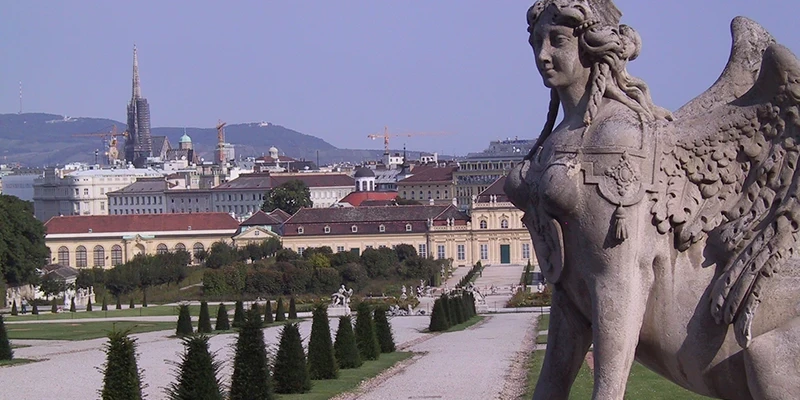
At Belvedere I finally get to see a large formal garden, but not the insides of the palace, reflecting a satisfying mirror image of the previous palace we saw what was it called?. These places tend to blur together after you've seen so many in a day. But here it's a grand view of the very long formal garden, which produces the best photo of Vienna, capturing the elegant feeling and order of this major city. Then quickly back on the bus this tour is over thank you very much. Our guide was so good I still feel a bit guilty for not tipping him as I scampered off the bus in search of food, quite hungry after such a full day.
The bus dropped us off next to the opera house, which is quite convenient since I have a ticket for a show starting in two hours. After a brisk walk it's easy to find a nice restaurant nearby, next to the Hotel Sacher.
I apologize to the waitress since by now I'm feeling a bit rushed with about one hour before curtain time, "Es tut mir leid aber ich muss, im halb stunde, zum oper gehen," asking as politely as I could in my busted Deutsche to be served quickly. We agree on delicious chicken crepes, which she delivers right away, with strong black coffee. Right!
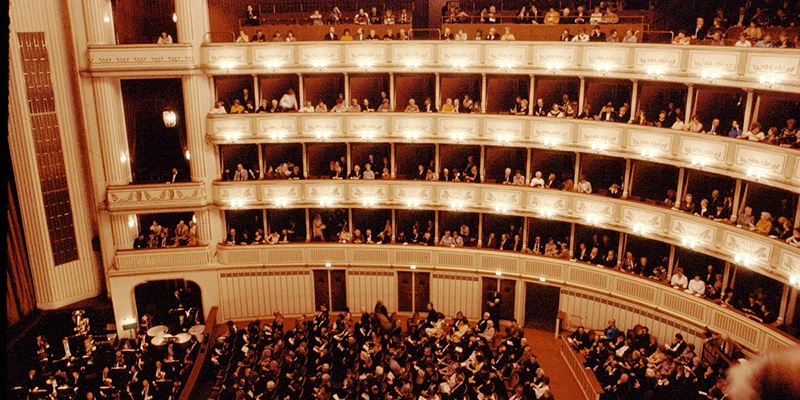
My seat at the opera is 'nicht sehr gut' on the upper side balcony with a view of only half the stage, as I was warned when I purchased the ticket. Besides, the opera is in Italian, so I have no idea at all what is going on in this "Barber of Seville" with my partial view. And yet... how grand to be in this historic theater, certainly one of the top five in anyone's world. Sitting near me in these low-cost lofty perches are several serious students of music, following every note in their monstorous books, 2,000 pages of libretto for many different operas. The theater is full of mature, well-dressed people.
By the first intermission I'm getting kind of restless, not knowing what's going on with the story, but more importantly, I feel like I am missing out on seeing Vienna at twilight. So, part of the way into the second act, I slip out. Walking down three staircases of the elaborate Rococo lobby, quiet and empty, I feel totally exhilarated, ready to take on Vienna at night.
The main pedestrian mall, the Kartnerstrasse, starts right at the opera and leads into the heart of the inner city. It's really alive with people on this Thursday evening, strolling along enjoying one of life's great pleasures -- the urban promenade! In such a grand place, crowned with a dark purple sky as the city lights blaze into the coming night, can a tourist hope for much more? Well, yes, let's try a stimulating conversation with local residents covering their life and times, followed by a passionate session with an attractive native. Unfortunately, such events are not easy to come by but since I am travelling alone I do manage to talk with local people every day.
Ten minutes into my stroll I run into two familiar faces--Linda and Raleigh! We split a few days ago back in Salzburg but now they have caught up with me and we have a good laugh at the small world. I'm glad to hear they are getting along fine without me, having landed a nice room for $8 each, as Linda says "with a lucky break at the train station when we arrived -- this lady comes up to us while I'm phoning a hotel and she offers us a room in her house, so we went with her and it turned into a good deal." That's part of the fun of travelling spontaneously without reservations, especially in the off season. Take a chance...go for it
Hugs and kisses with twenty minutes of talk brings the three of us up to date, then we part company again, for the last time as it turns out. It would be nice to pal around together the next few days, but alone I can throw myself more into the local scene and pursue only the exact things I want t o do. Maybe, probably, I'll see L & R again someday somewhere.
Walking further along the mall past the cafes, shops, and street musicians, mingling with the crowd, I come upon the most atrocious pop music ever played by six strung-out hippies, who have gathered the biggest crowd tonight -- about one hundred people circled around them smiling at what must be some kind of satirical rock and roll joke. This makes me hunger for the true essence of Viennese music -- the waltzes of the Strauss family. One good place to catch them, according to our tourbus guide, is a pavilion in the Kursalon dancehall where they serve drinks and free music. After a fun hour there listening to some yodelling and plenty of Strauss, sitting at a big table filled with Japanese tourists, I walk fifteen minutes back into the heart of town.
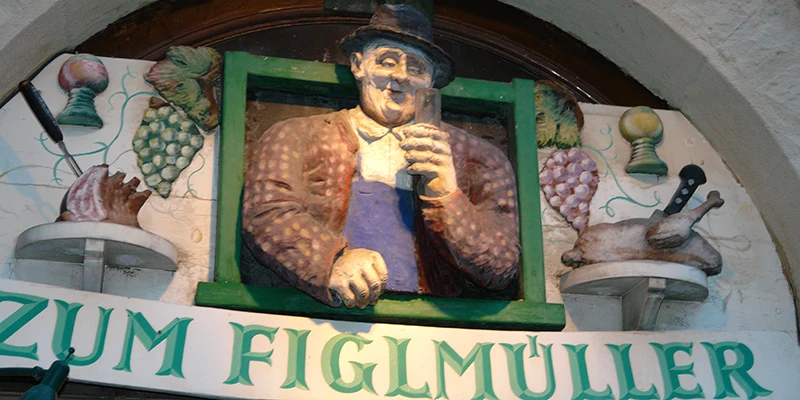
Wine cellars are supposed to be places that will deliver a good time, so I head for a famous one, "The Twelve Apples," searching through dark twisted back alleys to find it. Inside, you walk down narrow steps to three levels of basement activity with many people drinking and talking in their dimly lit cozy nooks. One can see why it has been a tradition for two hundred years. But me, I'm all alone and this is not really much of a place for mingling, so I sit at a little table and have a few, choosing a spot next to a table of twelve young ladies. I break out the camera and take a flash photo of them, and they squeel--then I say I'm from Hawaii and they start yelling. One of them climbs over the table at me, "vut ar yu dooing hier, vy yu take pikture?" She's real friendly and interested and I probably should have done something about it, but all I could think to do at the moment was give her my business card, because she said "ve all vant to go to Hawaii." I'm still waiting to hear from them.
Getting past midnight with a full day coming up, I climb out of the subterranean grape festival back to Earth's surface. The trolley stop is just a few short blocks away and before I know it I'm back home asleep.
Ouch! My only cold shower of the trip is a painful experience, but it sure wakes me up this morning as I prepare to hit the museums, pastry shops, and the major monuments of Vienna. Coffee is served in a tiny breakfast room of this "youth hotel" among some very interesting fellow-travellers from all over. I sit with Joe and Joseene, a nice couple from L.A. and D.C. who just met here yesterday. Within minutes we're into a close relationship, talking fast about everything, knowing it's going to end with the last sip. Wonderful/awful to come and go so quickly. They went to the same opera last night, paying only One Dollar ($1) for standing room, and they too left in the middle, sharing and validating my exact feelings.
This becomes another typical action-packed day, living at approximately ten times the normal speed of home. Consider this quick outline: major military ceremony in front of massive castle; tour the fourth biggest art museum in Europe; visit the giant natural history museum with no-one else in the whole place; fifteen minute dash through the culture museum; consume the world's most delicious pastry; two more museums; trolley to suburban wine garden; another opera; last-minute change of plans...bail out of hotel...gasp gasp...rush to catch overnight train to Venice!
More than typical: that may have been my wildest day ever in this life. And it only cost me forty bucks.
Here comes a more elaborate description of the wonderful details of The Day. I break away from that fascinating wakeup coffee talk and hop the trolley for a ten minute ride downtown to the Hoffburg Palace, a monstrous baroque government building that grew for a century into the largest structure in Austria, taking up several city blocks. It remains the political center of the nation, officially called the Imperial Palace. I arrive there about ten in the morning to find several busloads of Austrian soldiers lining up in formation, complete with brass band, getting ready to welcome the new ambassador from Rumania with full military honors. They put on quite a spectacle, marching ramrod straight across the plaza, allowing me to get some of the best photos of the trip.
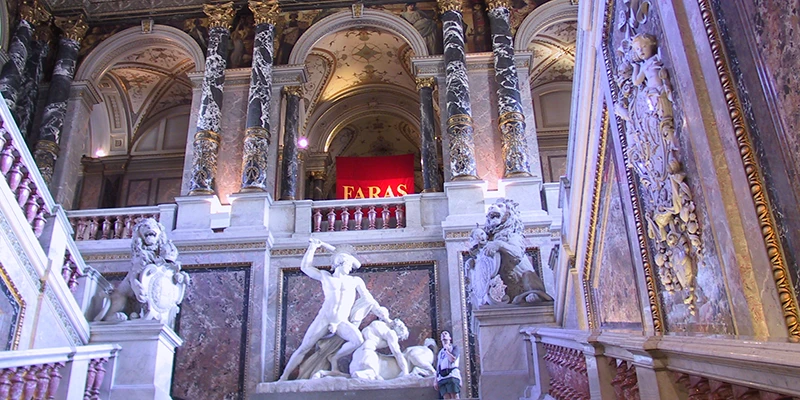
Next stop is the Kunsthistorisches Museum of fine arts, just across the park. My favorite room among many here is the world's largest collection of masterpieces by Brueghel, a starkly satirical painter poking fun at human foibles. Also impressive are the truly huge baroque paintings, twenty feet square filled with angels and biblical scenes. The entrance lobby is totally incredible -- a baroque masterpiece clad in colorful marble, with heroic statues and vast murals on the walls and ceiling, making you dizzy with beauty as you climb the grand staircase. Other attractions include lots of Rembrandts, Rubens,Durers, mummies with ugly black skin, delicate Greek and Roman statues, Cellini's famous gold salt cellar, and a thousand more treasures of the Habsburg Empire.
After this I walk across the park past the monumental statue of Maria Theresa to a similarly impressive building that houses the Museum of Natural History. This huge structure is open but appears completely devoid of visitors, which creates an eerie feeling as I rush past hundreds of dead stuffed animals in their ancient cases of thick distorted glass. The only other living flesh are the guards posted in each big gallery -- there must be twenty of them watching over me. As usual, the artifacts of primitive paleolithic man are included as "natural history," which somehow denigrates our close kin, early Homo sapiens, into the same category as the wild animals. Nevertheless, it's nice to breeze past the displays of chipped stone tools and Venus statues.
These primitive implements remind you how early humans were part of nature, so it's appropriate for them to be here with the stuffed turtles and rodents. My favorite part of this old museum is the vast human skull collection, housed in three big rooms showing the great variety of racial types. You can really see the differences around the world shaped in these bone domes.
I rush out, heading for the third museum in this neighborhood, housing an anthropological collection of tribal artifacts from around the world. But it's closing in twenty minutes, so I hustle back through the park and arrive with fifteen minutes to go. The entrance guard discourages me, saying "wir schlossen im funfzen minuten," so it might not be worth the entrance fee. Now it's time to pull out the trusted old technique of getting-into-museums-free-at-the- last-minute. You say,"Oh, Ich mochte sehen. Kann Ich frei gehen, als Ich habe kleine zeit, bitte?" (Can I go in free, since I have such little time?). "Ja, ja, gehen sie" they say with a smile to this feeble attmpet at German from a fractured American speeding tourist. So I quickly float through and see all the galleries--a panorama of the whole world. They're especially strong on Mexico and New Guinea, with many good carvings sitting out in the open for your appreciation.
Next stop is the old parliament building, which looks like a giant Greek temple -- pillars, heroic statues, elaborate fountains, vaulted pediments; the whole package in grand scale. As our tour guide said yesterday, "it is the most beautiful building of all." Marble figure of Athena crowning the peak sets a mood of philosophy, justice, and leadership, with many classical poses frozen in time.
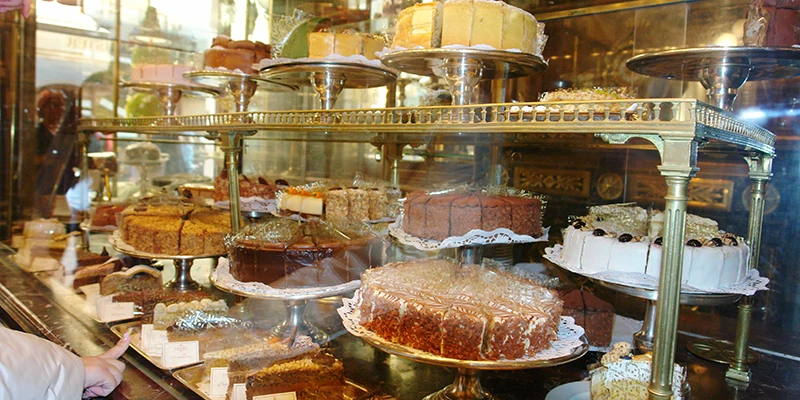
Demels has claim to the world's most delicious pastry-- the "sachertort, mit schlag," a chocolate fudge cake with heavy whipped cream, yes, invented elsewhere at the Hotel Sacher but found here too in all its glory. Truly a taste of paradise! I quickly grab a forbidden photo of the sumptuous cake display before the waitress is able to say "no, no photographs allowed." This famous Vienna coffee house was no disappointment.
It is a perfect warm Spring afternoon, sunny blue skies, great for strolling again on the main malls and people watching for an hour, taking some street photos. Then I head for two more museums--totalling five today--this time for Art Nouveau, and contemporary art. The Nouveau show is housed in a museum that has a temporary, astounding thirty foot high golden statue of a naked woman on the roof. Otherwise the show is merely OK, featuring 1890's furniture, jewelry, statues, and household goods, all in that organically curved style with floral motifs--sort of pre-deco, pre-modern; the brink of a new age.
A trolley ride brings me close to the contemporary art museum, but then I get slightly lost walking through crooked residential back streets. I ask a teenage girl for directions and she offers to walk me there, even though it's fifteen minutes out of her way -- very generous, one of my nicest helping hands of the trip. "Vielen dank, mein schatz."
Our walk together took us through typical residential streets of the city, giving me a more accurate and down-to-earth view of how it feels to live here. It's certainly less elegant than downtown -- the buildings are without rococo embellishments, but still quite nice. The only contemporary style building I see here is the chrome and glass train station, with its angular bulges sticking out in rhomboidal, cubist fashion. Very interesting. She knows "hardly good the English" so we talk in my equally limited German and walk in a real brisk pace to the art museum. I give her profuse thanks and danke schons for the help in finding this out of the way place.
It looks like a giant classical mansion from the outside but that is deceiving--the inside is jumping with wild modern art featuring big names: Warhol, Segal, Rauschenberg, big-league stuff. Their Cartier-Bresson show I was looking forward to consisted surprisingly of watercolor paintings, which was disappointing at first to one expecting his photos; but it shows his wide artistic range, and besides, that's what he's doing now since giving up photography. That makes four museums today with one more to go, the Art Nouveau show: the 1890's in art, clothing, furniture, and jewelry displays, with plenty of wall graphics telling the history (but it's all in incomprehensible German).
Leaving that place after a twenty minute sprint, I've now got a liesurely hour and a half to get to the opera. Just enough time for a late afternoon trolley ride to The Grinzing for some "heurigen," the fabulous outdoor wine gardens at the edge of town. They serve fresh wine, which contains half the normal alchohol yet tastes delicious and alive -- you can enjoy more of it that way. Too bad for me though, a couple of things: I only have twenty minutes allotted for here, which means no time to eat or have more than a single big mug of the grape. But worse than that, I'm starting to feel a bit lonely sitting by myself in this romantic garden cafe. So it's just as well to shove off and get to the opera.
As usual, my timing is perfect, which-means-it's-a-big-rush-to-get-there-at-the-last-possible-minute, after packing in everything you possibily can before you arrive. I get off the elevated train at the stop for the "Volksoper" with minutes before curtain time, but I don't know where the theater is.
Totally lost for a moment...I ask these two guys for directions, and they kind of laugh at me while pointing to the big building right across the street, which puts me in my seat just as the lights go down.
This opera is totally different from last night: The theater is smaller, plainer, and the audience much, much younger. Also, the story is simpler and easier to follow, with talking and singing in German rather than last night's Italian which I couldn't follow at all. It's a Mozart piece called "Die Entfuhring aus dem Serail," or we would say "Escape from the Seraglio," A WONDERFUL STORY: lovers, tragically separated by an arabian pirate who kidnaps the girl from the harem--and then, re-united by heroic exploits! lt is slightly reminiscent of the rescue plot in "Comedy of Errors" back in York, England, but the audience here is much different and more amazing....
The audience up here in the balcony is mostly young people of high school age, who impress me to the limit with their good behavior and elegant looks, dressed beautifully in tuxedos, suits, gowns, and other imaginative outfits. Even the small kids sit quietly and pay close attention to the story, laughing and clapping at the right times. I can't help but compare this sophisticated youth with the product back home, surfers and punks who will never see an opera or anything like it. Of course, Vienna too must have its share of lowlife, and my home has some people with style and class--but this balcony is a reminder of the higher levels of enlightenment one can achieve. These kids are getting a nice head start. Yet, their innocence shows during the intermission where the boys stick together as do the girls, while downstairs in the large bar the older folks are mingling, drinking, smoking, and talking up a storm.
After the opera, the subway delivers me back to the main train station, the Westbahnhof, which is the closest stop near my little hotel. Walking through the station past the arrival and departure boards, I notice that an overnight express to Venice is leaving in 40 minutes from the other big station on the south side of the city...hmmm, maybe I could catch it if I put-on-another-big-rush-go-go-go. My plan was to depart tomorrow morning -- but I can gain a whole day by Leaving Right Now! Another sudden change at the last minute--Go For It!
Only forty minutes. I run the five blocks to the hotel, knowing that nothing is even packed yet, with my stuff thoroughly scattered around the tiny room of course, since everything has found its way out of the bags during this relatively long three-day stay in one place. Within two minutes I shove it all into the bags. The fastest packing of my life. Quickly exiting the hotel, I don't even have time to say good-bye to that very nice American couple who are sitting up this late in the coffee room. The seven dollars I've already spent for tonight's lodging is wasted, but a small price to pay for the extra day it gets me.
Now it's 10:40 pm. The train leaves in twenty minutes and I don't even know where the station is, let alone how to get there. My only hope is to find a taxi, which shouldn't be too hard since I am right on a big street. Sure enough a cab comes along--jumping in babbling German, "please rush at the South Station-how long will it take-my train go in fifteen minutes." "No problem," he says, "you'll be early." Whew, what a relief: The plan worked!!
Sudden changes that succeed can be so exhilarating. A fresh start. New opportunities. Unexpected stimulation. Serendipity strikes again.
Ten minutes early, I have time to buy a bottle of wine and sandwiches in the lively station cafe. Get on board and find a whole first class compartment to myself so I can pull the seats together, forming a giant comfortable double bed for the seven hour overnight ride. The wine, food, and smooth sounds of the rolling train quickly have their effect -- a lull sets in -- my excited rush dissolves into a deep sleep.
Deep sleep...very comfortable here on the train.
I wake up the next morning for sunrise -- it's the Italian Alps, the Dolomites, spectacular! Absolutely beautiful! One of my best moments ever, not just because of the beauty, but where I am and what I am doing, speeding along to Italy. Snow-covered peaks tipped with pink dawn, train down deep in the canyon. After a seven hour snoozy ride, a great rest, Venice is coming up.
ITALY
Venice
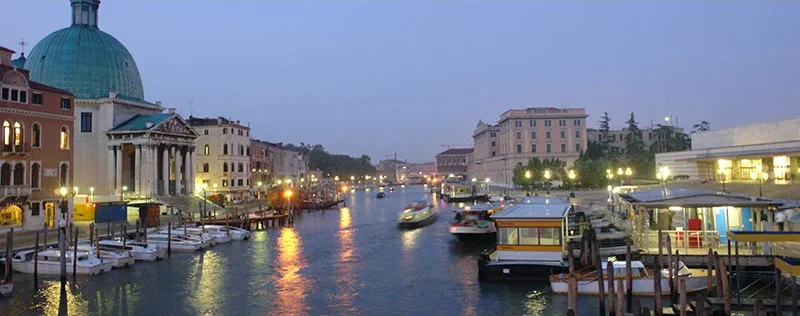
As we roll in, the train station sign says "Venezia-Mestre," so I grab my bags and get ready to hop off when a voice says "no, this is not Venice." She is just down the narrow corridor, smiling in a helpful way that prevents my premature departure. Maria "from Central America" has been through here before and knows the ropes. "Stay on" she says, "Venice is coming up in ten minutes." She's right. Before I can tell you about Venice, the "most beautiful city in the world," let me just mention that after saying goodbye to Maria and her boyfriend at the station I ran into them again six days later in another country, along the French Riviera at Nice, as you will hear later towards the end of this epic odyssey. Chance reunions like that turn strangers into long-lost friends.
Venice, the most dreamlike place I've ever been. As you leave the station after the usual hassles about waiting on line to change your money and check the bags at the luggage room (yes, embarrassing confession, I'm only staying for the day then moving along tonight on my second consecutive overnight rail ride, to Roma) you walk onto a broad promenade fronting The Grand Canal smack into the watery essence of Venice. This is a great and perfect city arrival, with a view down the canal lined by ancient palaces and mansions. Many gondolas and boats dot the water, which does not look at all polluted despite dire warnings of flotsam and jetsam. Everything here is truly beautiful, instantly, and smells great.
Presto, I hop the water bus to San Marco Plaza, squeezing on by preventing some Pushy Italians from getting past me, instantly getting into the swing of things in this sometimes-pushy country. It's a 35-minute ride down the Grand Canal to the great Plaza, the only true "piazza" in Venice. The giant bell tower looms over that famous open space called "Saint Mark's Square" in English, or better yet, Piazza San Marco. Hundreds of people are walking about, enjoying the largest pedestrian mall I've ever seen. Venice itself is probably the world's biggest pedestrian-only shopping center, a place devoted to people and pleasure.
Walking, of course, is the best way to see any European city, but here in Venice it's the only way -- and you get extra benefits that no other place can deliver. This city was made for walking, with narrow lanes, low-rise buildings, numerous open plazas and outdoor cafes, and most importantly, no traffic. Just a few little boats here and there gliding silently along the intricate network of one hundred canals.
There is no modern architecture in this town of ancient buildings. Total historic preservation creates the illusion you are back in the days of Byzantium when Venice ruled over the world's largest trading empire. It's an orderly hodgepodge of connected structures combining Moorish and Christian design --plenty of domes, pointed arches, colonnades, mosaics, frescoes, guaranteed to saturate your eyes with beauty.
I wander around Venice a bit, then stop for lunch in this tiny corner cafe--my lasagne is served immediately, deliciously. While eating I draw a very complicated walking route onto a detailed map, based on the directions in the "walkers guidebook." This becomes a perfect tool for seeing as many different areas and sights in the one little tiny day I've got here, as I'm planning to leave tonight at 11pm on a train for Rome.
Fortified with that fabulous lunch, and guided by the wiggly line on the map and pages ripped from the guidebook, I have one of the most amazing days ever, really, in a trip filled with them let me say it again -- amazing. The peeling plaster, old bricks, pastel walls, lush balconies, iron railings, kids playing soccer, plants on ledges, laundry hanging over canals, piazza after piazza, tiny alleys, churches, statues, fountains, cobble walks, and lots of people, local as well as visitors, all blending into one of life's greatest experiences.
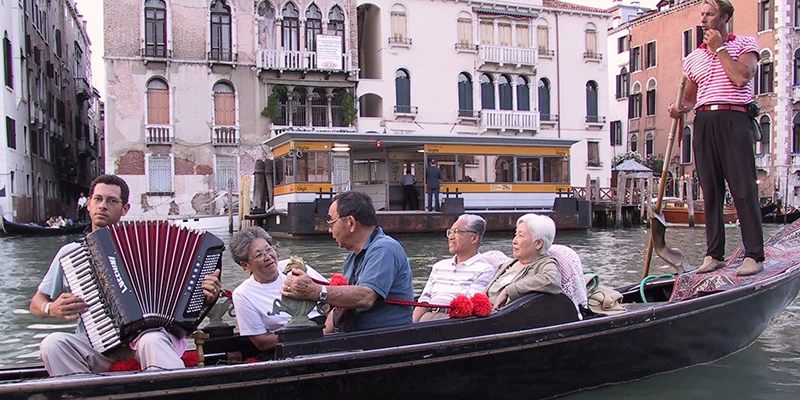
A singing gondolier glides by in this narrow twisting little back canal. He's belting out a powerful number, backed up by the accordionist, and the sound is amplified richly by these ancient brick walls lining the waterway. It's like watching a movie, or that spot on the Today Show when they go to Italy, but much better to be here now, in person.
By the Rialto Bridge, which is certainly the most magnificent of the three bridges crossing the Grand Canal, I spot a wedding party in a shiny black gondola, with friends on shore clapping. About twenty gondoliers are lounging around here by the bridge, talking and eating in some of the little places nearby. A great spot for hanging out.
My tour book and map work well, so I can navigate through some of the most crooked twisted paths ever laid down. The route gets me around the inner "peninsula" and across the Grand Canal to the outer perimeter so I get a good over-view and cross-section of the whole place. But still I only touch less than five percent of the total paths. This place is huge! And really fun!
I have coffee in an outdoor cafe, sharing a table with a couple from Long Island, my old home. They are both interns in The Bronx, enjoying a belated graduation reward in Europe. Nice people. I suggest to them the chamber music concert this evening, and sure enough I do run into them at the show, which is a performance of Bach by solo violin and harpsicord. Splendid music! My first real chamber music in classic setting, a small concert hall seating 250, very elegant, very old. While enjoying the music immensely, I do feel like a slob since all the other men have jackets and ties compared to my T-shirt. The other Long Islander also had the pits on-standard poor- student T-shirt dungaree outfit. All day I felt out of place since it looked like I was the only person in town wearing a T-shirt. Nearly everyone else was very well-dressed, completely attired in splendid designs.
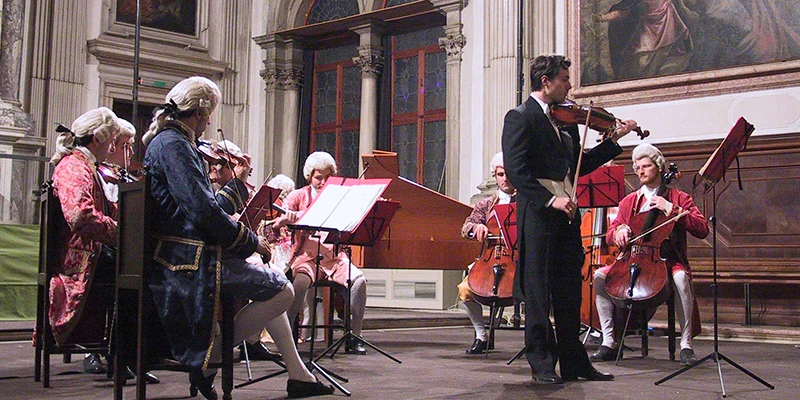
Before the concert began while I'm sitting comfortably, glad to be off my feet after such a day, I can't help but eavesdrop on the couple behind me who are having a most amusing conversation in which they make up stories analyzing the people around them: "there's a rich old guy on a first date with that Florentine model...a German couple on their second honeymoon...college kids from Iowa...two farmers from Perugia...tone-deaf lounge-lizard from LA" in a steady stream far more entertaining than my snippets. You had to be there.
Bach. Finally I meet up with him on his 300th birthday in this ancient little theater, a side-chamber in the Fenice Opera. The violin makes such beautiful sounds with long runs up and down the scales. Music that make you feel like heaven...paradise, or as close as one can get.
Unfortunately I cannot stay until the end of this rather long concert. My train is leaving in one hour, so I quietly sneak out in the brief pause before the final number, sorry to leave this blissfull experience. But I have to get moving because reaching the train station will be very difficult -- a confusing walk along dark back alleys, getting slightly lost, but I reach the ferry-bus landing OK. While waiting ten minutes for the boat, I hear the wonderful music of a dozen singing gondollas drifting across the water, their little lanterns bobbing rhythmically in the black ripples.
These heroic efforts get me to the train station a little early, so I am able to grab a nice 1st class compartment for myself, shut the curtains and turn the lights out in hopes no-one else joins me. It works, and I am able to extend the three seats out into one giant bed -- luxurious to the extreme, covered in soft red velour, the world gliding by underneath as I enjoy a fabulous deep sleep. It's my second consecutive overnight train ride, and delivers another good rest. If you avoid the summer months of crowding, you can generally get your own overnight compartment, at no added cost, on nearly all the major train lines. This is like having a travelling hotel room that carries you in your dreams to a different city to wake up in.
ROME
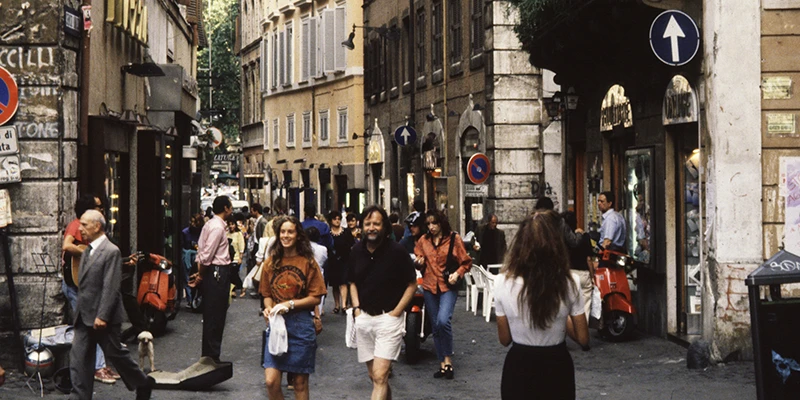
Rome! The most hectic place yet... Vibrant... cars, trucks, scooters and people flying by: It all stops for three hours in the afternoon, then comes back for more in the evening.
Somehow this city seems more active and alive than any other city here or in America. One big reason for this apparently brighter life in Rome is the first prolonged sunshine of my trip, now four weeks old. We are in the springtime of early May, temperatures on the sunny side of eighty. Almost perfect, slightly too-warm weather, a great change from the cool grey of last month.
And yet, the frenzy... yes, that's the best word...near disorder of this fascinating world capital. It's not just the sunshine. This place is bursting with action-things are going on here. There are also hundreds of important ruins and preserved structures from ancient times, giant museums, seven unbelieveable churches, historic buildings everywhere! Also, Rome has the best food!
Our train pulls into the giant "Termini" train station at the heart of Rome. It's early Sunday morning, about seven, so not many people are around in this vast space, -- a covered plaza about the size of a football field--that's soccer over here, Europe's national sport.
First goal is to get some espresso at the big cafe, about the only thing open here at Termini. I notice two guys being booted out of a near-by table because they didn't have any Italian money yet. Canadians, just arrived overnight from Morocco. So I invite them to have some coffee, which they gladly accept, since there's no place else to sit in this huge platform mall. They're from Prince Edward Island, a rustic spot well above New England.
"We left most of our luggage back in Nice two weeks ago, at a hotel we stayed at," says Peter. "The boat ride across the Mediterranean only cost eight American dollars, and was well worth it." He described how the bazaars are these immense open-air markets that dwarf nearly all of Europe's pedestrian malls that I have been most fascinated by. Some future trip I will have to include that sunny desert coast, along with Spain and Greece, which everyone keeps raving about.
Next step is finding a hotel, so the three of us look through my various guidebooks, scanning for deals. At the same time, various Italian characters are coming up to us with suggestions left and right for their hotels, flashing color brochures, wearing bus conductor hats, "this is the best you can find, just around the corner, come I show you."
Somehow I feel more comfortable using tips from the American guide books than from these anonymous street people. So I get on the telephone, after spending ten minutes looking for the phone tokens you've got to use here. It's the standard train station arrival routine. Wonderful confusion, with positive results.
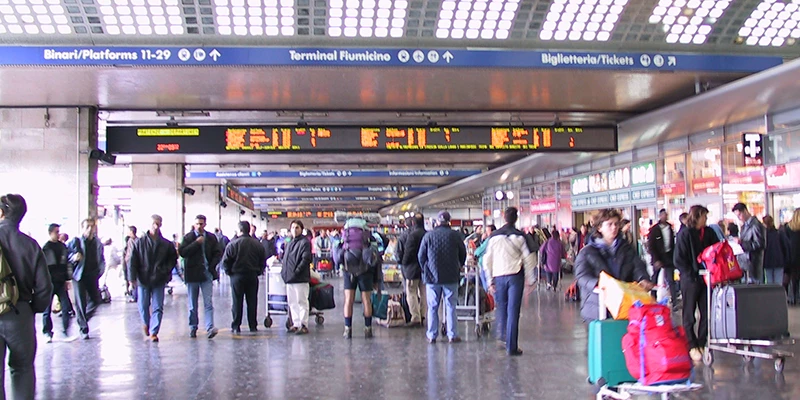
Frommer especially recommends the couple of streets to the left of the station as you walk out for finding the best hotel value, called "pensionnes." We spend about thirty minutes on the phone, trying to get through to anything nearby and good, struggling through the big language barrier. I find what sounds like a good room, while the Canadians go for a good double in another part of town, so it's "aloha."
A brief meeting follows, in the money-changing line, with a nice American girl who is lucky enough to be staying with friends here in Rome. That would be nice, but so is my hotel.
The Pension Sonya works out just fine, although the price they told me on the phone was a bit less than the price actually charged, but then, I probably didn't hear it right the first time. It cost about $18 per night, still a good deal. Many prices in Rome are reasonable, especially the deals I got at the Sunday flea market, which was my very next move after checking into the hotel. What a flea market!
Rome's flea market turned into the best shopping bargain of the entire trip -- certainly the lowest prices, with lots of good-quality new clothing, like a jacket for ten dollars, and cotton shirts for three dollars, plus lots of miscellaneous junk. I spent all my Italian currency right there, about $80, and--my biggest single regret of the trip-, I wish I had $300 more to spend at the time, for a ton of ultra-contemporary, cool, cheap clothing. A"two-year supply could easily be purchased on the spot for relative peanuts. Another bargain I enjoyed throwing $20 at was the antique reproductions of little bronze statues and ceramic jugs.
By one o'clock all the merchants start taking down their booths, and soon this once-a-week phenomenon is packed up and gone home.
So am I, back to the Pensione Sonya for siesta. First, a twenty minute walk from the flea market to the subway station, through a slightly boring neighborhoods-nothing much happening here on this warm Sunday afternoon.
There is one fascinating sight right near the metro station--Rome's only pyramid, a marble beauty about eighty feet high dating back 2,000 years. Actually, back at the flea market you can see some other spectacular ancient ruins, especially the big ceremonial arch that forms the entrance. One has the feeling this site has been used for eons as a marketplace.
It was a tiring first morning in Rome, so I am real glad to be able to get a solid snooze. I like this old hotel -- small, quiet, in a central location two blocks from the Termini, where all transit lines converge.
Rome's public transportation system relies mostly on buses, helped out by a subway with two lines crossing town. The buses are usually packed to bursting with people. The huge open area in front of the Termini forms the biggest bus station I've ever seen -- it has about fifty buses coming through at a time. With typical Italian inefficiency, there's only one ticket window for the entire extravaganza--so you buy the ten-trip ticket instead of waiting on line every time.
Late afternoon, after my nap, I try to buy such a ticket, but the man behind the window refuses to take my large bill, worth about $50. Oh well, I could use some espresso to help wake up anyway, and the cafe doesn't mind taking my money.
It's 4:30 in the afternoon. What should I go see? I don't know Rome! How about the Via Veneto, which all the guidebooks list, a swanky expensive three block long strip of sidewalk cafes. It's OK, but not really worth two bucks for espresso to sit and look at wealthy old tourists. A month after I was here a terrorist bomb killed a few of them.
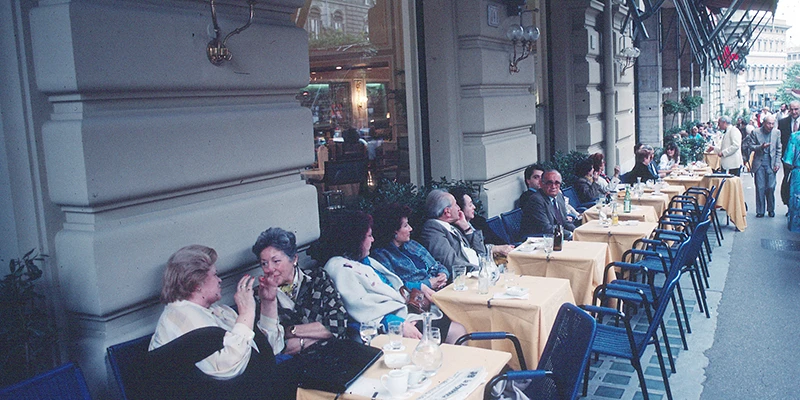
Strange behavior from the over-priced waiter in this fancy sidewalk cafe: I pay with a 5,000 lire-note, about three US dollars for the tiny two-buck cup, hut he claims he doesn't have change for it. Like right, he doesn't have a dollar hack there somewhere, sure. This guy is just trying to hijack me for a dollar tip, even though I had to wait a long time for this rude service. He thought he had another dumb American tourist here. Wrong. When he goes back inside I simply walk away, with my money. Romans love to bargain, but that was ridiculous.
What to do next? This Via Veneto is only three blocks long, lined with similar-looking cafes that only can hold my interest ten minutes. I head from here to the Trevi Fountain, one of Rome's most popular places to hang out and meet people.
Indeed, plenty of Italians are mingling in. the piazza around this beautifuly-carved baroque fountain. It's very lively. Late afternoon seems to be" a good time for it, but mid-day is nice too with lots of sun shining on the shooting fountains, although fewer locals are around then. I eagerly toss my coin in because I definitely want to come back to Rome--what a great place. Increasingly, the most "exciting" city of the trip.
Getting hungry in delicious anticipation of more pasta feasting: it's my favorite kind of food! Who could do it any better than these Romans? One of Frommers favorite restaurants is located two minutes from the fountain, and produces one of the top-three meals of the trip! Excellent, mouth-dripping goodness: cannelloni, cheese, fried beef with salad, beer, fresh fruit', espresso, all served presto, quick happy waiters, low prices, and it was all so easy to order, despite the ever-present language problem. Thanks to Frommer's recommendation, I just said "Venezia." The appetizer arrived ten seconds later, some mighty tasty antipasto. (Once again, you might notice I am not telling you the specific name and address of the restaurant, because this is not a guide-book laundry list. Such books and web listings are widely available, and absolutely essential for the traveller to study, but they differ from this more personal account of the main highlights, and we know how quickly restaurants can change from good to catastrophe and vice versa -- so look it up yourself with the latest information.
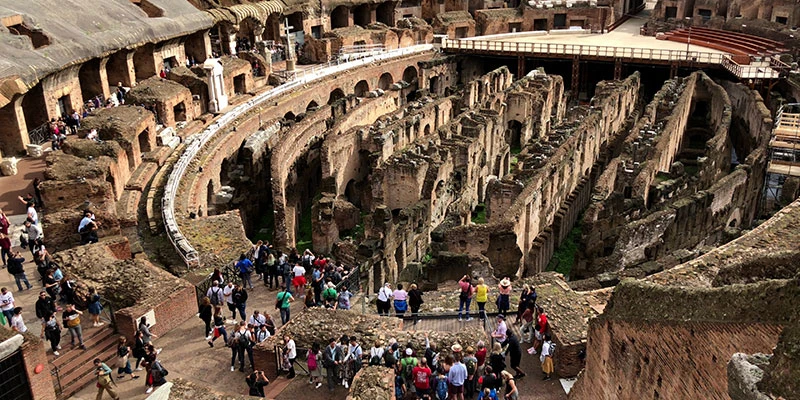
Another major attraction to try and catch on this first day in Rome is the C*******, that's right class, the Colosseum. By the time I get there it is late twilight, with the massive monument looming supreme in the dark purple sky. At this hour one can walk all the way around it and not see another person. It's nice to be alone here so you can contemplate the incredible kinds of events that took place in ancient days. Curiously, it was not used much for sacrificing the Christians, but instead for extravagant battle, displays: between gladiators; or fighting lions and bears; or how about full-scale naval warfare in the flooded amphitheater, with a labyrinth of rooms and passageways under the artificial sea. If it rained, or was too hot and sunny, a giant roof was pulled across the top forming a kind of domed stadium that seated 60,000 screaming fans!!
This has been a long and very enlightening day. A quick tour through the heart of Rome. But now I am tired so it is back to the hotel and to sleep.
Next morning. Monday. While looking for the right bus to the next most important stop, St. Peters, I meet this Japanese girl who is also heading for the Vatican. We team up for the day, and meet again the next day, seeing Rome together. Kayoko is her name, a native of Tokyo.
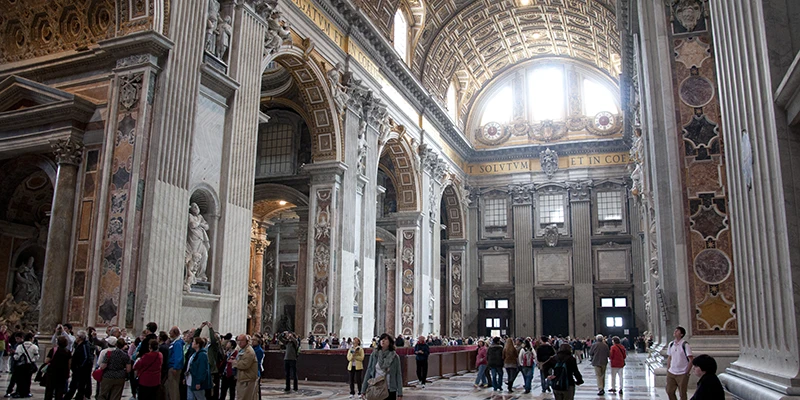
We do have a great, busy day. St. Peters is totally overwhelming. This is the winner of my award for the "greatest room" ever built. It is certainly the world's biggest church. Awe inspiring, even for heathens. It is SO BIG! Wonderful. A, peak experience by far. Probably the only larger interior space in the world is down Florida way at Cape Kennedy in the Vehicle Assembly Building. This church has a big room! Plus, it is filled with two hundred statues carved in precious marble of all colors. Too much. This place is -- too much.
It is worth walking the hundreds of steps up the dome for a view of Rome you just can't beat.
Next move is into the Vatican Museum, which sounds easy here in this tiny principality, but turns into a long, hot, fifteen minute dusty walk. The trip is well worth it. It has the world's 'greatest' collection of "ancient sculpture." Roman statues of all kinds, pure Etruscan gold, priceless jewelry, intricate carvings, treasures that will dazzle you.
The famous ceiling of the Sistene Chapel, and walls, are marvelous, but the long halls of sculpture are even better! It is fun to have someone to talk with about it, and Kayoko is very perceptive. These statues go on forever, in the longest halls I have ever seen, maybe 1/2 mile straight through.
Out of there after three perfect hours, we look for lunch -- and find a Frommer spot on a narrow noisy dusty alley, behind an unmarked inconspicuous door that is covered by the ubiquitous Rome red dust. Everything in this city is covered with a thin layer of red dust, or at least a red tint. Without the guide book we would have never known it was a restaurant from the clouded exterior. Inside was another story.... another winner!
Great food! We had the place to ourselves. It was siesta time, about two thirty pm: all the shops outside had closed down already for the afternoon, and nobody was around in this sleepy backstreet downtown neighborhood. The restaurant could hold 25. but it was just us and the old lady, who brought us a fabulous lunch. A perfect meal. Egg noodles, meat and tomato sauce, veal cutlet, salad, wine, plus I ate half of Kayoko's noodles with bacon-cheese sauce. This high octane fuel provides the after-burner that gets us through the afternoon in place of the universal nap. We use that pasta energy for a walking tour through the center of Rome.
This is a very old town, founded about 2,500 years ago. Most of the current buildings go back several hundred years. They certainly have that aged look, a dirty patina on brick and marble surfaces, worn out around the edges. Many different architectural styles have been built over the centuries, and somehow they all fit together comfortably here. Most outstanding of course, the styles for which Rome is best known are the Renaissance, and the ancient.
As we walk through this maze of history we see many fine sights: old piazzas, miraculous churches, cool fountains every few blocks, sleepy shops scattered in residential neighborhoods, local people hanging out and taking it easy.
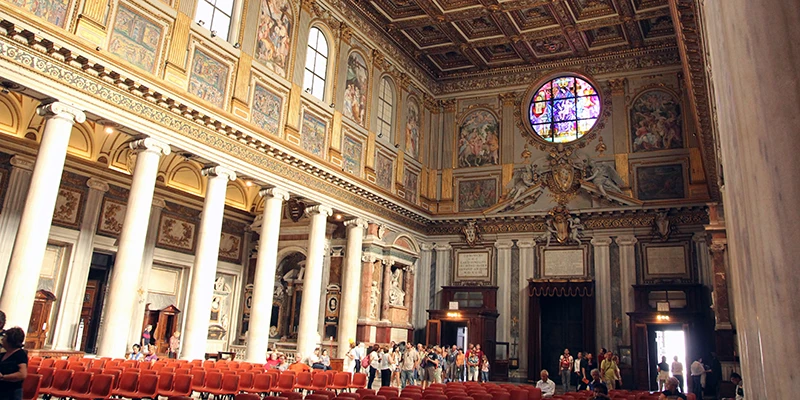
Some of the most astonishing sights here are the painted ceilings in the major churches, and their many statues, all housed in stunning architecture. St. Peters of course, so huge, so vast -- the world's biggest church --undisputed champion. Other big churches are Santa Maria Maggiore, Church of St. Paul, and Church of St. John Lateran, plus a score of medium-sized masterpieces. Peek into as many churches as you walk past. Even though many of them look plain from the outside, inside they are elaborately beautiful. One ceiling in particular stands out -- as you look one hundred feet up, you see heaven itself, with angels floating in the golden clouds, rays of light symbolizing god's blessings streaming across the sky -- glorious rewards for leading a religious life. When you look at the 3-D frescoes on the ceiling your soul jumps up in a rush! It looks like the painted bodies are floating in space! You see legs hanging down, and wings lifting up, with clouds floating above it all.
Kayoko and I continue walking... another piazza, with guys playing soccer. Wow! This plaza looks larger and more interesting than any other. Check the guide book...it's the Piazza Navona, Rome's best. The "living room" of the city. Three major fountains by Bernini, obelisks, a huge Baroque church, cafes all around the square, and these guys kicking the soccer ball around. A movie is being shot inside the church, with a Big Van parked out front and lots of cables running inside, people milling all around. This place seems to be the Real Rome, a microcosm all in one spot. There are no other tourists around for most of the walk.
We are following the route laid out by a walking tour guidebook, called Turn Right at the Fountain, as it leads us through the back streets one can easily miss--places that show the true city. This valuable book also has walks to the giant tourist attractions as well, with brief informative descriptions of the significance of places you walk past. A wonderful book. However, the maps they provide, while a noble effort to trace out where you are walking, are quite inadequate, especially if you are travelling without a guide.
A word about maps: you need good ones, preferably maps with an index listing all streets in the city -- any city -- wherever you are, you can benefit from having a good map!
I found that the way to cure the map problem was to combine various items onto one map, transferring the basic route from the walking tour book onto a separate detailed, map of the city. That way when you get lost, like about every half hour, you have the complete map to get you back on the track of the walking tour. And you have the written descriptions from the book to interpret the places you are seeing. It's a very effective combination of information: Added to the other guidebook information you should be carrying around at all times!
It is also possible to combine several different guidebooks together in a single binder -- if you organize it properly. Do this: go ahead and spend the forty bucks to buy the half-dozen best paperback guidebooks you can find. Then, rip them apart, chapter by chapter, place by place, and rearrange it so that each of the chapters about Paris, for example, from the various books, is combined together. Use a small three-ring binder to hold it, after punching suitable holes in the loose pages. It's like carrying five guides bursting with information, with less than the bulk of a single book, plus you have extra carrying capacity in your handy little binder, like end pockets for maps and brochures. After finishing a place, simply pull out those pages and pop in the new ones.
While this technique does add several pounds to your luggage at the beginning of the trip, it is well worth the effort. The informed, educated traveller can get much more out of any trip.- Armed with this pile of information, you can make better decisions about what to see in the limited time you have available, especially if you read through it ahead of time. After you finish a place you can take the pages and send them home, lightening your load and making room in your luggage for some of the many things you are buying. It's best to send a package home every few weeks, surface mail, rather than drag a lot of stuff all over Europe. Alternatively, you could avoid the build-up of stuff by simply not buying anything along the way -- but don't deny yourself the chance to pick up some exotic foreign goods, clothes, gifts, crafts, from among tons of tempting choices in those shops you keep visiting.
Enough of a digression on guidebooks and massive consumption. Let's get back to the streets of Rome, armed with proper chapters and maps. But don't fall into another trap, nose buried in books reading all about it but not looking up once! Use a balanced approach.
More about Rome follows...
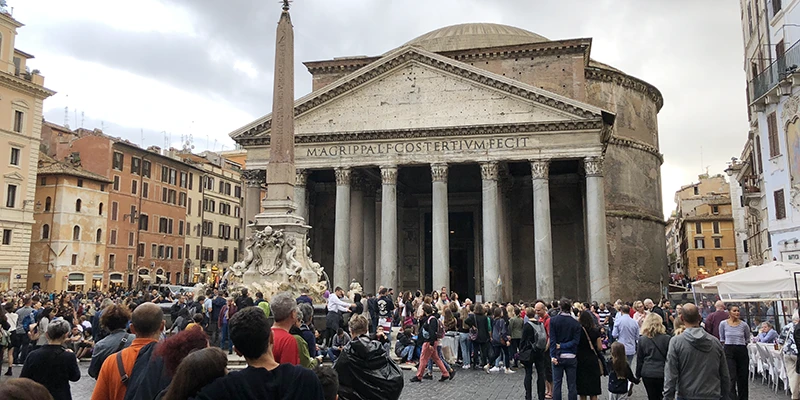
I keep walking through these narrow streets, looking for the Pantheon, which is perhaps the world's largest and oldest building surviving from ancient times. When constructed nearly 2,000 years ago it was certainly the world's biggest domed building -- enclosing a huge indoor room, its ceiling over 150 feet high with no columns interrupting the massive space. Originally built as a temple to all the gods, it had been long since converted to a Catholic church, and now a public monument of the first order, covered in marble inside and out.
However, I get there in late afternoon just after closing, faced with the famous forty-foot high original bronze doors locked up tight, resting solid against my futile little tug on the doorknob. I'll come back and see it tomorrow.
So instead, I go shopping -- a visit to the Via Condotti, Rome's most fashionable downtown shopping district. God, it is packed! There are people all over the place on these five or six pedestrian-only streets, lined with expensive shops and small cafes. Funny, even here the old buildings look dirty, grimy, covered in layers of red dust. On the other hand, the shop window displays are very clean, modern, neon fancy, chromium tubular, new wave and classical. Nearly all of our fellow shoppers are well-dressed Romans.
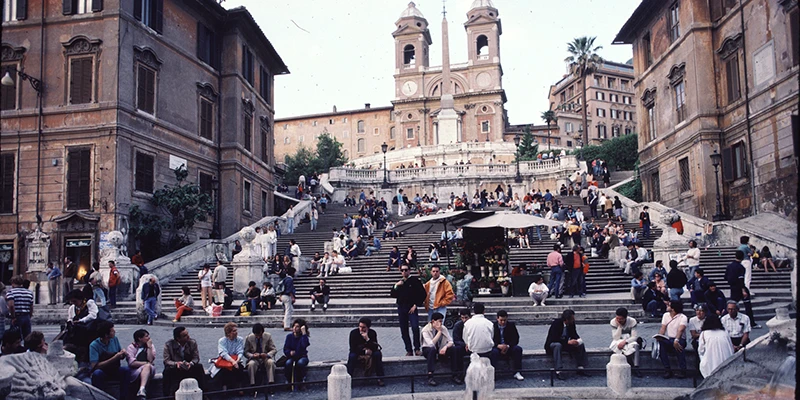
I go for a view of sunset at the top of the nearby Spanish Steps. Believe it, this is Rome's biggest meeting spot -- a place you can strike up a conversation with a stranger and become instant friends. As expected, a handsome Italian guy sitting on the steps is singing and playing his guitar to several interested females, loving his Simon and Garfunkel renditions. That is magic, but the sunset view is a mere pale burnt orange glow over miles of flat banal roofs and TV antennas.
After a bit more downtown walking, I catch the Metro subway back to Termini Station, and then walk back to my pensione for the night.
This place is funny! It's hilarious! Especially the traffic, which is totally crazy by our standards. People seem to drive anywhere they choose, and park at will. The traffic signals and signs are strictly advisory for many of these wild drivers. Cars parked on the sidewalk. I love it! Back in the USofA. I'm kind of a quick driver anyway, and after this I am more so. Do it, go for it, yellow light means don't stop!
Roman buses are packed and frantic too. You just get jammed on there, and try to work back to the door by the time your exit comes up. The main bus station, fronting the Termini train station, is another panic, funny, inefficient, slightly chaotic, as mentioned six pages earlier, so take a good look around when you get there.
Tuesday, May l4th, 1985, 8:00 am.
Trains Rome to Florence lv. 5:42 pm, arr. 8:31 pm.
Just planning for tonight's departure, but first, it's a Big final day for ROMA:
I'm a little late waking up and getting some needed espresso in a busy little corner cafe, with its quick-service stand up coffee bar, and a few tables outside where I sit enjoying this Italian morning. Rome coming to life.
In one of my best moves of this entire trip, I decide to start this all-important last day with serious shopping at the sidewalk markets, just three blocks away from the Termini.
Bargains galore, so I buy shoes and shirts at a bargain, yes, a bargain galore. One of the six shirts later turns out to be a little small, but the two pair of shoes for $20 each are very comfortable and well-made. I take further advantage of this later by purchasing more shoes in Florence, but that gets us ahead of the story.
After the shopping spree, I walk a few short blocks to one of the half-dozen mammoth churches of this Holy City. The high ceiling is covered in brilliant gold, said to have been brought back from South America by the conquistadores, and Columbus himself. This heavy golden ceiling hangs in solid contrast to those heavenly angels floating in the baroque clouds we had seen yesterday in other monumental churches. Amazing space, you walk in and are totally engulfed by the architectural design of these places. You Must Put these major Roman church interiors on the list of Ten Main Things To Do in Europe.
A quick aside: what are the other ten things to do in Europe? Some of many possibilities: for a three week trip.
-London, three days, walking all around.
-British countryside, near London, one day.
-Paris, two days, the Louvre, etc., enchante, I'm sure. -Drinking beer in Germany, preferably Bavaria, in Munich. -Why don't you go up into a Swiss mountain village? And-- check out one of their cities, like Zurich. -The French Riviera has got to get you! -Vienna and
-Venice. They both top out the most important list of things To Do!
-From here you've got to figure out yourself what to do with your three measly days left on the tour. Or would you rather extend for a fourth week. All of these desires can be accomodated. Stay tuned for more.
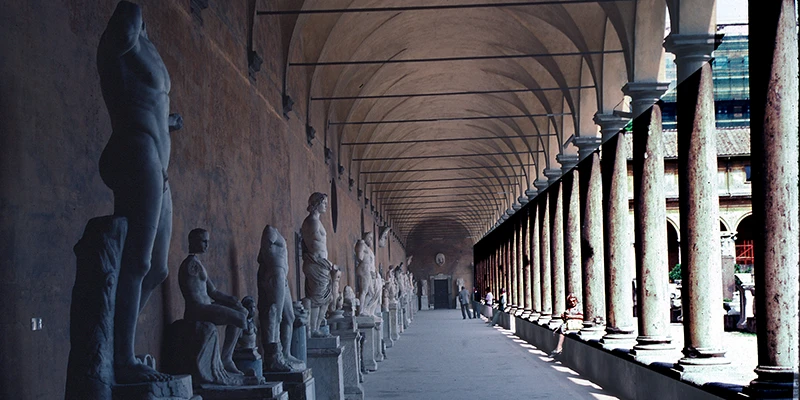
After eating I visit the National Museum, which is second only to the Vatican for the grand display of Roman statues. Unfortunately, most of the galleries are shut down so I only get to walk around in the outdoor statue garden. I also missed out on seeing another major building, just around the corner from here, the Baths of Diocletian, because I didn't know it existed. Michelangelo transformed this enormous room into the Basilica of Santa Maria Degli Angeli, creating one of Rome's biggest churches. It's another one of those massive spaces that makes you feel three inches tall. Months later back home my pal Hugo showed me his 2,000 slides of Europe, and the most amazing shot of all--the only one that really screams out in my mind -- is that basilica interior: light streaming through lofty windows into the vast eternal reaches of this holy space, with microscopic people walking across the endless floor. Too bad I missed it. It was the largest bath in all of ancient Rome.
My luck is better at the "Campidoglio" Capitoline Hill, but even here something is missing, as the famous statue of Marcus Aurelius has been removed for restoration. Even with that crucial centerpiece gone, this piazza is still "one of the most beautiful and noblest small squares in the world," according to Turn Right at the Fountain, who's informative footsteps I am still happily following.
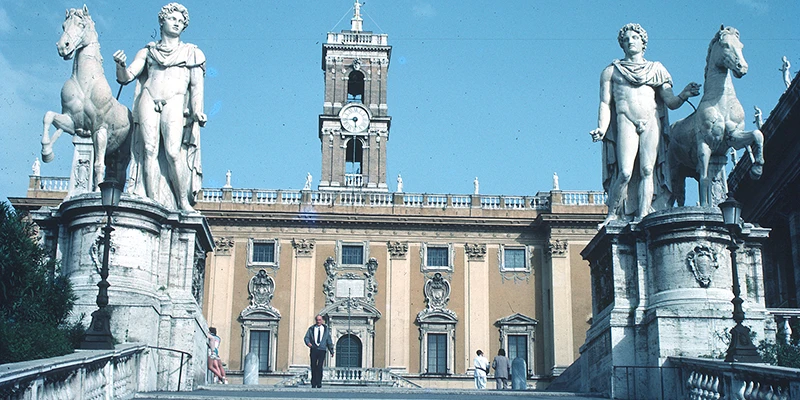
Splendid palaces designed by Michelangelo form the outline of this remarkable piazza, and just beyond are the giant white memorial to Victor Emmanuel II, and the Forum, which served as ancient Rome's "downtown." The two main palaces have been converted to museums, the Capitoline and the Palazzo dei Conservatori, housing some of Rome's most important statues. The 2:00 pm siesta closing hour is rapidly approaching, so I rush through with just barely enough time to appreciate it, overwhelmed not only by the sculptures but equally by the elaborate baroque interior design of the palaces. It seems every inch of ceiling and wall has been carefully carved in precious marble. Two guards at the Capitoline Museum discourage me from entering, since there's but ten minutes till closing. By now I have perfected the "quick sprint" art tour, and seeing my determined interest, they let me in anyway and don't even charge. Fortunately, I had a bit more time just before this to enjoy the Conservatori Museum, which featured, in the midst of the ancient relics, a special exhibit showing the development of painting from "Cezanne to Picasso." Nearly one hundred canvases spanning about sixty years illustrate beautifully the evolution of modern art -- probably the period of greatest change in all of art history.
Another peak experience! The Capitoline Hill certainly delivered 2,000 years of stimulation, from the Forum to Picasso. Too bad that cherry on top was gone -- the only equestrian statue remaining from ancient Rome -- but let's hope that Emperor Marcus someday rides his bronze steed triumphantly back to what may have been at one time the most important place in the universe.
Needing a break after this rush of overstimulation, but not wanting to waste my final afternoon in Rome with a siesta, I head for the nearest cafe, on the other side of the huge traffic circle called Piazza Venezia. Crossing this traffic is a life-threatening experience, for there are no signals and hardly any breaks in the speedy flow of little cars. It's a good time to practice that old aphorism, "when in Rome..." so I copy the nimble footwork of the brave Roman pedestrian and sprint right through for the wildest street-crossing ever made.
I get a ring-side table at the sidewalk cafe looking out upon this traffic madness, and sip espresso for thirty minutes in total amazement as cars, trucks and buses whizz by. This is one of Rome's four daily rush-hours, speeding home for lunch and a nap, clearing the streets so that I can enjoy a relatively peaceful afternoon walking through some residential neighborhoods.
One of the best places to get off the beaten track and experience the daily life of working-class Romans is the Trastevere, reached by a short bus ride across the Tiber River. This neighborhood is one square mile of ancient buildings along narrow twisting lanes, with the locals sitting out on their stoops and chairs, passing the time of day.
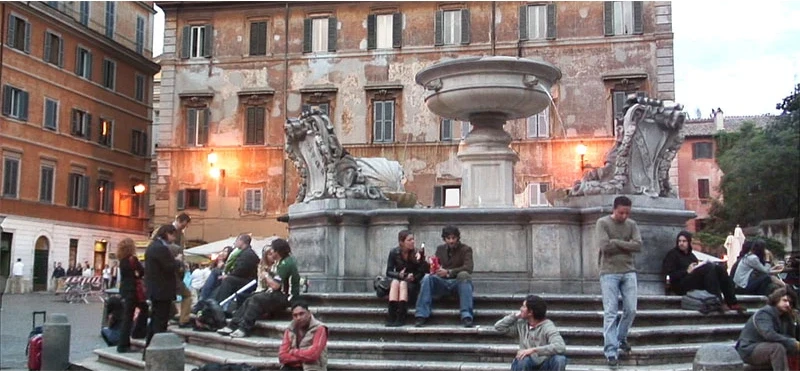
Trastevere. This is the real Roma--kind of the "left bank" complete with shopping streets, grand churches, restaurants, government offices, etc., but mostly back- street funky residential Italian from the Old World.
I walk past several sidewalk cafes along the main tree-lined street here, also called Trastevere, then take a right turn following the guidebook's complicated directions to another major-magnifico-baroque-church. I eagerly enter counting on a beautiful interior, and am pleasantly surprised to find a high mass in session -- an old priest singing ancient Latin, with a strong smell of incense hanging in the dark air. And then something I have never seen in a church -- a second mass is going on simultaneously in a back corner alcove. Such devout activites completely upstage the elaborate mosaics I briefly view on the way out.
Back to the streets. It's almost time for the end for I am leaving Rome this evening, sob, sob. I have a final snack at yet another charming tree-lined sidewalk cafe. I never had gelato before this, even though it is becoming popular back home, but now I am hooked. Soft and creamy, sweet and delicious, complete with a wafer cookie and espresso on the side. A nice sugary way to say goodbye to Roma.
Head back to my hotel, pack the bags, check out and walk to the train station just in time to hop on the deluxe Trans European Express for Florence.
Green rolling hills of Tuscany spill past the train window, dotted with small villages and the occasional bell tower which symbolizes this region, as we glide along towards Florence. The comfortable three-hour ride gives me a chance to review the guidebook information about Florence while drinking a famous product of this area, some of the best wine in Europe.
FLORENCE
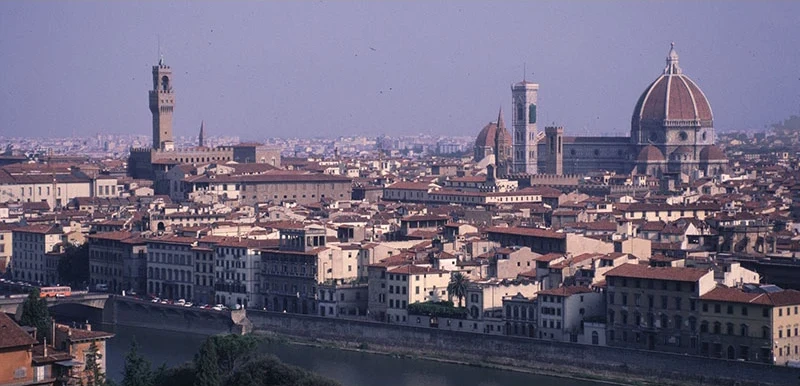
I have wanted to see this fabled "Jewel of the Renaissance" ever since hearing about it as a youngster from my older cousin, who had just returned from a Europe vacation in which Florence was her favorite place. She raved on about the great art museums, creating an impression in my young skull that never went away. While my own experience here did not quite live up to these long-held expectations, due to various complications you'll soon hear about, I did enjoy this city immensely and look forward to a return visit some day so I can catch all the things I missed during this 24-hour stop.
Arriving at the train station about 8:30 pm, I telephone four pensiones before finding a vacancy. It's a small place two blocks from the station, run by a friendly, elderly husband and wife who speak no English whatsoever, matching my total ignorance of Italian. We flounder a few minutes, too tired for elaborate charades, but manage to check me in.
A large soft bed invites my sleepy body, but I fight off the drowsies because I am eager to take a walk and see this city right now. Plus, I have read in Frommers about a stimulating art lecture/slide show given each night in a small gallery which provides an overview of Florence's role in the Renaissance.
Map in hand, I wander through lively streets bustling with evening activity: Shops are open, restaurants are busy, pedestrians are out and about, so I wake up and join the flow. Armed with precise Frommer directions, I find the gallery just in time for a quick glass of wine served out on the terrace -- a most civilized way for the event to begin. We adjourn to a small room, holding about twenty of us, for a very entertaining talk by this expatriate American art critic. His analysis of various Florence masterpieces projected on the white wall helps me better understand the paintings I will see tomorrow.
Pizza and beer for a late snack, then back to my pensione for some much-needed sleep. Another big day coming up.
Well, Florence turned into a hurry-up rush-around kind of place for me, since I just have this one day to see it all before catching the 6:30 pm overnight train to Nice. Make the most of a day by starting early--I'm up at dawn for a nice long walk, watching the city come alive. Rush hour traffic spins by in a riot of mopeds, scooters, mini-trucks and lots of tiny toy-sized cars.
Breakfast is included in the fifteen dollar price of my room, so it's worth circling back to the pensione after this early morning stroll for some espresso with bread and jelly. There is no dining room in this little place -- the meal is served on a tray in my room, almost like breakfast in bed.
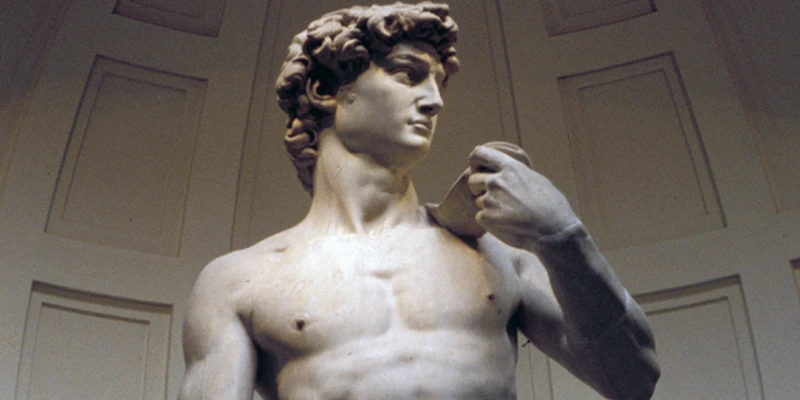
By 9:30 I get to see one of the top sights in town, Michelangelo's heroic statue of David, twenty feet tall in all its naked glory. Some have called it the world's greatest sculpture, while others place it a close second to his other perfect masterpiece, The Pieta, back at the Vatican. Several more wonderful marble statues by this home-town hero are also found here in the Accademia delle Belle Arti. These pieces were left slightly unfinished, which provides an interesting contrast between smooth marble skin and rough-hewn edges -- it sets up a before-and-after dynamic where you can almost witness the creative process and better appreciate the outcome.
Nearby is the Museo dell'Angelico, which had been a medieval monastery whose most famous resident was Fra Angelico, the superb fresco master. Monks lived on the second floor in austere little cells, but their lives were brightened by colorful sacred scenes in each room painted by the master -- the blessed contradiction of priceless art midst vows of poverty inherent to much of Italian ecclesiastical life.
The central courtyard is a peaceful garden surrounded by a Mediterranean-style arcade, which leads to several galleries of medieval paintings. A group of a dozen Italian college students is getting a lecture I wish I could understand about these pieces, but then I do eavesdrop on a charming English-speaking guide who is escorting a very affluent-looking elderly couple. Now that would be a nice way to travel, if you could afford your own personal interpreter, with all the educational benefits of a tour and none of the apparent disadvantages of the herd. This small moment was to become the biggest epiphany in my life, and led me on to become a professional tour guide arranging similar services for thousands of future travelers, but that too gets ahead of the story.
As I forge on blazing my own trail, doing all the work myself, studying the books while walking amongst the treasures, I am gaining new respect for the value of a guided tour, which I had previously deprecated. Especially now, as this day progresses and slightly falls apart due to my own ignorance, including:
-wasting time at the colorful street markets, which turn out to have high prices and nothing I really want anyway, -an incredible hassle with the Italian Post Office, -my biggest museum mistake ever, getting to the Uffizi Gallery just after closing.
-missing about 80% of the sights of Florence.
-not going inside the Duomo, the Catholic world's highest dome, -thereby developing a lousy attitude towards what I did see.
Despite that, the day did have some saving graces.
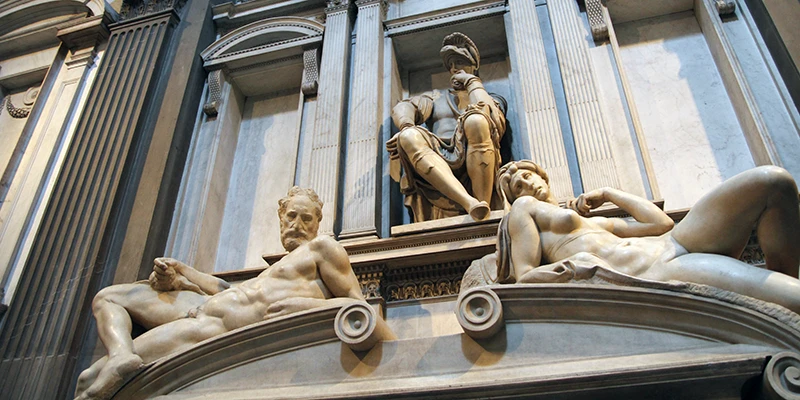
After visiting the medieval cloisters of the Museo dell' Angelico I follow the walking-guide pages to the nearby Medici Chapels in search of more Michelangelo wonders. Here he carved marble monuments for the tombs of two dukes in the Medici dynasty which ruled Florence for centuries. Each crypt is flanked by two saintly carvings, titled "Dawn and Dusk" and "Night and Day," fleeting human figures that symbolize our transitory existence. I wait three minutes for the group-tour crowd to pile out of this small chapel so I can contemplate these mystical images in silence.
One exits down a narrow hallway that leads to the main chapel -- a large round room with a dome about one hundred feet high constructed, of course, in marble with lots of baroque decoration, six large tombs embedded in the walls surrounding the open central floor area. Thanks to Frommer, I visit two bizarre rooms behind the altar, whose obscure unmarked entrances I would have never noticed otherwise, for a glimpse of the actual bones of dead saints contained in elaborate jewel-encrusted golden sculptures. Out of this world!
Too intense. I can't take any more museums or churches right now as I burst out to the bright sunshine of mid-day. Having seen nearly thirty museums on this trip so far, and uncounted churches, I want to put them aside for a few hours and just walk around, do a little shopping, mail a package, eat, and take it easy. It would require a week to see the art and historic architecture which is probably found in greater concentration here than anyplace else in the world, but I only have hours left. Do not get frustrated at missing it, or burned out racing to see it. You've got to draw the line somewhere, and be happy with what you can do.
Besides, it's not painful to skip the many other treasures and palaces, because I am saving the biggest treat of all for later in the day, the Uffizi Galleries, on every list of top ten museums in the world. As mentioned earlier, this plan did not work. Uffizi was supposed to remain open until 4:00pm, according to several different listings, but they lied. By the time I got there, leaving myself a generous final hour to view this world's finest art show of Italian medieval and Renaissance, it was closed.
Oh well, so it goes. I had a very interesting afternoon anyway, filled like a paradox-bowl of delight, frustration, and solution. My difficulties mailing a package wasted nearly half of the time I had before catching the evening train to the French Riviera, but that hassle created such a memorable experience I'm glad it happened. It's nice to look back and laugh at such things.
BATTLE OF THE POST OFFICE
All this junk had accumulated in my bags since Munich, way back in Germany: shirts, pottery, shoes, bronze statues, tour books, jackets, plastic souvenirs and other crap. It totally over-loaded the already-excessive pile of stuff from home I don't need anymore, like warm clothes and 25 cassette tapes I'm tired of hearing. No way can this mountain be hand-carried five more days and ten thousand miles. It has to be mailed, gulp, at the Italian post office.
Scavenging an old cardboard box on my long hot walk back to the hotel room, I then cram it full, tape it up and carry it back downtown to purchase the special wrapping paper which my guidebook says is required. No-one else in the little stationary shop speaks any English, but the young clerk finally seems to realize what I want and comes up with some heavy brown paper. Wrapped and sealed, it then takes me a confusing thirty minutes to find the parcel post office, which I reach just before the 2pm siesta and come face-to-face with the obscenely fat, slow moving, unsympathetic clerk.
He carefully eyeballs my tape job while I fill out the many forms and labels. The tape passes the test, but the paper flunks! "It is only acceptable for air mail parcels," he says in surly body language and a few English words. Surface mail needs heavier paper, and since it would cost $95 to send by air compared to $25 surface, I decide to look for the right wrap. The clerk then actually becomes helpful and draws a route onto my map showing me the nearest paper store, three twisted blocks away. I carry this increasingly-heavy clumsy box right over there, but just as I figured, closed for lunch for two more hours.
Oh no, just when I was planning to walk around town for a couple hours sightseeing, I'm stuck carrying a thirty-pound box and it is too far to walk back to my hotel on this hot day. Where am I going to stash this important stuff? I ask a few shop-keepers if I could leave it with them, or if they could suggest a place to store it, but all they said was "no,no,no" probably not even understanding what I was talking about. Shuffling along discouraged, I pass what looks like the fanciest hotel in town, The Savoy, which could be just the spot for my heavy burden. The elegant well-dressed desk clerk is a perfect gentleman. "Yes, of course," he says in fluent English, even though he must have realized from my rumpled clothing I was not a guest at his hotel. Jokingly, he asks "Is there a bomb?" Since this was still 1985 such remarks could be made in jest, but the turmoil of subsequent years may have put an end to such trust between strangers.
After two hours of walking, eating, and taking lots of photographs, I return to the hotel for my package, find my way to the paper shop, wait on line there for twenty minutes, and finally emerge triumphant with a professionally wrapped parcel that the fat man cannot refuse. Two months later it arrives at home split open, but with all the contents safe.
It feels good to be free of that heavy load, but I am still a prisoner of the clock as my train is leaving in about one hour -- barely enough time to walk across town, buy two pairs of shoes in a five minute rush, get my bags from the pensione, and make it to the train with eight minutes to spare.
The overnight train to France was another big success, where I had the whole compartment to myself in a car that was nearly empty. Pull those seats together after several hours of reading, eating, and drinking, and have a good deep sleep.
The Riviera, in One Day
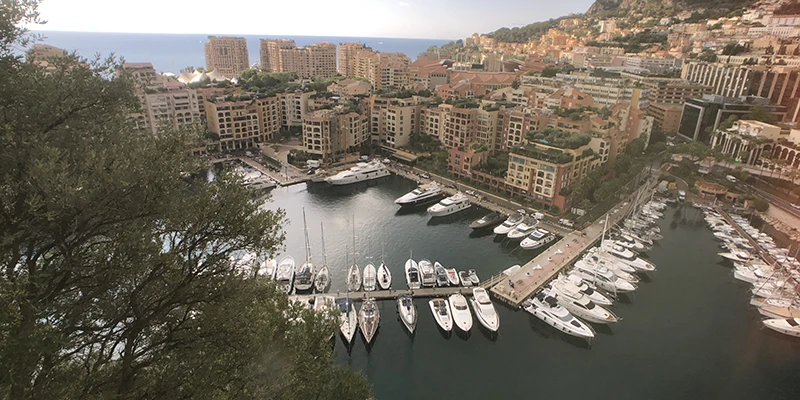
I wake to a beautiful sunny morning just as we are leaving Italian territory, for my first glimpse of the beautiful Mediterranean. The train soon reaches Monaco, where I discover that the practice sessions are already under way for the car race I had always hoped to see, the Grand Prix of Monte Carlo, which is to be held the day after tomorrow. However my vacation is over in three days and I still want to see the Riviera plus a good piece of Switzerland. It's a great temptation to just get off the train here at the Monaco station and extend the vacation -- maybe I could telephone the boss back home with an urgent last-minute request for an extra week without pay, but I got in trouble like that last year when I disappeared on a California vacation without telling the company ahead of time. They docked my pay for those two weeks in retaliation, which ironically, benefitted me this time, for I was able to carry over the two weeks of paid vacation time which they still owed me from last year. Do you follow so far? That's why I could get a six week vacation for this trip.
All these and many more thoughts are racing through my head as the train makes a five minute stop at the Monaco station. Platform vendors are hawking programs for the big race, shouting it out. Ohhh...what a temptation what a temptation. I could hop off here and have a good look at the exciting trial races -- much cheaper and less crowded than the weekend finals.
On the other hand, my existing plan gives just one day for the entire Cote d'Azur, and only two days for Switzerland, then hop the silver tube for home. Granted it's too quick, but consider this:
-most important, I really should get back to work on schedule.
Without that situation looming I would certainly have stayed an extra week, since I had enough extra money. -after five and a half weeks of rapid touring I am ready to go home.
-by now I am such an efficient successful traveler that three days should be adequate time to cover that vast area.
As things turn out, this was definitely the right decision. Smooth as silk -- everything of importance got done--a fabulous final weekend! Hang in there gang, we're almost home.
I am definitely running out of time. Today, tomorrow, Saturday, fly home Sunday.
Downtown Monte Carlo looks fabulously beautiful in a Parisian coastal way, but I can only enjoy it a few minutes from the train window while making those final decisions to roll in with the main plan: Visit today: Nice, Cannes, St. Tropez, St. Raphael, then catch the overnight train to Geneva.
Things are speeeeeding up. You can see that, not much time, so what I am now going to do is shift gears to overdrive and present from here on out the literal transcription of the daily journal I have been keeping since the beginning of the trip. In fact, this is the diary's first mention so far in the story. That diary is the only reason I could recall the trip details you have been reading, which enabled me to capture the experience and get more out of it. Especially when combined with the three thousand photographs I took which form a strong visual notebook. Such extra efforts are well worth the time and expense, for they heighten your concentration while you are travelling, and solidify your memory and later appreciation of the trip. Something to look back on decades later.
The remaining few pages will include some literal transcriptions from that aforementioned daily diary, scribbled here and there, at lunch or tea, before sleep or on the train, sometimes in a pub or park, but never standing on my head. OK, and I have added a few more descriptions to the bare bone notes. We are running out of time. The itinerary is getting tighter. I wish I could take a few more days and see the remaining places better.
Story picks up on that morning, leaving Monaco: "Thur 5/16
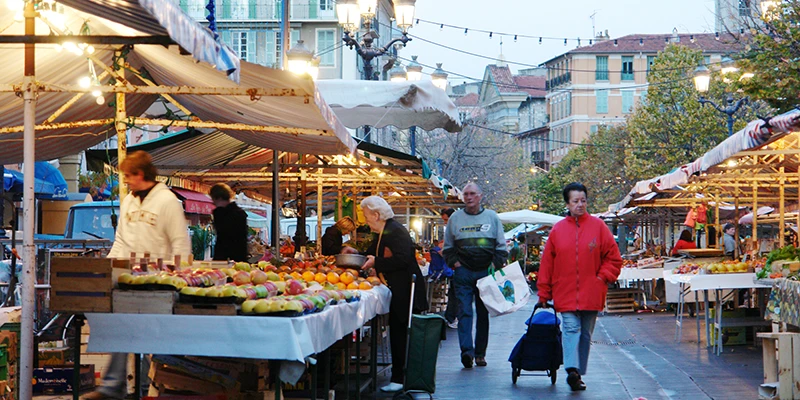
So I get to Nice on schedule. It's a beautiful sunny day! Walk around Nice for two hours. Station to the beach is about ten blocks, beautiful boulevards, beach is sunny but it is too early for anyone to be on it. Nice promenade along beach, then back to station for trip to Cannes, along the coast. Nice chat with three Americans, and then CANNES. Oh god, this place is bursting with breasts! It really does happen here, topless sunbathing, some beauties too. And on the promenade all the fashions are out. We are in the middle of the International Film Festival, making the place really fun, with glamorous people everywhere. But I must go since I want to see the whole Cote d'Azur in one day, so I go - back to the station (after having walked the entire beach feasting my eyes on the shapely bodies). Ride train for l/2 hour, catch a bus for a two hour ride to St. Tropez, and here the Fete is going on for some national holiday. It's a sunny warm afternoon and there are thousands of people here. Instead of more topless beaches, which are, boo hoo, three miles away (and were a major reason I came here so far out of the way) I get a charming little boat harbor resort, surrounded by classy cafes and the "beautiful people .
Another nice surprise. This gives me the best chance yet for good people-watching and photographing too, while waiting for a parade to come into the square. This place more than satisfies my desire to see Portofino. And I was merely expecting a quiet little topless beachs This pleasure harbor is far more interesting, since I had already had a lovely look at the boobs in Cannes.
Now I am back at St. Raphael, another coast resort, eating a good French meal (at sunset) and waiting to catch the 9:30 pm train to Geneva. Purchases so far--film $18, dinner $9, fruits $3, bus round trip $7- Now just need a bottle of wine and maybe some bread for the train trip. I'm all of a sudden looking forward to getting home. It will be fun to start telling friends about the trip, and looking at all the slides and arranging them. It might have been nice to have one more week, but this was plenty, especially now, going fast, two days in the heat with no shower. In reflecting on the trip, nothing has gone wrong at all. I would do it over if I could, exactly the same way.
SWITZERLAND
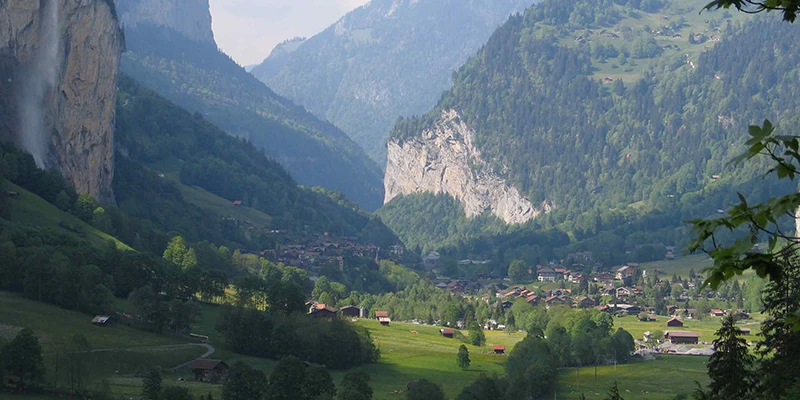
Gen 8:45 > Brig ll:08
FRI 5/17 BRIG 11:12 > 12:10 SPIEZ
BOAT to INTERLAKEN, spend the night.
INTERLAKEN Depart: 7:00 AM arrive LUZERN 9:37 depart LUZERN 12:07 arrive 12:56 ZURICH depart 15:57 BASEL, Arrive 22:22 FRANKFURT
GESCHNETZELTES & ROSTI, walk to castle over Lake Thum Train S ->Intlk @ 1:07, 2:07, 3:00
The above is my last minute change of schedule that gives me 2 days in Switzerland, since I realized today is Friday and not Saturday. So I took a one hour walk through Geneva to start the day -- after spending my second night in a row on a train, had the whole compartment to myself again, six hours good sleep. I was tired...Great shower in the Geneva train station. Hop train towards Interlaken, a very nice ride through long alpine valleys. This was the day's highlight -- white sharp peaks over hills covered with yellow wild flowers, blue and purple too. Cows, chalets, wonderful. In Spiez I take boat for 1&1/2 hour ride to Interlaken, which is quite touristy but nice... Like Innsbruck, Interlaken has giant mountains all around. My rented bicycle takes me into all the residential areas, away from the souvenir shops and tourists. I had a hilarious moment, watching a family walking up their driveway to the house with their cow, and they all walked inside the home together, the cow presumably heading for the garage/barn.
The boat ride was very refreshing, calm blue glassy lake, as we meandered from one side to the other making five stops at little piers. Especially nice after two days on trains and buses; this is the open air good life. Had a beer with two gals from Idaho, we laughed about similar problems mailing packages -- they actually had to unpack and carry for 2 more days before they could send one.... Anyway, this Interlaken was worth the trip. Too bad I have, once again, no time to go to the Jungfrau peak, but I must go to Lucerne, Zurich, and Frankfurt tomorrow. Aloha. Fri. expenses Franc 2,5 = $1 • bicycle, $12 hotel, $7 food & wine, $2 beer, $7 chocolate, $11 film.
SAT 5/18
This is the last full day, starting in a coffee shop in Interlaken, next to a big table of locals speaking in their incomprehensible dialect. A drizzly morning. I pedal around in very quiet residential roads. 7:30 and no-one is up yet. Misty, great houses. After early sightseeing and shopping I have coffee with two American gals I meet in this nice restaurant. I tell them about the many trains I've caught on the trip, without missing one yet, but little do I know that on this final day I will miss three trains by various mistakes. Still, it has been a good day.
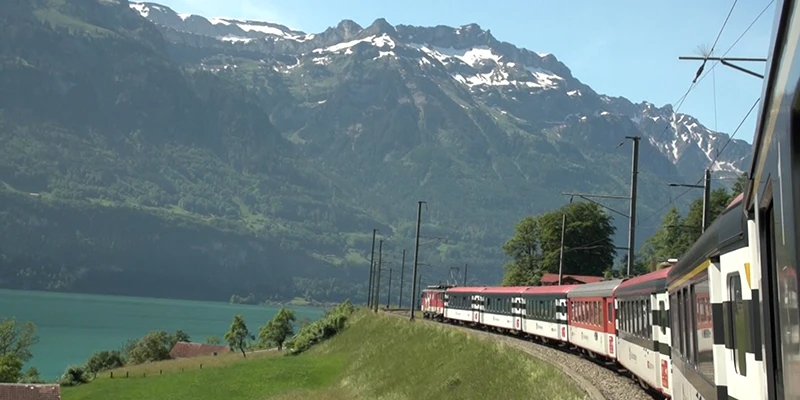
TRACK 1 HOTEL BISBADEN 58 A rather amazing final day. It started in Interlaken, then stopped in Geneva, Luzern, Zurich, Basel, and ended in Frankfurt. But it started with a small mistake that slowed me down! taking the non-scenic train, round about to Luzerne (missing the alternate route through spectacular snowy alpine peaks), but I got there. Street markets along the river were jumping, and several small plazas nearby were very pleasing, with nicely painted buildings. After 1 1/2 hours back to the bahnhoff and on to Zurich. I walk quickly for two hours--the flea market has many interesting characters, good rapid photos more interesting than ever. Lots of good junk on sale. I tear away from these aging hippies and head towards a museum, but with limited time, detour back to the street scene and come upon an ancient ritual of some sort at St. Peters, the church with the biggest clock in Europe. Hundred of people are dressed in native costumes. This is really another dreamscape. Back to station after crossing old wooden covered bridge across the river, hop on board.
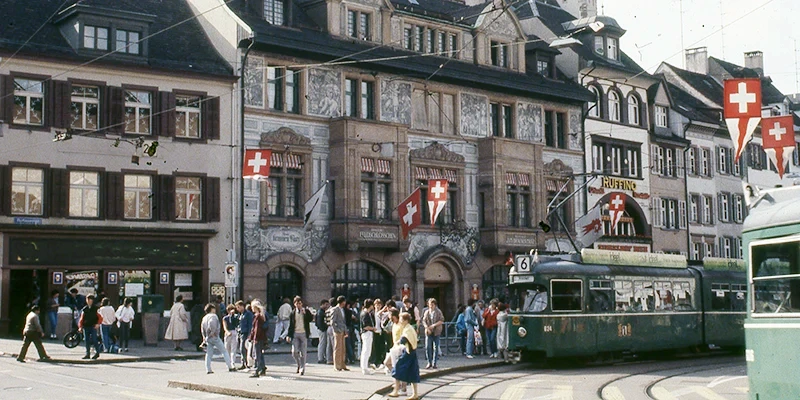
As the train pulls into Basel I realize I am one hour early, so when I get there I have a useful two hour layover, a great chance to see yet another medieval old town, and it proves worthwhile. The Marketplatz with its gilded Rathaus is a beauty, as is the view across the Rhine River. This city is at the corner of Germany, Switzerland, and France. A fitting spot to end up my trip. But it ain't over 'til it's over, so I'm off to Frankfurt. My planned train doesn't run on Saturdays, but luckily, another train to Frankfurt leaves 1/2 hour later. It's ironic, since I engineered my whole schedule today to catch the last train to Frankfurt, and it wasn't even running!
So, I arrive in Frankfurt around 11:30 pm, call a couple of numbers scribbled from Frommers in a Zurich bookstore, and yes, they have a room for a reasonable 58 marks, right across from the station. Check in and finally find a World Airways schedule, from the good old Savoy Hotel, the same folks who rescued me from carrying that package around Florence. I've got to catch a flight tomorrow, but until now have had no idea of their schedule, despite my earlier phone calls to their always busy lines. Great, now I know World takes off at noon, so I take a late walk around, hit three bars in sin city, all around this train station area. Lots of American GIs, and then, plenty of Germans! I'm in a small smoky bar with a great sound system and non-stop tapes. I get back to the hotel for needed sleep to get ready for the challenge of getting home, flying standby in the middle of a United Airlines strike. I feel like after this six week trip a strike cannot stop me now. I will get there, no problem.
SUN 5/19=
This is the big day! I'm on my way to the airport by 9:30 am for the noon flight. If all goes well, I naively thought, I could be in Honolulu by midnight (wrong, wrong, wrong). Breakfast with a man who has been Eurailing on his own for 8 weeks, and also heading home. He liked SW Germany the best, didn't care much for Greece (unlike many more people who had been praising it). Another fellow is going to buy a VW camper van for $18,000, and then drive it around for three months, at a saving of $3,000 off the California price.
Airport scene: very crowded around the World counter! I ask the agent about standby prospects and she says "forget it. Come back in about three days!" They wouldn't even put my name on the standby list for today, but I analyze the situation and come up with the solution....
I'm not sure how much of this I should put down in writing, but let me just say that getting on that plane was a combination of Moses going through the Red Sea, and Steve McQueen jumping his motorcycle in The Great Escape. Let's just say...I got on.
Then I'm on the plane. It worked. I sit with a cute blonde from Switzerland. It's her first plane ride, taking her all the way to L.A., so we fly together for fifteen hours. London, then Baltimore, get off for customs, and brief hassle over my boarding pass which somehow went missing, but re-board in the final minutes. Clear sailing to California - I'm making real progress for a standby.
Unfortunately, when I finally get to Oakland at 11:00pm I find out there is no flight out tonight for Honolulu. Their next flight is nine the next morning, which doesn't leave me enough time to go out to a hotel and get back here first thing for early morning standby check-in. My best option is to just spend this final night in the airport terminal, where I can hopefully find a quiet comfortable corner to sleep in. After what I've done the last six weeks, that's no big deal, especially since I will be home tomorrow, if I catch that flight.
I discover the only couch in the terminal that has one arm missing, allowing a person to stretch out straight and sleep. I get five good hours, waking at 5:15 am., with chewing gum all over my pants leg. Yuk! The first stain of the trip, and it is a peppermint gross-out.
Feeling a bit like a street person, I visit the public lavatory for a welcome shave and change of clothes. At 6:00 am I am one of the first to check in at the front counter, where I am told the blessed news, "there will be no problem getting on, here's your boarding pass." Thank you!
The Greatest Trip Ever!!!