.webp)
Patmos, Greece
Patmos is one of the most rewarding of the smaller Greek islands, a place whose fame far exceeds its modest size. Crowning the hill at its center is the great Monastery of St. John, a fortress of faith that has stood for more than nine hundred years, surrounded by the medieval village of Chora with its maze of whitewashed lanes. Below, on the shore, the little harbor town of Skala offers the relaxed charm of a typical Greek island port. For many visitors, arriving by cruise ship for only a few hours, Patmos delivers an outsized impression in a short time.
The island lies in the Dodecanese, in the eastern Aegean near the coast of Turkey, and is often a stop on Greek island cruises bound for Ephesus. Ships anchor in the harbor and tender their passengers ashore at Skala, from which it is a short drive up the hill to the monastery and the old village. Patmos holds a special place in Christian history as the island where St. John the Divine is said to have written the Book of Revelation around 95 AD.
You can also see this video on a separate video page.
The Monastery of St. John
The Monastery of St. John the Theologian looks like a brooding fortress, its tall stone walls towering over the whitewashed houses on the hilltop. Built beginning in the late eleventh century, it is a UNESCO World Heritage Site, a designation that reflects its importance to the history of mankind. It remains an active monastery, home to a community of monks who still carry out the Orthodox rituals and lead devout lives, and who have long been, in effect, the landlords of the island.
.webp)
From the tour bus it is a short walk up the ramp and staircase and through the gate into the monastery. The building looks as though it stepped straight out of the thirteenth century. Visitors are free to walk through the public areas, which include a church, a Gothic courtyard, private quarters for the monks, and a treasury displaying ancient manuscripts, mosaics, icons, jewelry and medieval textiles.
.webp)
.webp)
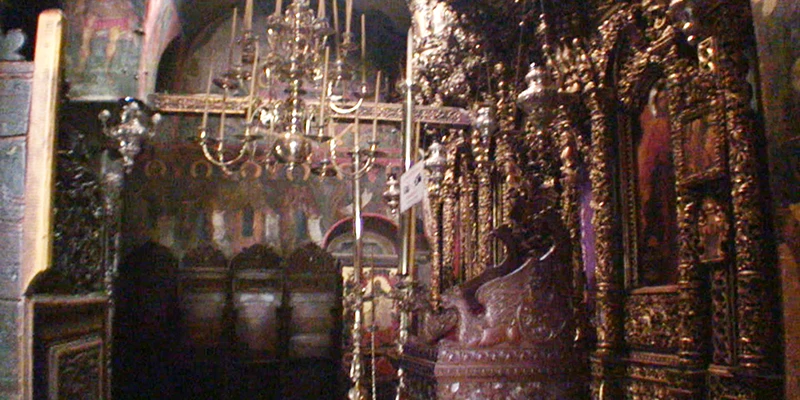
Inside the small Byzantine church, the narthex and the richly decorated interior are covered with frescoed murals in the Byzantine style, rimmed with golden trim and ancient architectural fragments. In the Middle Ages most people were illiterate, so the stories of the Bible were told in pictures, in the mosaics and frescoes that cover nearly every curved surface of the church.
.webp)
.webp)
.webp)
.webp)
The Chora
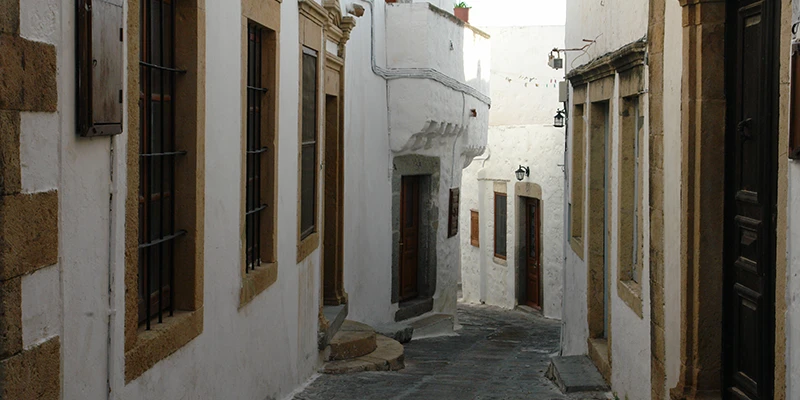
Wrapped around the monastery on the hilltop is the Chora, a medieval charmer of a village threaded with narrow alleys and staircase streets winding through an ancient residential complex. Its houses have been occupied for centuries, and by one enthusiastic account in the Michelin guide, they form the finest architectural group in the Aegean. Most cruise visitors, in port for only four hours, never see it, which makes a walk through its lanes all the more rewarding.
.webp)
.webp)
The village covers less than a square mile, and walking all the way around it takes about an hour. It is so densely built that in places the homes extend right over the pedestrian lanes, forming tunnels of whitewashed stone brightened by colorful doors. No cars are allowed; residents get around on foot or by motor scooter, hauling their groceries in and out by hand, a wonderfully human scale of living that is typical of Greek island villages but rarely seen by visitors who linger only on the waterfront.
.webp)
.webp)
.webp)
It is easy to find your way: keep circling and you will eventually come back to where you started, with the monastery visible above to help you get your bearings. The Chora, up on the hill at the center of the island, is actually the capital of Patmos, home to several thousand residents and to the island's town hall. Its cats are everywhere, well cared for as they are throughout Greece, gathering wherever an owner arrives with a bag of goodies.
.webp)
.webp)
.webp)
The Cave of the Apocalypse
Between the monastery and the harbor lies the Cave of the Apocalypse, where St. John is said to have lived while writing the Book of Revelation, the last book of the New Testament. It is a very special space, half cave and half built structure, now decorated with Byzantine icons and preserving the features associated with the saint's vision. The text he wrote here foretold the final judgment and the restoration of peace to the world, and the cave remains a place of pilgrimage.
.webp)
Skala
Down at the harbor, the little town of Skala is a typical and charming Greek island port. A compact three-block town gathers behind the waterfront, with fishing boats bobbing at the dock and pedestrian lanes just inland lined with souvenir shops, clothing stores, jewelry shops and a newsstand carrying papers from around the world. Cafes and restaurants line the shore, ready to serve visitors during the few hours their ships are in port.
.webp)
.webp)
.webp)
It is a relaxed place to sit at a sidewalk cafe, do a little shopping, and watch the colorful waterfront scene. A quick gyro sandwich makes a tasty and inexpensive Greek treat, and there are several places along the shore that serve it. Before returning to the ship, most visitors stop at the harbor bookstore and shops for postcards and a Patmos T-shirt.
.webp)
.webp)
.webp)
The harbor gives fine views back up to the monastery crowning the hill, and out across the bay to the cruise ships anchored offshore. From the water, the whitewashed village and the fortress monastery above make one of the classic images of the Greek islands, a fitting last impression before the tender carries visitors back to their ship.
.webp)
.webp)
.webp)
.webp)
.webp)
.webp)