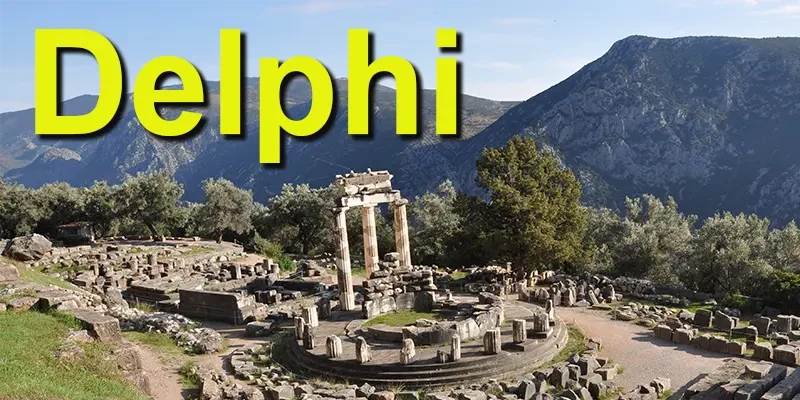
Delphi, Greece
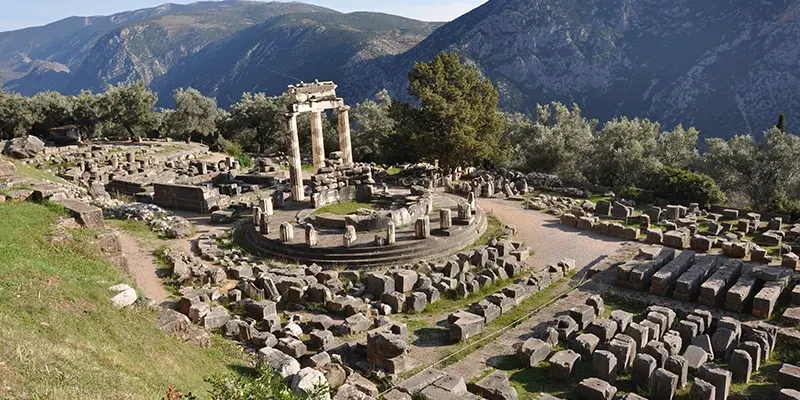
Few archaeological sites in the ancient world match Delphi for sheer drama of setting. Perched on the steep southern slope of Mount Parnassos in central Greece, the sanctuary looks out over a vast valley of olive trees stretching toward the Gulf of Corinth far below. The combination of monumental ancient ruins and one of the most breathtaking landscapes in all of Greece makes Delphi an essential destination — not merely a historical site but a place that retains something of the mystical atmosphere that drew pilgrims from across the ancient world for nearly a thousand years.
Delphi is about three hours by road from Athens, making it possible as a day trip, though spending a night in the modern village nearby allows a full day to explore the sanctuary and its exceptional museum without rushing.
You can also see this same video on a separate video page.
The Sacred Site
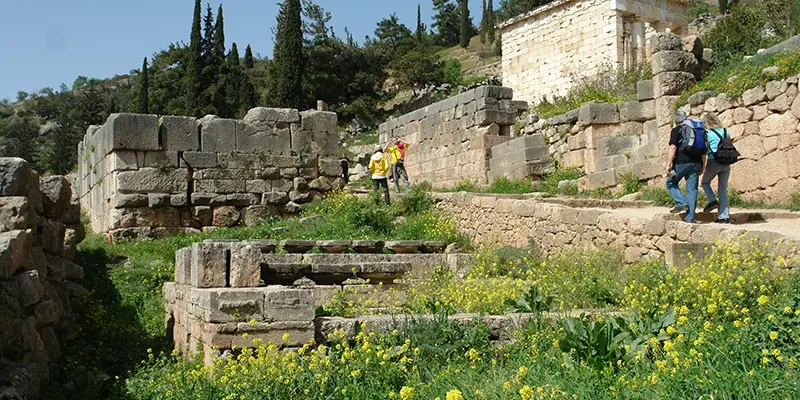
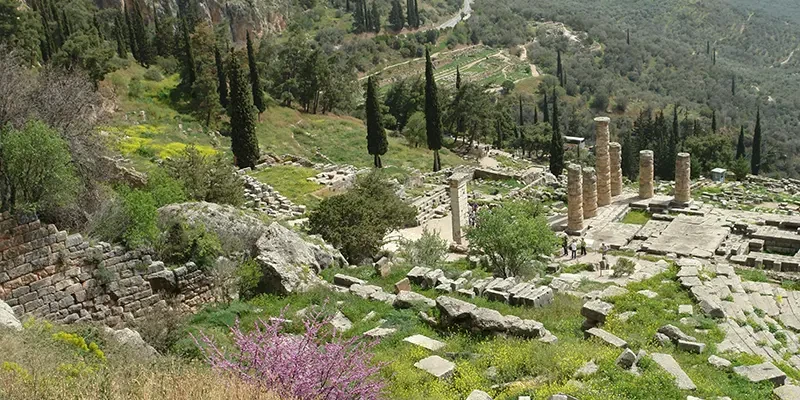
The entrance to the sanctuary marks the beginning of the Sacred Way, a processional path that winds uphill through a landscape of terraced retaining walls, ruined treasuries and column bases. Everything visible on the slope is man-made — a series of platforms and terraces built against the natural rock, creating what amounts to a sequence of elevated stages ascending toward the cliffs above.
According to the Homeric Hymn to Apollo, the god traveled from Delos in search of a location for his temple, arrived at Delphi, and slew Python, the serpent guardian of the earth oracle, before establishing his own sanctuary on the site. The great Temple of Apollo that stands — partially — today dates from the fourth century BC, built on the foundations of earlier structures going back to the eighth century BC.
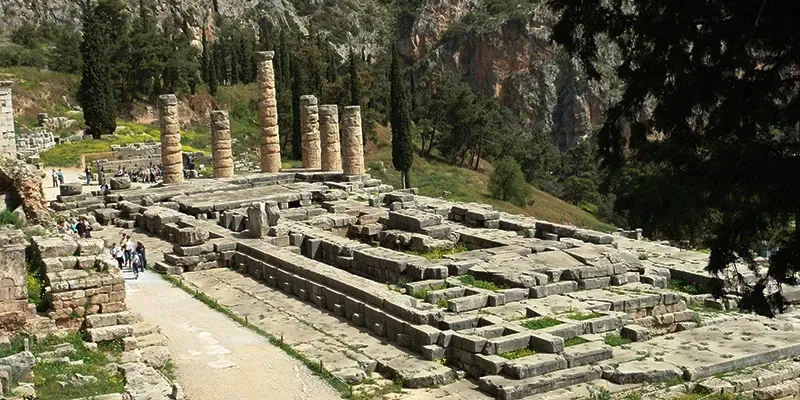
The temple is not the Parthenon in terms of architectural refinement, and it was built of local limestone rather than marble. But its setting surpasses every other sanctuary in Greece. The building sits on a massive terrace, its surviving columns the same pale grey as the rock face behind them, so that the ruins seem to grow directly out of the mountain. The atmosphere is one of withdrawal and mystery entirely appropriate for an oracle.
According to Greek mythology, Delphi was founded by Zeus, who determined it to be the center of the earth by releasing two eagles simultaneously from opposite ends of the world. They met above Delphi. The site was marked by the omphalos — a conical stone symbolizing the navel of the world — two examples of which survive, one in the sanctuary and one in the museum.
The site was sacred long before Apollo arrived. Its earliest worship was dedicated to Gaia, the earth goddess, whose oracle was believed to derive power from vapors rising through a crack in the ground. Those who inhaled them were said to gain the ability to see the future. Over time other gods entered the cult, including Poseidon, before Apollo supplanted them all.
.webp)
The Oracle
The Oracle of Delphi was a priestess known as the Pythia, who delivered prophecies from within the temple. Her utterances were famously ambiguous — she spoke in a state believed to be divine possession, and her words required interpretation by priests, who translated them for the consulting pilgrim. The result was guidance open to multiple readings, which gave the oracle a practical flexibility across centuries of use.
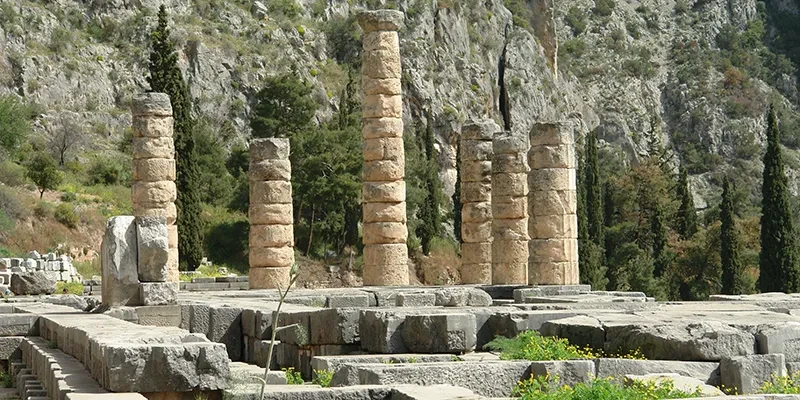
The institution became one of the most influential in the ancient world. Generals sought advice before military campaigns. City-states consulted the oracle before founding colonies. Kings asked about succession and conquest. During the great period of Greek expansion from the eighth century BC onward, the oracle at Delphi served as a kind of spiritual clearing house for the ambitions of the Greek world, its pronouncements shaping decisions from Sicily to the Black Sea. The sanctuary remained in active use through the Roman period, finally falling silent only with the spread of Christianity in the fourth century AD.
Theater
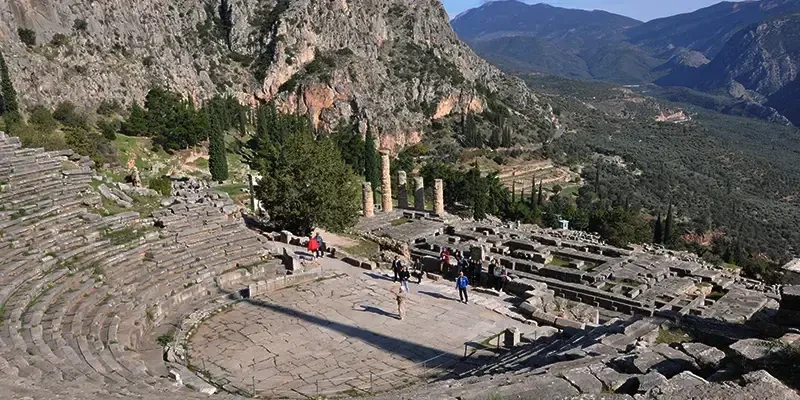
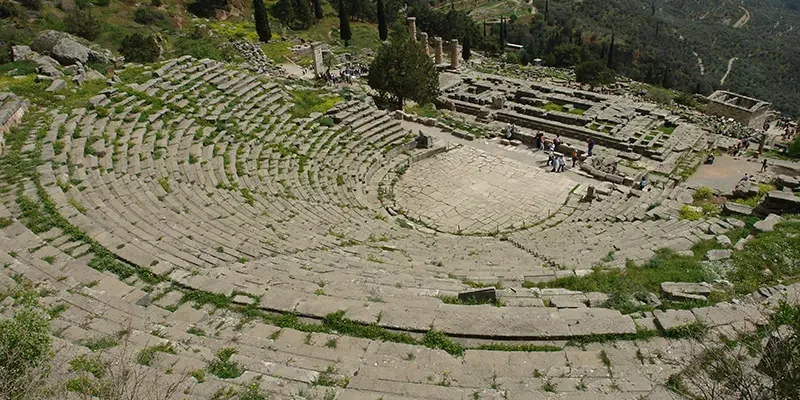
Above the Temple of Apollo, the ancient theater occupies a natural hollow in the hillside with a commanding view back down over the sanctuary and the valley beyond. It seated approximately five thousand spectators and was used for the musical and poetic competitions of the Pythian Games — the rhapsodies, hymns and instrumental performances held in honor of Apollo. The Romans later modified the orchestra by adding a low encircling wall, evidence of the site's long use across different eras. The acoustics, even without amplification, allowed performers at the center of the orchestra to be heard throughout the seating.
Stadium
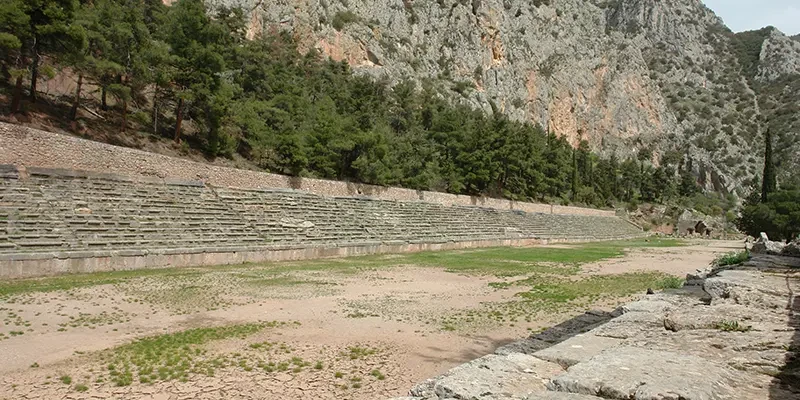
A further ten-minute walk up the slope leads to the stadium, the highest point of the sanctuary. At 178 meters in length and with a capacity of around seven thousand, it is smaller than the stadium at Olympia but remains remarkably well preserved, with sections of stone seating still in place. The Pythian Games held here every four years were among the four great Panhellenic festivals of ancient Greece, drawing competitors and spectators from across the Greek world.
The Treasuries
Along the Sacred Way, a series of small treasury buildings once housed the votive offerings of individual city-states — gifts of objects with symbolic or sentimental significance rather than simply material value, presented in gratitude for victories or divine favor. The Treasury of the Athenians, reconstructed from its surviving blocks, stands out for its material. While most buildings at Delphi used local limestone, the Athenians imported Pentelic marble from quarries near Athens — the same marble used for the Parthenon — as a deliberate statement of quality and prestige.
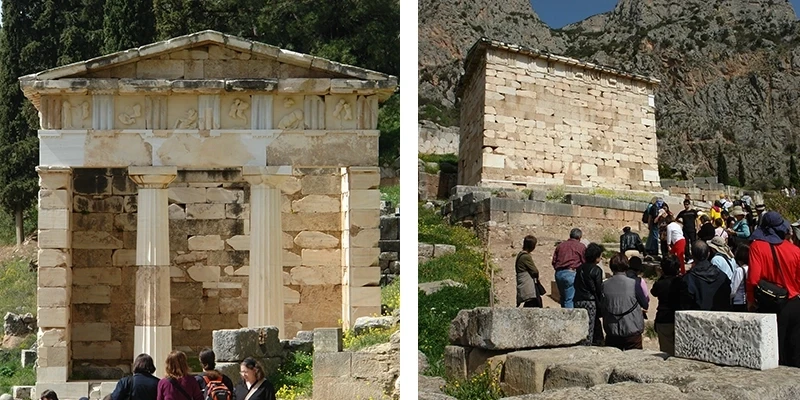
Polygonal Wall
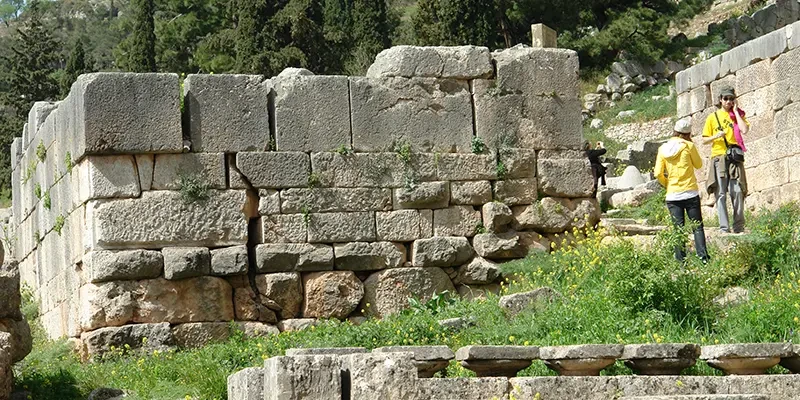
Behind the treasury runs the Polygonal Wall, a masterpiece of ancient dry-stone construction whose interlocking curved blocks have held for two and a half thousand years without mortar. Its surface is covered with approximately eight hundred inscriptions, most of them recording acts of manumission — the formal liberation of slaves. In a world where even democratic Athens accepted slavery as an institution, this wall constitutes one of the most remarkable surviving documents of ancient human rights, a record of private individuals choosing to free those who had been enslaved.
.webp)
The Museum
The Delphi Archaeological Museum, located immediately beside the ruins, houses the finest collection of objects recovered from the sanctuary during excavations that began in earnest in the 1890s, when a French archaeological team removed the accumulated deposits of centuries and the remains of a medieval village that had been built directly over the ruins.
.webp)
Among the museum's most important holdings are the kouroi — large marble statues of young male figures from the archaic period, with the characteristic frontal stance and faint smile of that era. These examples show the transition from Egyptian influence — the rigid posture, the forward-stepping foot — toward the distinctly Greek departure: fully worked in the round, the figure unclothed, with no supporting slab.
.webp)
A remarkable group of golden ivory statues, including a figure of Apollo, demonstrates the luxury materials used for cult images at the height of Delphi's influence. The wooden armatures that supported them have long since decayed, but surviving fragments of ivory — used for the flesh parts of the figures — and thin gold leaf — used for clothing and hair — give some sense of the original effect.
.webp)
The treasury frieze of Siphnos, carved in the sixth century BC, is one of the finest examples of archaic relief sculpture in existence. Two artists of different abilities and approaches worked on it, one using flat conventional forms, the other anticipating the spatial confidence of the classical period. The frieze depicts the council of the gods overseeing a battle from the Trojan War, with traces of original paint and metallic decoration still faintly visible. Two caryatids — female figures serving as architectural columns — supported the treasury's porch. They predate the famous caryatids of the Erechtheion on the Acropolis by a full century.
.webp)
The museum also holds a Sphinx column donated by the island of Naxos in the sixth century BC — a winged female figure combining human, bird and lion elements, set originally atop a tall column in the open sanctuary. And the omphalos stones, those symbolic markers of the world's center, sit quietly in their cases, modest in scale given the immensity of the claim they once embodied.
.webp)
The Charioteer of Delphi, cast around 478 BC, is one of the finest surviving examples of ancient Greek bronze sculpture. Standing nearly life-size, the figure depicts a young man holding the reins after a chariot race victory.
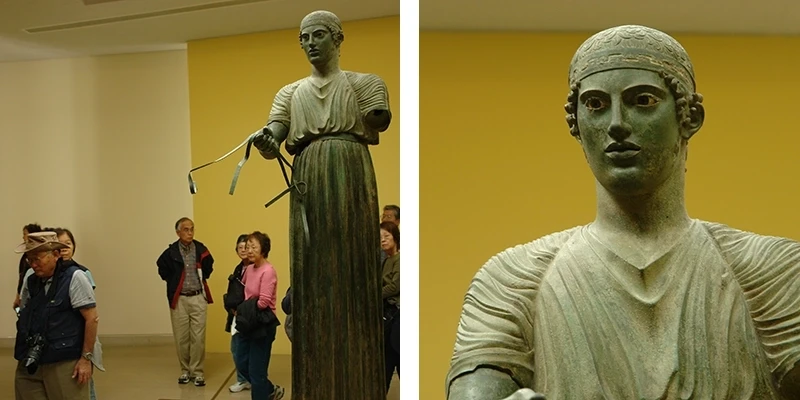
The remarkable preservation of detail is exceptional — the eyelashes, lips and headband inlaid with silver and copper still intact after 2,500 years. The calm, upright posture and serene expression represent the ideal of restrained athletic triumph that defined classical Greek values.
.webp)
The Modern Village of Delphi
The modern village of Delphi sits on a narrow ridge above the sanctuary, its main street lined with hotels, restaurants and shops looking out over the same extraordinary valley that made this location sacred in antiquity.
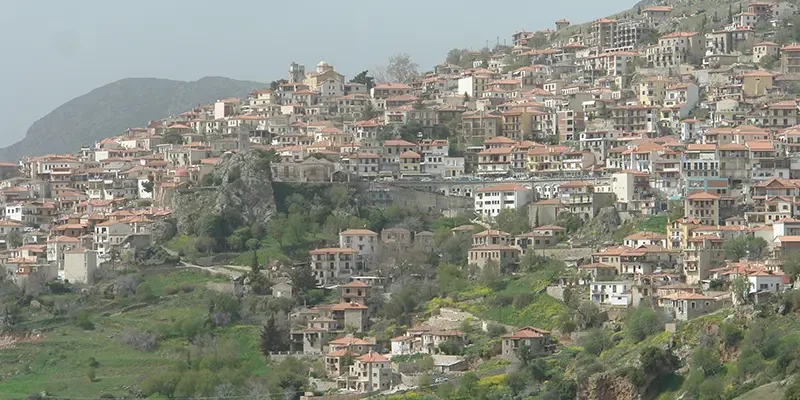
The view from almost anywhere in the village — across the olive groves of the Pleistos valley and down toward the Gulf of Corinth glittering in the distance — is reason enough to spend a night here rather than making the long return drive to Athens the same day.
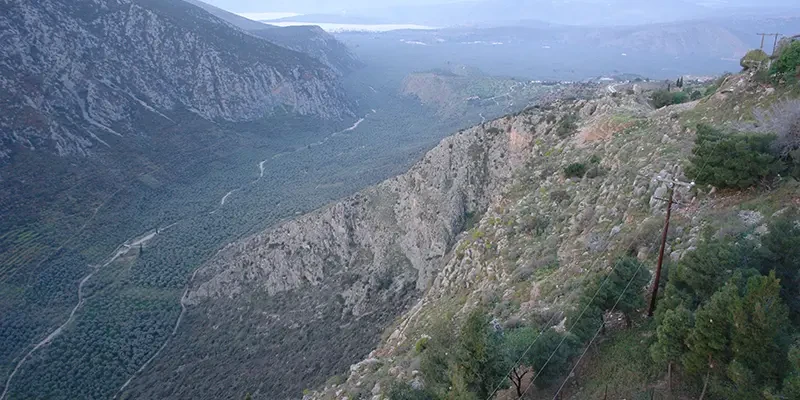
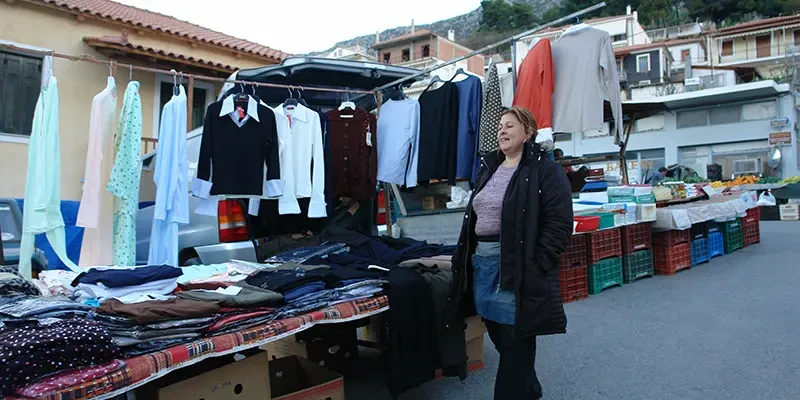
The village is compact and easy to navigate on foot, essentially a single main road with a parallel lane above and below it. It has the character of a small Greek mountain town that has adapted gracefully to tourism without losing its local texture. Alongside the souvenir shops selling reproductions of ancient objects, olive oil products and local honey, there are grocery stores, bakeries and kafeneions where residents gather in the mornings over coffee.
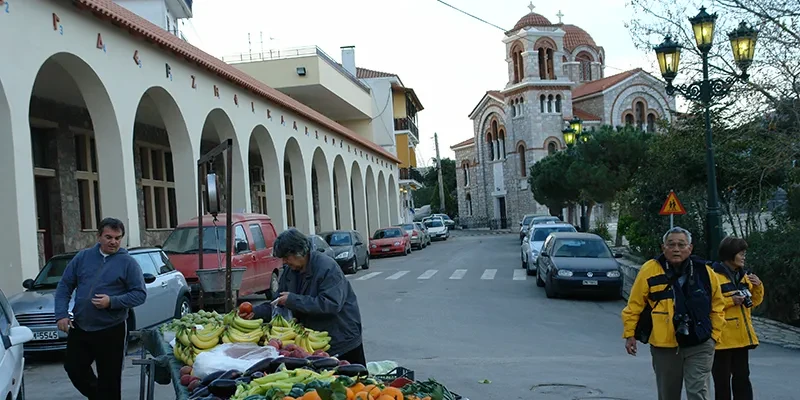
Hotels range from simple family-run guesthouses to well-appointed small hotels, most of them built to take advantage of the panoramic view. Rooms facing the valley are worth requesting for the spectacular mountain views.
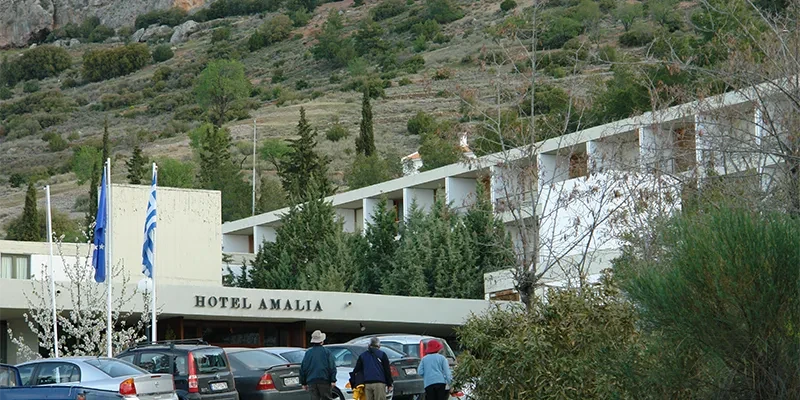
The village is quiet in the evenings — most tour groups depart during the afternoon — giving overnight guests a pleasantly unhurried experience of the site and its surroundings. Arriving the afternoon before a planned visit to the sanctuary allows time to settle in, walk the village, and watch the sun set over the valley, an experience that gives some sense of why this place held such spiritual significance for the ancient Greeks.
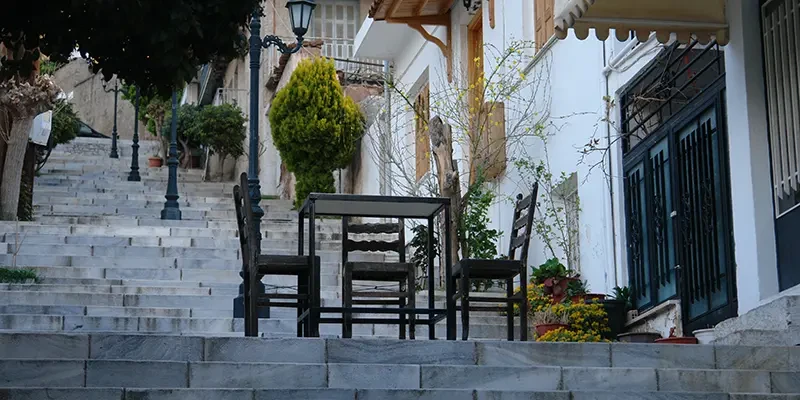
Restaurants cluster along the main street and on terraces overlooking the valley. The local cuisine draws on central Greek mountain cooking — grilled lamb and pork, bean soups, greens gathered from the hillsides, local cheeses and the distinctive honey produced from the thyme and wildflowers of Parnassos. Several tavernas offer outdoor terrace seating with unobstructed views, making an evening meal here a considerable pleasure.
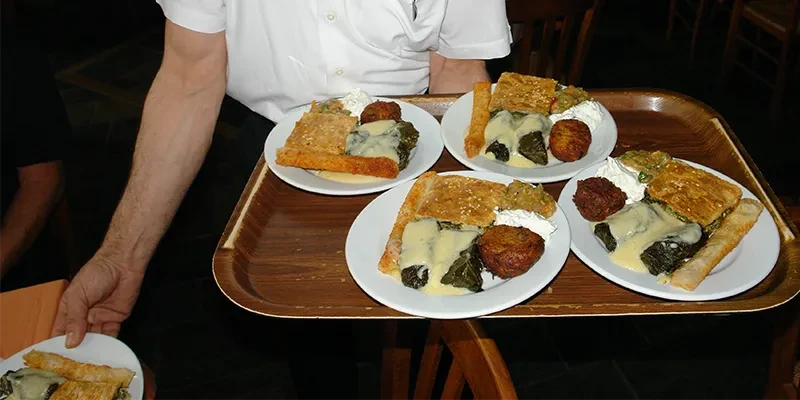
Shops along the main street sell quality reproductions of museum pieces, locally produced olive oil and olives from the vast groves visible in the valley below, hand-woven textiles and regional food products. The olive oil of this region is considered among the finest in Greece.
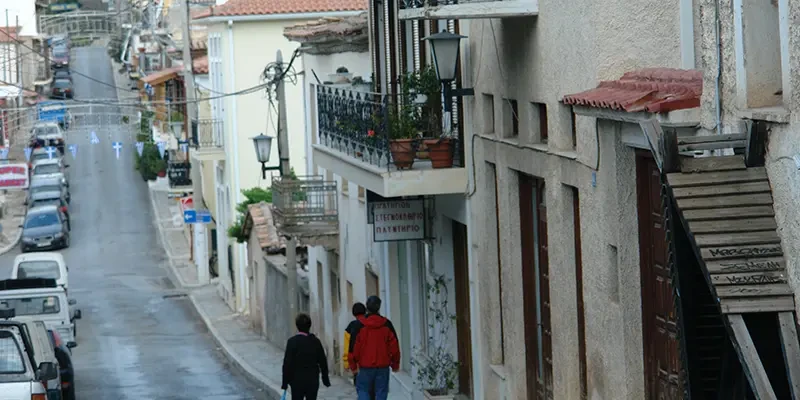
For visitors planning a full day at the sanctuary and museum, Delphi village provides everything needed — comfortable accommodation, good food and a setting that extends the experience of the ancient site long after the gates have closed for the evening.
Delphi rewards visitors who allow time for both the outdoor sanctuary and the museum, since each illuminates the other. The ruins provide the physical setting and the sense of scale; the museum supplies the detail and the beauty of what was once housed within them.
You can also see this same video on a separate video page.