.webp)
Santorini, Greece
The best words to describe Santorini are magical and romantic. Its whitewashed, cube-shaped houses are typical of the traditional architecture of the Greek Cyclades, but here they are different, built along the inside rim of a volcano, spilling down the cliff high above a deep blue bay. This is one of the world's most desired dream destinations, and the great lookout at Fira ranks among the most beautiful sights anywhere, so scenic that it is the second most photographed spot in Greece after the Parthenon in Athens.
Santorini lies in the southern Aegean, the most famous of the Cyclades islands. Its dramatic shape is the remnant of a massive volcanic eruption thousands of years ago that blew away the center of the island, leaving a ring of cliffs around a flooded caldera. What appears from town as a peaceful bay is the crater itself, with the surrounding islands forming the remains of the volcano's rim. The main town of Fira, also spelled Thera, sits on the cliff top overlooking it all.
You can also see this video on a separate video page.
Arriving on the Island
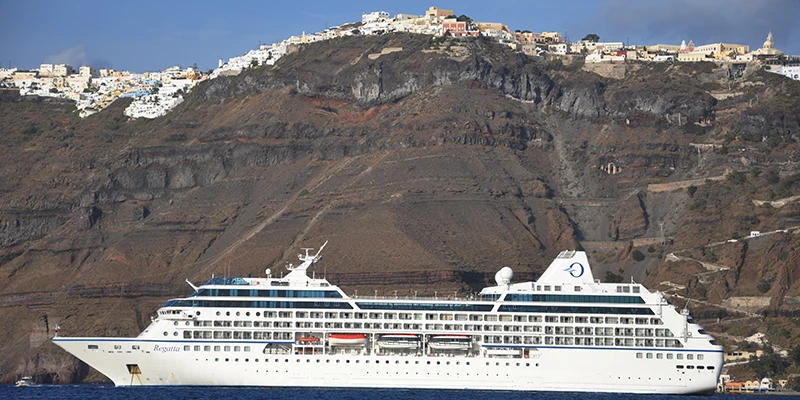
Although Santorini has a small airport, most travelers arrive by ship, very often a cruise ship, on an itinerary covering several islands. There is no dock or passenger terminal along the narrow shore, so passengers are brought from ship to shore on local tender boats in about ten minutes. Santorini is the most popular cruising destination in all the Greek isles, so popular that the local government has capped the number of cruise passengers allowed each day to ease the strain on the island's infrastructure.
.webp)
.webp)
The tender boats drop passengers at the small marina beside the cable car station, one easy way to make the 700-foot climb up the cliff. The cable car opened in 1982 and carries up to 1,200 people an hour on a ride that takes only three minutes, with an excellent view along the way. You can also get to Santorini by inter-island ferry, ideal if you plan to stay a few nights; the fast jet ferry from Mykonos, for instance, takes just over two hours.
The Famous Mule Ride
For a more exciting trip up the cliff, you can ride a mule. This famous mule ride is one of the special attractions of Santorini. Mules and donkeys have worked here for centuries, hauling goods and people from the shoreline up to the settlements on top, along roads always too rough for carts or trucks. In a real sense they are responsible for the creation of these towns, because without them nothing could ever have been built up here.
.webp)
.webp)
With growing concern for animal welfare, the government now bans riders over 100 kilograms, and some of the profit from the cable car is given to the mule drivers in recognition of their hard work and to help keep the tradition alive. A third option is to walk, up or down the roughly 600 steps of the zigzag path, perhaps best saved for the descent at the end of a visit.
Fira Town
The main town, Fira, consists largely of pedestrian lanes lined with shops and restaurants. Everybody gets off the cable car and shuffles along with the crowd, but look to the right and you will find the best viewpoint on the island, a postcard scene of the white town curving along the caldera rim. Looking out at this is one of the top thrills of being here.
.webp)
.webp)
The main part of the village runs only about 600 meters and is three narrow blocks wide, so it is easy to walk around and see most of it in a few hours. There is one main pedestrian lane and a couple of small side lanes, so you cannot possibly get lost; you simply reach the end and find another panoramic viewpoint. Along the way you will certainly meet some of the island's famous cats, well cared for and always ready to be admired.
.webp)
.webp)
.webp)
Shopping and Dining
A favorite activity is shopping, and the little stores here are a lot of fun. Some are unique boutiques with handmade items, alongside the usual range of Greek souvenirs: books, calendars, postcards, small bronze statues, Byzantine icons, imitation frescoes, pottery, soaps, tablecloths and clothing of every type. Locally harvested natural sponges are super absorbent, and Greece is famous for its golden jewelry, such as a necklace with the classic meander pattern. The merchants are multilingual and happy to help, whether you are buying or just window shopping.
.webp)
.webp)
Life does not get much better than sitting on a terrace in Santorini, enjoying a meal and drinks with friends while looking out over the scenery, the village behind you and the sun setting over the bay. With so many outdoor restaurants, terraces and walkways set against the caldera view, it is easy to understand why dining here is one of the great pleasures of a visit. The restaurants are very good and specialize in a local red wine grown on the island's vineyard-covered hillsides.
.webp)
.webp)
.webp)
The Residential Lanes
Away from the shops, it is worth detouring down into the residential neighborhood. It looks like an impenetrable maze, but it is really quite simple, with several lanes leading right through it. Many of the homes are dug straight into the hillside, which gives them added space and natural insulation, cooler in summer and warmer in winter. They gain further space by using their flat rooftops as outdoor patios, an efficient use of space in this high-density but low-rise community, and the mild climate all year round means the open-air spaces get plenty of use.
.webp)
.webp)
Walking through the residential area also gives ever-changing views from different angles, past the many small neighborhood churches typical of Greek villages. Hidden staircase alleys connect all the main lanes like a three-dimensional jigsaw puzzle. It is tempting to edge close to the cliff for the view, but it is wise to be careful near the unfenced edges. The village took enormous effort to build on these terraces and takes constant effort to maintain, much of it done by hand, and you will notice artistic touches everywhere, such as mosaic pavings and private garden courtyards.
.webp)
.webp)
Ia Village
Santorini is a small island with two main villages: Fira, the largest and the island's capital, and Ia, a smaller town at the northern tip that is a UNESCO World Heritage Site. Ia is comparable in spirit to Fira but charming in its own way, and much less crowded and busy. It is easily reached on a short organized day trip from a cruise ship, a small tour bought in Fira, or a rental car, and it rewards the effort with some of the island's most beautiful scenery.
.webp)
.webp)
Ia is famous for its blue-domed churches set against the white village and the deep blue caldera, one of the most recognizable images of all Greece. In the soft light of late afternoon the pastel buildings glow, and terraces with small swimming pools look out over the water far below. It is a place made for lingering, especially as the day winds down.
.webp)
.webp)
Twilight and Sunset
There is another side to Fira worth discovering as evening comes on: the main street, back from the cliff, where cars, motorcycles and trucks pass and the restaurants charge lower prices than the terrace places overlooking the view. This is the backstage town, the real place behind the postcard, and a good spot for an inexpensive gyro, some bargain shopping, or a friendly bar or coffee shop. It is a lot of fun and gives a truer feel for local life than the view-side lanes alone.
.webp)
.webp)
Above all, be here for twilight and sunset, the most magical time of day on Santorini, when natural and artificial light mix in perfect balance and the whole caldera glows. The sunsets are one of the island's most celebrated attractions, reason enough to squeeze every minute out of the visit. Eventually you have to tear yourself away, riding the cable car down to the docks in the dark and back to the ship, carrying the memory of one of the most beautiful places in all of Greece.