
Rhodes
The Old Town on the island of Rhodes is among the most extraordinary medieval cities in the world. Enclosed within massive defensive walls built by the Knights of St. John in the fourteenth century, the old city is a UNESCO World Heritage Site of winding pedestrian lanes, gothic churches, Ottoman mosques, Byzantine chapels and ruined palaces that have remained largely intact through successive conquests and centuries of neglect. The stone buildings — earthy brown rather than whitewashed, appearing to grow directly from the ground — carry the marks of every civilization that has occupied this strategic island since the ancient Greeks. A full day is enough to sample the main sites, wander the back alleys, visit the exceptional archaeological museum and taste the local food and wine. Cruise ships usually depart after 6:00 p.m. However there is so much to see here you'll want to consider staying for several days.
.webp)
In comparison to Mykonos and Santorini, the Old Town of Rhodes is three times larger in area, about one half mile across, and rather than being plastered in white, the old buildings are earthy brown with much of the stone structure visible, as if they grew directly out of the ground. Rhodes is also on the sea, but the Old Town is sealed off from the waters by the huge defensive wall. Outside the wall, next to Mandraki Harbor, a lovely row of outdoor cafes offers a view of the small craft tied up at the docks. Another section worth visiting is the modern downtown two blocks inland from the New Market.
You can also see this same video on a separate video page.
Highlights
- The massive medieval walls and dry moats, among the most impressive fortifications in Europe
- The Street of the Knights, one of the finest authentic medieval streets on the continent
- The Archaeological Museum, housed in the original fifteenth-century Hospital of the Knights
- The Palace of the Grand Masters, rebuilt to its original fourteenth-century gothic design
- The Turkish quarter with surviving mosques, minarets and an authentic Ottoman bathhouse
- Mandraki Harbor and the New Market, with waterfront cafes and excellent local food
- The ancient harbor entrance where the legendary Colossus of Rhodes once stood
.webp)
Arrival
It is quite easy to get to the island of Rhodes by air or as a stop on a Greek island cruise. Cruise ships typically arrive about 7:00 a.m. and dock at the pier in town, a few hundred meters walk to the Old Town. It is worth being on deck to witness the dramatic scene of the ship's entry into this impressive ancient harbor, viewing those massive medieval stone walls — the signature sight of this old city. The island rises from the Aegean Sea twelve miles off the coast of Turkey.
Walking Route
Here we describe a walking route, starting from morning and taking you right through to dinner – a full day in Rhodes. This is filled with suggestions for how to see the main sites and do some wandering through the narrow old pedestrian lanes. If you are staying for a few days, you might also consider taking an optional tour to Lindos, an hour's drive south, visiting a small whitewashed cubic village with ruins of an ancient Greek temple on the hill that towers above. However, it is equally rewarding to skip the trip to Lindos and transport yourself several centuries back in time by focusing on the Old Town of Rhodes, a UNESCO World Heritage Site. If arriving by cruise ship, walk a couple hundred yards along the docking pier leads through the gate of St. Mary directly into what looks like the Middle Ages.

The first thing visible is the ruins of a gothic church, Our Lady of the City, with pointed arches still holding up the end walls but without a roof, creating a tranquil outdoor garden setting among the rubble. Most of the Old Town is reserved for pedestrians, so the atmosphere is quiet and peaceful, although a few small cars with special permits and scooters will pass through. Standing next to the ruined church, the main street extends from here and runs through the entire length of the Old Town. It changes names a few times and winds through a couple of small town squares, until it becomes Socratous Street, lined with shops and cafes all the way.
.webp)
Jewish Martyrs Square
The first landmark you'll reach walking towards Socratous Street is Jewish Martyrs Square, which serves as a major social hub. It is a gateway with several lanes leading out for travelers exploring the deeper history of the neighborhood while enjoying the local atmosphere. It is a central gathering point within the former Jewish quarter, known as La Juderia. This lively square is shaded by large trees and surrounded by local cafes and shops. It is a common spot for street artists to set up easels and for visitors to pause while exploring the medieval alleyways.
The Seahorse Fountain in the center is one of the most recognizable landmarks in the Old Town, topped with three bronze seahorses and decorated with tiles depicting marine life, reflecting the island's long-standing maritime heritage. The square was originally a densely populated residential area of the Jewish community. During World War II, many of the surrounding homes were destroyed by bombings, and the square was later dedicated as a memorial to the 1,604 Jews of Rhodes and Cos who were deported in 1944.
.webp)
Hippocrates Square
Ippokratous (Hippocrates) Square is your next major sight, the vibrant social and commercial heart of the medieval city. Located at the end of the street leading from the Marine Gate, its historical significance is anchored by the Castellania, a grand building from the era of the Knights Hospitaller that now serves as the municipal library.
.webp)
The square features a medieval stone fountain and is surrounded by architecture that reflects both the Knightly and Ottoman periods of the island. Today, it is most famous for its bustling energy, acting as the entrance to the main shopping district. The square is lined with cafes and tavernas, many of which offer rooftop seating with expansive views of the surrounding fortifications and the harbor, making it a popular gathering spot from morning until late at night.
.webp)
From Ippokratous you can dive into the picturesque tangle of historic lanes of the Turkish Quarter, which many visitors overlook, yet it is one of the most interesting parts of town. However, hold that thought for a moment while we point you to the main street of town that will be the true highlight of most visits. Take a walk up and down this Socratus Street, then return to Ippokratous to begin that exploration of the Turkish Quarter.

Socratous Street
Socratous Street serves as the main commercial artery of the Rhodes Old Town, stretching from Hippocrates Square toward the Mosque of Suleiman. This bustling thoroughfare is defined by its eclectic architecture, where medieval stone facades meet Ottoman-era wood-shuttered windows, creating a visually rich environment for visitors.

This pedestrian street is the primary destination for shoppers, offering everything from high-end jewelry and leather goods to traditional Greek ceramics and local honey. Numerous cafes and restaurants line the street, providing shaded spots to enjoy a meal while observing the constant flow of people navigating the ancient, sun-drenched cobblestones. Then explore the historic side lanes and the magnificent, massive medieval walls.
Then venture into the residential back lanes of the crumbling Old Town. People are still living here in the old-fashioned way in these ancient stone buildings — it genuinely feels like stepping back several centuries.
.webp)
The Turkish Quarter
Walk up the straight lane of Pythagora into the heart of the old Turkish section, which makes up the back half of the town. On the right stands a tall minaret above the town's oldest Turkish mosque, Ibrahim Pasha Cami, built in 1531 and recently renovated. If the door is open, visitors may go inside — shoes must be removed first. The classic elements of a mosque are all here: the floor covered in lush carpets, a prayer niche pointing toward Mecca, Koranic phrases painted on wall plaques, a crystal chandelier hanging from the dome overhead, the pulpit for sermons and a cleansing fountain outside, the whole topped by a beautiful dome. There are fourteen surviving mosques and twenty-eight small Byzantine churches in the Old Town.
.webp)
Continuing up Pythagora, the lane passes under a large arch formed by a building crossing the alley — one of many such arches throughout the old town, designed to hold the buildings together during earthquakes and adding an exotic character to the architecture. The town is so densely packed in places that structures were built on top of alleyways, arched over to form small tunnels, with one house stacked above another and secluded little courtyards tucked between them.
You can also see this same video on a separate video page.
The Walls and Moats
.webp)
In another couple of blocks, Kokkini Porta Gate (St. John's Gate) appears — one of the major entrances through the wall. From here the elaborate fortification is clearly visible: two massive parallel stone walls, each sixty feet high and thirty feet thick, separated by two huge dry moats.
.webp)
Pay attention to the gate itself as you pass through — entrances were always the most vulnerable point in any walled town, and these were engineered accordingly, with multiple right-angle bends to create firing positions, platforms above for defenders, and mechanisms for dropping stones and boiling oil on attackers below. This section ranks high among Europe's most impressive stone fortifications.
.webp)
These extraordinary structures were built during the age of cannon artillery, when most castles were being defeated by the power of gunpowder. The response in Rhodes was to build walls so massive that even cannonballs would bounce off.
.webp)
The total circuit of walls extends for two and a half miles around the entire perimeter of the Old Town, and at the palace section the defenses become even more formidable, with up to five parallel walls running at slightly irregular angles.
.webp)
The Knights continuously upgraded the fortifications over two centuries, adding bastions, towers and artillery platforms as siege technology evolved. The result is one of the best preserved examples of medieval military architecture anywhere in the world.
.webp)
Returning through the gate, turn left on Omirou, passing the Redjep-Pasha mosque, then turn left down a small alley to reach the wall again.
.webp)
This is the highest stretch of the internal wall and leads to another impressive gate, St. Athanasios, which gives the most revealing view of the walls and moats, with the huge double walls extending in both directions and broad dry moats between them.
.webp)
Continuing through the Old Town along Ippodamou, then veering right through narrow twisting lanes, the route reaches the Moustafa Mosque and Baths. The mosque is slowly being restored, but the authentic Turkish bathhouse is open to the public. Taking the alley Ergiou through the arch leads to the quaint street Agios Fanourios, and turning left returns to Socratous Street, which by now should be fully open for business. This is a good time for a break at one of the cafes and some browsing for souvenirs, jewelry, fisherman hats, sponges and antiques.
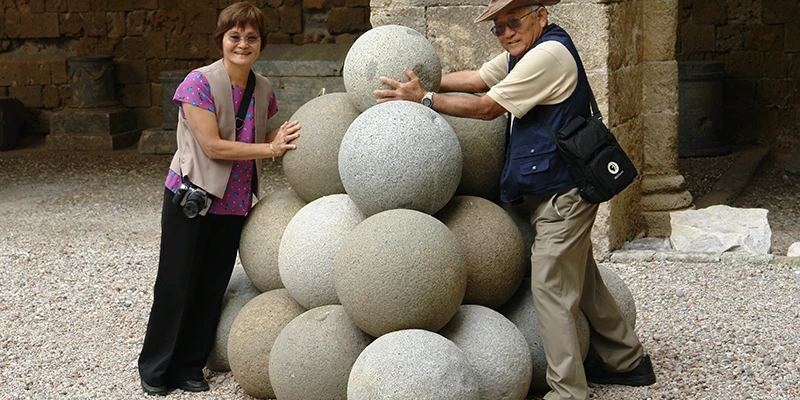
Throughout the old town, scattered among the residential neighborhoods, large stone balls are visible in courtyards and lodged in walls as if repelling the cannon shots that struck them. These were not cannonballs but projectiles for the massive catapult siege machines — enormous sling mechanisms that could be aimed with considerable accuracy and caused devastating damage. The walls of the old town extend for two and a half miles all the way around the perimeter, with the multiple parallel walls adding considerably to the total.
The Clock Tower and Mosque of Suleiman
.webp)
At the top of Socratous you will see the Mosque of Suleiman — the largest in town. Built in 1522 to commemorate the Ottoman victory over the Knights of St. John, the Mosque of Suleiman is the largest and most prominent mosque in the Old Town, its distinctive pink exterior and slender minaret visible from many points in the medieval city.
.webp)
Named after Suleiman the Magnificent, the sultan whose forces finally breached the walls after a two-year siege, the mosque was constructed using stones taken from earlier Christian buildings on the site. It has been under restoration for many years and is not currently open to the public, but its exterior and the street alongside it are among the most atmospheric in the Old Town.
.webp)
Next door is the Clock Tower, which can be climbed for a small fee to gain a bird's-eye view of the town. Attractive cafes and souvenir shops line Orfeos Street leading toward the Palace of the Grand Masters.
Moat, Palace and Museum
.webp)
Before the palace, continue straight through St. Anthony arch to D'Amboise Gate, another impressively fortified entrance with views of the moat and walls. Backtracking to St. Anthony arch, a small staircase leads through a tunnel into the dry moat. Standing on the grassy lawn of this moat and looking straight up at the sixty-foot wall provides a full appreciation for the heroic scale of these defenses. A grassy park runs through the moat for those who wish to explore further before returning to the staircase.
.webp)
Palace of the Grand Masters
This grand old palace was headquarters for the Knights of St. John, built in the gothic style during the fourteenth century, now open as a public museum. Read more about those knights later in the history section. Later in its history, after the knights were forced to leave town, the occupying Turks stored gunpowder in the basement. A lightning storm in 1856 triggered an explosion that leveled the palace to rubble, killing 800 people. It was completely rebuilt to the original design by the Italians in 1939. Inside, 205 rooms contain mosaics from Kos Island dating from the Hellenistic and Roman periods, marble statues including a copy of the Laocoon, and rooms that evoke the life of medieval aristocracy.
.webp)
Street of the Knights
A soaring gothic loggia built in the early fifteenth century stands in front of the palace and leads into one of the most beautiful and authentic medieval streets in Europe. Like the palace, the Street of the Knights was reconstructed in the early twentieth century, but the result is an accurate representation of the medieval headquarters of the various nations involved with the Knights — England, France, Germany, Italy, Spain and Provence each represented by a different building along the street. Cobblestone paving and rugged stone masonry of fortified palace facades lining both sides make for a dramatic vista.
.webp)
The Archaeological Museum
Located inside the Gothic Hospital of the Knights, the Archaeological Museum is one of the most fascinating sights in Rhodes. The building alone is worth a visit — this is not a reconstruction but the original hospital, dating from 1440 to 1481. The long hospital infirmary ward is one of Europe's great secular gothic interiors, spacious enough to have held 100 patients, with a chapel on one side that protrudes as a bay window above the street.
.webp)
The Knights of St. John were primarily on a medical mission to care for wounded Christian soldiers, and this hospital was a major focus of their activities — the reason for their existence here. If forced to choose between the palace and the museum, come here.
.webp)
The collection includes many exquisite sculptures, most notably the marble masterpiece of a nude Aphrodite, goddess of love, spreading her hair in a seductive crouch, the head of Helios the sun god, and a full-figured life-sized Aphrodite as well.
.webp)
Upon entering, a central courtyard is surrounded by a two-story stone loggia resembling a gothic cloister, with columns and arcades joined by pointed arches. The ground floor holds rooms of pottery and jewels, while the main collection occupies the second level, accessed by a broad stone staircase.
.webp)
St. Mary of the Castle and the New Town
Emerging from the museum, a short walk leads to the oldest church in town, St. Mary of the Castle, constructed in the Byzantine style during the eleventh century and predating the arrival of the Knights. The soaring stone ceiling and cross-vaulting reward the small admission price. Passing the ruins on the right near Freedom Gate, these are the remains of an ancient temple — one of the few authentic pieces from the ancient world still surviving within the town of Rhodes. From here it is one block to Symi Square and the Freedom Gate, which leads to the New Town.

Mandraki Harbor
Mandraki Harbor, filled with fishing and excursion boats, provides a scenic nautical backdrop for the lineup of cafes along the front of the New Market. The pastries on display will make the mouth water, and the soft padded seats on the terrace are an invitation to sit down for a pot of tea.

The open courtyard of the New Market also offers some of the best food values in town. There are also many good restaurants in the heart of the Old Town for later in the day.

New Town
Exiting the rear right corner of the New Market and walking uphill one block leads into the heart of modern Rhodes — a completely different world of fancy shops, streets filled with cars, noise, fast food and modern buildings. Walking up Galias Street one block, then through the busy intersection where seven streets converge, gives a quick slice of real local life. Taking a left on Sof Venizelou and heading for the small park leads back into the Old Town through D'Amboise Gate.
Dining and Shopping
.webp)
For a late lunch, fresh fish at Taverne Alexis in the mid-section of Socratous Street is hard to beat — prices are high but the food is excellent. There are also many reasonable places to eat in the Old Town, particularly along Pindarou Street and just beyond the Square of the Martyrs with the seahorse fountain. One dining note worth keeping in mind: stick to the posted tourist menu and politely decline suggested additions — extra sauces, salads and large bottles of water can inflate the bill considerably without warning. The main meal will be generous enough on its own.
.webp)
At Ippokratous Square, an excellent wine store under the gothic steps, The Cellar of Knights, stocks all varieties of the distinctive local Rhodian wines. The Public Library on the square is also worth a look, housed in an authentic gothic building with a medieval courtyard. For shopping, Greece is justly famous for high-quality gold jewelry, and Rhodes has a good selection. Carpets imported from Turkey, just ten miles across the water, are also available throughout the bazaar. The shoulder seasons of April and October are the most pleasant times to shop and explore — the old town is uncrowded, the pace is relaxed, and the lanes are at their most atmospheric.
Where to Stay
Accommodation in and around the Old Town of Rhodes ranges from simple pensions tucked inside the medieval walls to comfortable hotels just outside them in the New Town. Staying within the Old Town itself is the most atmospheric option — small family-run guesthouses and boutique hotels occupy converted medieval buildings, some with stone vaulted ceilings and inner courtyards, putting the entire historic district within a short walk in any direction. Facilities vary considerably: some properties have private bathrooms and air conditioning, others are more basic with shared facilities, so it is worth checking specifics before booking. Staying inside the walls puts the entire medieval city within a short walk and gives the experience of living, briefly, within one of the world's great historic monuments.

There are modern hotels at various price points in the new part of town, just outside the walls, within easy walking distance of the Old Town gates. The area around Mandraki Harbor has several well-established hotels with sea views. For those arriving by cruise ship with only a day in port, accommodation is not a consideration, but for independent travelers Rhodes rewards an overnight stay — the old town in the early morning and evening, after the day visitors have gone, has a calm and authenticity that is worth experiencing. The best bases for exploring the rest of the island beyond the city are hotels near Mandraki Harbor, from which buses and taxis connect to Lindos and other destinations along the coast.
Day Trip to Lindos
Lindos, about an hour's drive south of Rhodes town along the island's eastern coast, is the most popular excursion from the city and rewards the journey with a combination of striking scenery, ancient ruins and a beautifully preserved traditional village. The approach by road reveals the destination dramatically — a gleaming white cubic village clinging to a steep hillside, crowned by an ancient acropolis on the rocky promontory above, with a sheltered sandy bay curving below.
.webp)
The village itself is a maze of narrow whitewashed lanes lined with sea captains' houses dating from the seventeenth and eighteenth centuries, many decorated with distinctive black and white pebble mosaic floors. No cars are permitted in the village, and the only way up to the acropolis is on foot or by donkey along a steep path. At the top, the ruins of a Doric temple of Athena dating from the fourth century BC occupy one of the most dramatically situated ancient sites in Greece, with sheer cliffs dropping to the sea on three sides and views extending across the Aegean on clear days. The Crusader Knights later built their own fortifications around the ancient ruins, adding medieval walls to the classical remains. The bay below the village, Lindos Bay, is one of the finest beaches on the island, sheltered and clear, with the acropolis reflected in the water.
.webp)
Organized excursions to Lindos depart regularly from Rhodes town and are available through hotels, travel agencies and the cruise ship itself. These typically include return transportation, a guided tour of the acropolis and free time in the village — a convenient option that removes any uncertainty about timing and transport. Independent travelers can take the public bus from the main bus station in Rhodes, which runs several times daily and drops passengers at the edge of the village. Allow at least three to four hours to do Lindos justice — the walk up to the acropolis, time among the ruins, a stroll through the village lanes and lunch at one of the terrace restaurants overlooking the bay. Cruise ship passengers considering Lindos should weigh the travel time carefully — the round trip alone takes two hours, leaving limited time in port for the Old Town of Rhodes itself, which is equally deserving of attention.
.webp)
History
The history of Rhodes traces back to the Trojan Wars of 1,200 BC when, according to Homer, the island sent a dozen ships to join the forces attacking Troy. The town was first founded as a Greek settlement during the fifth century BC and became an important cultural and artistic center, noted for its school of philosophy and many fine statues in bronze and marble. When the Romans conquered, they plundered the island and took thousands of statues back to Rome.
The island is perhaps most widely known for its legendary Colossus of Rhodes, a bronze statue approximately ninety feet high that was one of the Seven Wonders of the Ancient World. Built around 280 BC, it stood for only about sixty years before being toppled — not astride the harbor entrance as popular imagination has it, but most likely standing at the harbor mouth as a colossal welcoming figure and beacon displaying the power of the city. Ancient coins bearing its image provide the only direct evidence of what it looked like. After it fell it lay in ruins for some six hundred years, a vast scatter of broken bronze, until the Saracens came around 600 AD and carted the metal away to be melted down. It is not merely legend — historical records confirm it existed, making its disappearance all the more extraordinary.
.webp)
Defensive walls had been built on Rhodes as early as the ninth and tenth centuries, but it was under the Knights of St. John in the fourteenth century that the massive fortifications took their present form. Knights from England, France, Germany, Italy, Spain and Provence formed a coalition to defend the eastern frontier of Europe against Ottoman expansion. The Old Town is still surrounded by the wall they built, and many of the buildings within date from this medieval period.
Rhodes was besieged by Turkish forces several times, finally falling in 1523 to the army of Suleiman the Magnificent, Sultan of the Ottoman Empire. A desperate battle raged for months, with an estimated 100,000 Turkish troops surrounding the fortified town defended by just a few hundred Knights of St. John and a mercenary force of around 5,000. The defenders held out for nearly two years — resupplying themselves, repelling assault after assault, and maintaining their position with extraordinary tenacity. Legend holds that the end came partly through treachery: a spy inside the walls sent word to the Ottoman commanders that the defenders were nearly out of water and on the verge of surrender. With this intelligence, the Turks redoubled their attacks and the town finally fell — not through the failure of its walls but through the exhaustion of the people within them.
Turkey ruled Rhodes with benign neglect until World War One, when the Italians invaded and occupied the island until World War Two. The Germans then controlled the city until it was liberated by the British and finally reunited with Greece in 1948. Through all of these successive occupations, the medieval fabric of the old town survived largely intact — making it one of the most important and evocative historic monuments in Europe, comparable in scale and preservation to Carcassonne in southern France or York in England.