Nafplion, Greece
Nafplion is one of the most charming towns in Greece, an elegant seaside resort whose quaint historic center comes as a genuine surprise to visitors expecting only ancient ruins in the Peloponnese. Set on a small rocky peninsula with fortresses on every side, it mixes Venetian and Turkish influences in a beautifully preserved old town of narrow lanes, neoclassical facades, waterfront cafes and a lively pedestrian zone. For many travelers it is the highlight of a Peloponnese tour, a place whose historical beauty simply knocks you off your feet.
The town lies on the Gulf of Argolis, in the northeastern Peloponnese, an easy drive from Athens and close to the great ancient sites of Mycenae and the theater of Epidavros. Its natural harbor is the safest anchorage on the gulf, and it was around this harbor that the town grew into an important trading center at the crossroads of east and west.
.webp)
The Fortresses
Nafplion is guarded by three fortifications. Out in the middle of the harbor stands the Bourtzi, a small Venetian sea fort built in the fifteenth century that looks like a stone ship at anchor and has guarded the entrance to the port ever since. It is one of the most photographed sights in the town, especially in the golden light of early morning.
.webp)
.webp)
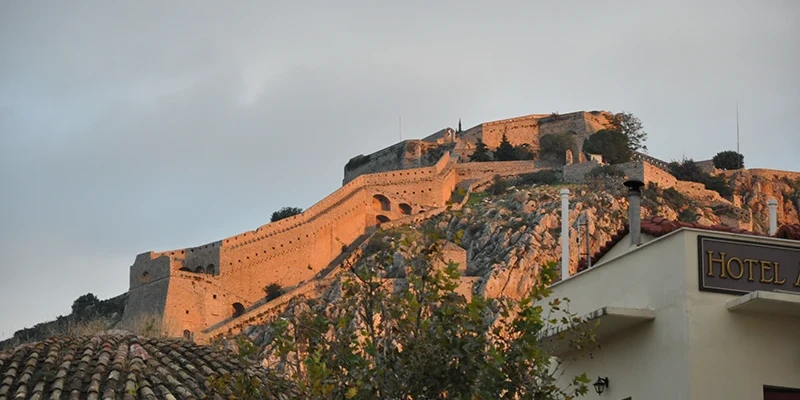
High above the town rises the Palamidi, a vast citadel built by the Venetians in the early eighteenth century, reached by a long climb up a stairway cut into the cliff. Below it, the older Acronauplia fortress crowns the rocky peninsula that the medieval walled town once occupied. Many hotels here are built within the old fortifications, and rooms on the hillside enjoy spectacular views over the harbor.
.webp)
History
Nafplion has a rich and layered history. It was a walled city in medieval days, held for long periods by the Venetians and the Turks, each of whom left their mark on its architecture and fortifications. Its greatest distinction came after Greek independence, when for a time it served as the first capital of modern Greece, before the capital was moved to its permanent home in Athens.
.webp)
.webp)
The Old Town
The heart of Nafplion is its old town, a compact grid of narrow streets and a pedestrian zone closed to cars. Neoclassical buildings in soft colors line lanes hung with bougainvillea, their ground floors filled with shops, galleries, tavernas and cafes. It is a town made for wandering on foot, with something to catch the eye around every corner.
.webp)
.webp)
.webp)
The main squares and lanes are lined with market stalls and small shops selling local goods, and the town has a relaxed, unhurried rhythm that rewards a leisurely pace. A domed church and other historic buildings punctuate the old quarter, evidence of the many cultures that have shaped the town over the centuries.
.webp)
.webp)
.webp)
The Waterfront
The waterfront is the town's gathering place, a wide promenade lined with cafes and restaurants looking out over the harbor and the Bourtzi beyond. A walkway leads out along the docks, past the harborfront cafes and the fishing boats moored along the quay. It is an especially beautiful spot in the early morning, when the town is quiet and the water holds golden reflections, or in the evening as the restaurants begin to fill.
.webp)
.webp)
.webp)
The food in Nafplion is delicious and, as throughout Greece, relatively inexpensive, drawing on the fresh ingredients and rich traditions of Greek cooking. The tavernas of the old town and the restaurants along the water offer a wide choice, and dining outdoors on a warm evening is one of the pleasures of a stay here.
.webp)
.webp)
.webp)
Views and Lanes
Climbing the stepped lanes toward the Acronauplia gives sweeping views over the rooftops, the harbor and the gulf, with the Bourtzi small in the distance and the mountains beyond. Nafplion is a town best explored slowly, and travelers often find it worth staying two or even three nights to enjoy its beauty at an unhurried pace.
.webp)
.webp)
.webp)
.webp)
Spring and autumn are the best times to visit, before the summer heat arrives, when morning walks along the waterfront are cool and peaceful. Most places in Europe are not worth exploring at dawn, but a coastal town like this one is the exception, and an early walk here can be a real eye-opener.
.webp)
.webp)
.webp)
.webp)
A Base for the Argolis
Its central location makes Nafplion the ideal base for exploring the ancient sites of the Argolis. Mycenae, with its Bronze Age citadel and Lion Gate, is a short drive north, and the great theater of Epidavros, famous for its acoustics and still used for performances in summer, lies to the east. Most tours of the region spend the night here, combining the ancient ruins by day with the pleasures of this elegant harbor town in the evening.
.webp)
.webp)
.webp)
.webp)