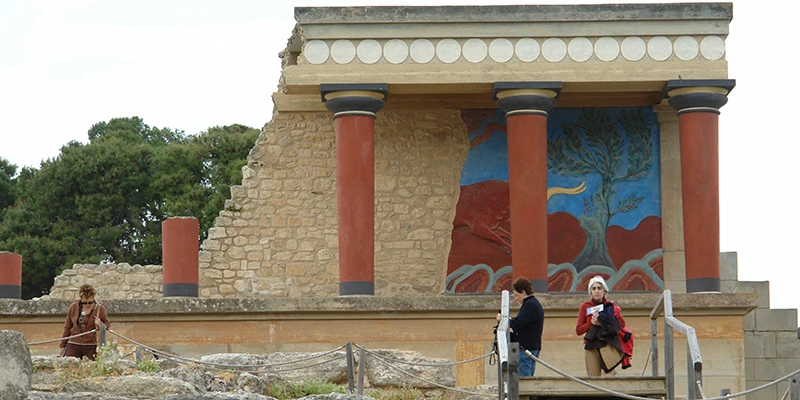
Crete, Greece
Crete is the largest of the Greek islands and one of the most rewarding, a place where a great ancient civilization, lively modern cities and a rugged Mediterranean landscape come together. Its greatest treasure is the Palace of Knossos, center of the Minoan civilization that flourished here more than three thousand years ago, the oldest in Europe. Beyond the ruins, the island offers handsome harbor towns, bustling markets, and a distinct Cretan character that sets it apart from the rest of Greece.
Crete lies at the southern edge of the Aegean, the boundary between Europe and the seas toward Africa and the Near East, a position that shaped its history as a crossroads of Mediterranean trade. Most visitors arrive by ferry or plane at Heraklion, the island's capital and largest city, which makes the natural base for exploring the Minoan sites and the towns along the north coast.
.webp)
The Palace of Knossos
Just outside Heraklion stands Knossos, the largest and most famous of the Minoan palaces and the mythical home of King Minos and the labyrinth of the Minotaur. First built around 1900 BC and rebuilt after earthquakes, it was a vast complex of hundreds of rooms arranged around a central court, with storerooms, workshops, residential quarters and grand ceremonial halls, so intricate in plan that it may itself have inspired the legend of the labyrinth.
.webp)
The site was excavated in the early twentieth century by the British archaeologist Sir Arthur Evans, who partially reconstructed sections of the palace using concrete, giving visitors a vivid, if debated, impression of how it once looked. The distinctive tapered columns, painted deep red and black, and the reconstructed porticoes make Knossos far easier to picture than most ancient ruins.
.webp)
.webp)
The palace is famous above all for its frescoes, whose bright blues, reds and ochres bring the Minoan world to life. Scenes of dolphins, leaping bulls, processions and elegant figures decorated the walls, and though the originals are preserved in the Heraklion museum, faithful copies at the site show them in their original settings. The charging bull and the graceful dolphins are among the best-loved images of Minoan art.
.webp)
Heraklion
Heraklion, the island's capital, is a lively working city with a well-preserved historic center reflecting its long Venetian past. Its outstanding attraction, apart from the nearby palace, is the Heraklion Archaeological Museum, home to the world's finest collection of Minoan art, including the original Knossos frescoes and countless treasures recovered from the island's ancient sites.
.webp)
.webp)
At the heart of the old town is the Morosini Fountain, its basin supported by carved stone lions, a graceful survival of the Venetian era and a favorite meeting place surrounded by cafes. The surrounding streets and squares, lined with arcaded buildings, shops and restaurants, are made for strolling, and the city market is a colorful, aromatic tangle of stalls selling produce, cheeses, herbs, olives and Cretan specialties.
.webp)
.webp)
.webp)
Agios Nikolaos
East of Heraklion along the coast lies Agios Nikolaos, one of the most charming of Crete's smaller towns. Built around a picturesque harbor and a small, almost circular lake connected to the sea, it is a relaxed and scenic place of waterfront cafes, fishing boats and pastel houses climbing the surrounding hills.
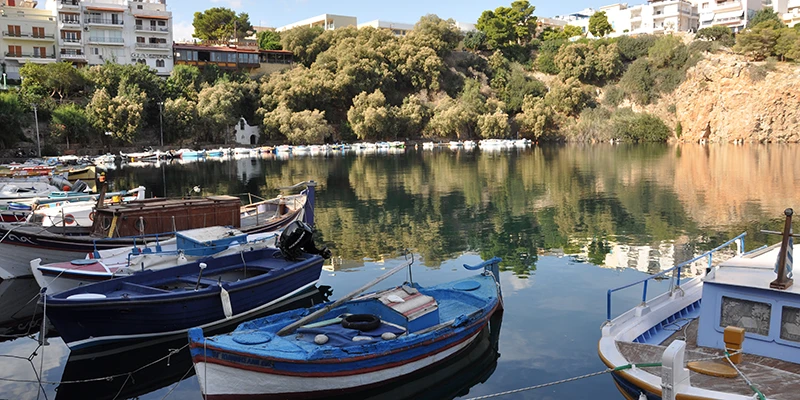
.webp)
The town makes a pleasant contrast to the ancient sites and the bustle of the capital, an easy place to sit by the water over a meal of fresh fish and Cretan dishes and watch the harbor life go by. Together, Knossos, Heraklion and Agios Nikolaos give a fine introduction to an island that rewards far more time than most visitors give it, from its Minoan origins to the flavors and rhythms of Cretan life today.