Corinth, Greece
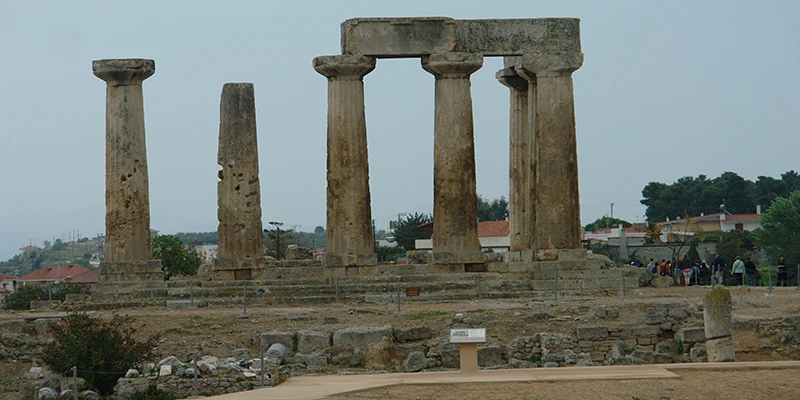
Ancient Corinth ranks among the largest and most rewarding archaeological sites in Greece, a place where the visitor sees not just an isolated temple but the outline of an entire ancient city. Standing columns of the Temple of Apollo rise above a broad field of Roman streets, shops, fountains and civic buildings, all set beneath the dramatic rock of Acrocorinth. Unlike sanctuaries built for a single purpose, Corinth conveys the everyday texture of classical urban life, which makes walking the site an unusually vivid experience.
Corinth sits on the narrow isthmus that joins the Peloponnese to the Greek mainland, roughly an hour and a half west of Athens. Its position controlling the land route between eastern and western Greece, together with harbors on two seas, made it one of the wealthiest and most important cities of the classical world. For a time it served as the capital of Greece, and later the Romans made it the capital of their Greek province.
.webp)
The Corinth Canal
Before reaching the ruins, most visitors stop at the Corinth Canal, a ribbon of water cut like a slash straight through the peninsula. It runs about four miles long but only around thirty yards wide, its sheer rock walls dropping dramatically to the narrow channel below. Completed a little over a century ago, it connects the Aegean Sea with the Gulf of Corinth and the waters beyond.
.webp)
The idea of cutting through the isthmus is ancient. In antiquity a paved roadway called the Diolkos hauled ships and cargo overland across the narrow neck of land. The Roman emperor Nero attempted an actual canal in 67 AD, putting thousands of laborers to work with picks and shovels, but the grandiose plan was abandoned and not achieved until nearly two thousand years later. A pedestrian lane along the modern road bridge gives a clear view straight down the channel.
.webp)
The Temple of Apollo
The Temple of Apollo is the oldest and most prominent monument at the site, its heavy Doric columns dating from the sixth century BC. These are among the earliest Greek temple columns still standing, each carved as a single monolithic shaft rather than the stacked drums used in later classical temples such as the Parthenon. The squat proportions and massive capitals belong to the Doric style in its early stages, before it found the lighter balance of the following century.
.webp)
When Greece was liberated from Turkish rule, almost nothing of ancient Corinth was visible apart from this temple. Everything else lay buried beneath a village and under layers of accumulated earth, and had to be excavated. The level on which visitors now walk is largely Roman, with the earlier Greek layer lying about a meter deeper. Excavation, begun by the American School of Classical Studies, continues at the site to this day.
.webp)
The Roman City
Spread across the plain below the temple are the ruins of the city itself. The main Roman road, lined with the foundations of ancient shops, leads toward the civic center with its fountains and baths. This was the administrative heart of Roman Corinth, built directly on top of the earlier Greek town. The Roman city dates essentially from the time of Julius Caesar, around 44 BC, and flourished for nearly four centuries.
.webp)
Well-preserved steps, terraces and platforms give a strong sense of how the city functioned. Among the most notable structures is the Fountain of Peirene, fed by underground basins formed naturally in the clay and conglomerate layers of the Peloponnese. One of its arched chambers was later converted into an early Christian church, which helped preserve it. Fountains were numerous here precisely because the surrounding land held so much underground water.
.webp)
.webp)
The Museum
The site museum, though small, is well worth the time. It traces the development of pottery styles across the centuries and displays a collection of marble statues, including Roman emperors and governors associated with the city. Everything on view was recovered from the square and the surrounding city that visitors walk through outside, so the objects and their setting illuminate one another directly.
.webp)
.webp)
Among the highlights are floor mosaics preserved from the Roman period, their central medallions still showing finely worked figural designs. The statue gallery includes draped figures whose missing heads are typical of ancient sculpture recovered from long-buried sites. Together the collection gives a clear picture of the wealth and artistic reach of a city that stood at the crossroads of the ancient Mediterranean.
.webp)
.webp)
Corinth makes an easy and rewarding stop between Athens and the sites deeper in the Peloponnese such as Mycenae, Nafplion and Olympia. Allowing time for both the outdoor ruins and the museum, along with a pause at the canal, gives a full sense of a city that shaped the commercial and cultural life of ancient Greece for close to a thousand years.