Barcelona Day Three
Eixample, Barri Gòtic, Sant Pere, La Ribera, Montjuïc, Tapas
-10.webp)
There is much more to see in the downtown center — visits which could have been made earlier if you don't have the added luxury of a third day.
.webp)
See our Eixample video — broad boulevards lined with sidewalk cafes, stylish shops, beautiful landscaping and excellent apartments.
Spreading out the walks this way provides the pleasure of absorbing the sights at a relaxed pace while leaving time for unplanned detours.
.webp)
Start out once again at Plaça de Catalunya and walk north a few blocks along Passeig de Gràcia to appreciate some of the great Modernista buildings along this major boulevard.

You soon come upon another masterpiece by Gaudí, Casa Batlló, with curvaceous lines that seem organic, growing like a plant out of the ground, or considered by some to look like bones.
See our Casa Batlló video — looks alive with curved lines and organic shapes, visit the main room and the rooftop ceramic dragon.
The architecture is also considered a metaphor that portrays the legend of St. George slaying the dragon, evidenced by the building's roof contoured like dragon's skin, and the interior stairway banister shaped like a dragon's spine.
.webp)
Two blocks further north you will find Gaudí's other famous apartment house, the Casa Milà, also called "La Pedrera," which means "stone quarry" because of the large amount of rock it took for construction.
See our Casa Milà video — visit inside for exhibits about Gaudí's work and the rooftop whimsical observation deck with views across the city.
This is a former apartment house now owned by a bank and open to the public as a museum, and is still partly occupied as a private residence.
.webp)
You are in a modern section of town called Eixample, a 19th century enlargement of Barcelona with many trendy boutiques, sidewalk cafes, art galleries and wonderful architecture — so if this is your style, wander and browse for a while.
.webp)
Lovers of modern art would enjoy a visit to the MACBA Museum of Contemporary Art, housed in a dramatic, all-white 1995 building designed by Richard Meier, located in the Raval district on the west side of the Rambla, a pleasant five-minute walk from Plaça de Catalunya along the pedestrian Carrer d'Elizabets. When satisfied, plunge again into the Gothic Quarter.
Barri Gòtic Revisited
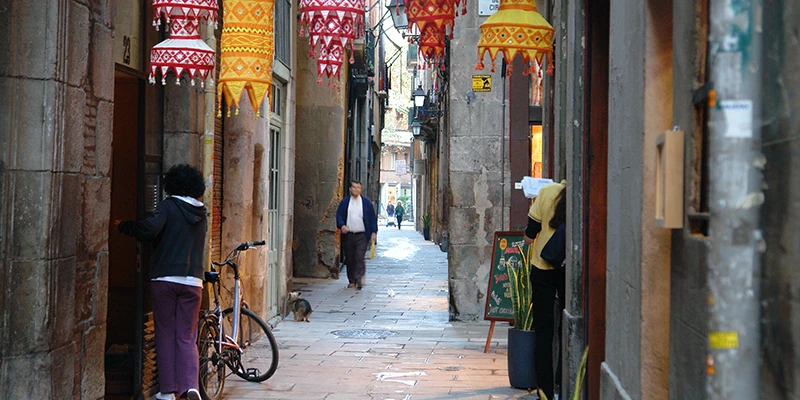
This will be another adventure of walking through more pedestrian lanes, crossing scenic plazas, perhaps visiting an art museum and seeing places not previously covered in this huge Gothic Quarter, as well as back-tracking later in the day to some of your favorite haunts.
-10.webp)
Cross from the east corner of Plaça de Catalunya, near the Tourist Information Office, to Portal de l'Àngel, one of the widest and busiest pedestrian shopping streets in town, lined with department stores and specialty boutiques, and packed with shoppers all day and into the night. In fact this street is so prominent that you have probably already discovered it earlier on your own and will end up returning here many times during the visit. Often there are outdoor craft markets set up along this mall, and El Corte Inglés, Spain's biggest department store, has a major branch here to supplement its larger flagship back at Plaça de Catalunya.
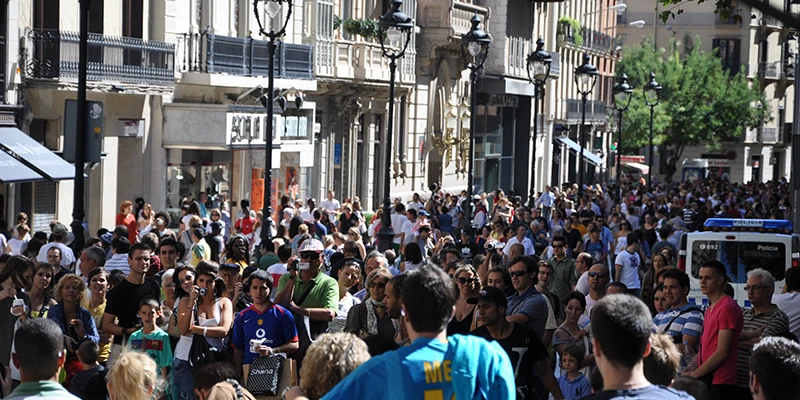
Portal de l'Àngel is generally filled with friendly shoppers, making this an ideal place for people-watching and perhaps striking up a conversation if you feel so bold, although it can get extremely crowded. A universal ice-breaking topic is asking someone for tips on eating or shopping. Just don't try and stop anyone who is in a hurry. This street is such a major destination that you would enjoy walking up and down its full length, exploring beyond each end and looking all around, then doubling back to the beginning of l'Àngel to continue your journey.
.webp)
Intriguing side lanes branch off from l'Àngel in both directions, leading to more shops and restaurants that are certainly worth exploring. Some fascinating hybrid shop/restaurants resembling delis with wine bar can be found in this central area.
.webp)
La Pineda, at 16 Carrer del Pi, the lower extension of l'Àngel, is a cozy little tapa bar that sells meats, cheeses, salads, packaged foods and beverages to go, or for consumption on the spot where you can enjoy the friendly, casual atmosphere of a neighborhood gathering place for locals, standing at the tiny bar or sitting at one of the few tables. It's the kind of friendly mixed-use hangout for socializing that is a classic local institution, not a tourist gimmick. The Àngel promenade is just a few blocks long and leads directly into the heart of the Gothic Quarter.
.webp)
Turn left on Carrer Comtal and walk a few blocks to Palau de la Música Catalana. This UNESCO World Heritage Site is a major music hall built in the late 19th century encrusted with statues of musicians and mythological characters in the Modernista style, a Barcelona interpretation of the Art Nouveau style that expresses the distinct Catalan identity through architecture.
See our Ribera and Born Walking Tour video — Palau de la Música Catalana, Sant Pere, Santa Maria del Mar, Parc de la Ciutadella, Arc de Triomf.
The Palau is busy as an active venue for the performing arts, with events staged here every week, and you can also pay to go inside for a guided tour during the day.
Sant Pere
.webp)
If you would care to veer away from the tourist path for a taste of an ordinary working-class neighborhood with a medieval atmosphere, continue east a few blocks through the district of Sant Pere, traversed by three parallel streets, all named Sant Pere but ending with different suffixes: mes Alt, Mitja and mes Baix. Narrow, pedestrian alleys interconnect them creating a delightful maze of ancient lanes in which to wander. The neighborhood is named for the former convent monastery of Sant Pere, an ancient church on the small plaza of Sant Pere. The church's dark interior features 10th century Corinthian columns, a 12th century dome and Byzantine barrel vaulting.
.webp)
As you walk along you will see the locals going about their business, shopping, talking, hanging out and skating by. Small grocery shops spill out onto the sidewalk with stands for fresh produce, next to alluring bakeries that will tempt you with their sweet delights. This is a quiet part of town that enjoys a slow pace of life in a world of its own. Exit this district along Basses de Sant Pere, which leads to Carrer dels Corders, one of the main thoroughfares through the area.
Alternatively, if you are pressed for time you could skip that extended walk and head directly south from the music hall through a neighborhood of narrow pedestrian lanes, arriving in three blocks at the newly-renovated Mercat de Santa Caterina, with its swooping, colorful roof sheltering typical food stalls and a few small restaurants. Continue one block south to Carrer dels Corders, a main pedestrian lane worth strolling up and down, making note of the narrow, residential, side alleys with their colorful laundry hanging up above.
La Ribera
.webp)
Entering the section of old Barcelona referred to as La Ribera, turn from Carrer dels Corders into the major walkway of Carrer Montcada, which changes names a few times and basically takes you through the center of this historic zone.
See more of La Ribera: Part 1, Part 2, Part 3
This was an area of deluxe palaces of rich merchants back in the 14th and 15th centuries and many of these buildings still stand today, adapted to new uses, such as the Picasso Museum.
.webp)
Love him or not, Picasso was the major artist of the 20th century and lived in Barcelona during his formative years from ages 14 through 23 when his career and fame really got started. Then he left Spain, especially because of his distaste for the dictatorship of Franco, when he moved on to Paris and other parts of France where his genius continued to flourish. Founded after his death, this is the most popular museum in town, with one of the world's largest Picasso collections spread through what had been five separate mansions now seamlessly joined. If you don't want to pay for the museum admission, at least have a look at the series of interconnected courtyards, and you are always welcome to visit the gift shop.
.webp)
Continue south along Carrer Montcada, with some diversions through the numerous side streets that honeycomb this most historic neighborhood, with many little shops tucked away. When you get hungry, it pays to look carefully for the little restaurants hidden away in side alleys. Perversely, it seems the most popular eateries are trying hard to not draw any further attention to themselves and don't post signs, menus or addresses.
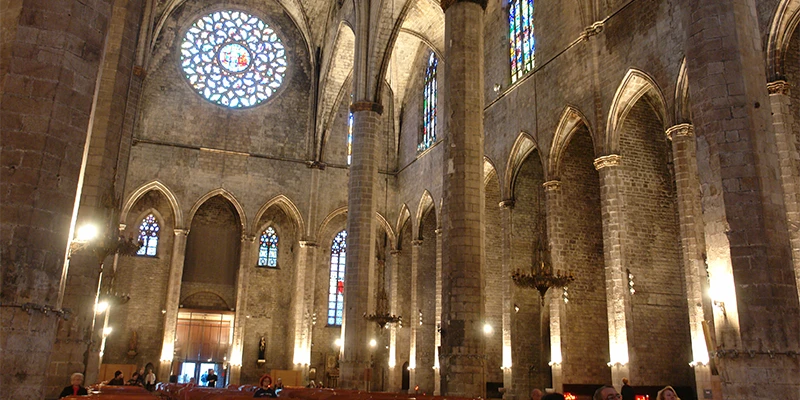
After lunch, head for the large gothic church, Santa Maria del Mar, with its massive interior second only to the cathedral in size. The church is really impressive, consisting of a huge nave with soaring ceiling supported on pointed arches, and brilliant stained glass. This was all built during the medieval period, in the 13th and 14th centuries, so the architectural form is pure gothic. There is no influence or embellishment here from the later period of the Renaissance, nor was it built upon an earlier foundation in the Romanesque style of thick walls, low ceiling and small windows.
-10.webp)
Notice the beautiful gothic façade and small plaza in front of the church of Santa Maria del Mar. It is busy during the day as well as at night with the shops and cafes around it, and the people walking through. This is a major pedestrian thoroughfare connecting different parts of the old section of town, so there are always plenty of people to see.
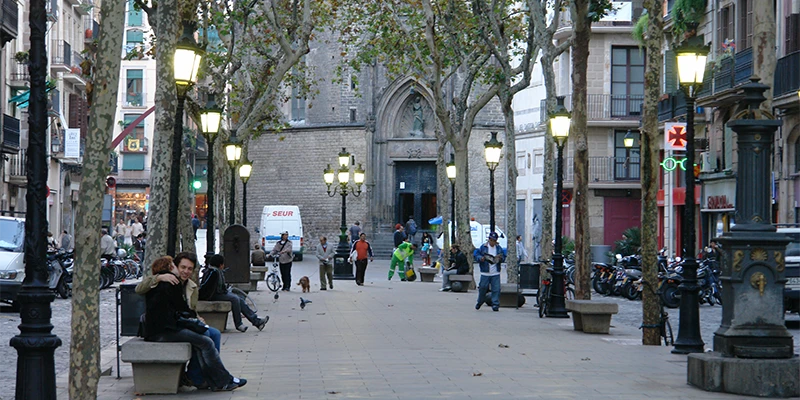
Behind is the tree-lined promenade of Passeig del Born with several short shopping streets extending a few blocks south. This neighborhood was the center of town back in the Middle Ages, functioning as the financial marketplace, major gathering spot, execution grounds, and general place to be.
-10.webp)
Today it is experiencing a rebirth, with many trendy shops and cafes thriving in the blocks around the church. A major park with the public zoo, Parc de la Ciutadella, is about one half-mile further east.
Green Oasis
-10.webp)
Parc de la Ciutadella is Barcelona's principal green space, a welcome breath of open air after the dense lanes of the Gothic Quarter and La Ribera, which border it to the west. The park was created on the grounds of a former military citadel demolished in the 1860s, and its broad lawns, tree-lined paths and ornamental gardens have made it a favorite gathering place for locals ever since.
.webp)
A large ornamental pond at the center invites leisurely rowboat rides, and the surrounding paths fill on weekends with families, cyclists and people simply looking for shade.
-10.webp)
The monumental cascade fountain at the northeast corner, partly designed by the young Gaudí, is one of the park's most photographed features, and the triumphal Arc de Triomf stands just outside the main entrance on Passeig de Lluís Companys.
-10.webp)
The park regularly hosts outdoor concerts, food festivals and cultural events, making it worth checking what is scheduled during your visit.
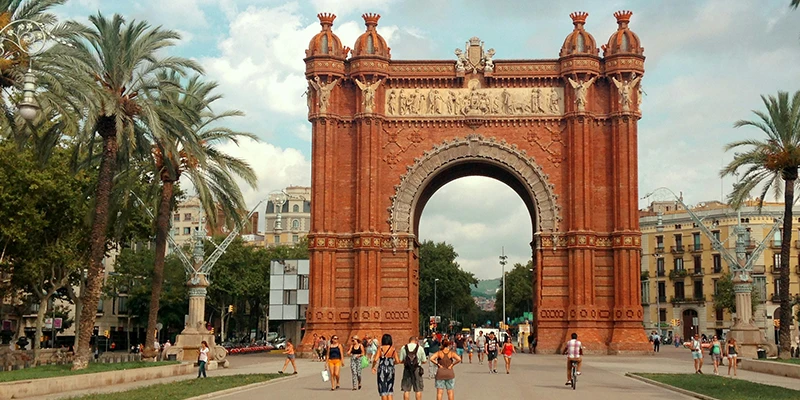
The Arc de Triomf stands at the main entrance to Parc de la Ciutadella on Passeig de Lluís Companys, built as the ceremonial gateway for the 1888 Universal Exhibition. Designed by Josep Vilaseca in the Mudejar style, its warm red brick and elaborate decorative friezes make it one of the more distinctive arches in Europe, quite unlike the classical Roman model it references.
When exiting this zone, follow the nice shopping street, Carrer de l'Argenteria, which extends 200 yards from the front of Santa Maria del Mar back into the center of the historic district, or on the other hand, you might want to head for the waterfront, which is only three blocks away.
Montjuïc
.webp)
If there is time remaining this afternoon consider visiting the hill of Montjuïc, an enclave of museums, parks and Olympic remains, flanked on the lower edge by old neighborhoods. You can reach it by walking from Plaça de Espanya, or taking a cable-car ride, either from the funicular station at Avda Miramar or directly from Barceloneta at Passeig de Joan de Borbó.
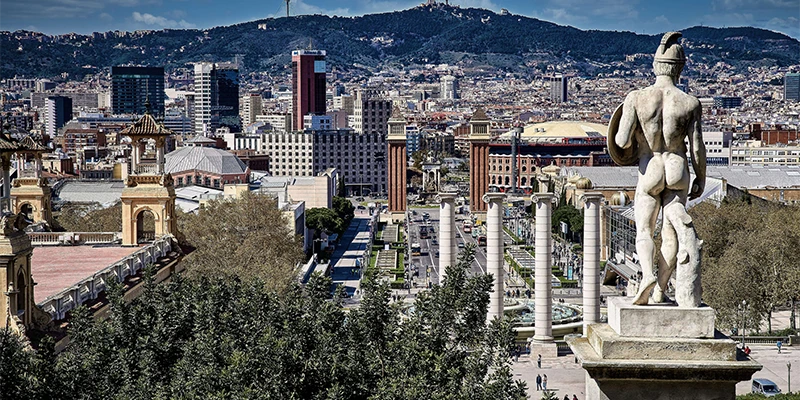
You could actually spend an entire day here, so if a fourth day is possible in your itinerary, this district alone would be good reason to extend the visit. Foremost among those museums is MNAC, Museu Nacional d'Art de Catalunya in the Palau Nacional, with a vast collection of Catalan fine art spanning the centuries from the Romanesque through modern times. The other great collection on the hill is the Fundació Joan Miró, especially for fans of this great abstract artist. Modern architecture fans would appreciate seeing the iconic Mies van der Rohe pavilion, left over from the 1929 International Exhibition. This simple glass and steel structure is considered by many to be the first modern building, introducing the dominant architectural style cities have followed ever since.
.webp)
A collection of replica Spanish buildings arranged into an artificial village might seem an unlikely place to end your visit to such an authentic ancient city, but you will undoubtedly find that Poble Espanyol is a completely delightful experience: 117 examples of traditional Spanish architecture representing the whole country are arrayed along dozens of tiny lanes and open plazas, with many restaurants, shops and craft displays along with great entertainment in the streets and nightclubs, including an excellent flamenco show. This fascinating collection was created as a temporary display for the 1929 world's fair, then retained due to its fantastic popularity which has continued ever since with further enhancements, making this one of the most popular spots in Barcelona. Seventy years of graceful aging have given it that patina of authentic old age.
When done with Montjuïc you can walk back to the center of town by passing through the historic neighborhood of Poble Sec, a formerly-poor district that is becoming increasingly hip, with cafes, galleries and more sights to see.
Nightlife
-10.webp)
Barcelona is just as active in the evening as during the day, so don't stop exploring when the sun goes down. Shops generally remain open until at least 8:00pm, although most shut down for siesta in mid-afternoon for several hours, making evening an ideal time for wandering the narrow alleys. Respectable restaurants don't open until 7:30 or 8:00pm, which is a bit late for some travelers but is the way of life throughout the country.
-10.webp)
Tapa bars and snack shops open earlier if you need a nibble, but save your real appetite for a bit later. Instead of sitting indoors eating during twilight you might find greater enjoyment by strolling during this magical time in streets filled with locals, illuminated by a special mix of light that combines the golden glow of evening with colored incandescent and fluorescent city lights. It is best to adjust your life-cycle rhythm to the local schedule and participate in their special way of life.
Mercè Festival
-10.webp)
See our Mercè Festival Opening Parade video.
Special bonus: Barcelona's Mercè Festival is the city's biggest entertainment event, happening every year on the last weekend of September for four days.
-10.webp)
Timing a visit to coincide with La Mercè is worth the effort — the city packs an extraordinary density of free events into four days, and the streets take on a character that is simply not present at any other time of year.
-10-2up.webp)
The human tower, or castell, is a Catalan tradition with people standing on top of each other nine levels high. There are several hundred other performances going on — lots of music, dance and cultural activities — with most events happening outdoors on the streets and plazas, all free fun for everybody. There is also abundant food of all kinds.
We have two more videos about the festival: Human Towers of Catalunya and Fire Run Parade.