Segovia
.webp)
Begin with the most spectacular sight — the huge Roman Aqueduct, one of the most impressive engineering achievements of the ancient world.
.webp)
This structure alone would be reason enough to visit Segovia, but there are so many more rewards awaiting you in a town whose entire historic center has been declared a UNESCO World Heritage Site. Cathedral, fortress, Romanesque churches, medieval lanes and one of the most charming main squares in Castile are all concentrated in a compact area barely half a mile long — the ideal conditions for a deeply satisfying day trip from Madrid.
The Aqueduct
.webp)
Built nearly 2,000 years ago, most likely during the reign of Emperor Trajan in the late 1st or early 2nd century AD, the Segovia Aqueduct is double-decked with 165 arches and reaches over 100 feet at its highest point. What makes it truly astonishing is that it was built without any mortar whatsoever.
.webp)
Ancient Roman engineers cut and positioned around 20,000 granite stones with such precision that gravity alone has held them together for two millennia — through earthquakes, winters and the passage of armies. The aqueduct carried water from the Río Frío in the Sierra de Guadarrama mountains nearly 15 kilometers into the city, and it remained in active use until the late 19th century.
.webp)
To fully absorb its grandeur, look up at the structure from ground level near the bus stop, where the full double arcade towers above you. Then climb the staircase running along the hillside beside it, pausing at different levels as you ascend.
.webp)
At the top you reach the main level of the old city, arriving at the perfect height for a level walk into the heart of Segovia along Calle Juan Bravo. Take the hillside stairs rather than the gentler steps rising from the middle of the plaza — only the hillside approach gives you that dramatic, straight-on view of the arches receding into the distance.
Main Streets and the Old City
.webp)
Segovia is one of the easiest historic towns in Spain to navigate, because it is small and has several spectacular sights — the aqueduct, fortress, cathedral and lovely main plaza. A single main street extends from the top of the aqueduct all the way to the Alcázar fortress at the far end, passing the cathedral and main square along the way.
.webp)
The entire walled city is barely five blocks wide and ten blocks long, so wandering at will carries no risk of getting lost. The main street changes names as it progresses — Calle Juan Bravo, Calle de la Infanta Isabel, Calle de Cervantes — but it remains continuous and easy to follow.
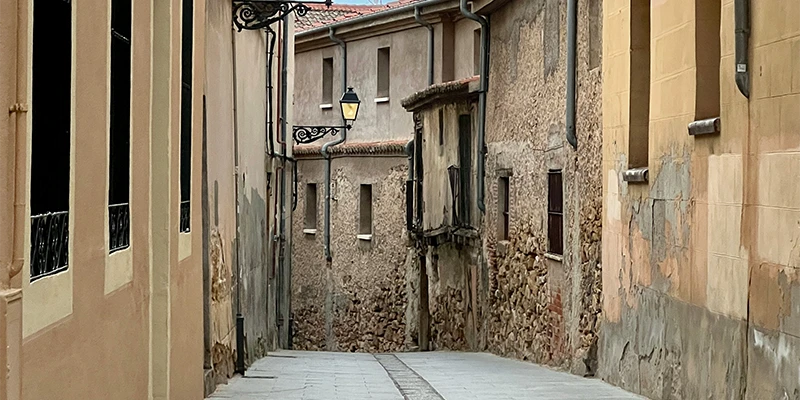
What makes the visit extra rewarding is stepping away from this spine into the dozen little side lanes that branch off in both directions. These quiet alleys pass ancient Romanesque churches, medieval palaces, half-timbered houses and local restaurants that the tourist trade has not yet homogenized.
.webp)
Shoppers will find small craft shops and local producers tucked into corners that a quick transit along the main road would completely miss. Allow time to zigzag rather than simply proceeding from one end to the other.
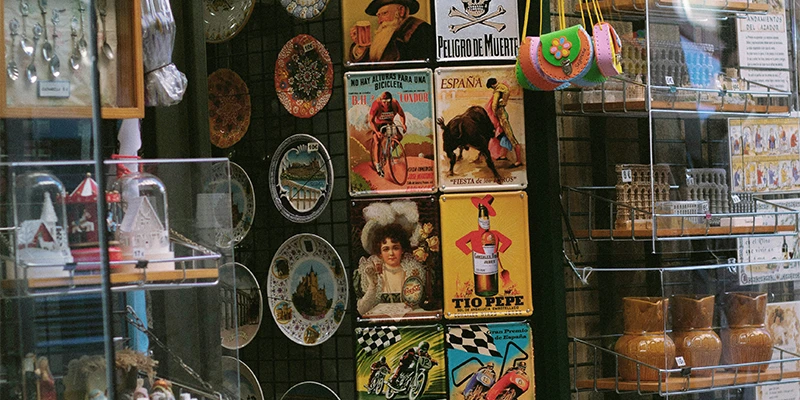
The Cathedral
The Cathedral of Segovia stands on the highest point of the city and its tower is visible from great distances across the surrounding plain. Despite being begun in 1525, it is known as the New Cathedral because it replaced a much older one destroyed during the Comuneros revolt of 1520.
.webp)
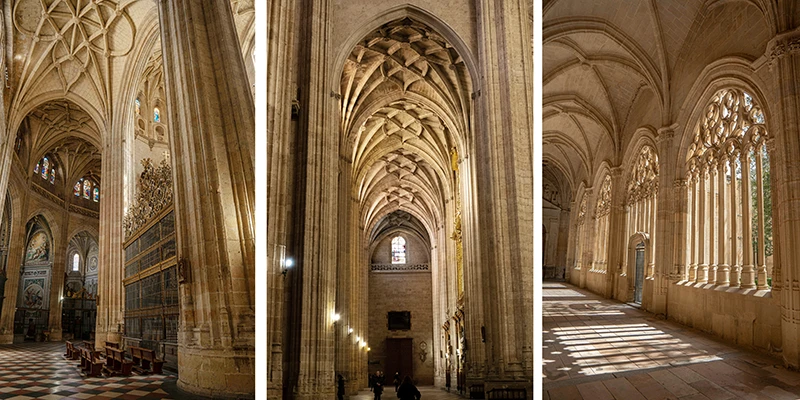
Completed in the mid-16th century, it is the last major Gothic cathedral built in Spain and represents the style at its most flamboyant and self-assured — soaring buttresses, intricate stone tracery, and a tower of exceptional elegance. Its interior contains 20 chapels, a gilded Renaissance choir, fine Flemish tapestries and stained glass windows that fill the nave with colored light on sunny mornings.
.webp)
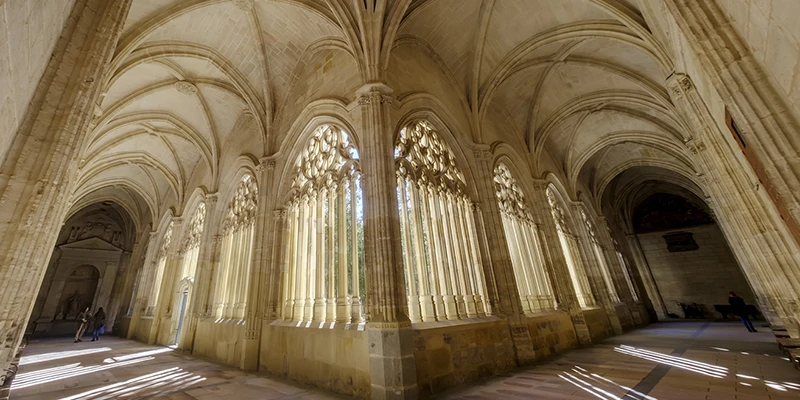
The cloister deserves particular attention. It was not built for this cathedral but salvaged from the destroyed original and reassembled here stone by stone — a remarkable act of preservation that saved one of the finest Gothic cloisters in Castile. Off the cloister, the chapter house contains a notable collection of religious art including several paintings of the Flemish school and an ivory crucifix of exceptional quality.
The cathedral museum displays vestments, silver processional pieces and a painting by Rubens. For a building that tends to be overshadowed by the aqueduct and the Alcázar in most visitors' priorities, the cathedral rewards those who spend proper time inside rather than simply admiring its silhouette from the plaza. See the Cathedral official website.
Plaza Mayor
In front of the cathedral lies the Plaza Mayor, one of the most appealing main squares in Castile and the genuine social center of Segovia. The square is lined on all sides with arcaded buildings housing cafes, restaurants and small shops, with the cathedral's Gothic facade closing the eastern end in a dramatically photogenic composition.
.webp)
On weekend afternoons and long summer evenings the terrace cafes fill with locals of all ages — families with children, older residents reading newspapers, younger groups gathered over wine and tapas. The atmosphere is relaxed and genuinely local rather than staged for visitors, and the square is ideal for resting after the walk from the aqueduct.
.webp)
The square's current form dates largely from the 17th and 18th centuries, when the arcaded buildings were regularized and the Town Hall given its present facade, but the function of the space has never changed. It remains what it has always been: the place where Segovia gathers.
.webp)
On any given evening the dynamic between locals and visitors is worth observing in itself. Segovian families occupy the same tables their parents and grandparents used, the older generation watching the square while the younger ones drift between groups. Visitors tend to cluster near the cathedral end, which has the best views, while the side arcades closer to the Ayuntamiento are where you are more likely to find yourself sitting next to someone who actually lives here.
.webp)
The staff at most of the terrace cafes are accustomed to a mix of languages and the atmosphere is welcoming rather than transactional. Order a glass of local Ribera del Duero wine or a café con leche, settle in for half an hour and let the square come to you — this is one of those places where doing nothing in particular turns out to be the most memorable part of the day.
The Ayuntamiento, or Town Hall, occupies one side of the plaza, and a statue of Juan Bravo — the local hero of the Comuneros revolt — stands at the center. On Sunday mornings a small market sometimes appears under the arcades. It was in this plaza that Queen Isabella was first proclaimed Queen of Castile in 1474, a moment that transformed Spanish history. For centuries before and after that event, the Plaza Mayor served as the stage for Segovia's public life — markets, festivals, proclamations and the daily theatre of a medieval city going about its business.
.webp)
The Alcázar
.webp)
At the far western end of the old city, perched dramatically at the point where two river valleys converge below a rocky promontory, the Alcázar of Segovia looks like a fairy tale castle — rounded towers topped with slate cones, crenellated ramparts and a deep moat cut into the rock. It was not built as a fantasy but served very real functions: royal residence, state prison, military academy and archive over its long history. The building visible today reflects extensive 19th century reconstruction after a fire in 1862, closely following the medieval original.
.webp)
The interior is richly decorated with elaborate carved Mudéjar wooden ceilings — intricate geometric patterns reflecting the Muslim craftsmen who worked for Castilian kings — along with original furniture, tapestries, suits of armor and historic paintings.
.webp)
Ferdinand and Isabella spent significant time here. Isabella was proclaimed queen in the main plaza in 1474, and the castle was a center of the court life of 15th century Castile. The Tower of John II, the tallest structure of the complex, can be climbed for panoramic views across the city rooftops, the cathedral tower and the Sierra de Guadarrama beyond.
.webp)
Romanesque Churches
.webp)
Segovia has an exceptional concentration of Romanesque churches dating from the 12th and 13th centuries, more than almost any other town in Spain. San Esteban has perhaps the finest tower in the city — a tall, arcaded Romanesque campanile that rivals the cathedral's spire as a landmark. San Martín stands midway along the main street with an elegant porticoed atrium. San Juan de los Caballeros, San Sebastián, San Nicolás and San Millán are others worth noting as you pass, each with its own character and state of preservation. Many non-religious buildings from the same period survive alongside them — the narrow lanes of the old city are lined with medieval mansions whose carved stone facades speak of the wealth this city once commanded.
Eating in Segovia
.webp)
The culinary specialty of Segovia is cochinillo asado — roast suckling pig — and the town takes its reputation for this dish seriously. It is served throughout the old city in restaurants ranging from modest to formal, and the traditional test of its perfection is that the pig can be carved using only the edge of a ceramic plate.
.webp)
The most famous restaurant is Mesón de Cándido, in business for well over a century at its spectacular location right beside the aqueduct, where the arches fill the windows completely. It is touristy and not inexpensive, but the setting is incomparable and the cochinillo is as good as advertised. Reservations are advisable at peak times. Several other respected options line the streets of the old city for those who prefer a less theatrical setting.
Getting There
.webp)
The transport situation has changed since older guides were written and it is worth knowing the current options clearly. The high-speed Avant train from Madrid Chamartín or Atocha stations reaches Segovia-Guiomar station in about 30 minutes — faster than the bus — but the station sits outside the city and requires a connecting bus into the center, adding 15 to 20 minutes and a transfer. The traditional La Sepulvedana bus from Madrid's Moncloa bus station takes about 75 to 80 minutes and drops you directly at the foot of the aqueduct in the city center, which makes it the most practical choice for a day trip despite being slower overall. Buses run frequently throughout the day. Check current schedules at the La Sepulvedana website before traveling.
Day Trip Combinations
Segovia pairs well with other destinations for those wanting to combine visits. La Granja de San Ildefonso, a royal summer palace built for Philip V in the early 18th century in imitation of Versailles, lies just 11 kilometers from Segovia and is reachable by a short local bus ride. Its formal French gardens with elaborate fountains are among the finest in Spain and make a rewarding half-hour addition if time allows.
El Escorial, the vast monastery-palace built by Philip II from which he administered the Spanish Empire, lies on the road between Madrid and Segovia and can be combined with a Segovia visit, though doing both justice in a single day is demanding. Guided bus tours from Madrid visit both sites and are available through several operators — convenient if you prefer not to manage transport independently, though they allow less free time at each location than going on your own. A dedicated day for each is the more rewarding approach if your schedule allows.