Barcelona Day Two
Market, Gaudí, Waterfront
Mercat de la Boqueria
.webp)
Housed in an old-fashioned steel and glass structure first built in mid-19th century with an elaborate steel facade in the Modernista style of one century ago, the Mercat de la Boqueria resembles other great food halls once found in Europe's major cities, nearly all of which have been torn down or converted into shopping malls. In many ways these food hall structures were the first truly modern buildings to incorporate the engineering technique of glass walls held together by steel frames which has subsequently dominated urban architecture.
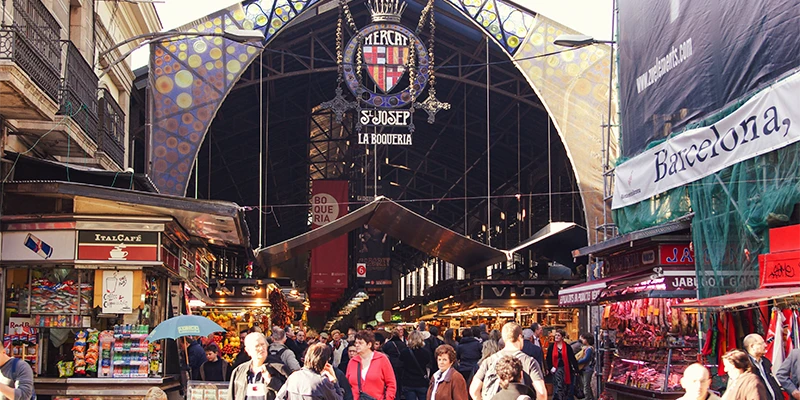
Early-birds will find that most of Barcelona does not open until well after breakfast, except for the huge food market along the Rambla, the Mercat de la Boqueria.
See our Mercat de la Boqueria video — Barcelona's huge food market along the Rambla comes to life from 6:00am when the first merchants arrive.
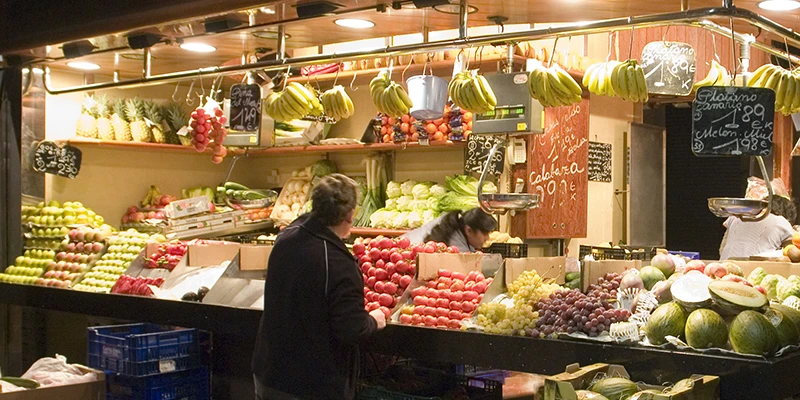
This busy food hall comes to life very early, starting from 6:00am when the first merchants arrive and a few coffee counters open inside the hall and just outside along the Rambla, making this about the only place in town available for a pre-dawn caffeine fix, if you happen to wake early and want to get a head-start on the day.
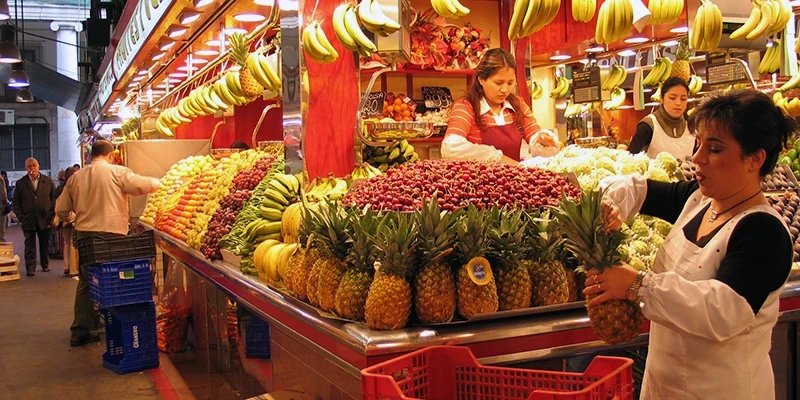
Even if you are not hungry and have no interest in architectural history, simply walking through this market is an adventure for your senses, passing row after row of perfectly displayed fruits and vegetables arranged by workers who really care about visual impact, color and aesthetics, while at the same time you are immersed in the bustling atmosphere of busy shoppers and merchants calling out their specials in booming Spanish tones to grab your attention. Odors fill the air with a constantly changing palette as you walk from cheese to fish and on to the fruits and veggies. So you are getting sight, sound, color, motion, aroma and taste, for an experience not to be missed.
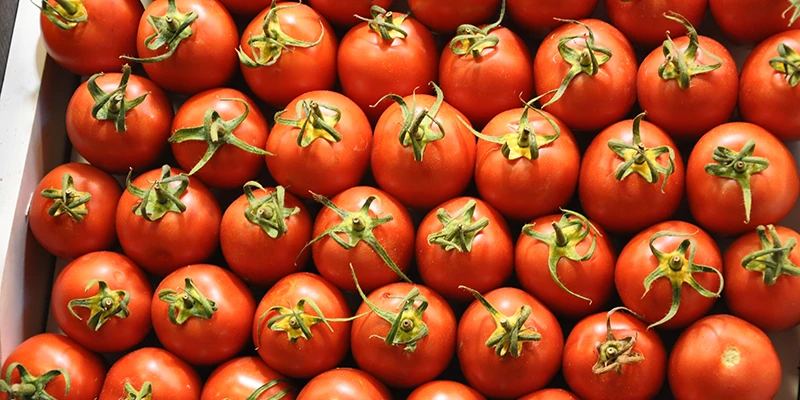
Mercat de la Boqueria is fully up and running by 7:00am and stays open throughout the day, making this a great place to hang out for a while, watch the colorful action, get a coffee and maybe pick up some snacks for your busy day ahead. Several small counters offer excellent, quick meals and a chance to rub elbows with some talkative locals. Eating at a simple café like this is a refreshing contrast to the long wait for table service in a typical restaurant, because everything happens immediately in front of your eyes when you sit on that stool, especially when they are not crowded.
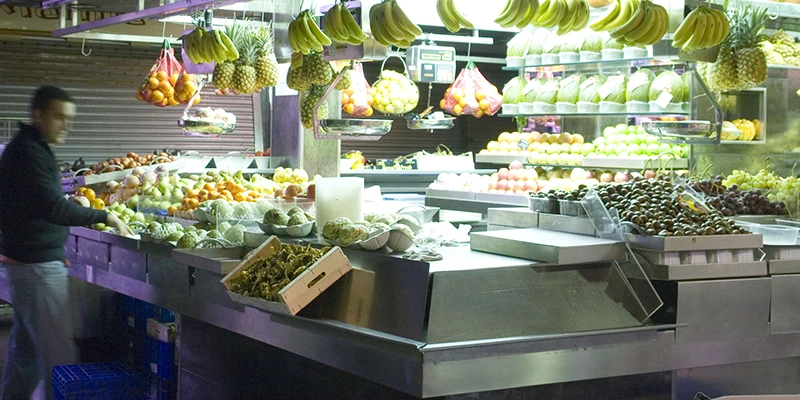
While most of the market's products are meant to be brought home and cooked, the intrepid traveler can certainly find fruits, nuts, cheese, breads, sweets and other great items for snacking during the day that will cost less and be more convenient than meals purchased in a restaurant. There is a lot to be said for munching on simple foods pulled out of your pocket while walking along sightseeing, and so far, no medical reports have suggested there is anything unhealthy about eating while you walk. Of course you are going to want to sit down and enjoy some great meals but not necessarily every time you get hungry, especially outside normal meal hours when your appetite and slumping energy level call for some attention.
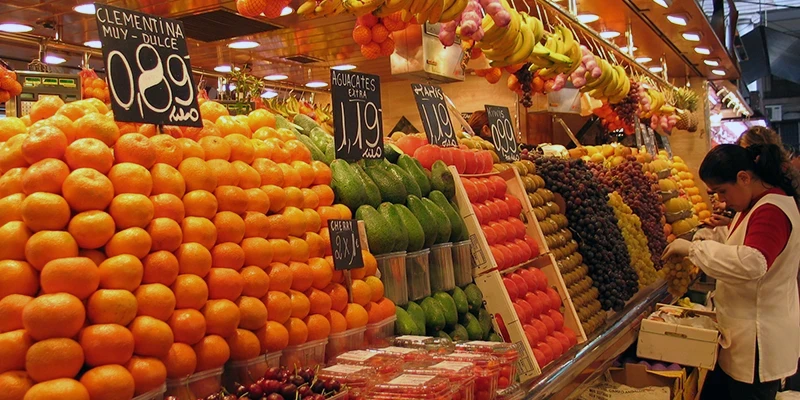
The continued existence of this venerable structure is another fine example of the intact preservation of Barcelona's historic center. Its archaic glass and steel design looks like something out of an old movie but the market continues to play an important role in the modern daily lives of shoppers getting their daily fix of fresh, healthy foods. Most shops of the Gothic Quarter have sleek, ultra-contemporary interiors behind their old facades, unlike Mercat de la Boqueria, where you step into the 19th century.
Parc Güell
.webp)
See our Parc Güell video — a whimsical whirl of colored ceramics, sculptures, sinuous benches, bizarre pavilions and curved paths winding through a lush garden setting.
Get an early start to begin your pursuit of architectural masterpieces created by Antoni Gaudí (1852–1926), Barcelona's most famous architect. A good strategy is to start at Parc Güell, a whimsical whirl of colored ceramics, sculptures, sinuous benches, weird buildings, bizarre pavilions and curved paths winding through a lush garden setting, with a view across the city from its hill-top perch.
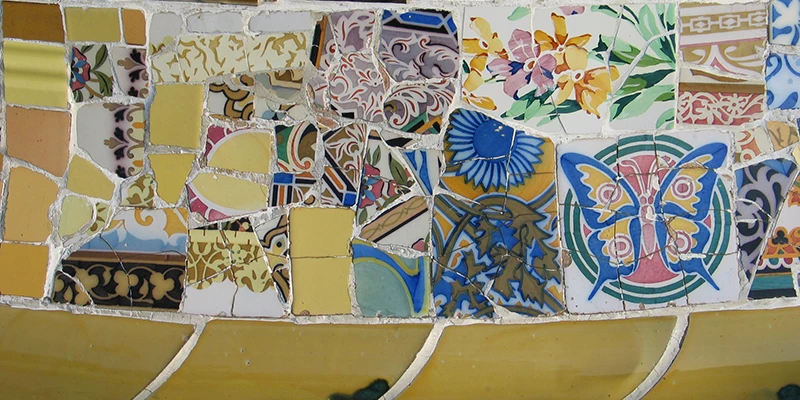
The park's structures are curved in a mélange of fairy-tale shapes covered with mosaics of broken tiles in a style called "trencadís." Most of these tiles are brightly colored creating dazzling surfaces on the benches and columns, while other tiles are earth-brown fragments covering various pavilions and structures that look like they have grown out of the ground. Craftsmen worked under Gaudí's direction to create these amazing mosaics by smashing porcelain plates and pottery into little pieces then arranging them like a jigsaw puzzle.
.webp)
Some sculptures are similarly covered, especially the salamander fountain on the divided staircase that leads up to the 86-column Hypostyle Hall. There is usually a small crowd waiting in turn to be photographed next to the bizarre salamander.
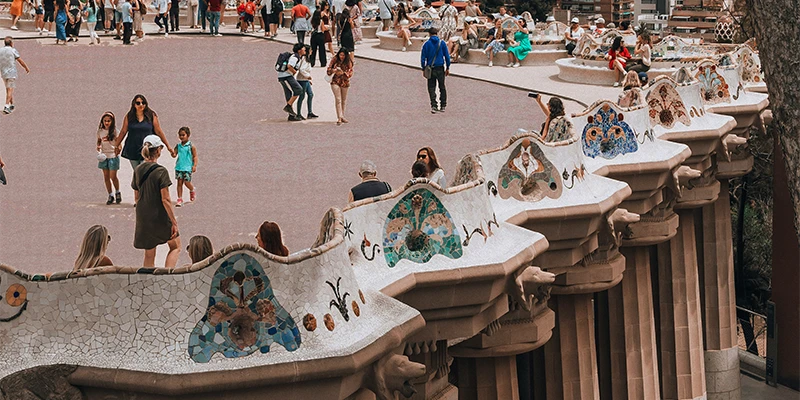
Its main section consists of a broad terrace rimmed with benches and steps leading down to the front gate, which is flanked by two small Hansel and Gretel-inspired huts topped with ice cream sundae-shaped roofs. These small areas get very crowded, making it difficult to properly appreciate this premium destination, so your best strategy is to arrive when the park opens at 10:00 a.m. in order to see the colorful sights without a thousand other tourists getting in your way.
.webp)
Gaudí was the city's most famous architect, best known for his still-unfinished Sagrada Família church which is also worth seeing but is not as pleasing as this park. He lived from 1852 to 1926 and designed Parc Güell at the beginning of the 20th century as part of a large housing project that never got built. Instead we are left with this much more interesting and valuable 37-acre park that is one of the city's most popular attractions.
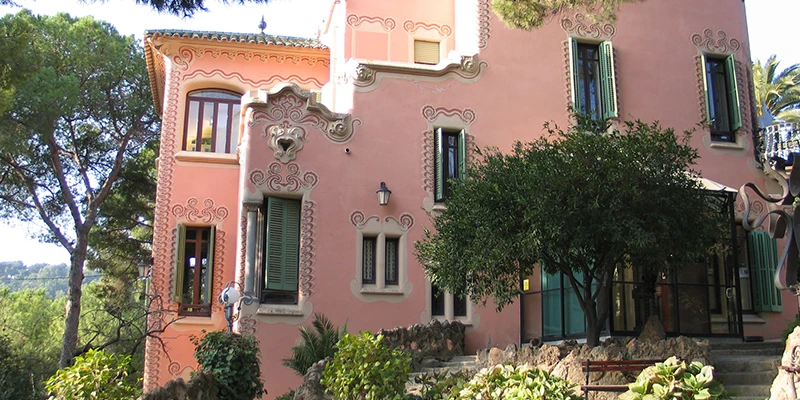
Gaudí lived on the property in one of the two houses that were actually constructed here. His home has been converted into a small museum of his memorabilia, for the die-hard fans. However there is not all that much in the way of attractions inside the house. They display some of the odd-shaped furniture designed by Gaudí, and visitors can enter his study, bedroom, living room and other parts of the house. There is an admission charge and the visit will take time, so you might find it unnecessary to enter this little museum, but you can certainly admire the outside of the house and garden for free, and it is conveniently located near the exit for the bus stop.
.webp)
It only takes 30 minutes to see the park from top to bottom, but you might linger in the gift shop and get something to eat at one of two snack bars. The food and seating is a bit better at the lower café near the front gates, but the sandwich counter up above on the main terrace has a pleasant outdoor ambience, with a strangely entertaining way of ordering food in which you tell the clerk your sandwich choice and he barks back "five minutes" without taking your name or giving you a number, but all works out well in the end. This is not great food, but it's a simple, inexpensive sandwich on a long, hard roll, and if you are hungry it is conveniently located in this beautiful setting which could hit the spot.
Parc Güell is too far from the center to comfortably reach by walking but you can get there in 30 minutes by public transportation, preferably bus number 24 heading in the Carmel direction, which conveniently drops you off right next to the upper level of the park. You can catch the bus from major downtown locales including Plaça Catalunya and along the Passeig de Gràcia. If you have a ticket for the hop-on hop-off bus it will drop you off and pick you up at the park.
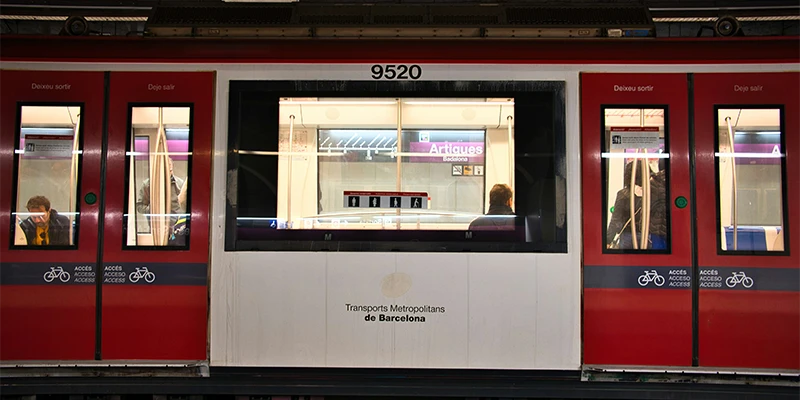
Alternatively, the metro could bring you to the general vicinity, but requires much more walking than the bus. If you prefer rail, take the metro Green Line L3 and get off at the Lesseps or Vallcarca stations and tackle a 20-minute walk, with the last portion leading up a steep hill and then into the park along a pleasant winding path through the woods. Some of that uphill climb is alleviated by outdoor escalators running alongside the road, but overall you'll find it easier to take the bus. The same bus route will take you back to downtown after the visit.
After your visit, exit the east side of the park and walk a block to the public bus stop on the park side of the street to catch a 10-minute ride bringing you close to Gaudí's monumental masterpiece, Sagrada Família. It is a mildly entertaining ride, taking you through some typical, non-touristic local streets, and delivers you to a convenient bus stop two blocks from the cathedral.
.webp)
Upon exiting the bus walk along three wide blocks of Avinguda Gaudí towards the looming towers of the church. Another diversion might beckon first, however, with a two-block walk in the opposite direction to the beautiful Hospital de la Santa Creu i Sant Pau, a gothic complex begun in 1401 containing a cloister, schools, churches, library, hospital, patios and park, listed together as a UNESCO World Heritage site.
Sagrada Família
.webp)
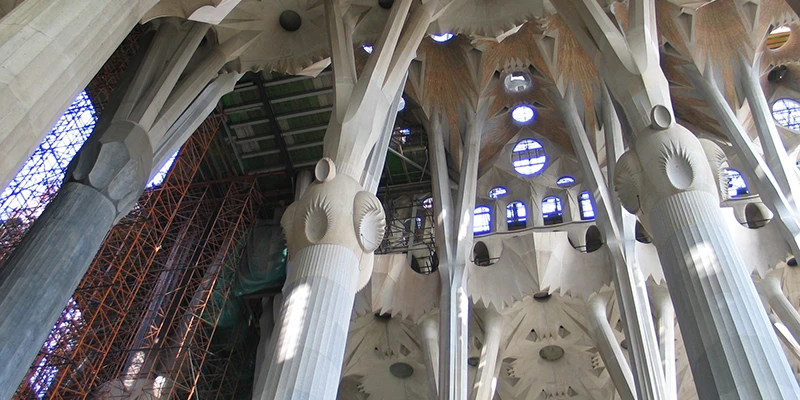
The number one attraction of Barcelona is undoubtedly Sagrada Família. This church looks like it's alive — a whimsical, steel-beamed mountain growing out of the landscape, a creature of the imaginative mind of Gaudí. Barcelonans have been working on the church for a century and are nearly finished. The amazing interior is complete now and will astonish you with its soaring height and unique style of columns, seeming to grow out of the ground with organic shapes.
See our Sagrada Família video — a detailed visit to Barcelona's number one attraction, the cathedral born from the imaginative mind of Antoni Gaudí.
Visiting Sagrada Família requires advance booking, as timed-entry tickets sell out days or weeks ahead, especially in peak season. Tickets are purchased at the official website, www.sagradafamilia.org, where you select a date, entry time and ticket type — basic admission or with tower access. Booking as far ahead as possible is strongly recommended.
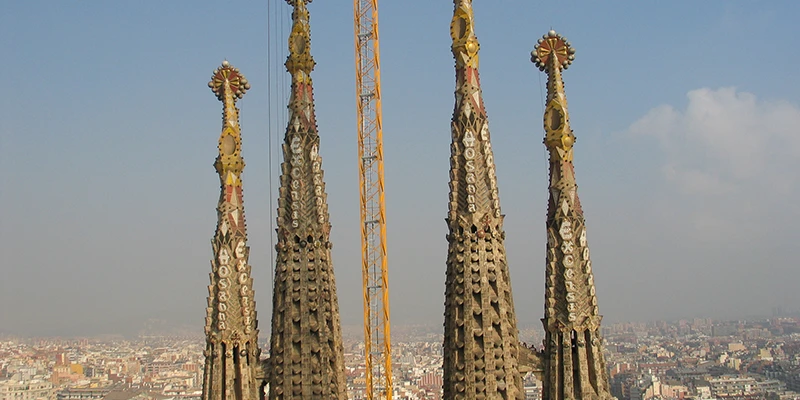
You can ride an elevator most of the way up one of the towers and walk a bit further to the top. From here you gain quite a view as well as vistas across the city — a panorama of the skyline of Barcelona and some details of the towers of Sagrada Família itself.
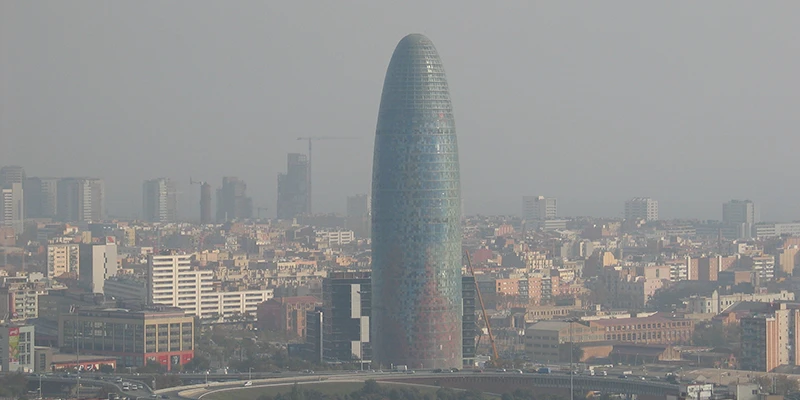
The vista is impressive, showing the general city layout and one outstanding building, an odd round tower looking like a big, glass pickle, like the "Gherkin" in London.
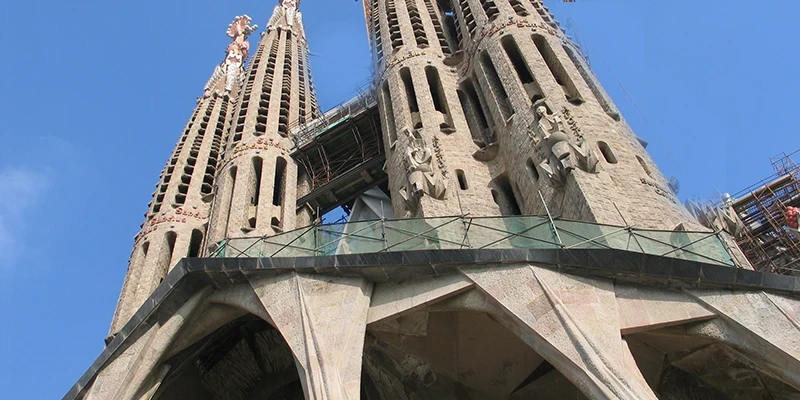
Scale-model exhibits on the ground floor help you envision what the final product will look like. You can also watch the workers as they create sculptures, carve decorative architectural details and do the heavy construction on this busy site, with hard-hat laborers bustling around. It's really a busy, productive area.
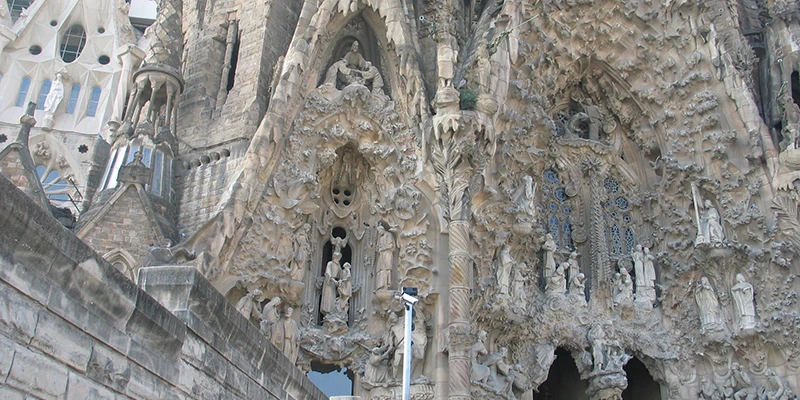
Alternatively, you could save time and money by just looking at it from the outside, which gives an overview, but the interior is so spectacular you really should not miss visiting inside.
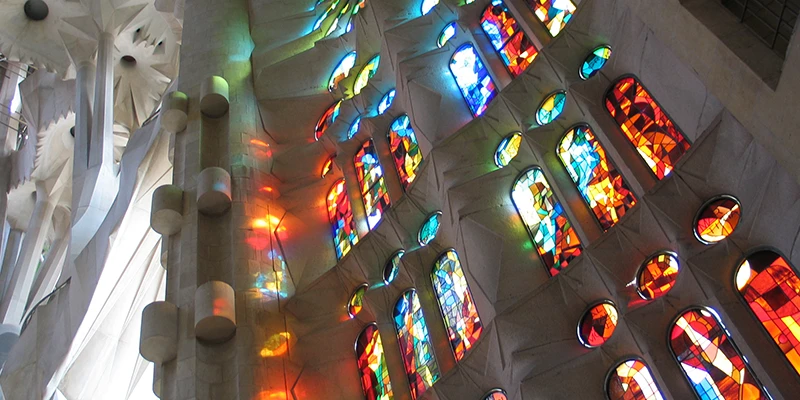
Of course, those with a genuine interest in this famous site will enjoy walking through it, admiring the beautiful stained-glass windows and forest of tall columns finished in many different styles. Such an unusual building is not everyone's cup of tea, but it has become a symbol of Barcelona, so you should come have a look.
Fortunately, there is a metro stop here so you can easily get back to the center of town, especially if you take the L2 line. Its entrance is just east of the church, traveling in the direction of the Paral·lel terminus. You might also consider hopping on one of the open-top sightseeing buses for a city tour — the buses all stop at Sagrada Família and you can board right here.
Waterfront
.webp)
You could spend the rest of this afternoon along the waterfront, visiting two major museums and Europe's largest aquarium containing 8,000 fish. Strolling along this open, sunny area is a dramatic contrast to the more constricted lanes of the Old Town. Palm trees, outdoor restaurants with views of the Port Vell marina, wide busy streets, and a mix of modern and older buildings make this a refreshing change of pace. Leave the rest of the Old Town for tomorrow and the next day.
.webp)
Nautical buffs will surely enjoy the naval history museum, Museu Marítim, housed in the original shipyard structure that partly dates back to the 13th century. Just the building alone is worth seeing, for it is one of Europe's largest medieval, secular buildings. Centerpiece of the collection is the 200-foot-long reconstruction of an oar-powered galley, the warship manned by 400 sailors that was used in the crucial Battle of Lepanto which defeated the aggressive Turks in 1571, keeping the Moslems out of Christian Europe. Many other ships and displays of daily life in previous centuries could keep you captivated for hours.
.webp)
The other large waterfront museum is the Museu d'Història de Catalunya, which offers "a stroll through history" from the Stone Age through modern times in a huge, restored, brick warehouse. Four floors of exhibits take you on a multimedia journey covering the Bronze Age, Romans, early Christians, coming of the Visigoths, 19th century industrialization, and present times.
The Beach
.webp)
Barcelona's beach is one of the unexpected pleasures of the city, running for nearly three miles along the Mediterranean coast just southeast of the old town. The main stretch, Barceloneta beach, is reached on foot from the Gothic Quarter in about 15 minutes by walking south along the waterfront, then turning east past the Port Vell marina. The Barceloneta neighborhood that backs the beach is a dense grid of narrow streets with a strong local character, full of seafood restaurants and bars that fill with residents on summer evenings. Walking through and discovering its charms are added benefits of finding your way to the sandy shore.
-10.webp)
The beach itself draws an enormous mixed crowd of locals and visitors from June through September, when the water is warm and the long days encourage hours of outdoor life. It would be a wonderful break for you to jump in.
-10.webp)
Outside summer the beach is far quieter but remains a pleasant place to walk, with the broad promenade, palm trees and open sea views making it worth the short trip from the center at any time of year.
.webp)
Continue reading: Barcelona Day Three