Córdoba, home of the Great Mosque
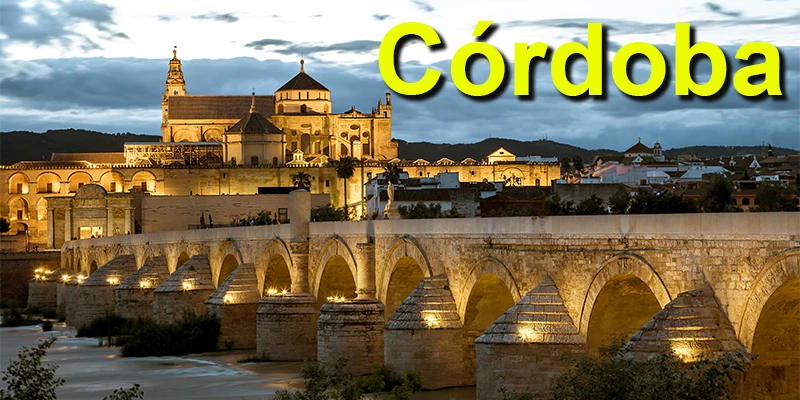
See our video tour visiting the mosque and pedestrian zone.
Córdoba is amazing: it holds one of the most extraordinary buildings in the world, is a medieval old town of rare character, and has residential courtyards filled with flowers that give the city a distinctive beauty unlike anywhere else in Spain.
.webp)
The city's current modest scale gives little hint of its former greatness. During the 9th and 10th centuries, under the rule of the Umayyad Caliphate, Córdoba was the largest and most sophisticated city in Europe, with a population approaching one million. While the rest of the continent was deep in the Dark Ages, Córdoba maintained paved and lit streets, a functioning sewage system, dozens of public libraries, and hundreds of mosques. Scholars here preserved and advanced the scientific and philosophical knowledge of ancient Greece and Rome, making contributions in medicine, astronomy, mathematics and philosophy that would eventually reach the rest of Europe and help ignite the Renaissance. The great mosque stands as the most visible legacy of that golden age.
La Mezquita
.webp)
The great mosque is larger than any Christian church in the world, covering an area of 425 by 570 feet, and it represents the high point of Moorish architecture in Europe. Nothing else quite prepares a visitor for the experience of walking inside. In a national poll conducted in 2007, Spaniards voted La Mezquita the most important historic treasure in the country. The verdict is easy to understand.
The building stands on a site that has served as Córdoba's primary place of worship across multiple civilizations. A Roman temple dedicated to Janus originally occupied the ground. The Visigoths replaced it with a Christian church. When the Moors arrived in 711, rather than demolishing the church immediately, they divided the building between the two faiths, Muslim and Christian worshippers sharing the structure for some decades — a remarkable expression of religious tolerance. Some seventy years later, the Moorish rulers purchased the Christian half and demolished the entire building to construct the grand mosque in its place. Subsequent expansions continued for two centuries, with the structure reaching its current dimensions in 987 following the completion of the outer naves and courtyard. At its greatest extent it contained 1,283 columns; 856 remain today, of jasper, onyx, marble and granite. The construction employed thousands of artisans and laborers over generations, funded by the enormous wealth flowing from the mines, marble quarries and other resources of Iberia. It became the second largest mosque in the world after the Holy Mosque in Mecca.
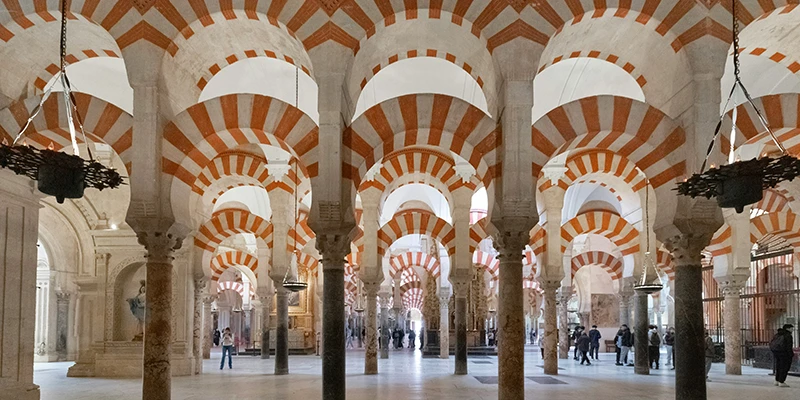
The interior produces an effect unlike that of any other building. Nineteen aisles run from east to west, and thirty-five from north to south, creating a grid of columns that extends in every direction as far as the eye can follow. Walking through this stone forest, sightlines are interrupted at every turn and the uniform plan creates a gentle disorientation, as if the space has no defined center and no clear end. One of the most precise descriptions ever written of the interior compares it to walking through the silent depths of a great forest, with marble trees growing from the soil and rows of columns crossing and lengthening endlessly in every direction. The architecture itself reinforces the impression — the double arches above each row of columns, with their alternating stripes of brick and cream-colored stone, form curving canopies that resemble the interlaced branches of great trees.
.webp)
The double arch was a significant architectural innovation. The combination of a lower horseshoe arch supporting an upper semicircular arch allowed the ceiling to reach a height of 35 feet while working with columns of relatively modest height. Many of these columns were salvaged from earlier Roman and Visigoth structures, which accounts for their variety of materials and proportions. To maintain the uniform ceiling height, taller columns were partly buried in the floor and shorter ones were raised on pedestals — a practical solution that contributes greatly to the visual richness of the space. In its original state the mosque was lit by more than ten thousand gold, silver and bronze lamps suspended from the ceiling, creating an atmosphere difficult to imagine from the dimmer interior that survives today.
.webp)
The mihrab, the ornate prayer niche set into the southern wall, is among the finest achievements of Islamic decorative art anywhere in the world. Its walls and the dome above are covered with intricate Byzantine mosaics commissioned by Caliph Al-Hakam II, who brought craftsmen from Constantinople to execute the work. Geometric patterns, flowing plant designs and calligraphic inscriptions in gold cover every surface with extraordinary refinement. In front of the mihrab lies the Maksoureh, the screened enclosure reserved for the caliph and his court, surmounted by a beautiful gilded dome. The concentration of craftsmanship in this section of the mosque — the layering of gold, marble and mosaic within a relatively compact space — represents the building at its most intense and is the point toward which any visit naturally builds. The hall served not only as a place of prayer but as a center for teaching and for the administration of Islamic law, reflecting the full range of functions that the mosque performed at the height of Córdoba's greatness.
.webp)
When Córdoba was retaken by King Ferdinand III in 1236, the mosque was reconsecrated as a Christian cathedral. The kings who followed added chapels and other Christian elements, but left the essential structure largely intact. The most damaging intervention came in 1523, when the bishop of the time obtained permission to build a full cathedral directly in the center of the mosque. Columns were demolished, the original larchwood ceiling was destroyed, and a large Renaissance church rose incongruously from the middle of the Islamic prayer hall.
.webp)
The cathedral is itself a masterpiece of Plateresque architecture, richly ornamented and built on an ambitious scale, but its placement is deeply jarring — the sudden appearance of soaring vaulted ceilings and Baroque choir stalls amidst the low, rhythmic repetition of the mosque creates a collision of visual worlds. Forty-four Christian chapels line the interior perimeter. Charles V, upon seeing the result, is said to have told the canons: "You have built here what you or anyone might have built anywhere else, but you have destroyed what was unique in the world." Paradoxically, the cathedral may have ensured the building's survival during the Spanish Inquisition, when structures associated with Islam were being systematically eliminated.
See our video tour of the Grand Mosque of Córdoba.
The Judería
.webp)
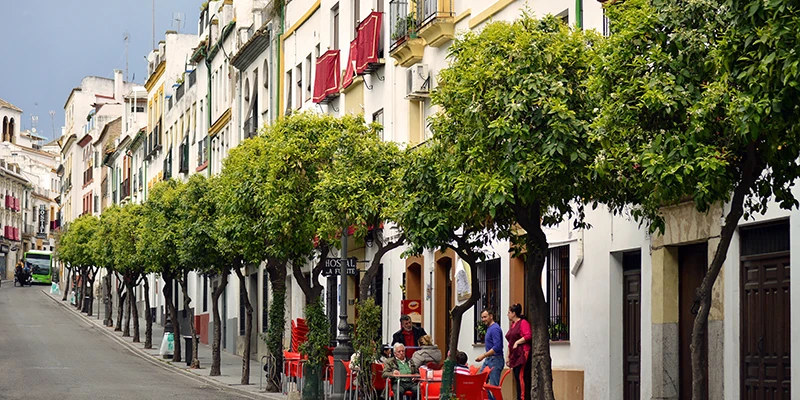
Córdoba's most atmospheric streets lie immediately outside the mosque in the Judería, the old Jewish quarter. Jews were welcomed and protected under Moorish rule and flocked to Córdoba from across Europe, contributing substantially to the city's intellectual and commercial life.
.webp)
The philosopher Maimonides, one of the most important Jewish thinkers in history, was born here in 1135. A statue in the square that bears his name commemorates that connection.
.webp)
The quarter has the same character as Seville's Santa Cruz — narrow lanes, small plazas, whitewashed walls, and no motor traffic — but on a smaller and quieter scale. The main pedestrian streets of Torrijos, Judíos, Luque and Tomas Conde wind through a compact area easily covered on foot. The small 14th-century synagogue on Calle Judíos is one of only three surviving medieval synagogues in Spain and is well worth the brief visit.
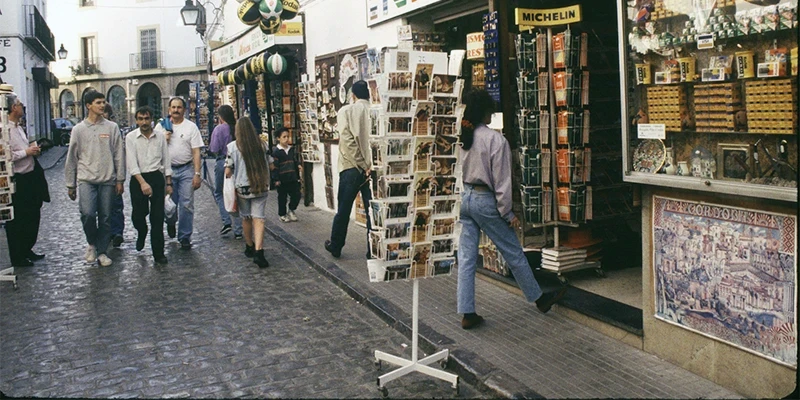
Gift shops line many of the lanes, reflecting the area's popularity with visitors, but the commercial activity sits lightly on the overall character of the district. Wandering a few blocks further from the mosque into the surrounding residential streets reduces the tourist density considerably and reveals the quieter, more domestic side of old Córdoba.
The Courtyards
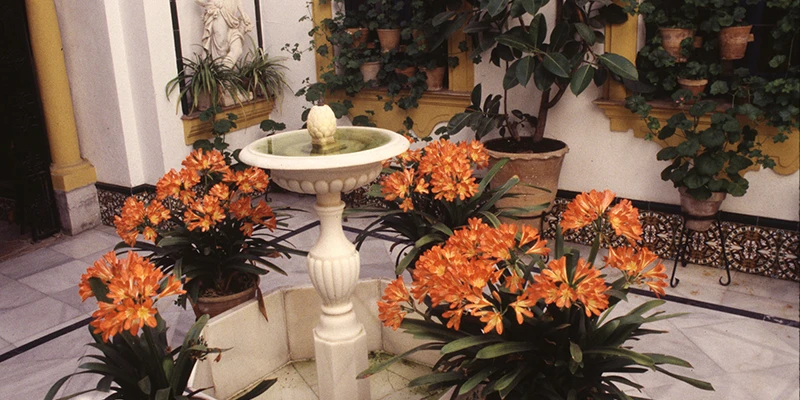
Córdoba is known throughout Spain as the city of courtyards, and the tradition is taken seriously. Each spring the city holds a competition in which residents open their private patios to the public and compete for prizes. The courtyards, invisible from the street until a gate swings open, are typically small, enclosed gardens packed with potted plants, climbing vines, ceramic tiles and a central fountain. Residents decorate them throughout the year with obvious care and evident pride.
.webp)
Outside the competition period, many courtyards remain accessible to passersby when the entrance gates are left open. Stepping through one of these doorways into a space dense with geraniums, jasmine and bougainvillea, with the sound of water from a small fountain, offers a direct encounter with a domestic tradition that has continued here for centuries.
Other Sights
.webp)
Visitors with additional time will find several other worthwhile sites within easy walking distance of the mosque. The Alcázar de los Reyes Cristianos, the fortress palace built by Alfonso XI in the 14th century, contains Roman mosaics, a collection of sarcophagi and extensive terraced gardens with fountains and pools. The view from its towers across the Guadalquivir River is one of the best in the city.
.webp)
The Roman Bridge, which crosses the Guadalquivir to the south of the mosque, dates originally from the first century BC, though it has been reconstructed many times since. The walk across it offers a fine perspective on the mosque's tower and the old city skyline. On the far bank, the Torre de la Calahorra houses a small museum covering the history of medieval Córdoba and the coexistence of the three cultures — Muslim, Jewish and Christian — that defined the city at its height. The Palacio de Viana, located in the northern part of the old city, contains twelve distinct courtyards and extensive gardens arranged around a 15th-century palace. It offers perhaps the most refined example of Córdoba's courtyard tradition and is worth the walk from the mosque for those interested in the city's domestic architecture.
Getting There
.webp)
The AVE train from Seville Santa Justa to Córdoba runs approximately once an hour throughout the day, with the journey taking 45 minutes. Tickets can be purchased at the station or in advance through Renfe. The mosque is about a 15-minute walk from Córdoba station, or a short taxi ride. Most of the main sights are concentrated within easy walking distance of the mosque, making the city straightforward to navigate on foot.
This makes it possible to visit Córdoba as a day-trip from Seville, or you might consider spending a few nights here to enjoy all that this rewarding city has to offer.
.webp)
.webp)