Granada
 copy.webp)
In the southern region of Andalusia, at the foot of the Sierra Nevada mountains, Granada is one of the most rewarding destinations in Spain — a city where Islamic and Christian civilizations left monuments of extraordinary beauty within walking distance of each other.
.webp)
Most visitors come for a single reason: the Alhambra. But the city rewards those who linger beyond its famous hilltop palace.
The Alhambra
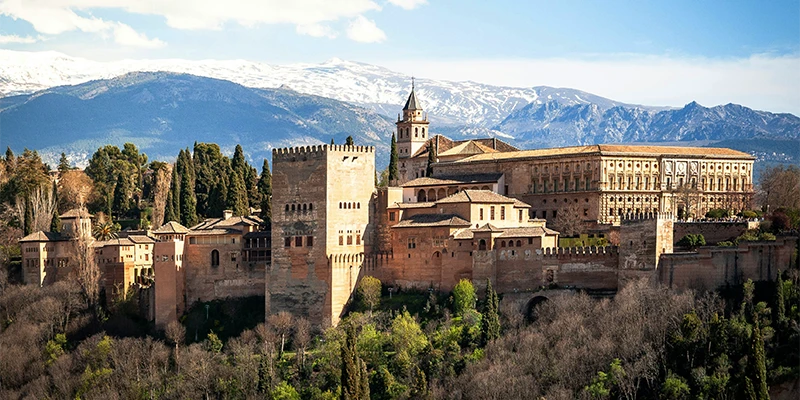
No building in Europe prepares you for the Alhambra. This vast fortress-palace complex was begun in 1238 by the Nasrid dynasty and took well over a century to complete, evolving from a military citadel into the most refined royal residence of medieval Islam.
.webp)
The name means "the red one" in Arabic, a reference to the reddish clay used in its walls, which glow a warm ochre in the late afternoon sun.
.webp)
The complex divides into several distinct zones. The Alcazaba, the oldest section dating to the 9th century, is the military fortress at the western tip, its towers offering sweeping views across the city and the Albaicín below. From here the true palace begins.
 (1).webp)
The Nasrid Palaces are the heart of the Alhambra and the reason people travel from every corner of the world. Three interconnected royal chambers — the Mexuar, the Comares Palace and the Palace of the Lions — represent the pinnacle of Moorish decorative art.
.webp)
Every surface is covered in an intricate layering of carved plasterwork arabesques, geometric tilework and calligraphic inscriptions from the Quran. The craftsmen worked wet plaster into elaborate patterns before it dried, painting them in the same colors as the ceramic tiles: deep blue, ochre and red, much of which has faded to the pale honey tones visible today.
.webp)
The Patio de los Comares centers on a long reflecting pool that mirrors the Torre de Comares, the tallest tower of the Alhambra, in its still surface. The Arabs used water as a natural mirror throughout the complex, a deliberate device drawing on the Quranic imagery of paradise, where rivers flow beneath pavilions. The effect is one of extraordinary serenity.
.webp)
The Patio de los Leones, named for the famous fountain at its center supported by twelve marble lions, is perhaps the most photographed space in Spain. The lions served as an ingenious water clock — at each hour of the day, water spouted from the mouth of a different lion in sequence, a feat of hydraulic engineering that astonished contemporaries.
The surrounding arcade of slender columns and the honeycomb muqarnas vaulting above are among the finest examples of Islamic architecture anywhere.
.webp)
Visiting the Nasrid Palaces requires advance booking — timed entry tickets sell out weeks or months ahead, especially from spring through autumn. Book through the official website at alhambra-patronato.es and choose your entry time carefully, as once your slot has passed there is no re-entry.
The Generalife
.webp)
Adjacent to the Alhambra on a neighboring hillside sits the Generalife, the summer garden residence of the Moorish kings. Its name derives from the Arabic for "garden of the architect" and it is among the most beautiful garden complexes in the world.
2upcopy.webp)
Terraced pools, water channels, cypress hedges and flowering borders climb the steep hillside in a series of interconnected levels, the sound of running water constant throughout.
.webp)
The gardens were laid out in the early 14th century, though much of the planting visible today reflects later restoration — the underlying structure of pools, channels and terracing follows the original Moorish design closely.
.webp)
The Generalife was conceived not as a palace but as a retreat — a place of pure pleasure and contemplation away from the formal demands of the royal court. Its open-air ambience and lush planting provide a striking contrast to the enclosed splendor of the Nasrid Palaces below.
.webp)
Where the palace turns inward, its beauty concentrated in carved plasterwork and tiled interiors, the Generalife opens outward to sky, mountain air and the sound of birdsong above the city.
copy.webp)
The central Patio de la Acequia, a long rectangular pool flanked by jets of water arching overhead, captures perfectly the Islamic ideal of the garden as earthly paradise. The Quran describes paradise as a garden beneath which rivers flow, and the Moorish garden tradition took this imagery literally — water was not merely decorative but sacred, a symbol of life and divine generosity.
.webp)
The acequia, or irrigation channel, that gives the patio its name once formed part of a sophisticated hydraulic system drawing water from the Sierra Nevada snowmelt through a network of channels and cisterns that still functions today.
.webp)
Beyond the central patio, a series of smaller gardens rise up the hillside through shaded walkways and cypress-lined stairways where water runs down the stone balustrades beside your hands as you climb. The Upper Gardens offer increasingly open views across to the Alhambra palace and the city below, the Sierra Nevada forming a dramatic backdrop in the distance.
.webp)
In the heat of a Granada summer, which can be fierce at this latitude, the combination of shade, moving water and elevated breezes made the Generalife genuinely livable in a way the palace interiors were not.
.webp)
The gardens are best visited in spring when the rose beds and flowering borders are at their peak, or in early morning before the main crowds arrive. An open-air theater carved into a cypress grove at the lower level hosts Granada's famous International Festival of Music and Dance each June and July, with performances staged against the floodlit Alhambra as a backdrop — one of the great cultural experiences in Spain if your visit coincides with the program.
Staying on the Alhambra Grounds
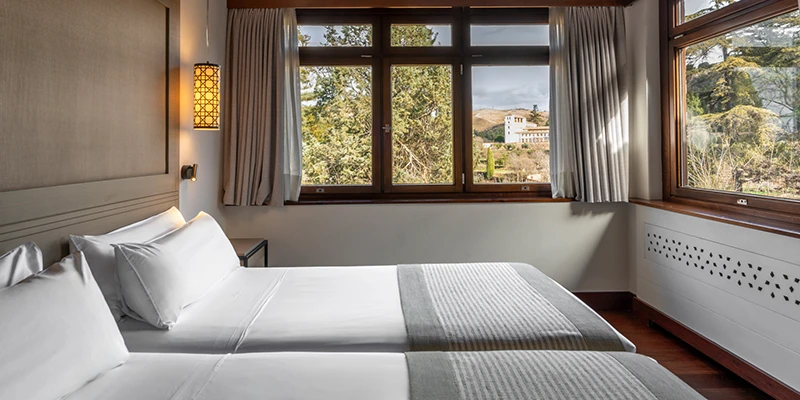
Within the Alhambra walls sits the Parador de Granada, housed in a converted 15th century convent and considered one of the finest paradors in Spain. Demand is so high that reservations a year in advance are not unusual. Even if you are not a guest, dinner at the restaurant is open to visitors and worth the effort of a reservation — the setting, inside medieval stone walls surrounded by the palace gardens, is incomparable. A unique opportunity awaits you at this monastery built by the Catholic Monarchs in the heart of the Moorish palace. However this is a luxury splurge at about 500 euro per night.
The Albaicín
.webp)
Directly across the valley from the Alhambra, connected to it visually but separated by the deep gorge of the Río Darro, lies the Albaicín — the old Moorish quarter of Granada and a UNESCO World Heritage Site in its own right.
3up.webp)
Its tightly woven maze of whitewashed lanes, steep cobbled alleys and small plazas retains the character of a medieval Islamic city. Carmen houses — private walled gardens terraced into the hillside — are scattered throughout, their greenery visible above the walls.
.webp)
The quarter was established by Moorish settlers from Baeza after that city fell to the Christians in 1227, and it remained the heart of Muslim Granada until the final reconquest in 1492. Many of its lanes follow paths that have existed for over seven centuries.
.webp)
The Mirador de San Nicolás at the top of the Albaicín offers what many consider the finest view in Andalusia: the entire Alhambra spread across its ridge, the Generalife visible to the right, and the snow-capped Sierra Nevada rising behind on clear days. The square fills at sunset with locals, musicians and visitors, making it one of those rare places where a famous view actually lives up to its reputation.
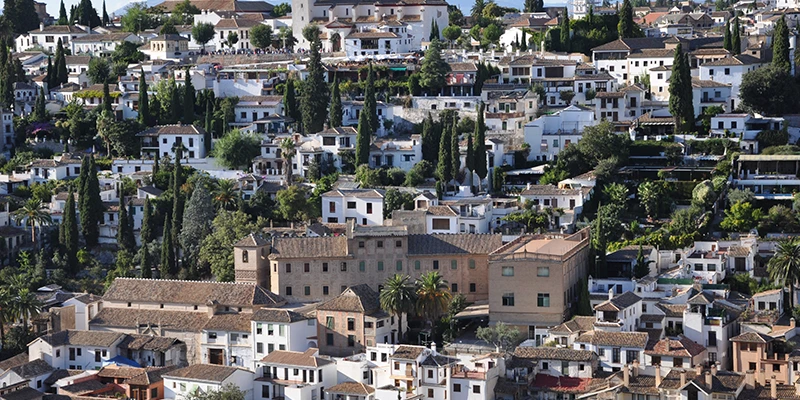
A second mirador, San Cristóbal, sits at the northern edge of the quarter and rewards those who make the climb with equally sweeping views but far fewer crowds — a worthwhile alternative if San Nicolás is packed.
.webp)
The neighborhood's small market streets carry on a daily life that feels largely unchanged — fruit and vegetable stalls, small bakeries and neighbourhood cafes that are not oriented toward tourists.
.webp)
Calderería Nueva and Calderería Vieja, two steep lanes descending from the upper Albaicín, are lined with Moroccan tea houses and spice shops that give this part of the city a distinctly North African character, a reminder of how recently — in historical terms — this was an Islamic city. It is worth spending an hour or two simply wandering without a specific destination.
The Cathedral and Royal Chapel
.webp)
Back in the lower city, Granada's Cathedral is one of the earliest Renaissance churches in Spain, begun in the 1520s on the site of the principal mosque after the Christian reconquest.
3up.webp)
Its Capilla Mayor — the chancel beneath a soaring 150-foot dome — is among the most dramatic interior spaces in Andalusia, flooded with light from sixteen tall windows. Construction took nearly 150 years, and the building reflects the gradual transition from late Gothic to Renaissance as the decades passed.
.webp)
Adjoining the cathedral is the Capilla Real, the Royal Chapel, built specifically as the mausoleum of Ferdinand and Isabella. The two monarchs who completed the reconquest of Spain, expelled the Muslims and Jews, and funded Columbus's voyage lie here beneath an elaborate Renaissance tomb carved by Domenico Fancelli.
.webp)
In the crypt below, the actual lead coffins are visible through a grille. The sacristy contains the monarchs' private art collection, including remarkable Flemish paintings acquired during their reign.
Downtown Granada
copy.webp)
The lower city between the cathedral and Puerta Real repays exploration beyond the obvious monuments. Calle Reyes Católicos, the main commercial artery, connects Plaza Isabel la Católica to the shopping hub of Puerta Real, where Calle Recogidas continues south with the city's better fashion boutiques. The pedestrian lanes of Calle Zacatín and Alcaicería thread between the cathedral and Plaza Bib-Rambla, the latter a relaxed square of flower stalls and outdoor cafes ideal for a mid-morning coffee.
.webp)
The Corral del Carbón, a 14th century Moorish caravanserai tucked just off Reyes Católicos, is easily missed but worth finding — its arcaded courtyard is one of the oldest intact structures in the city. The Madraza, Granada's original Islamic university founded in 1349, stands opposite the Capilla Real with a restored prayer hall whose stucco decoration rivals anything in the Alhambra.
Eating in Granada
copy.webp)
Granada maintains one local custom that has largely disappeared elsewhere in Spain: the free tapa served with every drink ordered at a bar. The tapa changes with each round and can be substantial — a small plate of stew, fried fish, or cured meat.
-10copy.webp)
Over the course of an evening this tradition can amount to a complete meal at little cost, and it draws locals and visitors alike into the city's convivial bar culture. The streets around the cathedral and around the Albaicín offer the best concentration of places to experience this.
Getting There
Granada is well connected by high-speed train from Madrid in about three hours, and by frequent bus services from Seville, Córdoba and Málaga. The city is compact enough that the Alhambra hill, the Albaicín and the cathedral quarter can all be reached on foot from a central hotel, though the climb to the Alhambra is steep and the free minibus service from Plaza Nueva is a practical alternative.
You can also see this same video on a separate video page.