800wcopy.webp)
Toledo
A day trip from Madrid to the historic city of Toledo will fill the day with wonderful experiences. Toledo had been the capital and most important city of Spain for many centuries before the government was moved to Madrid by Philip II in 1561.
.webp)
Allow six to eight hours for a full visit. Arriving before 10:00am is strongly recommended — the main attractions get extremely crowded by midday, with long queues at peak season. The Toledo Tourist Bracelet, available at the tourist office, bundles entry to several monuments at a saving and helps avoid separate queues.
Walking
copy.webp)
Toledo is ideal for strolling. You cannot get very lost because you are inside a walled town barely one square mile in area.
3upcopy.webp)
For many visitors the outstanding appeal lies not with specific monuments but in the overall atmosphere — narrow pedestrian lanes lined by ancient stone buildings where you can wander away from the busy shopping streets and float back in time. Before cutting loose in the little alleys, however, there are several major attractions to visit while the crowds are still thin.
The Cathedral
.webp)
This wonderful church is the most important historic site in Toledo and one of the great gothic buildings of the world. Construction began in 1226 and continued for nearly 300 years, producing a church nearly 150 yards long — longer and wider than Notre Dame in Paris, built around the same period — with five naves, a double ambulatory and 88 massive columns supporting vaulted ceilings rising 45 yards high. Walking through it is like finding your way through a stone forest. Light streams through numerous stained glass windows. Impressive chapels line the entire perimeter, each with its own story, with those behind the main altar of special interest.
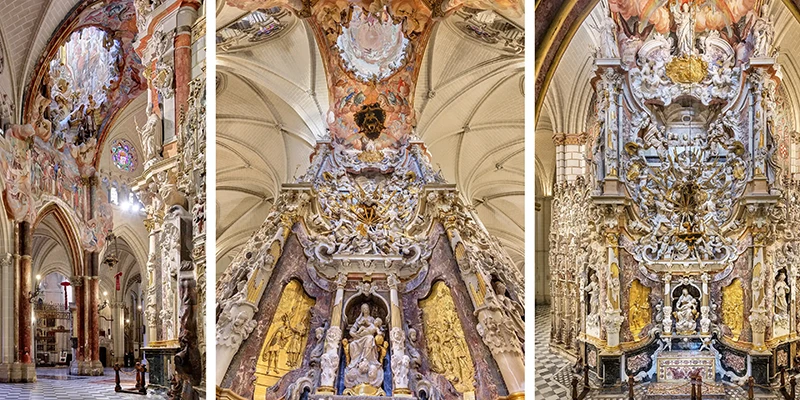
The single most astonishing artistic creation here is the Transparente — a Baroque sculptural ensemble in marble, alabaster and gilded bronze depicting angels, sunbursts, clouds, the Virgin and Child and a life-sized Last Supper, illuminated by light from a concealed round window cut into the roof above. It flows from ceiling to floor in a way that defies easy description.
.webp)
The choir features a double row of carved stalls representing Gothic craftsmanship at its most flamboyant. The main altar retablo is covered in gold said to have arrived with Columbus on his first voyage. The Sacristy is a veritable art museum with masterpieces by El Greco, Goya and Velázquez, and a ceiling fresco of vivid three-dimensional perspective covering the entire vault.
3upcopy.webp)
The exterior is hemmed in by other buildings, but the facade with its three Gothic doorways and asymmetric towers is visible from the plaza in front, where Toledo's City Hall — designed in part by the son of El Greco — faces it across the square. See the Cathedral official website.
The Alcázar
.webp)
Rising above Zocodover on the highest point in the city, the massive Alcázar is impossible to miss and worth a visit. This fortified palace was largely destroyed during the Spanish Civil War siege of 1936, when Nationalist troops held it for months against Republican forces in one of the conflict's most dramatic episodes. Rebuilt after the war, it now houses the Army Museum of Spain, which covers the military history of the country from medieval times to the modern era. Even if military history is not your primary interest the building and the views from its towers justify the visit.
Plazas
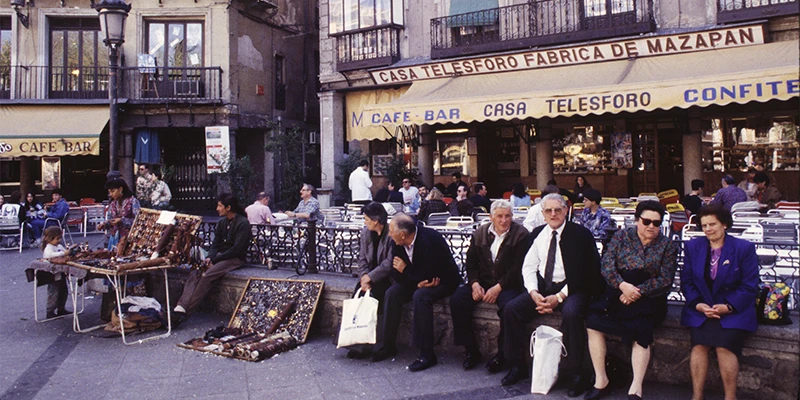
The natural heart of Toledo is Plaza de Zocodover, a triangular square at the top of the escalator from the lower town where visitors and locals have converged for centuries. Its name derives from the Arabic for livestock market, and it retains something of that role as a place of transaction and gathering — today it is ringed with cafes and ice cream shops, busy from morning until late at night. The Tourist Information Office sits here, buses stop nearby, and the streets leading off it carry most of the daytime foot traffic of the old city. It is the obvious place to orient yourself at the start of a visit and the natural endpoint after a long day of walking.
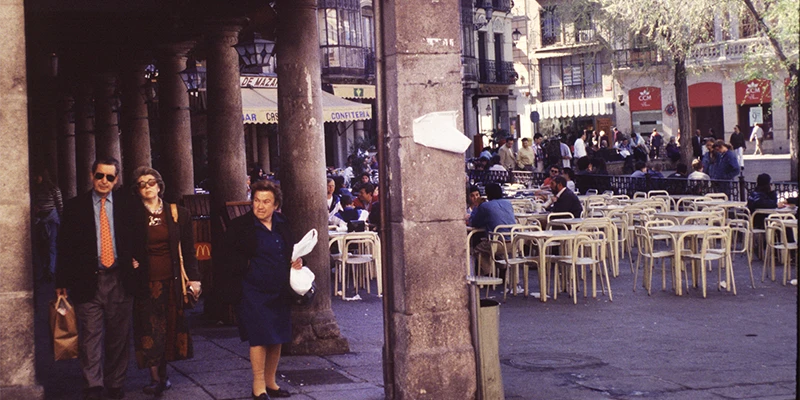
Beyond Zocodover the older neighborhoods reveal quieter gathering places more representative of daily Toledo life. Plaza del Ayuntamiento, in front of the Cathedral and City Hall, has a formal civic character and fills on weekend evenings with families and couples strolling in the Spanish manner.
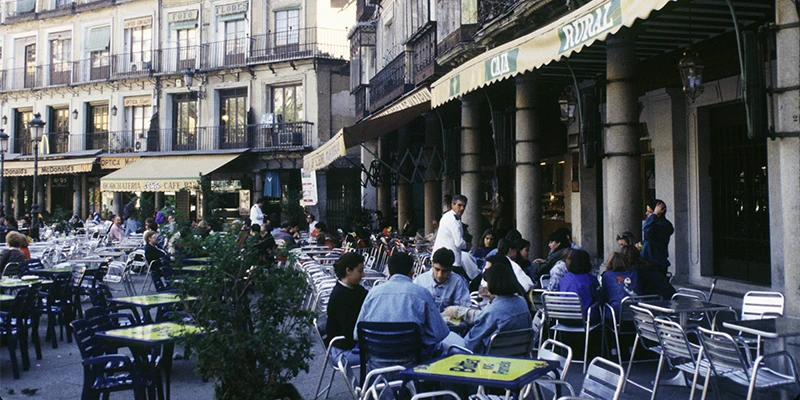
Calle Comercio and Calle del Hombre de Palo, the main pedestrian shopping streets connecting Zocodover to the cathedral quarter, are lively throughout the day with small shops, bakeries selling marzipan and bars where locals stop for coffee.
copy.webp)
Further into the residential neighborhoods west of San Juan de los Reyes the streets grow quieter and more authentically local, with small neighbourhood bars and shaded corners where the tourist circuit rarely reaches.
Church of Santo Tomé
Continue along the main street, now called Calle la Trinidad, toward the Church of Santo Tomé. Inside you will find El Greco's absolute masterpiece — The Burial of the Count of Orgaz.
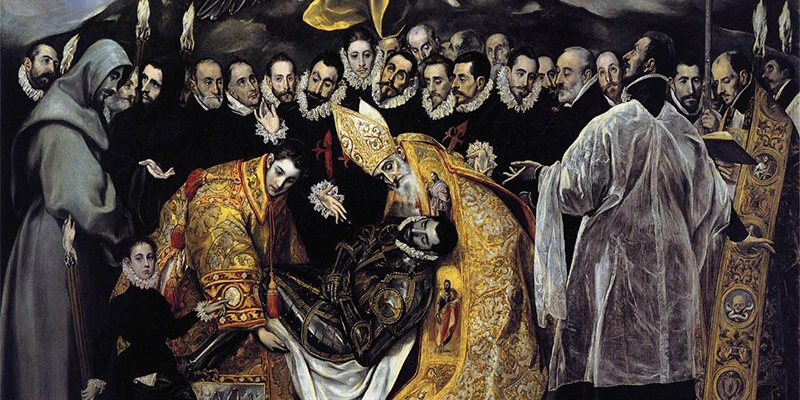
Considered one of the world's great paintings, it depicts a miraculous funeral scene with the heavens above and Toledo's nobility paying tribute, the patron himself buried in this very church. It is the only exhibit this writer has encountered where admission is charged for a single painting — but it is worth it. Arrive early, because at midday in peak season the queues to squeeze into this small space can be hundreds of people long.
House of El Greco
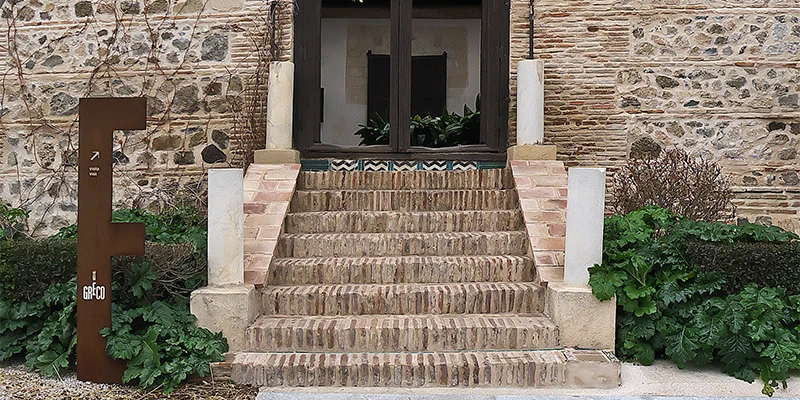
One block down San Juan de Dios, the so-called House of El Greco is interesting to see even though he did not actually live here. The home is typical of the period, with authentic furnishings and some of his original paintings. This brilliant Greek-born artist trained in Italy and came to Toledo while still young, never gaining the favor of Philip II, and stayed until his death in 1614. Toledo's Jewish quarter surrounds the house, its narrow lanes preserving the pattern of the medieval neighborhood. See the House of El Greco website.
El Tránsito Synagogue and Sephardic Museum
.webp)
Just steps from the House of El Greco, the Synagogue of El Tránsito is the more elaborate of Toledo's two surviving synagogues and the more rewarding to visit. Built in 1357 for Samuel Halevi, treasurer to King Pedro I, it features exceptional Mudéjar decoration — carved Hebrew inscriptions, arabesques and geometric patterns covering the upper walls in the same style used in the Alhambra. The adjoining Sephardic Museum traces the history of Jewish life in Spain from its earliest presence through the expulsion of 1492.
Santa María la Blanca
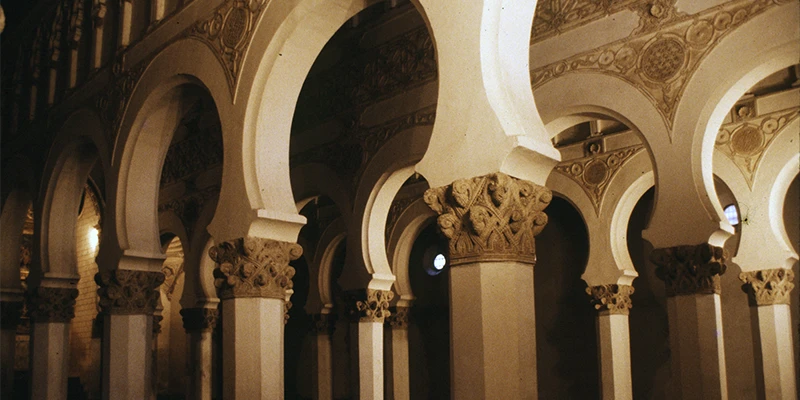
Two blocks further into the former Jewish quarter stands the older of Toledo's two synagogues, built in 1180 in the Spanish Arab style. Graceful horseshoe-shaped arches supported by octagonal columns with intricately carved capitals make the interior look more like a mosque than a synagogue or church — an intentional reflection of the Mudéjar aesthetic that Jewish patrons, Muslim craftsmen and Christian authorities all contributed to. It later became a Catholic church. This layering of architectural styles and religious functions is characteristic of Toledo and illustrates why the city remains such a compelling destination for understanding the complex history of medieval Spain.
Cristo de la Luz Mosque
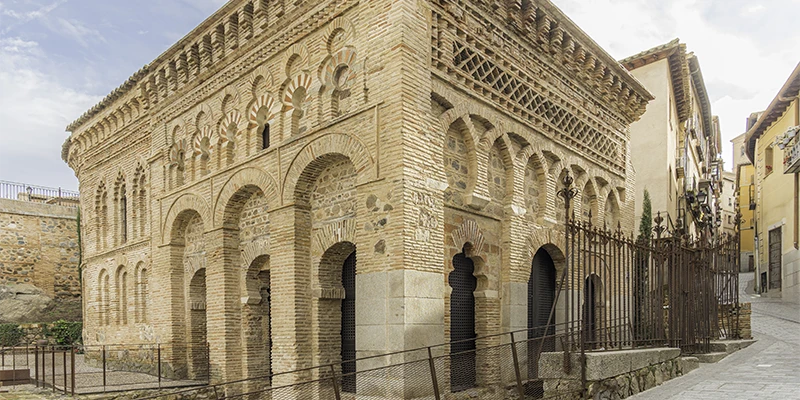
Near the entrance to the old town from the escalator, the small Mosque of Cristo de la Luz is easy to overlook but historically significant. Built around 999 AD by the Moorish rulers of Toledo, it is one of the best-preserved examples of Moorish religious architecture in Castile, predating the Alhambra by two and a half centuries. Its horseshoe arches and geometric brick vaulting reward a short visit.
San Juan de los Reyes
2upcopy.webp)
At the western edge of town you will find the exquisite late Gothic Church of St. John and its famous two-story cloister. Ferdinand and Isabella founded this monastery as their intended burial place before choosing Granada instead. Elaborate carved decoration covers much of the complex in the Isabelline style — among the finest examples of that transitional Gothic-Renaissance manner in Spain. Hanging from the exterior walls are chains and manacles, said to commemorate Christian prisoners freed from Muslim captivity during the Reconquista, a striking and unusual decorative choice.
copy.webp)
The cloister is especially beautiful, with its two arcaded levels surrounding an open courtyard and carved Mudéjar wooden ceilings sheltering the walkways.
3upcopy.webp)
Narrow Lanes
Along with seeing all the important sights you also want to take your time and wander through the little alleys. By now you have covered the major monuments and can stroll freely, turning left or right depending on what looks most interesting. This is where Toledo reveals its most honest character, away from the ticket lines and tour groups.
.webp)
The lanes here are barely wide enough for two people to pass, their stone walls worn smooth by centuries of shoulders brushing against them. Laundry hangs between upper windows. A cat sits in a doorway. The smell of garlic and olive oil drifts from a kitchen somewhere above you. A few small shops are scattered here and there.
copy.webp)
These streets follow no logical grid — they bend and fork according to the medieval logic of the neighborhoods that once divided this city among Christians, Moors, and Jews. That layered history is still readable in the architecture if you slow down enough to look: a Moorish arch framing a Gothic doorway, a Hebrew inscription carved into a stone lintel.
copy.webp)
Keep your eyes open for interior courtyards with their colorful flower gardens and shaded patios, many of them half-visible through iron gates left casually ajar. The residents here live quietly alongside the tourism without much acknowledging it. A shopkeeper arranges ceramics on a shelf. An old man reads a newspaper on a wooden chair outside his door. Heading generally eastward, with zigzags along the way, you will eventually get a bit lost, then find yourself.
copy.webp)
Turn a corner and the lane widens out to join with a busier street with people out for a stroll, passing various restaurants and cafes, bringing you full circle on a fun little loop through the back side of this busy town.
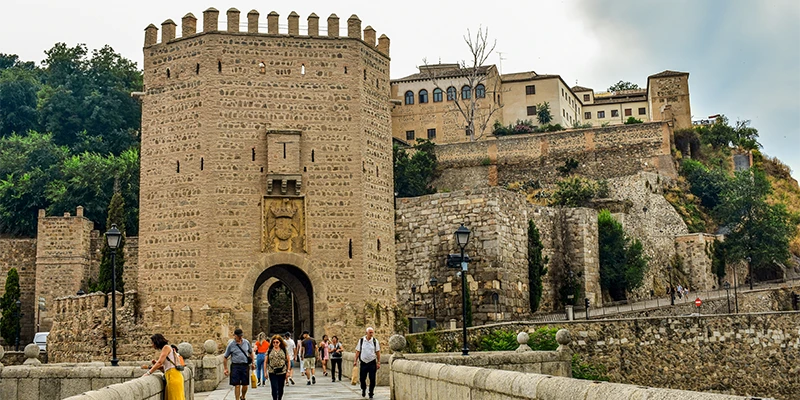
Fortifications
Toledo's defensive walls follow the natural fortification provided by the Tagus River, which wraps around three sides of the city in a deep gorge, leaving only the northern approach requiring serious man-made defenses.
.webp)
The existing walls date from multiple periods — Roman foundations, Visigothic reinforcement, Moorish reconstruction and later Christian additions — creating a layered structure that reflects every era of the city's occupation.
.webp)
The most impressive surviving section runs along the northern perimeter, where the Puerta de Bisagra, rebuilt by Charles V in the 16th century, serves as the main ceremonial entrance to the old city. Its massive twin towers and central arch, decorated with the imperial eagle of the Habsburgs, frame the approach from the Madrid road and give a first impression of Toledo's monumental ambitions.
.webp)
The older Puerta del Sol nearby, a 14th century Mudéjar gate with horseshoe arches and decorative brickwork, is a quieter but equally striking example of the city's architectural layering.
Museum of Santa Cruz
.webp)
Located one block from Plaza Zocodover, this late 15th century building was originally a hospital for the poor, built in the elaborate Plateresque style with two levels of large halls, high ceilings and several courtyards. Converted into a museum, its ten galleries display sculpture, paintings, tapestries and decorative arts — but the architecture is even more attractive than the contents. If time and energy are running short, at least stop to admire the exterior and entrance portal.
The View and the Parador
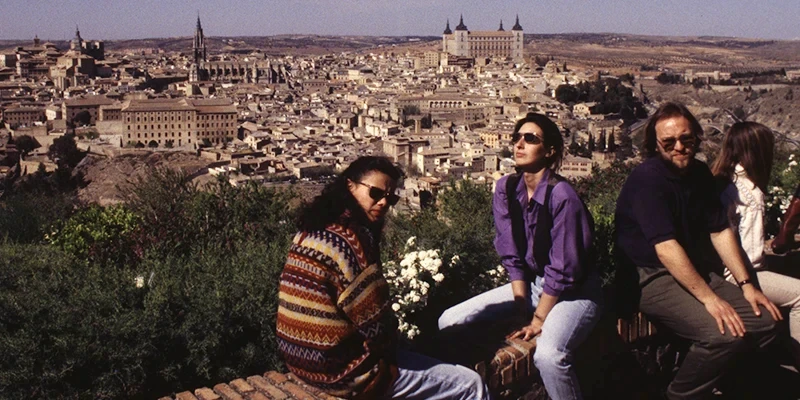
Before returning to Madrid consider one quick side trip by taxi. Toledo is a magnificent sight, but it is impossible to see the city as a whole from inside it. The classic view requires driving to the Parador on an adjacent hill facing the town across the Tagus gorge.
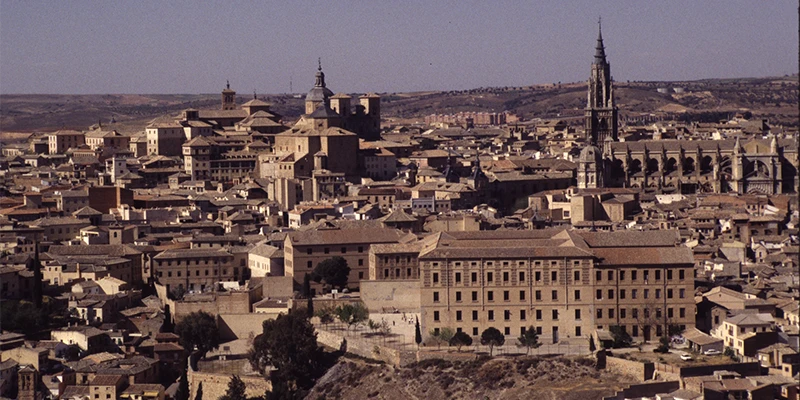
For the full effect, continue past the Parador a short distance to the Mirador del Valle, the finest panoramic viewpoint of Toledo, best at sunset when the cathedral tower and Alcázar glow above the rooftops.
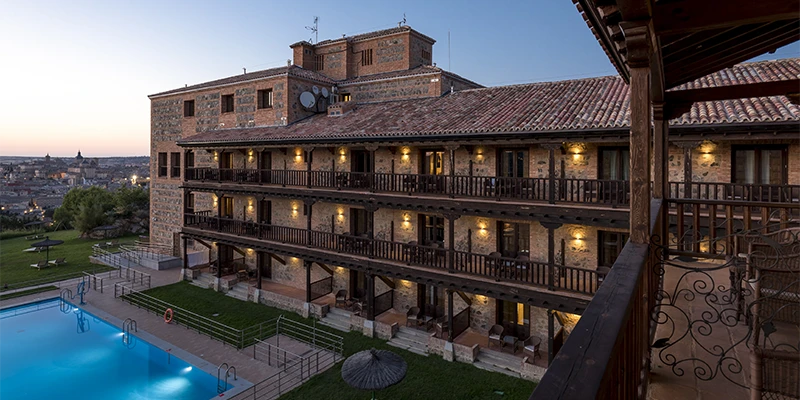
The Parador itself is one of the finest in Spain and the outdoor terrace is ideal for lunch with the grand view before you. Taxis are readily available from Zocodover. Advance reservations are essential if you wish to stay the night. See the Parador de Toledo website.
Marzipan
.webp)
Toledo's other great claim is culinary: its marzipan, known as mazapán, is considered the finest in Spain and is sold at confectionery shops throughout the old town. It comes in elaborate molded shapes and is made to recipes that some shops claim to trace back centuries. Worth sampling on the spot and taking home as a gift.
History
Toledo was a major center of Christian, Muslim and Jewish culture, especially during periods of coexistence, though this harmony fluctuated over time and ended with the forced expulsions of 1492. During the 10th and 11th centuries under Moorish rule the city became one of the great intellectual centers of Europe, a place where Arabic, Hebrew and Latin scholarship intersected and where texts of Greek philosophy, mathematics and medicine were translated and transmitted to the wider world.
3upcopy.webp)
Christian kings captured Toledo in 1085, but wisely retained much of its character — Muslim craftsmen continued to work for Christian patrons, producing the distinctive Mudéjar style visible throughout the city's churches and synagogues to this day. Jewish scholars thrived here under royal protection, serving as physicians, advisors and translators at the Castilian court.
.webp)
This layered civilization produced buildings that changed function without changing form — mosques became churches, synagogues became chapels — and the architectural evidence of all three faiths survives in close proximity unlike anywhere else in Spain. With the rise of Madrid, Toledo was left behind and largely undisturbed for four centuries, preserving its buildings as an extraordinary time capsule of the Middle Ages, with a rich mix of Christian, Moorish and Jewish architecture concentrated in a single square mile.
Getting There
The fastest and most convenient option today is the high-speed AVE train from Madrid Atocha Station to Toledo Railway Station, which takes about 33 minutes. Direct buses from Madrid's Estación Sur de Autobuses — four blocks south of Atocha, next to the Palos de la Frontera metro stop — remain a cheaper alternative, departing every hour from 7:00am, but the train is quicker and more comfortable. Check current schedules online before traveling. Doing this trip independently is easy and gives maximum flexibility, but guided bus tours are also available as half-day or full-day options from Madrid.
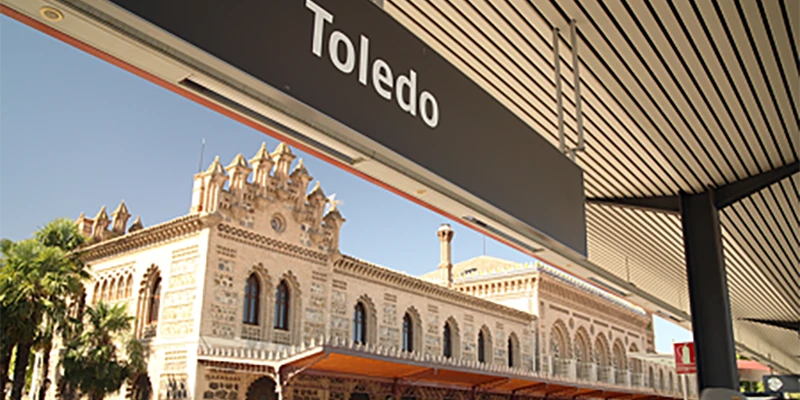
The station and bus terminal both sit at the foot of the hill below the old town. An escalator carries you effortlessly up to the old city and Plaza de Zocodover, one of the main squares at the edge of the historic center. The Tourist Information Office here provides free maps, brochures and event schedules. From Zocodover it is a short walk along the main street, Calle Comercio, to begin the visit at the Cathedral.
.webp)
Back to Madrid
With an early start you can cover the major sights of Toledo and return to Madrid comfortably by late afternoon, leaving the evening free for the capital.