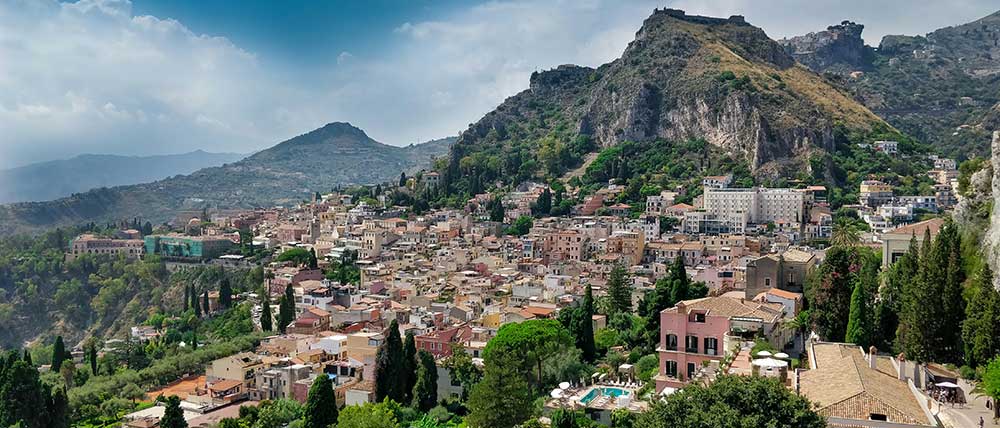
Taormina occupies an elevated position on a hillside overlooking the Ionian Sea in northeastern Sicily, with the urban area concentrated along a ridge backed by Mount Tauro and descending toward coastal beaches. The town consists of a compact historic core centered on a pedestrianized main street, surrounded by residential neighborhoods and scenic viewpoints, with attractions organized in distinct geographic zones that reflect development from Greek and Roman times through medieval, baroque, and modern periods.
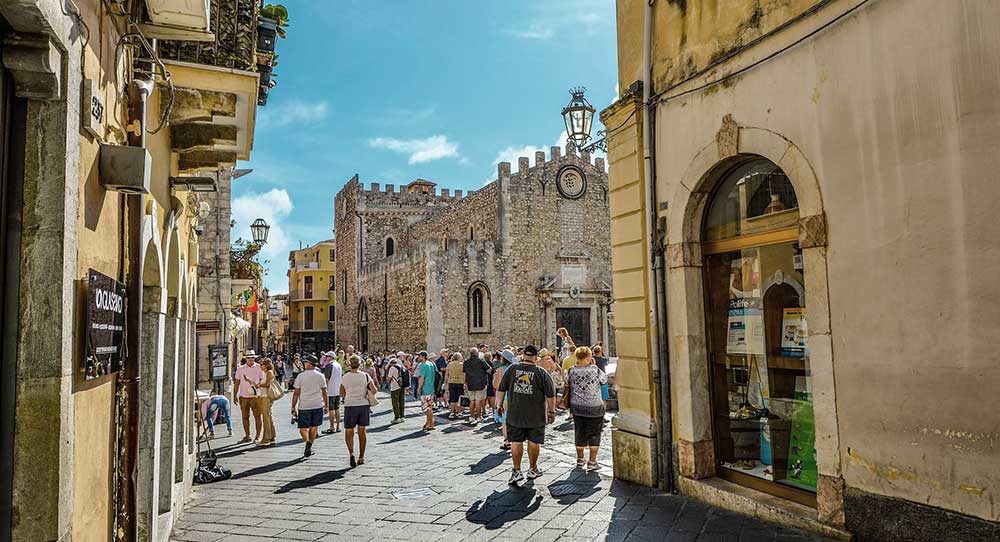
Visitors find the layout conducive to walking within the center, with cable cars and paths connecting to coastal areas, and the terrain features steep slopes offering panoramic vistas of Mount Etna and the sea. The built environment integrates ancient ruins, religious structures, public gardens, and pedestrian spaces that serve both residents and those exploring the region's scenic and historical appeal.
This interactive Google My Map shows locations of attractions mentioned in this story, with information that can be displayed by clicking on the symbols. It has a sidebar index and displays best in full-frame by clicking the box in top-right. You are welcome to make a copy as described here. The map can be used in your mobile phone or tablet, very useful to help navigate while visiting a city. There are many hotels listed in the map with contact information. My hotel choice is Excelsior Palace Hotel.
The Official Tourist Information website has a large amount of information about the city and surroundings, including sights, accomodations, dining, tours, scenic routes, free brochures, maps and more.
Historic Center: The Core of Taormina
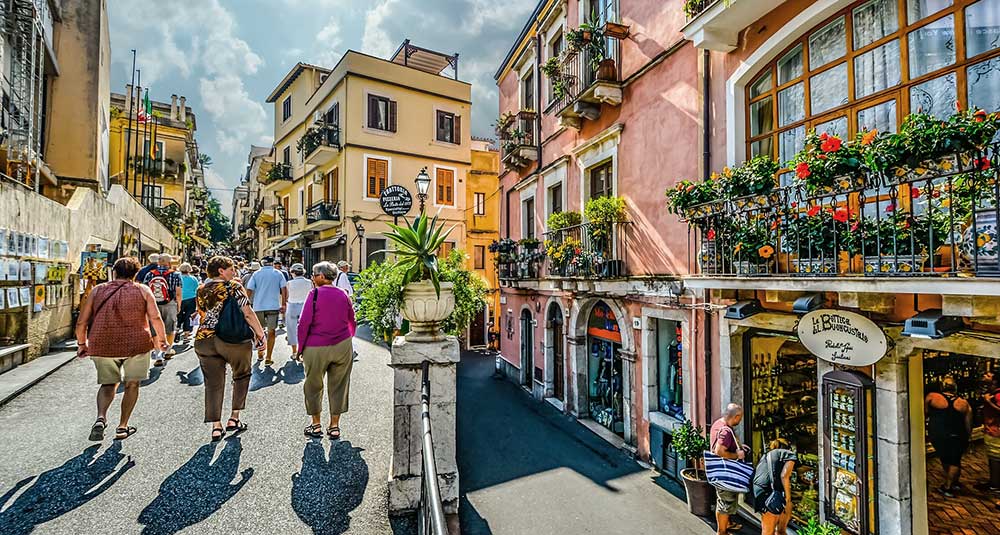
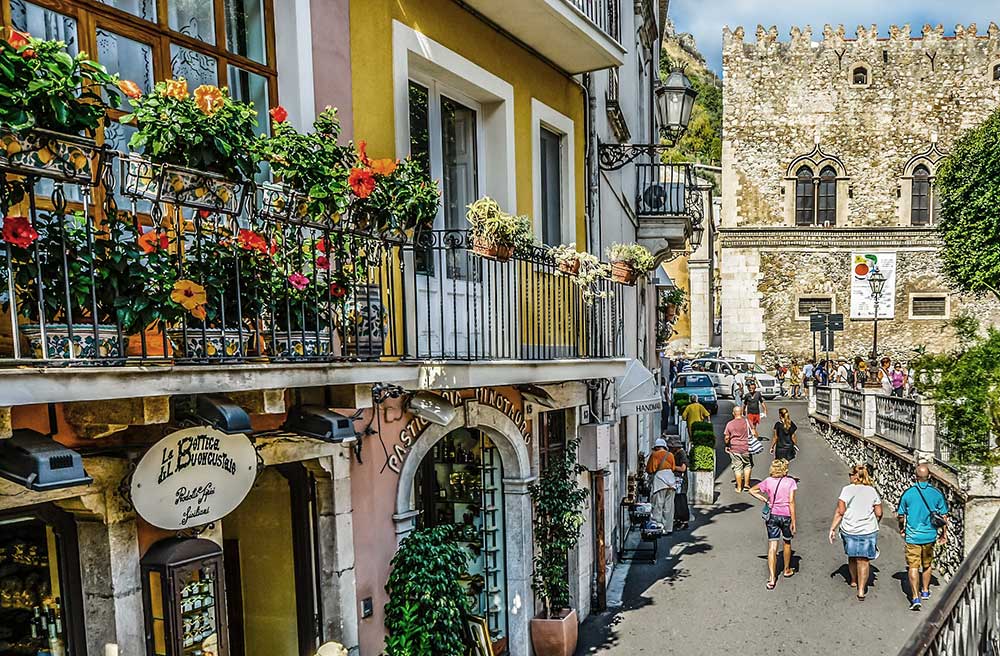
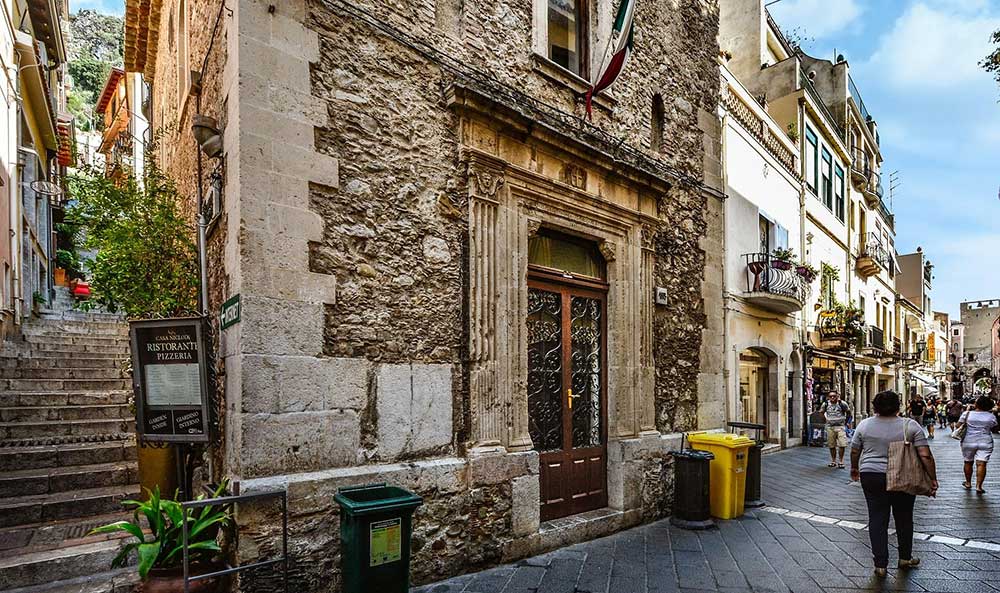
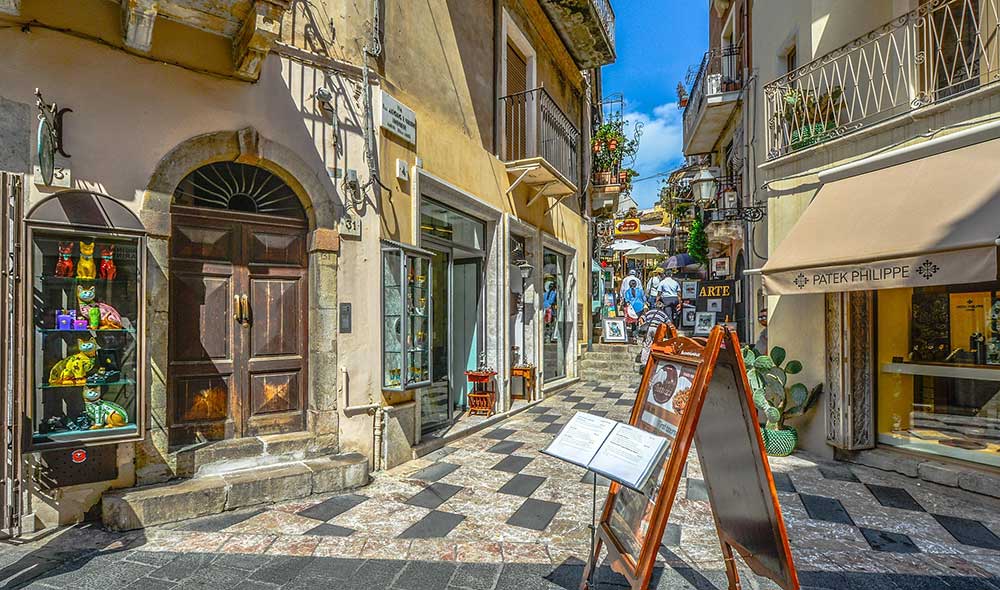
The historic center stretches along Corso Umberto I, a pedestrianized thoroughfare running from Porta Messina in the north to Porta Catania in the south, forming the primary commercial and social axis of Taormina. Medieval buildings line the street, with ground floors housing shops selling ceramics, jewelry, clothing, and local products, alongside cafes, restaurants, and gelato vendors. The corso retains its medieval width and irregular stone paving, accommodating constant foot traffic as visitors and residents move through the town. Evening hours bring increased activity during the traditional passeggiata, when people stroll and gather in a routine display of social interaction. Side alleys branch off into quieter residential areas, revealing the dense urban fabric of stone structures with balconies and arched doorways.
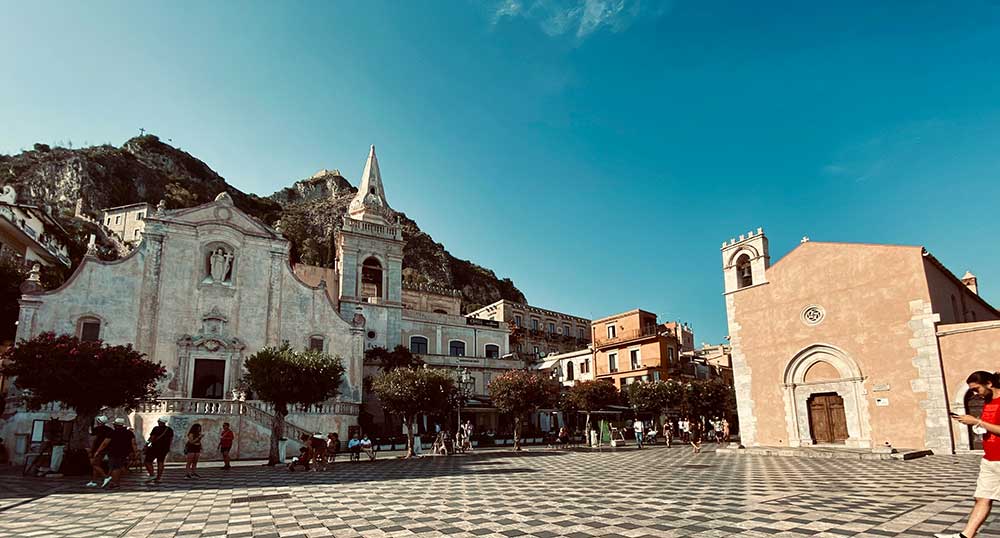
Piazza IX Aprile functions as Taormina's primary gathering point, with a central position along the corso, functioning as a terrace-like square with unobstructed views across the coast toward Mount Etna and the Calabrian mountains. The square features the Church of San Giuseppe and a former convent framing the space alongside cafes with outdoor seating. Checkerboard paving and baroque facades create a composed setting enhanced by the dramatic backdrop, making it a frequent stop for photographs and observation. The Church of San Giuseppe features a double staircase leading to an ornate facade, with a baroque interior containing altars and decorative elements, contributing to the square’s architectural ensemble.
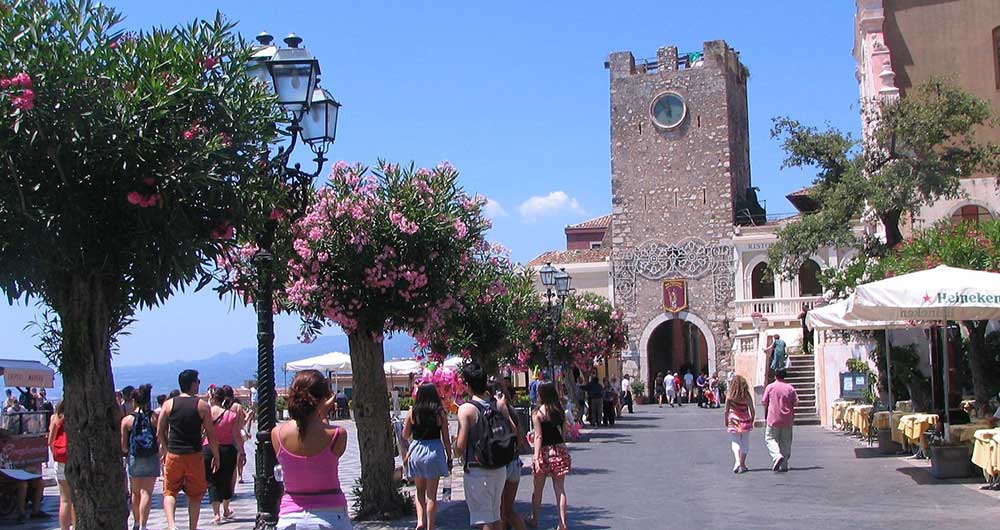
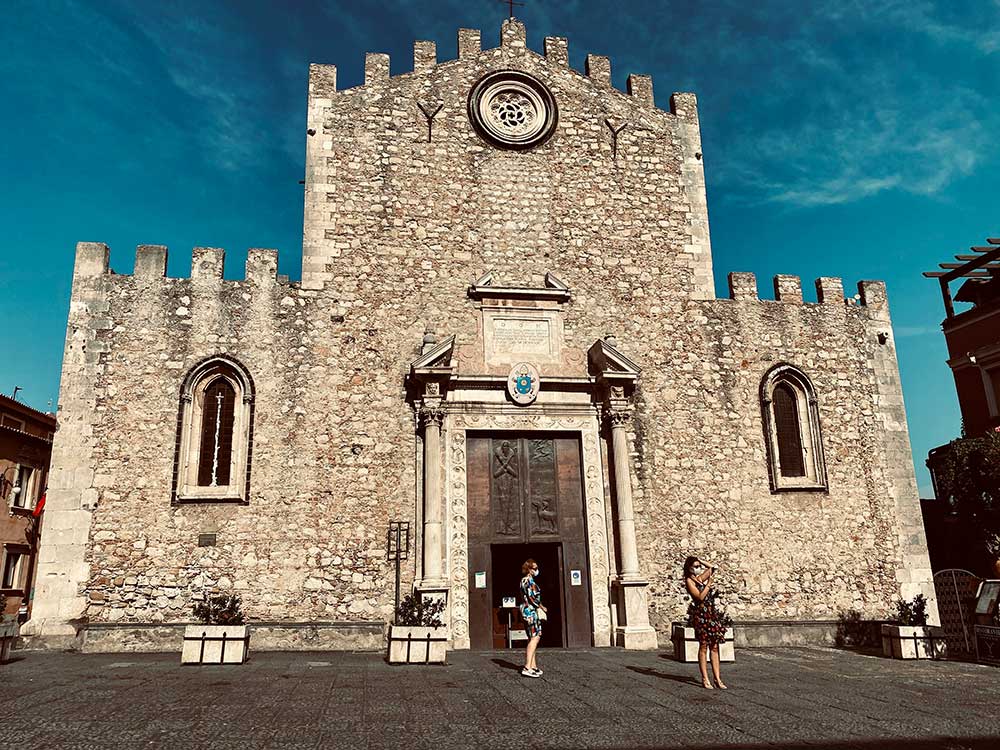
Torre dell’Orologio, a medieval clock tower, stands in Piazza IX Aprile, dividing the corso with a stone arch and clock face rebuilt after destruction in the late seventeenth century. The tower serves as a landmark, with pedestrians passing through to access both sides of the town, integrating the structure into the flow of movement. Piazza Duomo, further along the corso, fronts the Cathedral of San Nicola, a fortified medieval structure with crenelated walls and a simple facade reflecting its dual role as a religious and defensive building. The interior contains baroque altars added during later renovations, and a baroque fountain in the square depicts a centaur, the town’s emblem, with water flowing from a tiered basin, providing decorative interest and a gathering point for cafes.
Piazza Vittorio Ema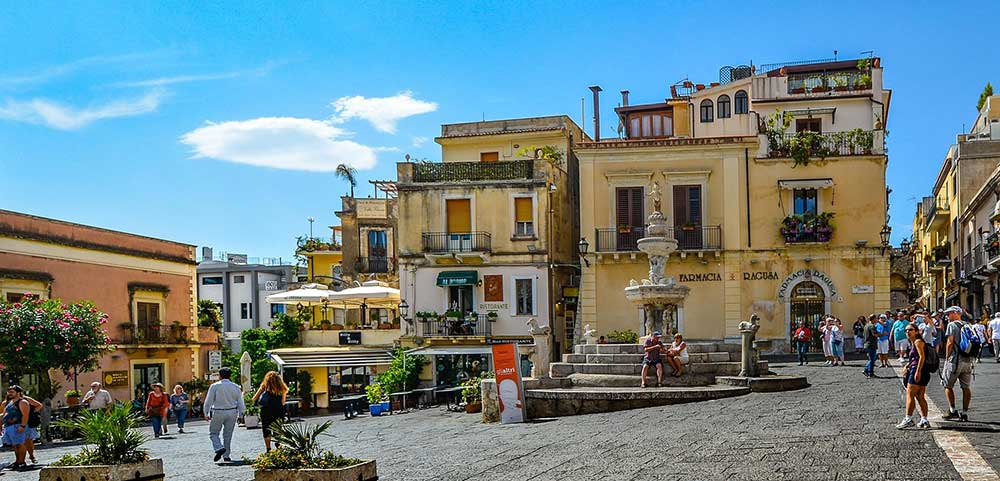 nuele occupies the site of the ancient Roman forum, with archaeological remains beneath revealing the original layout. The square provides open space for events and markets, framed by Palazzo Corvaja and other historic buildings, demonstrating continuity of civic spaces from antiquity. Palazzo Corvaja, near Porta Messina, combines Arab-Norman and Gothic elements with checkered stone patterns and a crenelated tower, having served as a parliamentary seat in medieval times. The palace now houses a museum with artifacts and crafts, with a courtyard offering a quiet retreat from the busy street.
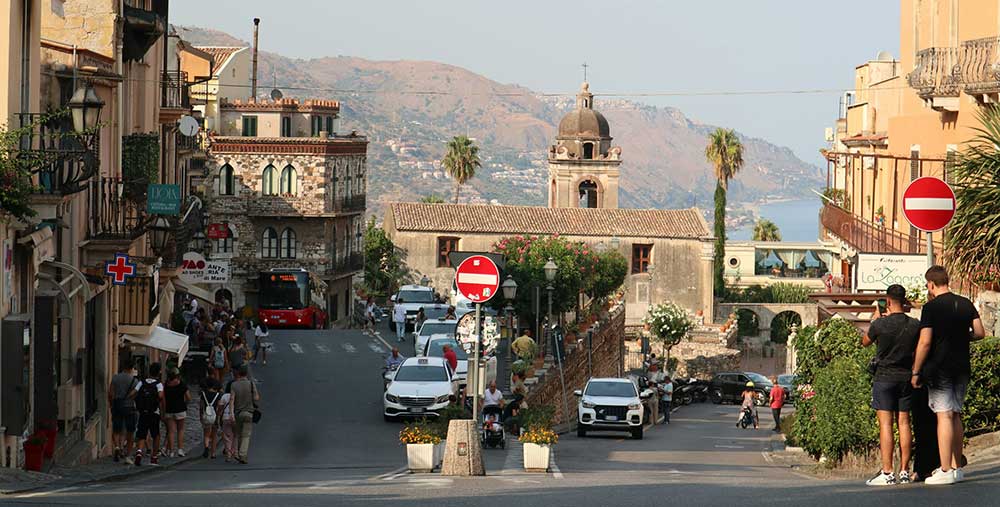
Porta Messina marks the northern entrance through medieval fortification walls, with a stone arch controlling access and showing defensive architecture adapted to the hillside. Porta Catania, at the southern end, serves as the opposite gateway, connecting to paths toward the coast and providing access from southern routes. Both gates integrate into the pedestrian flow, with nearby terraces offering coastal vistas.
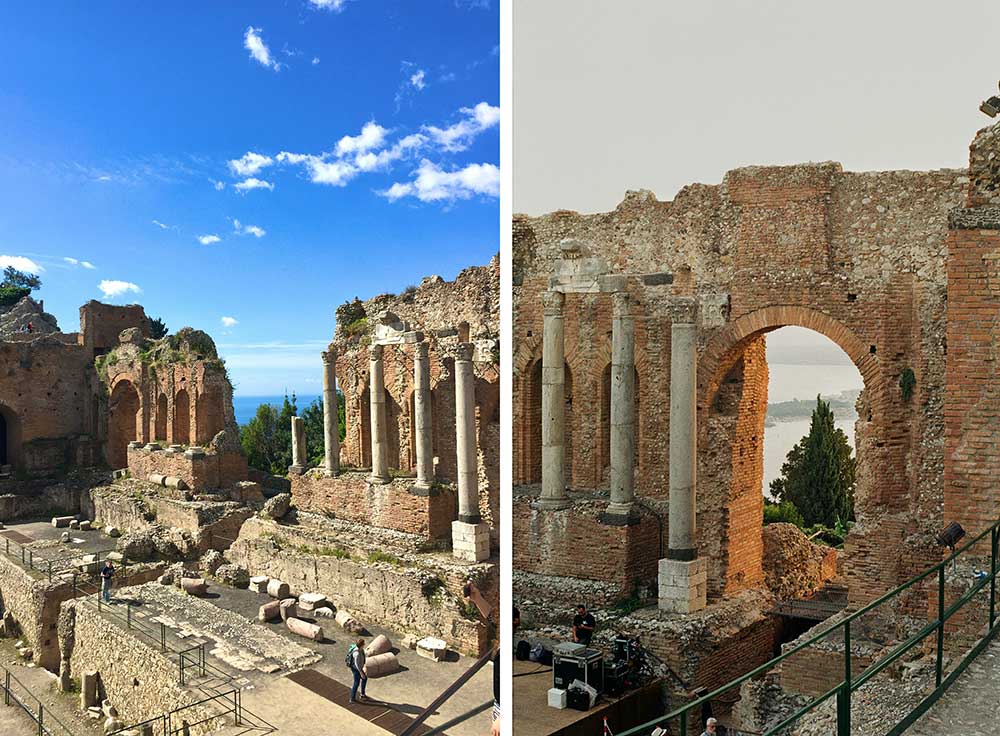
Chiesa di Santa Caterina d’Alessandria, near Piazza Vittorio Emanuele, overlays the Ancient Roman Odeon, with portions of the Roman structure visible beneath and beside the church. The baroque facade and interior contrast with the excavated ruins, illustrating layered construction over centuries. The Odeon, designed for small performances, features a semicircular seating area and stage, indicating intimate cultural events in Roman Taormina. Church of San Pancrazio, built over a Greek temple site, incorporates ancient foundations and walls, showing the transition from pagan to Christian worship in an elevated area near the Greek Theater.
Upper Town: Archaeological and Religious Sites
The upper town, extending uphill from Corso Umberto I, encompasses major ancient monuments and quieter residential areas, with paths leading to elevated viewpoints and historic structures. Via Teatro Greco branches from the main street, leading uphill to the Greek Theater, passing through neighborhoods with hotels and villas amid gardens. The street maintains a residential character, with shops and restaurants near the theater entrance, providing access to Taormina’s most prominent monument.
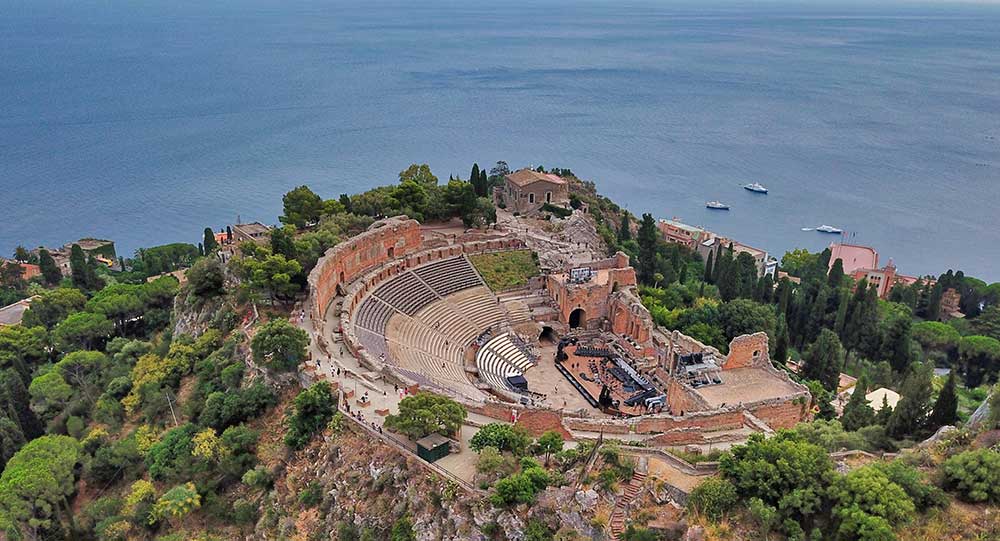
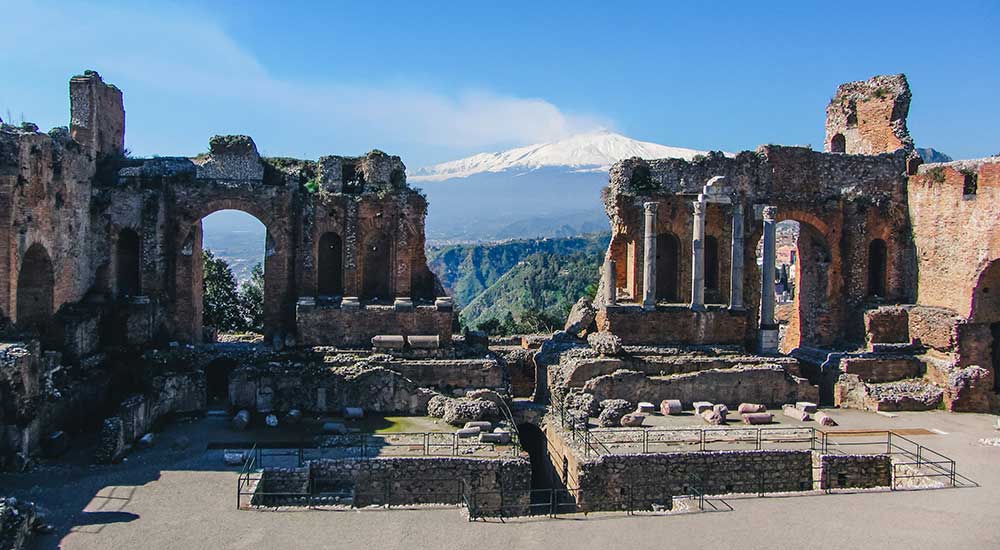
The Greek Theater occupies a hillside position with tiers carved into the slope, framed by Roman columns and arches that open to views of Mount Etna and the Ionian Sea. Originally constructed in Greek times and rebuilt for Roman spectacles, the theater hosts modern concerts and festivals, preserving its performance function. Visitors walk the stone tiers to observe the layout and scenery, combining archaeological exploration with the natural setting.
Roman Infrastructure and Engineering
The Naumachie consists of a Roman-era brick wall structure extending approximately one hundred twenty-two meters along Via Naumachia, showing eighteen arched niches that supported either an aqueduct or possibly retaining walls for a large cistern. The name derives from the Greek word for naval battles though the structure's actual function remains debated among scholars. The massive construction demonstrates Roman engineering capabilities and infrastructure developed to support the town. This wall represents one of Taormina's less-visited Roman monuments, overshadowed by the theater but significant for understanding ancient urban systems and water management projects undertaken during the Roman period.
Santuario Madonna della Rocca, carved into a rock face above the town, features a simple interior and a terrace with views of Taormina and the coast. Accessed via Via Madonna della Rocca, a steep path with steps, the church offers a quiet stop for observation and reflection, integrating spiritual and scenic elements.
Lower Town and Coastal Areas: Beaches and Nature Reserves
The lower town and coastal areas lie below the historic center, connected by the cable car from Via Pirandello, which transports passengers down the steep slope to beaches and waterfront amenities. The cable car provides views during the descent, addressing the elevation difference between the hilltop and sea.
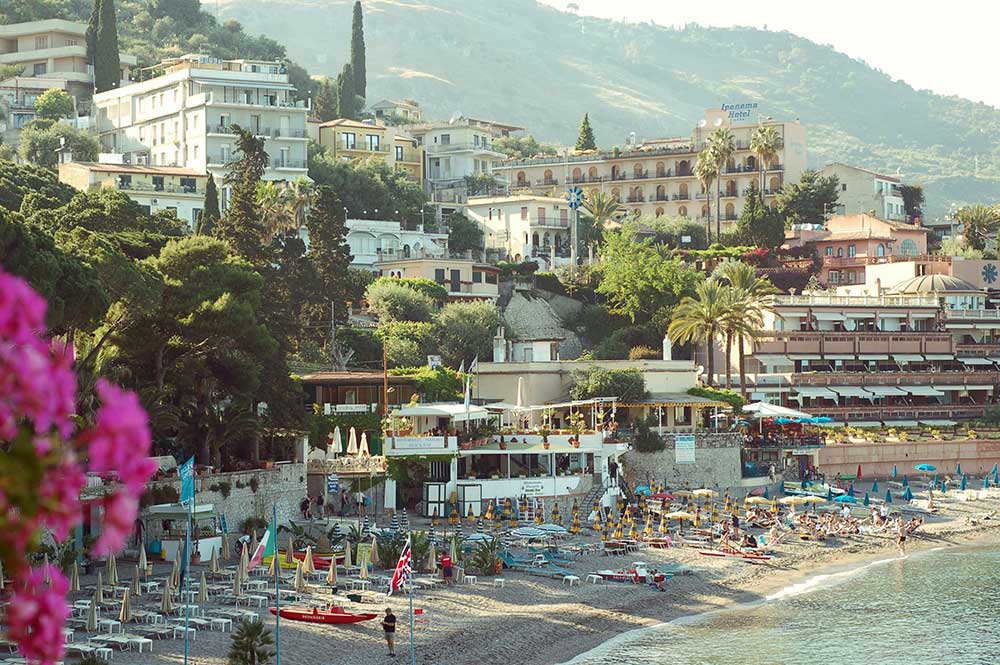
Mazzarò Beach, a pebble shore below Taormina, offers clear waters for swimming and views of the town’s cliffs. Beach clubs rent umbrellas and loungers, with restaurants serving seafood, catering to visitors combining cultural sites with seaside relaxation. Spiaggia di Spisone, nearby, provides similar facilities and coastal vistas, accessible by cable car or road, suitable for swimming and dining.
Isola Bella, a small island reserve connected by a sand isthmus, features Mediterranean vegetation and clear waters for snorkeling, managed as a protected area. A former villa on the island houses a museum, and the setting creates picturesque views with Taormina rising above. The beach and island integrate natural beauty with coastal access, complementing the town’s historic attractions.
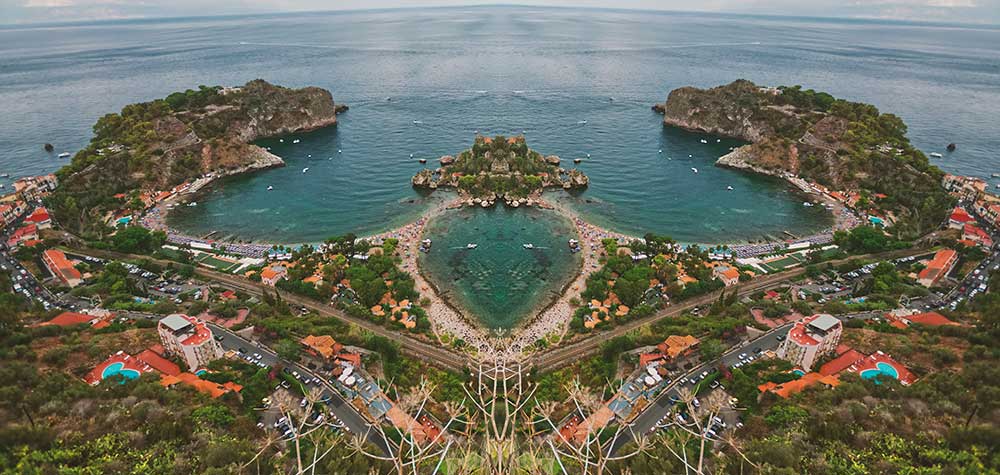
Belvedere di Via Pirandello, along the road to the coast, offers a terrace with benches and views of Isola Bella, the sea, and Etna, serving as a stop for photographs during walks to beaches. The viewpoint integrates into routes connecting the town to waterfront areas.
Public Gardens and Peripheral Sites
Giardino Pubblico, or Villa Comunale, occupies a terraced hillside below Corso Umberto, featuring shaded paths, exotic plants, and Victorian pavilions created by a nineteenth-century resident. The gardens provide relief from the crowded center, with views of the sea and Etna, and benches for rest amid eclectic structures. The space reflects contributions of foreign settlers to Taormina’s development as a resort destination.
Piazza Belvedere, near the gardens, offers unobstructed vistas of Etna and the coast, with a terrace and seating accessible from Corso Umberto or Via Bagnoli Croci. Piazza San Domenico, centered on a former convent now a hotel, provides a quieter square with sea views and benches, connecting to nearby paths.
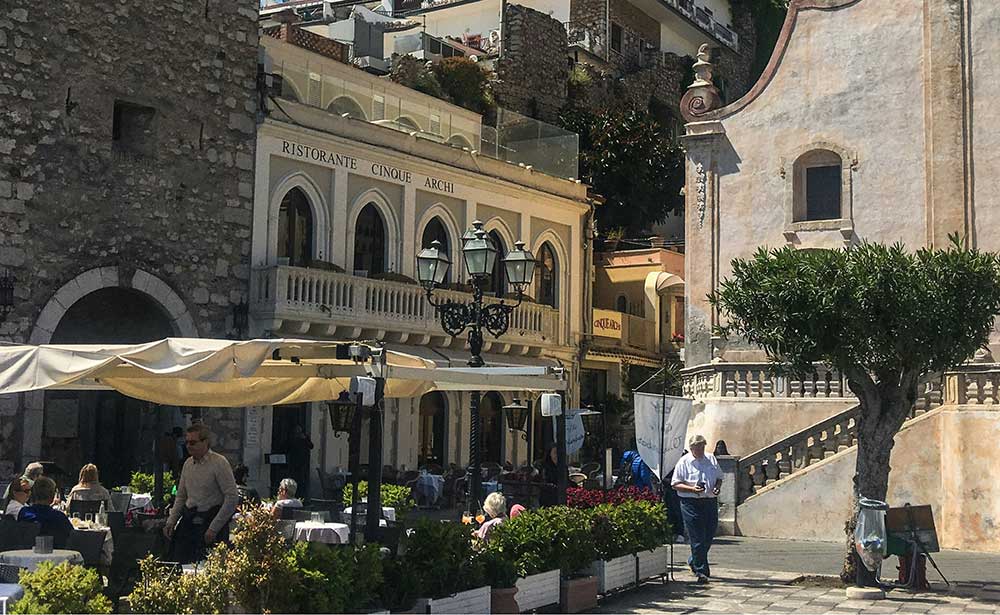
Via Bagnoli Croci runs near the gardens, lined with hotels and villas, offering a less commercial route for pedestrians with coastal scenery and access to viewpoints. The street maintains a residential character, contrasting with the main thoroughfare.
English Cemetery, a small burial ground, contains graves of foreign residents from the nineteenth and early twentieth centuries, documenting Taormina’s history as an expatriate retreat. Headstones reflect the international community drawn to the town’s climate and views, providing a quiet historical site.
Medieval and Gothic Architecture
Badia Vecchia, a medieval tower, features a checkered stone pattern combining volcanic materials, originally used for defense and later religious purposes. The structure, visible across the town, now hosts exhibitions, representing Arab-Norman decorative traditions in secular architecture.
Palazzo Duca di Santo Stefano, a Gothic palace, displays geometric stone patterns and pointed arches, reflecting Arab-Norman influences under Spanish rule. The building, used for cultural events, showcases refined stonework from the late medieval period, contributing to the town’s aristocratic heritage.
Perched high above the coastal town of Taormina, Castelmola is one of Sicily’s most enchanting hilltop villages. The journey to reach it is part of the experience itself, and the view from the top is unforgettable. The ride takes only about 15 to 20 minutes, with each moment offering a new and dramatic view. The bus lurches around hairpin bends, and every turn reveals the Ionian Sea sparkling far below, until the village appears suddenly, a cluster of honey-colored stone houses perched on a limestone crag.

When the bus arrives in Castelmola, it stops at a small square surrounded by quiet cafés and stone buildings. The air is cooler and fresher, and the town feels suspended in time. Narrow cobblestone alleys wind between old stone houses, leading up to the ruins of the medieval Castello di Mola. From there, the panorama stretches across the coastline, with Taormina far below and Mount Etna dominating the horizon. Walk ten minutes and you have crossed the entire village, but no one hurries here. Castelmola’s charm lies in its simplicity.

The main square, Piazza Sant’Antonino, opens like a balcony with a view of the whole east coast of Sicily beyond Taormina’s red roofs. The square is the heart of the village—a perfect place to sit, sip a coffee, and watch the light change across the sea. Nearby, the Chiesa di San Giorgio offers a peaceful glimpse into the village’s history.
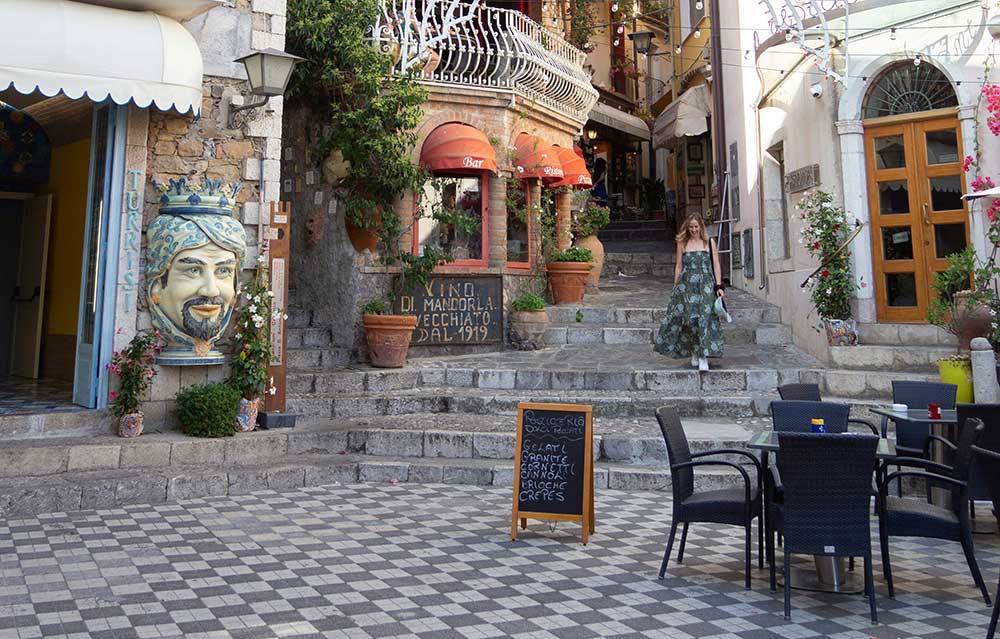
Everyone, eventually, finds Bar Turrisi, an eccentric, art-filled bar with a terrace that overlooks the coast. The wine, the view, and the quiet rhythm of village life come together to create an experience that feels authentically Sicilian. Three floors of carved wooden phalluses grin from every corner, a fountain spurts from a stone member, and the house almond wine arrives in bottles shaped like the family jewels. The drink is cold, sweet, and strong enough to make the ruins blur pleasantly. Also overlooking the square is the historic Caffè S. Giorgio, founded by monks in the 18th century. Moving down Via De Gasperi , the town's main street, you pass by little shops selling lace, embroidery, and souvenirs.

Stay until sunset. Watch Etna catch fire and the sea turn the color of tarnished silver. Somewhere below, Taormina’s hotels switch on their lights one by one, but up here the only glow comes from a single lantern outside the church. Castelmola is ideal for a half-day visit from Taormina, either by bus or on foot along the scenic hillside trail. Whether you come for the views, the history, or simply to sit with a glass of almond wine and breathe in the mountain air, this little village offers a glimpse of Sicily at its most serene and beautiful.
Day Trips: Exploring Beyond Taormina
Organized day trips from Taormina, arranged through local operators or transport, reach regional sites for full-day excursions, often including guided explanations and meals, returning in the evening.
Excursions to Mount Etna involve hikes on volcanic slopes, visiting craters and lava fields, with stops at wineries for tastings. These trips cover geological features and local agriculture, with private options for customized routes, typically lasting a full day.
Tours to Syracuse explore Ortygia’s historic core, the cathedral, and archaeological park, combining baroque architecture with Greek and Roman ruins, often with gastronomic breaks. These outings include transport and guided walks, extending to nearby baroque towns like Noto for additional exploration.
Trips to Alcantara Gorge feature river canyons formed by lava, with paths for viewing and wading in waters, suitable for nature enthusiasts. The excursions include transfers and time for observation, often paired with Etna visits.
Visits to Castelmola, a hilltop village above Taormina, involve walks through the historic center and castle ruins, with cafes serving local specialties. Accessible by road or footpath, these trips offer elevated views and a quieter contrast to Taormina.
Tours to Catania cover the city’s baroque center, fish market, and cathedral, with options for street food tastings. These outings provide urban exploration, contrasting with Taormina’s hilltop setting.
Excursions to Savoca and Forza d’Agrò visit hilltop villages with medieval streets and churches, often linked to cultural references, including guided walks and local dining.
Boat tours along the Ionian coast explore coves, sea caves, and Isola Bella from the water, with opportunities for swimming and snorkeling, emphasizing coastal scenery and marine life.
These day trips complement Taormina’s urban and coastal attractions, providing access to Sicily’s volcanic landscapes, baroque heritage, and maritime features within a short distance.
Ancient Theater of Taormina (Teatro Antico); Via del Teatro Greco, 1; Sitting on the upper steps of this stunning Greek-Roman theater provides one of the world's most iconic views, perfectly framing the Ionian Sea, the coastline, and the magnificent Mount Etna
Bar & Chiostro; San Domenico Palace A Four Seasons Hotel; This focal point bar offers aperitifs and after-dinner drinks with handcrafted cocktails and fine Sicilian wines paired with gourmet small plates inspired by local flavors, featuring breathtaking views of the sea in a serene ambiance perfect for unwinding as the sun sets over Taormina
Bar Timeo; Via Teatro Greco 59; An elegant bar at the Belmond Grand Hotel Timeo, renowned for classic cocktails and breathtaking vistas of Mount Etna and the Bay of Taormina
Belvedere di Via Pirandello; Via Luigi Pirandello; A popular roadside lookout point that provides the classic, sweeping view of the iconic Isola Bella islet, the curved coastline, and the town of Taormina perched above
Blue Sky Bar; Vico Ebrei, 2a; Located on a terrace at Palazzo Vecchio Taormina adorned with Gothic-Catalan crenellation, this exclusive bar provides iconic views of the sea and Mount Etna, creating a very romantic setting for an evening cocktail
Euphoria Restaurant; Hotel Villa Carlotta; This rooftop panoramic restaurant offers spectacular sea and Mount Etna views while serving à la carte meals in an elegant ambience, combining relaxed yet sophisticated all-day dining with amazing Sicilian food and wines in a warm Mediterranean atmosphere featuring a color palette of green, fuchsia and cream
Hotel Villa Paradiso Al Settimo Cielo Rooftop; Central Taormina; This rooftop offers one of the most enchanting views of Taormina with vistas from the Greek Theatre to Duca di Cesarò Park, from the Bay of Naxos to Mount Etna rising majestically, serving rich breakfast offerings and excellent cocktails expertly prepared by barman Giuseppe accompanied by tasty daily snacks during splendid sunsets
NH Collection Taormina Rooftop; Heart of Taormina near main attractions; This hotel features a rooftop bar with incredible views of the city, offering poolside service with outdoor swimming pool and bar area where guests can enjoy cocktails and Mediterranean atmosphere with professional staff providing recommendations and reservations
Piazza IX Aprile Belvedere; Piazza IX Aprile; This beautiful checkered public square acts as a natural balcony, offering a famous and easily accessible panoramic vista over the coastline, the Bay of Giardini Naxos, and Mount Etna
Principe Cerami; San Domenico Palace A Four Seasons Hotel; This Michelin-starred restaurant within San Domenico Palace offers views of the Bay of Taormina where Executive Chef Massimo Mantarro reinvents Sicilian cuisine with seasonal ingredients and reimagined traditional flavors paired with a wine list of more than 1000 labels by Head Sommelier Alessandro Malfitana
Rooftop Bar at Hotel Villa Taormina; Via Tommaso Fazzello 39; Found in the heart of Taormina, this charming boutique hotel features a lush Mediterranean Garden with solarium, Jacuzzi, sunset corner and rooftop lounge bar offering breathtaking views stretching from Mount Etna to the crystal-clear waters of the Ionian Sea, serving carefully mixed cocktails prepared by knowledgeable barman with selections from fine Villa Taormina wine list open to external guests every evening
Rosso; San Domenico Palace A Four Seasons Hotel; This newest Italian restaurant in Taormina offers views of Mount Etna and Taormina Bay where traditions from north to south Italy meet modern elegance, serving refined dining with seasonal Italian cuisine made from locally sourced ingredients celebrating Italy's rich culinary heritage
Sky Rooftop Bar & Restaurant; Via Tommaso Fazzello 45 Hotel Continental near Corso Umberto and Duomo Square; This spacious sun-drenched terrace on top of Hotel Continental offers unique panoramic views across the Bay of Naxos, Mount Etna and Castelmola, featuring comfortable lounge sofas, front row dining tables and sleek bar serving locally sourced Sicilian food and refreshing cocktails in a garden-like intimate atmosphere especially magical during sunset hour
Taodomus Rooftop Bar; Corso Umberto 224 Hotel Taodomus; Nestled on the top floor of the intimate and charming Hotel Taodomus in the center of Taormina, this lush Mediterranean roof garden is surrounded by amazing views over both the Bay of Naxos and Mount Etna, serving exquisite vegetarian breakfast from 8am to 10am and transforming into a stylish crafted cocktail bar for sunset aperitifs and romantic after-dinner drinks open by reservation to all guests
The previous information is very detailed, so here we provide a shorter summary of the top-20 sights to see, in a Google My Map, followed by a list of those places with brief descriptions.
Ancient Roman Odeon (Via Teatro Greco, 1): This small Roman theater dating from the 2nd century AD was discovered beneath later buildings and shows a structure designed for musical performances and poetry readings rather than large dramatic productions. The semicircular seating area and small stage indicate intimate performance scale. The odeon demonstrates that ancient Taormina possessed multiple performance venues serving different cultural functions. The structure's burial under later construction and eventual rediscovery illustrates the archaeological layering characteristic of long-occupied sites. The odeon provides evidence of Roman cultural life and entertainment practices in this hilltop town. The monument represents the smaller-scale ancient structures often overshadowed by the larger Greek Theater.
Castello di Taormina (Castello di Taormina): Perched on Monte Tauro above the town, these are the ruins of a medieval castle, accessible via a strenuous hike. It provides the highest and most expansive panoramic views of the area. These 9th-century Arab ruins crown Taormina with 360-degree views of coast and volcano. Hike steep trails to Byzantine cisterns and Norman remnants, a rewarding summit for history and sweeping Ionian sunsets.
Castelmola: A hilltop village above Taormina offering breathtaking views, medieval charm and sweet almond wine in traditional bars. Hilltop village of stone alleys and panoramic bars, crowned by a Norman castle ruin overlooking Etna. It offers hikes, ancient gates, and village feasts, a fairy-tale detour from Taormina's crowds into rustic Sicilian charm. The medieval village perches above Taormina at 550 meters elevation, reached by road or hiking path. The ruined castle crowns the hilltop with vertiginous views across the coast, Mount Etna, and surrounding mountains. The tiny village maintains authentic character with narrow alleys. The dramatic position and quieter atmosphere contrast with busy Taormina below.
Cattedrale di San Nicola: The medieval cathedral’s fortress-like façade and Baroque fountain mark the spiritual and architectural heart of Taormina.
Corso Umberto I: The main pedestrian street traverses Taormina's historic center from Porta Messina to Porta Catania, connecting its two main gates. Medieval buildings house shops, cafes, restaurants, and churches along the traffic-free corso. Piazza IX Aprile provides a scenic terrace midway along the route. The elegant pedestrian avenue maintains atmosphere despite tourist crowds, offering shopping, dining, and architectural interest within the compact medieval town. Buzzing with gelaterias and jewelers, it's a glamorous promenade for sunset strolls and people-watching in cliffside elegance.
Duomo di Taormina (Piazza Duomo, 13): 13th-century cathedral with a Gothic portal and Baroque portal, guarding a Norman relic basin. Flanked by a Renaissance fountain, its simple facade belies medieval frescoes, anchoring Taormina's spiritual heart in citrus-scented piazzas.
Giardini della Villa Comunale (Via Bagnoli Croce): The English-style public gardens created by Lady Florence Trevelyan in the late 1800s contain exotic plants, flowers, and whimsical Victorian follies. The terraced gardens provide panoramic views across the coastline and Mount Etna. Stone structures include bird houses and pavilions dotting the landscaped grounds. The peaceful gardens offer respite from tourist activity with shaded paths through botanical collections.
Isola Bella: The small island connected to the beach by a narrow sandy path becomes isolated at high tide. The nature reserve protects Mediterranean vegetation and clear waters ideal for swimming and snorkeling. The pebbly beach below Taormina offers cable car access from town, or path, lures with azure coves and pine groves.. The island's dramatic setting between steep cliffs and azure water makes it Taormina's most photographed natural feature.
Madonna della Rocca (Via Cappuccini): The small church carved into rock above town provides panoramic views after climbing from Via Circonvallazione. The sanctuary sits at 398 meters with the medieval castle ruins above. The church interior incorporates natural rock formations creating an intimate spiritual space. The strenuous climb rewards with comprehensive views of Taormina, the theater, coastline, and Mount Etna from an elevated perspective.
Naumachia Ruins: Roman-era brick walls believed to have hosted water spectacles now provide a quiet backdrop for cafés and gardens.
Palazzo Corvaja (Piazza Santa Caterina): An elegant medieval palace, noted for its mix of Arab, Norman, and Catalan-Gothic architectural elements, with an elegant courtyard and exterior staircase.. It formerly housed the Sicilian Parliament and is now home to the Sicilian Museum of Art and Folk Traditions. This10th-century Saracen tower fused with 15th-century Gothic halls, once Sicily's noble parliament seat. Its triple-arched windows and frescoed rooms evoke medieval intrigue in Taormina's historic core. The building now houses the tourist office and museum displaying archaeological finds and Sicilian cart decorations. The structure dates from the 10th century with additions through the 15th century, representing Taormina's historical importance as an administrative and cultural center.
Piazza Duomo (Piazza Duomo): A charming square featuring the Duomo, a 13th-century fortress-style cathedral. The fountain at its center showcases a centaur with a woman's torso, the symbolic emblem of Taormina.
Piazza IX Aprile (Piazza IX Aprile): The scenic square along Corso Umberto serves as Taormina's outdoor living room with cafe terraces enjoying views of the bay and Mount Etna. The piazza features the baroque San Giuseppe church and distinctive clock tower. The terrace location provides sunset gatherings and people-watching opportunities. The square marks the center of town along Corso Umberto, creating natural gathering space within medieval walls.A panoramic terrace square where sweeping sea views create Taormina’s most enchanting atmosphere.
Porta Messina (Largo Giove Serapide): The northern gate marks the main entrance to Taormina's historic center, leading to Corso Umberto I. The medieval gate replaced earlier Greek and Roman entrances, maintaining its defensive function through centuries. The area around the gate includes remains of ancient walls and the small church of San Pancrazio built over a Greek temple foundation, showing architectural continuity.
Porta Catania: Medieval gate marking the ancient entrance of the town, framing its historic Corso Umberto.
Teatro Greco (Via del Teatro Greco): A spectacular ancient Greco-Roman theater carved into the hillside, famous worldwide for its breathtaking view of the Ionian Sea, the coastline, and the smoking cone of Mount Etna. Sicily's best-preserved Greek amphitheater from 3rd century BC perches on a cliff with Etna and sea vistas, seating 5,400 spectators.. Carved into rock, it hosted tragedies and now operas, its horseshoe tiers framing nature's drama in eternal acoustics. Later modified by Romans, it provides the most spectacular setting of any classical theater with Mount Etna and the coast visible beyond the stage.
The Odeon (Via Teatro Greco): A small, well-preserved Roman Odeon, or small theater, dating back to the Imperial Age, situated near the Palazzo Corvaja. It was likely used for intimate musical performances or minor public gatherings.
Torre dell’Orologio (Piazza IX Aprile, 1): This 12th-century clock tower in Piazza IX Aprile divides Corso Umberto. Rebuilt after 1679, it features a stone arch and clock face. Visitors pass through to access both sides of the town, noting its role as a historic landmark. The tower’s central location makes it a focal point for navigation, with its medieval origins adding historical depth.
Via degli Artisti: An alley alive with art galleries and crafts, reflecting the creative and bohemian soul of Taormina.
Villa Comunale: English-style gardens filled with sculptures, tropical plants and sea views — a serene oasis below the bustling centre. Also known as the Public Gardens, these beautiful, lush municipal gardens were once the property of an eccentric English noblewoman. They feature unique Victorian-style follies and stunning Mediterranean views. The gardens cascade down slopes with exotic blooms, pavilions, and sea-gazing benches. Bustling with locals and cats, it's a serene escape for picnics, shaded paths, and Etna panoramas amid manicured tranquility.