
Travelers making the journey between Syracuse and Palermo or Catania by bus face a six-hour route across the Sicilian interior. Enna provides a practical midpoint for dividing this trip into manageable segments. Enna is not your typical tourist town, but instead offers a look at an authentic Sicilian slice of life.

The city sits at 931 meters elevation on a steep plateau in the center of the island, roughly equidistant from both coastal destinations. Buses arrive at the lower modern town, Enna Bassa, where connections continue to the historic center, Enna Alta, perched dramatically above.
The position of Enna Alta has shaped its development since ancient times. The settlement occupies a narrow limestone ridge that extends east to west, with precipitous drops on all sides. This defensible location attracted successive civilizations, from the Sikels who established an early center here, through Greek, Roman, and Byzantine periods, to medieval Norman and Aragonese rule. The compact medieval core remains largely intact, compressed along the ridge and spilling down the northern slope in layers of stone construction.
.jpg)
Adjacent to Piazza Vittorio Emanuele, Piazza Francesco Crispi forms an elegant pedestrian space with views extending across the surrounding countryside. The square features a historic fountain incorporating a bronze reproduction of Bernini's sculpture depicting the myth of Persephone, appropriate given Enna's ancient association with this goddess. The myth places the abduction of Persephone by Hades at nearby Lake Pergusa, visible from various points in the city.
.jpg)
The Quartiere Fundrisi occupies the steep northern slope below the main ridge and contains some of the oldest residential architecture in the city. Streets here often take the form of stone staircases rather than paved roads, descending in stages between houses built directly into the rock face. The layered construction creates a distinctive appearance when viewed from the valley below. This neighborhood experiences less tourist traffic than the central areas and shows evidence of the population decline affecting many Italian historic centers, with some houses standing vacant or in need of repair.
Via Mercato winds through residential sections of the old town, maintaining much of its medieval character. The narrow street passes beneath balconies and through sections where buildings nearly meet overhead. Stone doorways and window frames display centuries of weathering, and the minimal modern intervention preserves an authentic sense of the historical urban environment.
.jpg)
The Cathedral Quarter and Central Ridge
The eastern section of Enna Alta contains the city's religious and civic center. The Duomo di Enna anchors Piazza Vittorio Emanuele, an irregular open space that functions as the main gathering point for residents. The cathedral itself dates from the fourteenth century, though its present appearance reflects extensive Baroque remodeling in the sixteenth and seventeenth centuries. The facade displays a distinctive three-part design with columns and statuary. Inside, the nave extends through three aisles with painted wooden ceilings and side chapels containing altarpieces from the Renaissance and Baroque periods. The Torre Campanaria, the cathedral's bell tower, stands separately and rises approximately thirty meters. Visitors can climb the tower for elevated perspectives over the old town's terracotta rooftops.
.jpg)
The Museo Alessi occupies buildings adjacent to the cathedral and houses religious art collected from churches throughout the diocese. The collection includes vestments, liturgical metalwork, chalices, and processional items spanning several centuries. A numismatic collection contains coins from Greek and Roman periods excavated from sites around Enna. The museum provides context for understanding the religious traditions that have shaped the city.
Western Heights and Fortifications
The western end of the ridge rises to the Castello di Lombardia, a medieval fortress complex that occupies the highest point of Enna Alta. Via Lombardia ascends toward the castle, offering increasingly expansive views during the climb. The castle dates primarily from the Norman period in the twelfth and thirteenth centuries, though it incorporates foundations from earlier fortifications. Six towers remain of an original twenty, connected by walls that enclose several courtyards at different levels. The castle grounds are open to the public and provide unobstructed panoramas across central Sicily. From the uppermost courtyard, Mount Etna appears on the eastern horizon when atmospheric conditions permit, while the Madonie and Nebrodi mountain ranges extend to the north.
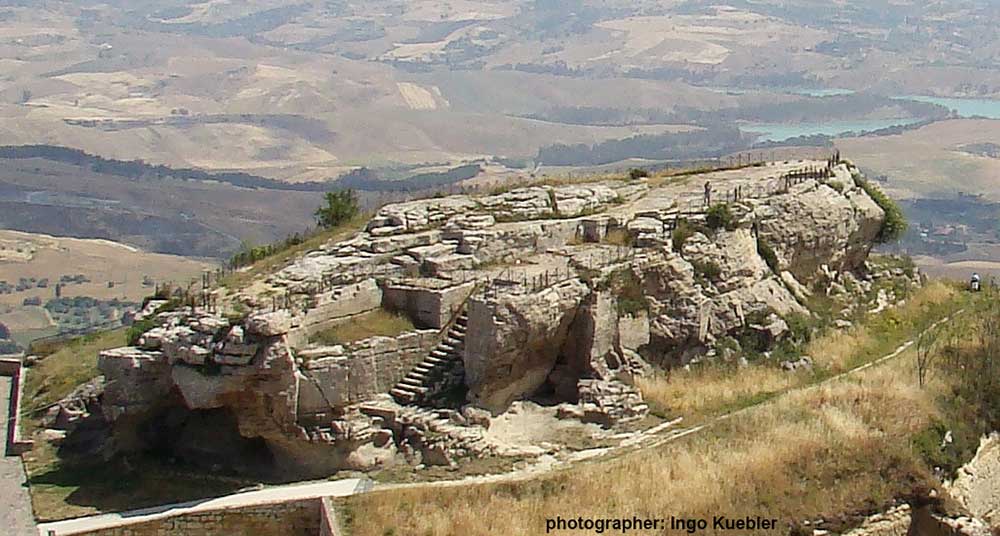
Beyond the castle, the path continues to the Rocca di Cerere, the rocky outcrop at the western extremity of the ridge. This site held the ancient Temple of Demeter, goddess of agriculture and grain, though no visible remains of the temple survive. The position offers another perspective on the surrounding landscape, with valleys extending in multiple directions and the town of Calascibetta visible across a ravine to the north.
.jpg)
Viewing Points and Public Spaces
Several belvederes provide designated viewing points around the perimeter of Enna Alta. The Belvedere Marconi occupies the northern edge, accessible by a short walk from the main streets. This terrace includes benches and a small garden area, making it a rest point during walking tours. Views extend across the valley toward mountains in the distance. The Belvedere Torre di Federico, near the remains of an octagonal tower dating from the Swabian period, gives a more elevated perspective from a different angle.
Piazza Garibaldi serves as another focal point in the civic life of Enna Alta, flanked by the Palazzo di Città, which houses municipal offices, and the Church of San Rocco. The square hosts markets and public gatherings, and the surrounding streets contain additional shops and services. Piazza Napoleone Colajanni offers a wider open space with benches and some greenery, providing a pause point away from the more commercial areas.
.jpg)
The Church of San Cataldo sits on a small piazza of the same name in a quieter section of the old town. Dating from the fifteenth century, the church contains frescoes and altarpieces from the Renaissance period, though many show deterioration. The piazza functions as a neighborhood gathering space removed from the main tourist routes.
Practical Considerations and Regional Excursions
Enna functions primarily as a base for exploring central Sicily rather than as a destination with extensive attractions of its own. The compact size of Enna Alta allows visitors to cover the main sights within several hours of walking. The elevation provides relief from summer heat that affects coastal areas, though winter brings colder temperatures and occasional snow.
.jpg)
Organized day trips from Enna reach several significant sites in the surrounding region. The Villa Romana del Casale near Piazza Armerina, approximately thirty kilometers south, contains the most extensive and well-preserved collection of Roman mosaics in Sicily. The villa complex covers multiple rooms with detailed floor mosaics depicting mythological scenes, hunting expeditions, and daily life from the fourth century. The site requires several hours for a thorough visit.
Accommodations in Enna Alta range from small hotels converted from historic buildings to more standard modern establishments. Restaurants serve traditional Sicilian cuisine with an emphasis on inland preparations rather than seafood, including pasta dishes, grilled meats, and preparations using local legumes and vegetables. The evening passeggiata, the traditional stroll along Via Roma and through the main piazzas, provides an opportunity to observe local life away from more tourist-oriented coastal cities.
.jpg)
Bus services connect Siracusa to Enna, with journeys lasting between three and four hours, operated by companies such as Interbus and SAIS Autolinee, often requiring a transfer at Catania. From Enna, buses continue to Palermo in approximately one hour and forty-five minutes to two hours, with departures available multiple times daily through SAIS Autolinee. This arrangement allows travelers to divide what could otherwise be a direct trip of over three hours into segments, incorporating time to explore the city before proceeding. Accommodations in Enna include hotels and guesthouses in the historic upper district, facilitating access for those arriving by public transport.
This interactive Google My Map shows locations of attractions with information that can be displayed by clicking on the symbols. It has a sidebar index and displays best in full-frame by clicking the box in top-right. You are welcome to make a copy as described here. There are many hotels listed in the map with contact information. My hotel choice is Hotel Sicilia.
