Palermo occupies the northwest coast of Sicily where mountains meet the Mediterranean, creating a natural amphitheater that has sheltered human settlement for millennia. The city's current form reflects successive waves of conquest and cultural influence, from Phoenician traders through Greek colonists, Roman administrators, Byzantine officials, Arab emirs, Norman kings, Spanish viceroys, and eventually Italian unification. Each ruling power left architectural and cultural deposits that accumulated rather than replaced what came before, producing the complex urban fabric visible today.
This interactive Google My Map shows locations of attractions mentioned in this story, with information that can be displayed by clicking on the symbols. It has a sidebar index and displays best in full-frame by clicking the box in top-right. You are welcome to make a copy as described here. The map can be used in your mobile phone or tablet, very useful to help navigate while visiting a city.
There are many hotels and restaurants listed with contact information. My hotel choice is Eurostars Centrale Palace.
The Official Tourist Information website has a large amount of information about the city and surroundings, including sights, accomodations, dining, tours, scenic routes, free brochures, maps and more.
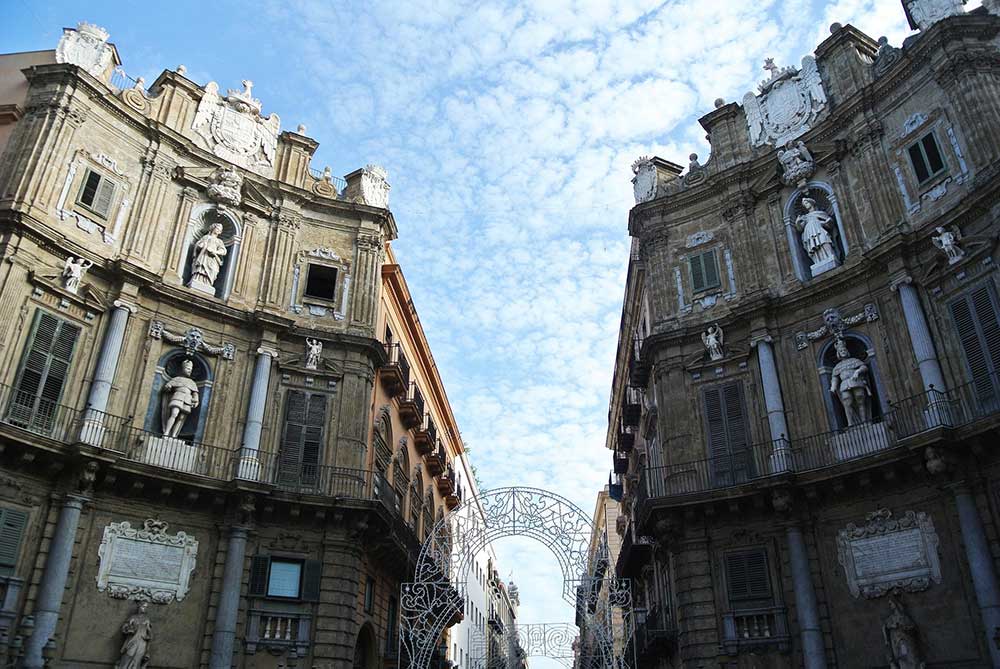
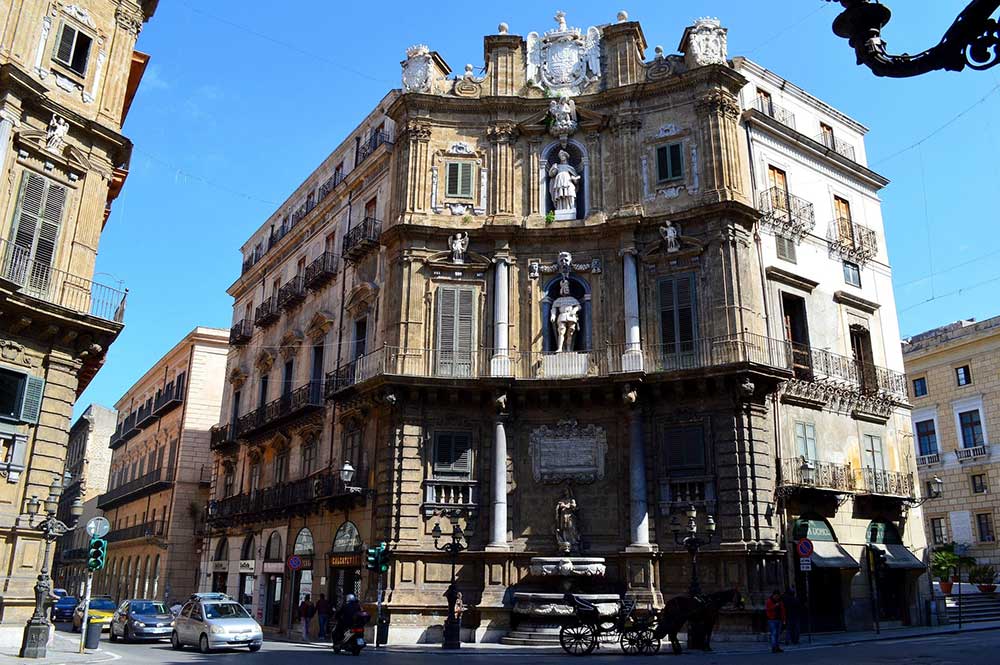
The historic center divides roughly into four quarters, defined by the intersection of two principal streets at Quattro Canti. This baroque intersection created in the early seventeenth century imposes geometric order on the medieval street pattern, with curved building facades at each corner featuring three tiers of decoration including fountains and statues representing seasons, Spanish kings, and patron saints. The architectural ensemble creates an octagonal space where Via Maqueda crosses Corso Vittorio Emanuele, serving as both a navigational reference point and a symbolic heart of the baroque city. From this central intersection, the city's major monuments and neighborhoods extend in all directions.
Central Historic District
The area immediately surrounding Quattro Canti contains the highest concentration of baroque religious architecture. The Church of San Giuseppe dei Teatini facing the intersection displays extraordinary interior decoration including marble inlay, frescoes, stucco work, and architectural elements creating an overwhelming visual effect. Every surface receives decorative treatment with polychrome marble covering walls and floors. The church served the Theatine order and demonstrates resources devoted to religious architecture during the Counter-Reformation.
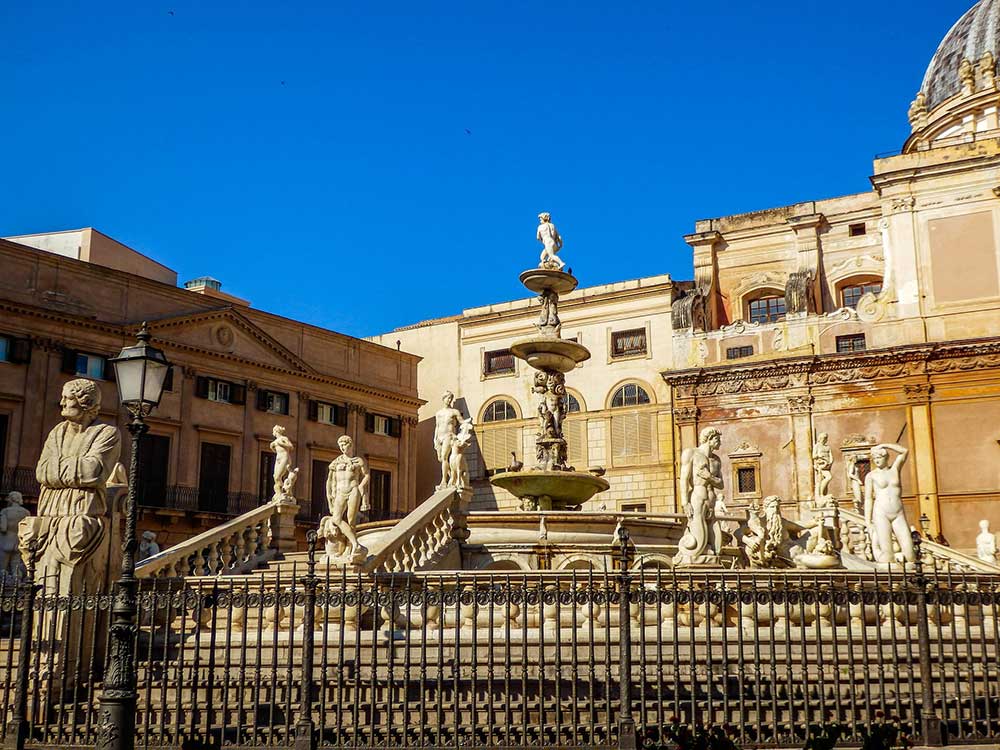
Piazza Pretoria lies adjacent to Quattro Canti, containing the Fountain of Shame, a sixteenth-century Mannerist fountain originally designed for a Florentine villa and relocated to Palermo. The multi-tiered structure displays numerous nude statues representing mythological figures, river gods, and animals arranged around cascading water basins. The fountain's nudity scandalized some residents when installed, leading to its popular name. The Palazzo Pretorio serving as city hall frames one side of the square while baroque churches occupy other sides.
Nearby stands Piazza Bellini, containing both the Martorana Church and the Church of San Cataldo. The Martorana, founded in the twelfth century, contains exceptional Byzantine mosaics including an image of Roger II receiving his crown from Christ, demonstrating the political theology of Norman kingship. The original square plan with dome and mosaics represents Greek Orthodox tradition, reflecting diverse religious communities in Norman Palermo. Baroque additions altered the building's exterior and added side chapels, creating contrast between medieval mosaics and later decoration.
Commercial Streets and Daily Life
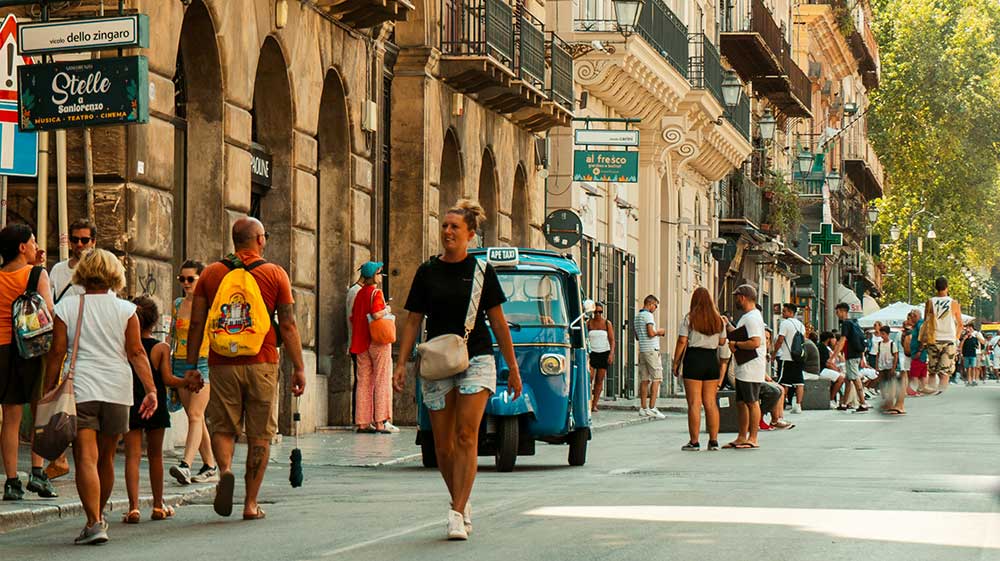
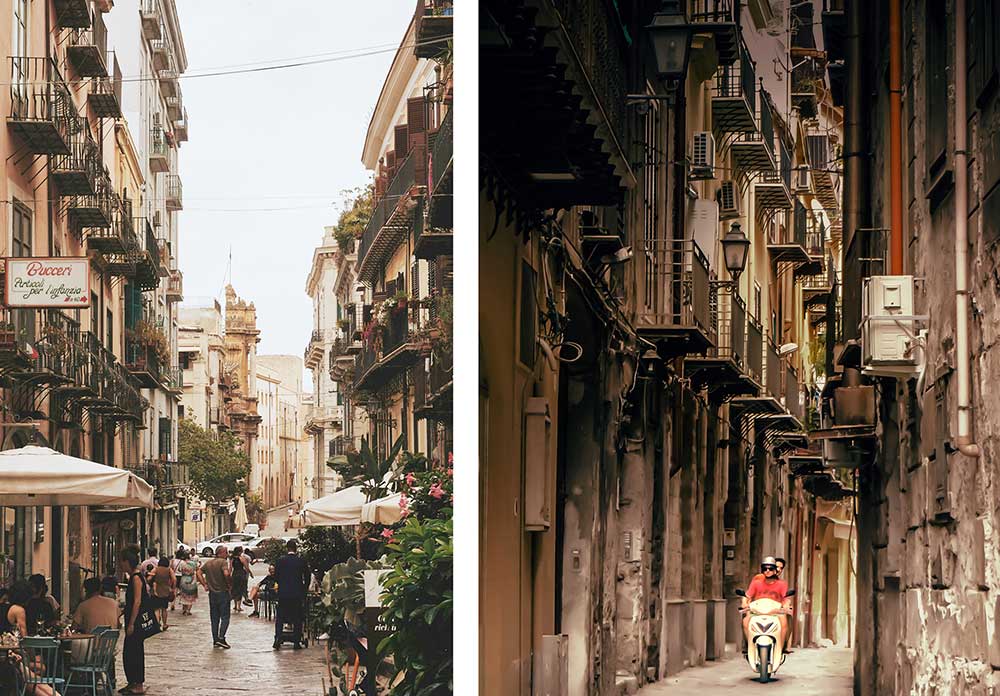
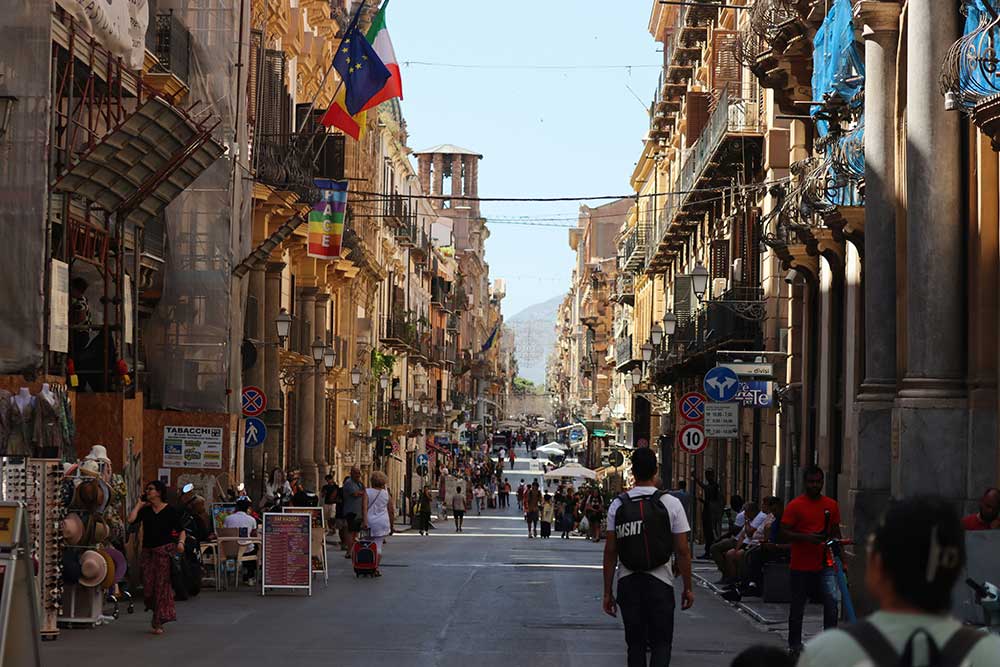
Via Maqueda runs north-south through the historic center connecting the train station area with northern quarters, serving as a primary commercial and pedestrian thoroughfare. The street passes through Quattro Canti and continues past churches, palaces, and commercial buildings representing various architectural periods. Shops, cafes, and restaurants occupy ground floors while upper stories contain residences and offices. The via experiences constant pedestrian traffic throughout the day as locals and visitors move between different parts of the city center.
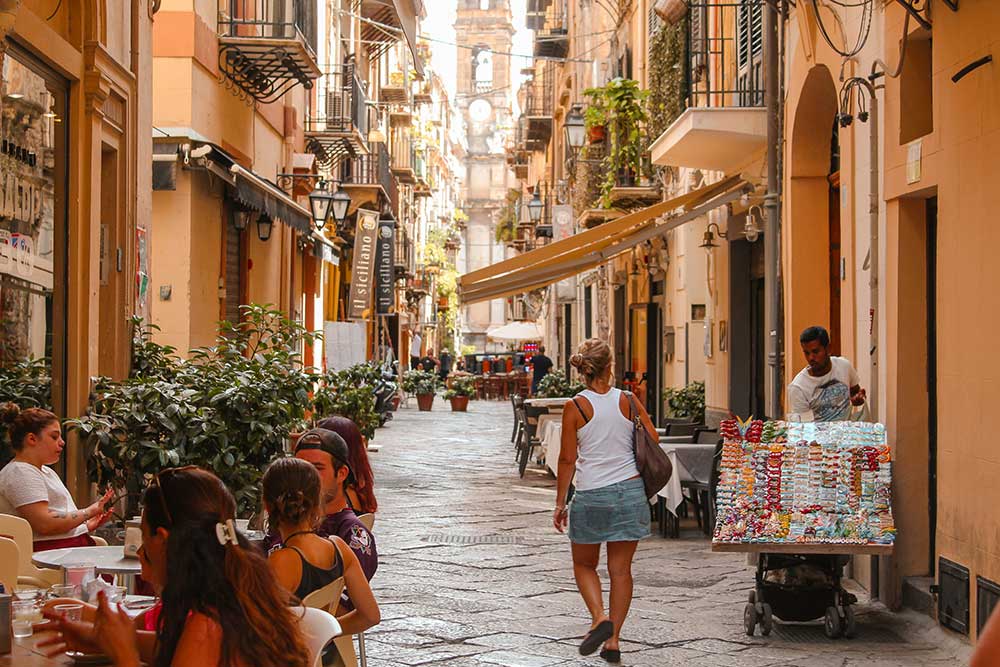
Via Roma runs parallel to Via Maqueda featuring department stores, fashion boutiques, and historic buildings. The street connects to the central station and provides access to markets including the Vucciria. Corso Vittorio Emanuele runs east-west from the port area to the Norman Palace forming the other principal axis through the historic center. The street follows approximately the path of the ancient Cassaro, the main street of medieval Palermo. Buildings lining the route display facades from various centuries showing architectural evolution.
The Vucciria Market has experienced significant changes with reduced daily market activity but increased evening entertainment uses. Remaining market stalls operate primarily in morning hours selling fish and produce, while night brings bars and restaurants occupying the streets and piazzas. The area takes its name from the French boucherie reflecting medieval origins as a meat market. The quarter demonstrates how traditional market areas adapt to changing economic and social patterns while maintaining their character as centers of urban life.
The Norman Palace and Western Quarter
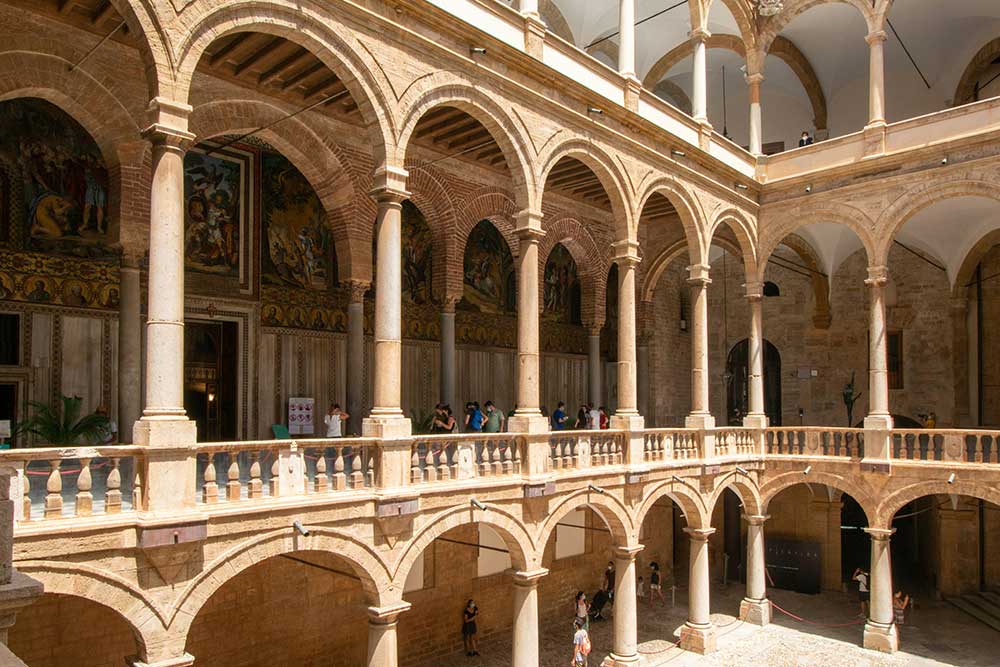
The western section of the historic center rises toward the Norman Palace, which occupies elevated ground commanding views across the city. Built on earlier Arab fortifications, the palace served as the seat of Norman kings and later Spanish viceroys before its current function housing the Sicilian Regional Assembly. The structure combines defensive military architecture with palatial residential quarters arranged around courtyards, demonstrating continuous political use from the twelfth century to the present.
Within the palace complex stands the Palatine Chapel, constructed in 1132 and representing the finest synthesis of Arab, Norman, and Byzantine artistic traditions in Sicily. Gold mosaics cover walls and vaults depicting biblical scenes created by Byzantine craftsmen, while the wooden ceiling displays intricate Islamic geometric patterns carved by Arab artisans. Norman architectural forms provide the structural framework for this convergence of three distinct cultural traditions. Light filtering through small windows illuminates the gold-ground mosaics creating an overwhelming visual effect. The chapel served as private worship space for Norman kings and displays the cosmopolitan character of their court.
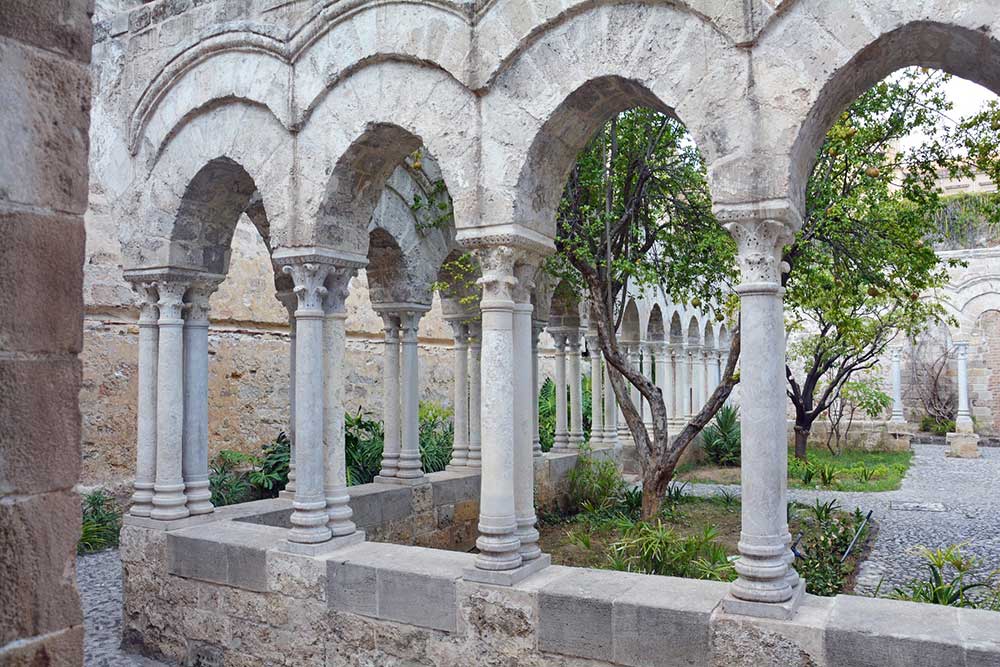
Near the palace stands the Church of San Giovanni degli Eremiti, displaying distinctive red domes and simple architecture reflecting Arab influence in form and construction. The structure stands within gardens containing remains of a Norman cloister with paired columns and pointed arches. The church's severe geometry and minimal decoration contrast with elaborate interiors of other religious buildings, showing alternative approaches to sacred architecture. The building originally served a Benedictine monastery and has undergone various uses and restorations over subsequent centuries.
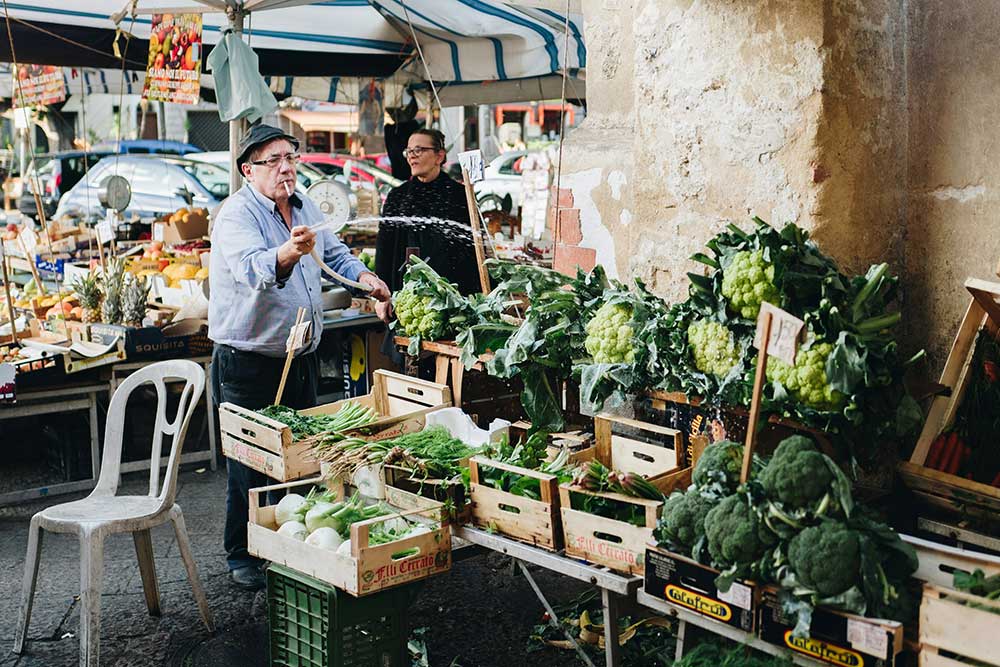
The Albergheria quarter extending southeast from the palace contains Ballarò Market, which occupies several blocks with vendors selling produce, fish, meat, cheese, and household goods. The market operates daily with constant movement through crowded passages between stalls. Vendors call out prices while buyers negotiate, maintaining commercial patterns that have continued for centuries. Street food vendors offer Palermitan specialties including panelle, arancini, and sfincione. The surrounding streets contain small shops, cafes, and residences creating densely populated mixed-use neighborhoods where market activity integrates with daily life.
Cathedral and Northern Districts
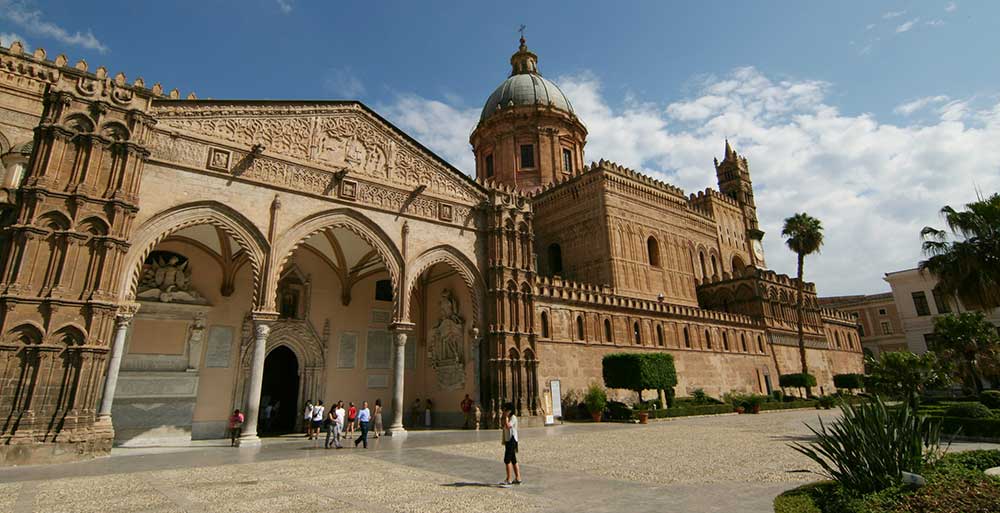
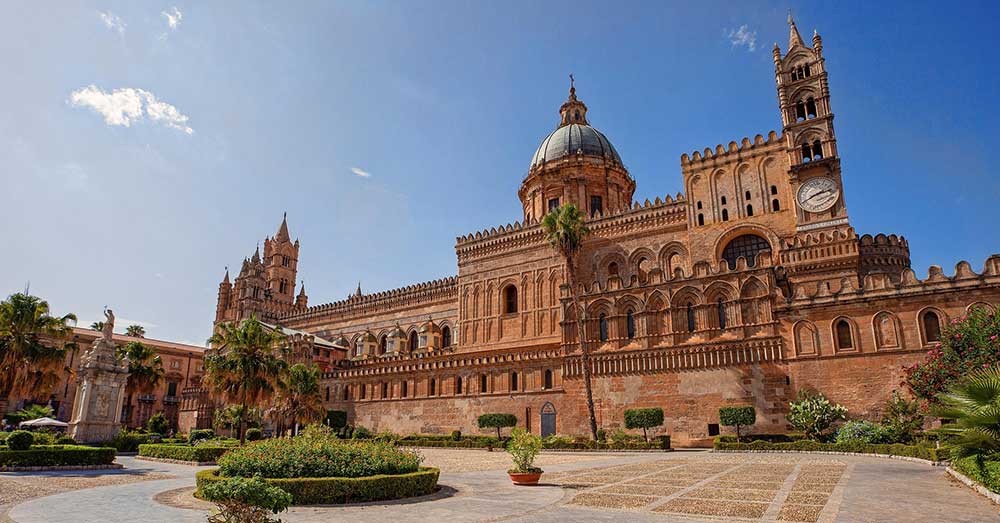
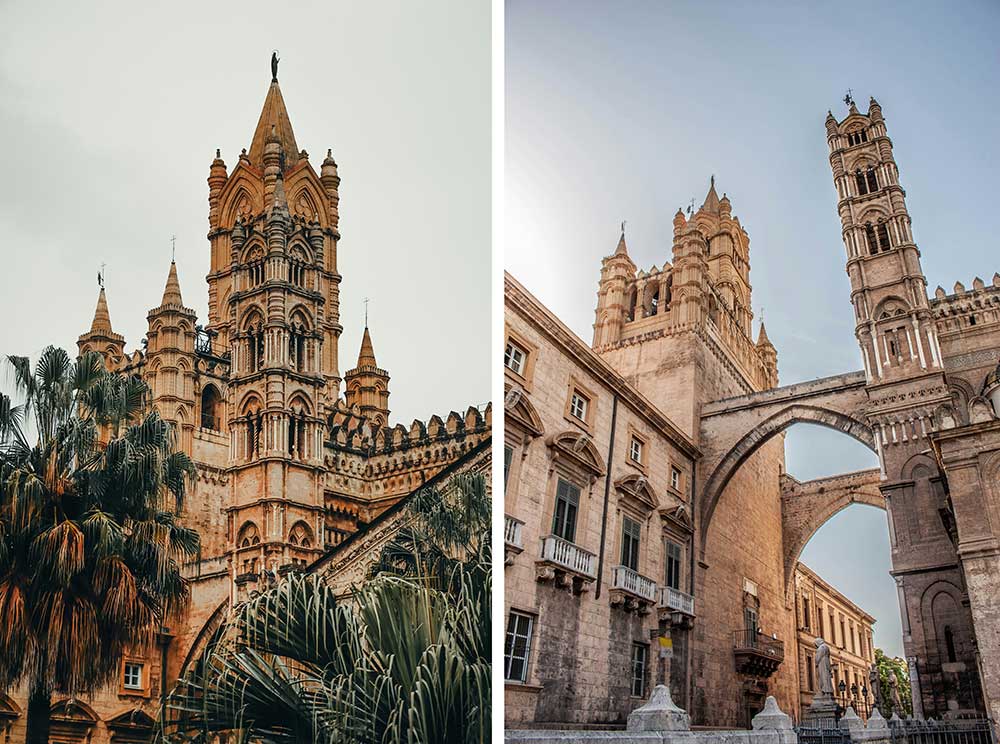
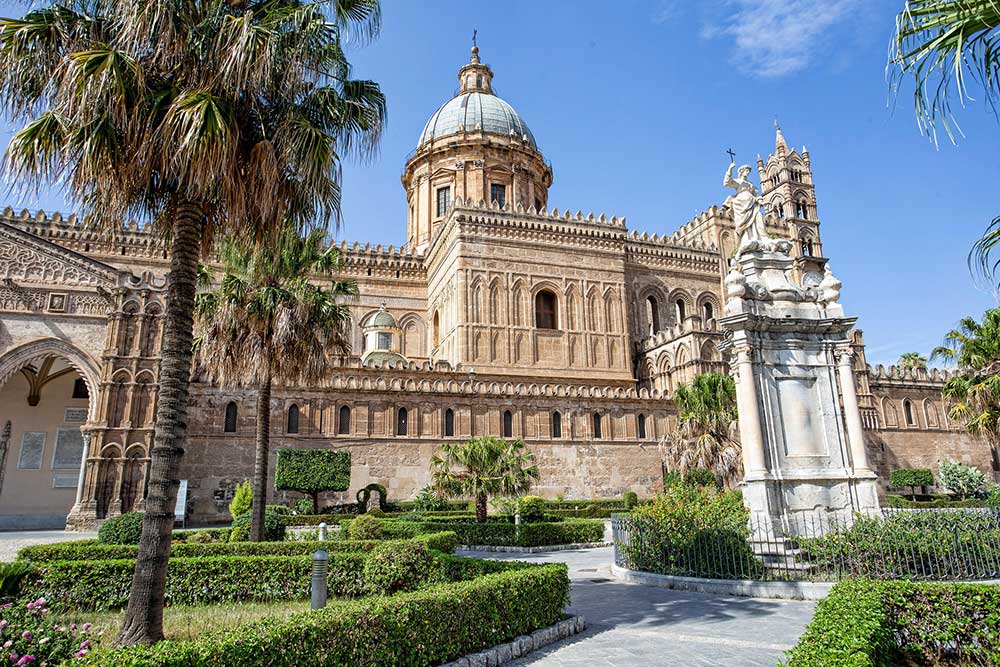
The Cathedral of Palermo stands along Corso Vittorio Emanuele reflecting successive centuries of construction and modification from its Norman foundation in 1185 through baroque additions and neoclassical alterations. The exterior displays Arab-Norman architectural elements including geometric stone patterns and blind arches, while the interior received an eighteenth-century neoclassical redesign that altered the original medieval character. The cathedral contains royal tombs of Norman and Hohenstaufen rulers including Roger II and Frederick II, making it a repository of Sicilian dynastic history. The treasury holds crown jewels and reliquaries including a jeweled crown worn by Constance of Aragon.
San Cataldo preserves its original architectural character with three distinctive pink domes, blank stone walls, and minimal decoration. The severely geometric exterior reflects Arab-Norman style stripped of later baroque additions that modified many similar structures. The interior maintains its medieval spatial quality with pointed arches and stone surfaces, providing rare example of unaltered Norman ecclesiastical architecture in Palermo.
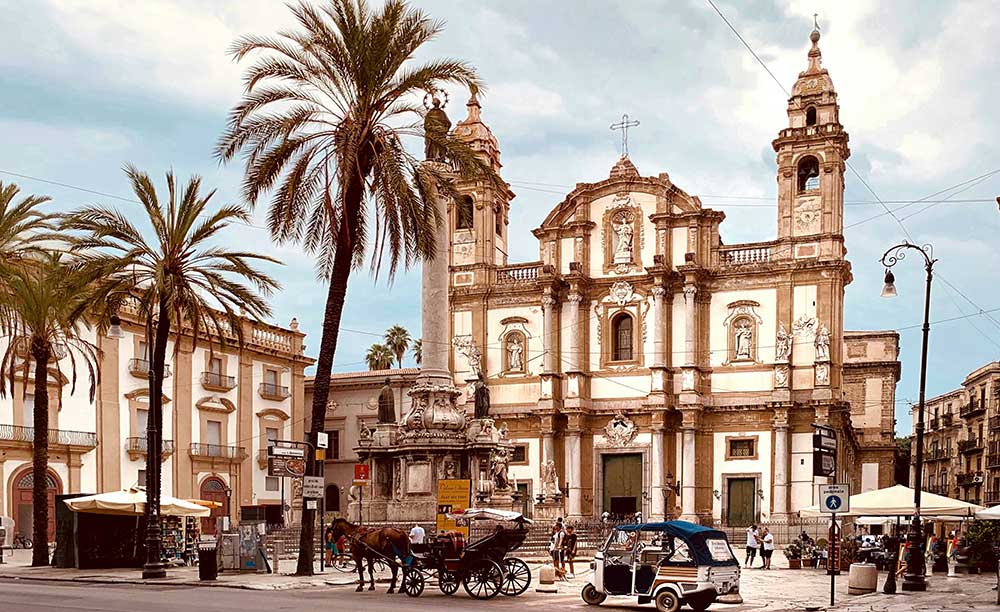
The Church of the Gesù displays overwhelming baroque decoration with every surface covered in marble inlay, stucco, painting, and gilding creating one of Sicily's most elaborate religious interiors. The church served the primary Jesuit house in Palermo and demonstrates the order's use of art to inspire devotion and display institutional power. World War II bombing damaged the church severely, but restoration has returned the interior to its baroque splendor, representing the pinnacle of baroque decorative excess and Jesuit artistic patronage in Sicily.
Several confraternity oratories contain extraordinary stucco decoration created by Giacomo Serpotta in the late seventeenth century. The Oratory of San Lorenzo features white stucco work demonstrating the highest level of baroque decorative art with putti, allegorical figures, and narrative scenes modeled in plaster. A Caravaggio Nativity that hung in the oratory was stolen in 1969 and never recovered. The Oratory of Santa Cita displays complex compositions covering all surfaces, with the Battle of Lepanto forming the subject of the rear wall's elaborate relief showing naval combat rendered in white stucco. The Oratory of San Domenico incorporates allegorical virtues, biblical scenes, and portraits of confraternity members. These spaces served prestigious confraternities whose members came from nobility and professional classes, reflecting how religious organizations expressed their identity through artistic patronage.
Northwest of Quattro Canti extends the Capo quarter and its market, operating daily with vendors selling food products, clothing, and household items. The market maintains traditional character with open-air stalls, vocal vendors, and crowds navigating narrow passages between displays. Streets close to vehicle traffic during operating hours, creating pedestrian zones devoted entirely to commerce. Small restaurants within the market area serve traditional Palermitan street food and simple meals. The market represents continuation of traditional urban marketplace culture within dense historic neighborhoods.
The Regional Archaeological Museum occupies a former monastery near the Vucciria market area, housing one of Italy's most important collections of Greek and Punic artifacts primarily from sites in western Sicily including Selinunte, Mozia, and Himera. The metopes from Selinunte's temples display archaic Greek sculptural art with narrative reliefs from the sixth and fifth centuries BC. Phoenician collections document the Punic presence in Sicily before Roman conquest, while Egyptian artifacts including the Palermo Stone provide comparative material. The collections trace Sicily's ancient history through material culture spanning prehistoric through Roman periods.
Eastern Historic Quarter and Waterfront
The Kalsa quarter near the port includes narrow streets, churches, and small squares developed during the Arab period. The area experienced damage during World War II bombing and subsequent decades of neglect before recent restoration efforts. Via Alloro passes through this neighborhood containing palaces, churches, and residential buildings showing various states of preservation. Walking these streets reveals the mixture of restoration, decay, and adaptive reuse characterizing much of historic Palermo.
Palazzo Abatellis occupies a fifteenth-century Catalan Gothic palace housing the Regional Gallery displaying medieval and Renaissance art. The palace architecture shows influence from Spanish Gothic traditions with a courtyard, stone staircases, and austere facades. The Triumph of Death, a dramatic fifteenth-century fresco fragment, dominates one gallery space. The collection includes paintings, sculptures, and decorative arts documenting artistic production in Sicily from medieval through baroque periods. Works by Antonello da Messina including his Annunciation demonstrate the influence of Flemish painting techniques on Sicilian artists.
Palazzo Chiaramonte-Steri, an imposing fourteenth-century palace in Piazza Marina, served as residence of the powerful Chiaramonte family before becoming headquarters of the Spanish Inquisition, later a courthouse, and now part of the university. The palace's dungeons preserve graffiti created by Inquisition prisoners depicting ships, saints, and prayers scratched into walls during imprisonment. The Sala Magna contains a painted wooden ceiling from the fourteenth century showing secular and religious imagery. The building's history documents shifts in power and institutional uses across seven centuries.
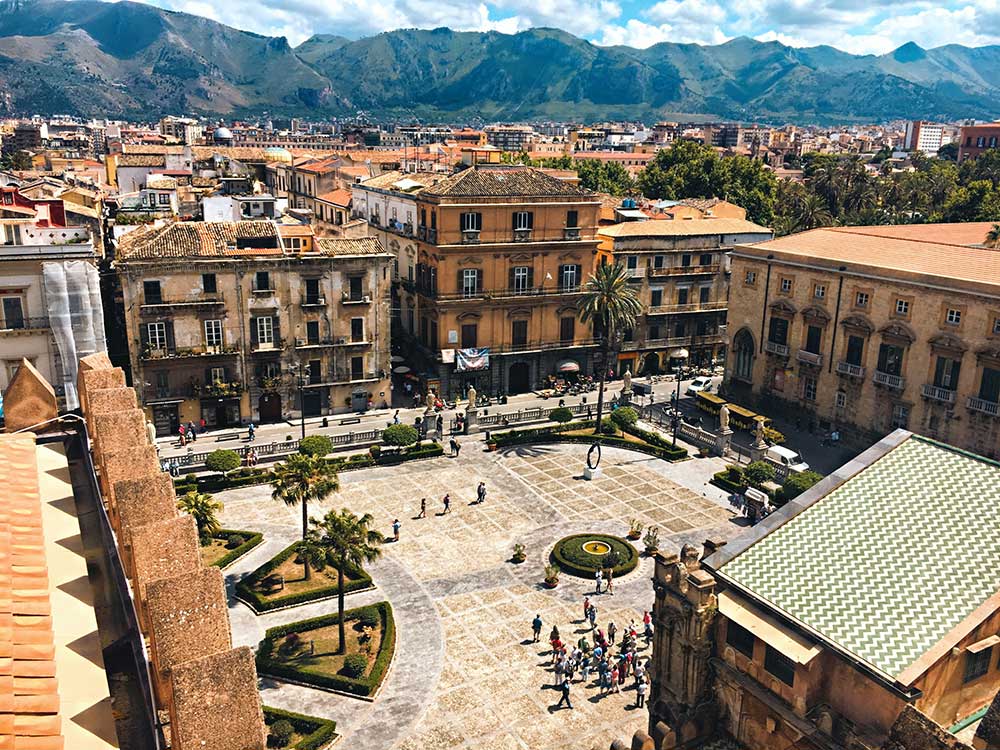
Piazza Marina contains the Giardino Garibaldi, a public garden with enormous ficus trees creating shaded walkways and seating areas. Historic palaces frame the square which once served as a maritime area before land reclamation extended the shoreline. The mature trees, some centuries old, create a distinctive environment with massive trunks and aerial roots. The square connects to the nearby port area and forms a transition between the historic center and waterfront.
The Foro Italico extends along the bay south of the historic center, providing walking and cycling paths with views across the water. Palm trees and gardens line the landward side while the shore offers access to the sea. The promenade connects to Porta Felice, a baroque gate marking the eastern terminus of Corso Vittorio Emanuele. This monumental structure dates from the early seventeenth century with two massive pillar structures framing the gateway. The waterfront development represents nineteenth and twentieth-century efforts to create public amenities along Palermo's coast.
Green Spaces and Cultural Institutions
The Botanical Garden, established in the late eighteenth century for scientific study of plants, contains collections of Mediterranean, tropical, and desert species arranged in taxonomic and geographical sections. Historic greenhouses shelter sensitive plants while outdoor areas display mature specimens of palms, cycads, ficus, and other species. Walking paths wind through different planted areas past ponds and historic structures. The garden serves research and educational functions for the university while opening to the public as a green space. The mature plantings create an oasis atmosphere distinct from surrounding urban neighborhoods.
Villa Giulia, an eighteenth-century public garden near the Botanical Garden, features geometric paths, fountains, and neoclassical decorative elements creating a formal garden space. The garden served as a fashionable promenade during the eighteenth and nineteenth centuries and continues to provide green space for recreation. Mature trees create shade while benches and paths accommodate walking and socializing, demonstrating Enlightenment ideals about public amenities and urban beautification.
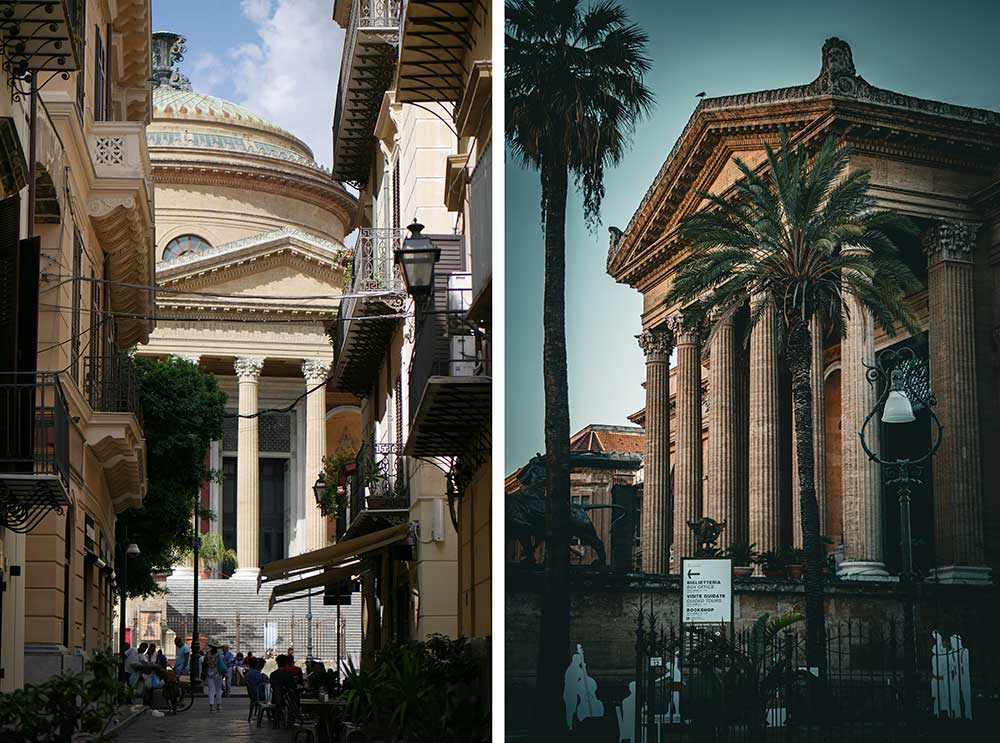
Teatro Massimo opened in 1897 after decades of construction, ranking among Europe's largest opera houses and showcasing neoclassical architecture with a monumental facade featuring a columned portico. The interior contains a horseshoe-shaped auditorium with excellent acoustics and elaborate decoration in gold and red. The theater hosts opera, ballet, and classical music performances throughout the season attracting international artists and audiences. Guided tours allow visitors to see the auditorium, royal box, and backstage areas when performances are not scheduled.
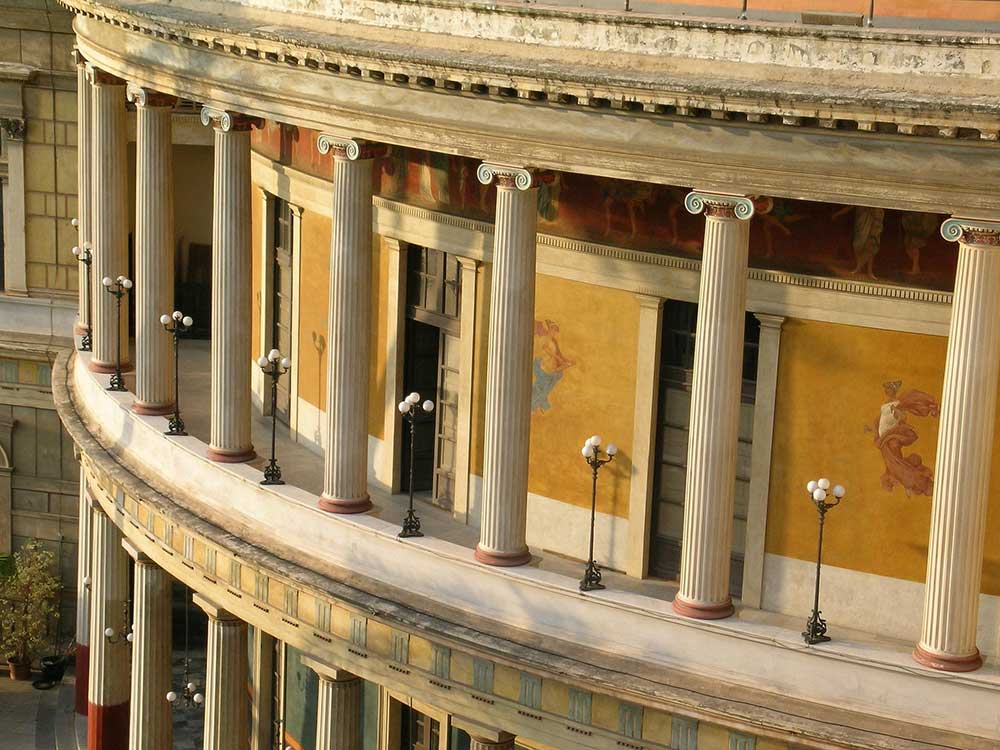
The Politeama Garibaldi Theater features late nineteenth-century neoclassical architecture with a distinctive circular plan and columned facade topped by a bronze quadriga. The building hosts concerts, ballet, and theatrical performances as home to the Sicilian Symphony Orchestra. The theater occupies Piazza Ruggero Settimo, a major square in the modern city center outside the historic core, representing cultural investment during Palermo's expansion in the decades following Italian unification.
Other Sites and Excursions
Monte Pellegrino rises six hundred meters above the city to the north containing the Sanctuary of Santa Rosalia, Palermo's patron saint, within a cave where her remains were reportedly discovered in 1624. The sanctuary attracts pilgrims year-round with particular activity during the July festival celebrating the saint. The mountain road ascending to the sanctuary provides panoramic views across Palermo, the Conca d'Oro valley, and the coast. The cave sanctuary contains a statue of the saint and votive offerings left by devotees.
Mondello Beach, approximately seven kilometers from the city center, features a sandy beach, art nouveau bathhouse, and Liberty-style architecture from the early twentieth century. The shallow water and sandy shore attract swimmers from spring through autumn. Restaurants and cafes line the waterfront serving seafood and providing views of Monte Pellegrino rising behind the beach. The area developed as a resort destination for Palermo's residents seeking seaside recreation, with the art nouveau architecture reflecting the belle époque period when the beach was developed.
The Zisa Palace displays strong Arab architectural influence in its twelfth-century design including a fountain room with muqarnas decoration and water features creating cooling effects. The palace served as a royal retreat outside the city walls, set within gardens and parks designed according to Islamic principles. The building's name derives from the Arabic al-Aziza meaning the splendid. The interior demonstrates sophisticated climate control using water and architectural orientation to create comfortable temperatures. The palace now functions as a museum displaying Islamic art and artifacts while preserving the architectural spaces.
The Cuba Palace, another Norman pleasure palace from the twelfth century, originally stood within a large park with water features and pavilions designed in Islamic style. The building shows cubic forms and architectural elements reflecting Arab aesthetics adapted by Norman patrons. The palace fell into various uses over centuries and became surrounded by later urban development. The structure now serves as a museum space occasionally hosting exhibitions.
Parco della Favorita, created in 1799, offers wooded trails, lawns, and a royal hunting lodge near Mondello. The large park provides green space accessible by car or bus with views of Monte Pellegrino. Visitors walk or cycle through shaded paths, offering recreational relief from urban density.
The Catacombe dei Cappuccini contain mummified bodies of Palermitans from the seventeenth through early twentieth centuries, displayed in corridors according to social status, profession, and gender. The naturally dry conditions and treatment processes preserved the bodies which remain dressed in period clothing. The catacombs originated as burial space for Capuchin friars before expanding to accommodate paying clients from the city's population. The most famous occupant is Rosalia Lombardo, a child who died in 1920 and appears remarkably preserved. The site attracts visitors interested in death customs and preservation techniques while raising questions about display of human remains.
Palermo functions as a base for excursions throughout western Sicily. Monreale, eight kilometers south, contains a Norman cathedral with extensive Byzantine mosaics and a cloister with paired columns featuring intricate carved capitals. Cefalù on the north coast combines a Norman cathedral, medieval streets, and a beach resort atmosphere. The Greek temples at Segesta and Selinunte demonstrate Sicily's ancient Hellenic heritage. The hilltop town of Erice offers medieval atmosphere and panoramic coastal views. These sites remain accessible as day trips by car or organized tours from Palermo.
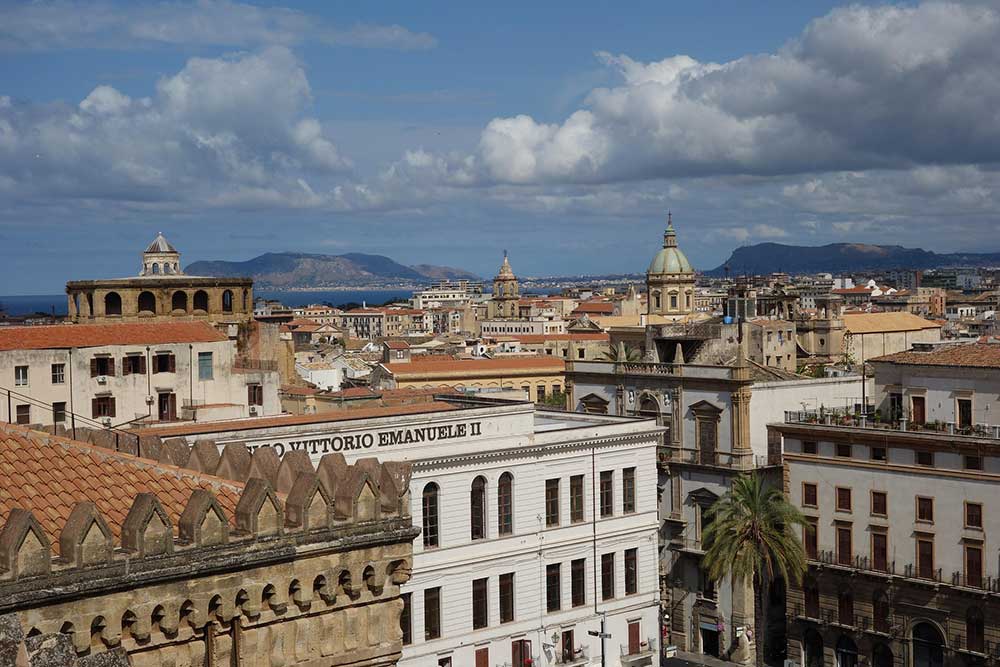
Church of the Santissimo Salvatore Rooftop; Corso Vittorio Emanuele, 396; A recently opened panoramic viewpoint in the Albergheria neighborhood that provides a compelling view over the historic rooftops, domes, and the bustling life along the ancient main street
Eurostars Centrale Palace Ai Tetti; Via Vittorio Emanuele 327; Located in the heart of Palermo, this classic rooftop garden and terrace on the top floor of the hotel offers fantastic views over the city stretching to the mountains in the horizon, with seating both inside and on the al-fresco terrace where the rooftop bar serves cocktails and wines while the Ai Tetti rooftop restaurant serves Sicilian dishes
Grand Hotel Piazza Borsa; Via dei Cartari 18; Set in central Palermo, this hotel offers numerous dining opportunities and a panoramic roof garden where breakfast is served during summer with views over the baroque square
Hotel Ambasciatori Rooftop Terrace; Via Roma 111; This panoramic rooftop terrace overlooks the historic city where breakfast and drinks from the bar can be enjoyed on the terrace, with the on-site restaurant serving local Sicilian cuisine and activities featuring classical and jazz music on summer evenings
Ibis Styles Palermo Rooftop Restaurant; Via Francesco Crispi 228; Featuring a terrace overlooking Palermo harbour, this hotel offers a rooftop restaurant and bar open 24 hours a day with views of the Mediterranean Sea
Il Bar at Rinascente; Via Roma 289 4th floor Rinascente shopping mall; Set on top of the Rinascente shopping mall in the center of Palermo, this rooftop cocktail bar and café offers amazing views over Piazza San Domenico and the Chiesa di San Domenico from its beautiful multi-level terrace with both inside and outdoor seating open daily throughout the day and night
Le Terrazze del Sole; Corso Vittorio Emanuele 291; Perched above Quattro Canti in the heart of Palermo, Quattro Canti Hotel this rooftop bar and restaurant provides extraordinary views over the Sicilian capital including Piazza Pretoria, serving Sicilian cuisine in an elegant yet inviting atmosphere with both open-air and indoor seating offering aperitif menus and full dinner with Land and Sea tasting menus and extensive drink selections
Osservatorio Rooftop; Via Nicolò Gallo 2; This sophisticated bar and restaurant features indoor and outdoor seating areas offering sweeping panoramas of the majestic mountains that encircle Palermo, serving a good selection of cocktails and wines including quintessential Sicilian varieties like Nero d'Avola open daily from 6pm to midnight
Palermo Cathedral Rooftop; Via Vittorio Emanuele; Climbing the bell tower and rooftops of the multi-styled Cathedral offers a unique 360-degree view of the city's architectural layers, the surrounding mountains, and a close-up on the adjacent Norman Palace
Politeama Roof; Piazza Ruggero Settimo 15; This rooftop restaurant in Politeama Hotel sits alongside Piazza Ruggero Settimo with floor-to-ceiling glass windows that open according to weather, offering bright and modern seating for early afternoon dining or ambient late-night meals with views of the city serving white Sicilian wine Passiperduti and Mediterranean cuisine
Seven Restaurant Roof Top Garden; Via Roma, 111; This lush rooftop restaurant and bar at Hotel Ambasciatori in the heart of Palermo offers a breathtaking panoramic view over the historic center's domes, ancient monuments, and the mountains in the distance
The previous information is very detailed, so here we provide a shorter summary of the top-20 sights to see, in a Google My Map, followed by a list of those places with brief descriptions.
Cappella Palatina (Piazza Indipendenza, 1): The royal chapel within the Norman Palace dazzles with golden Byzantine mosaics covering walls and a muqarnas ceiling. Built by Roger II in 1130, it combines Norman, Arab, and Byzantine elements— a jewel of multicultural Sicily.. The wooden muqarnas ceiling represents Islamic artistry while Christian mosaics depict biblical scenes, creating one of the world's most extraordinary examples of medieval craftsmanship.
Catacombe dei Cappuccini (Piazza Cappuccini, 1): An unusual and eerie historical sight, these catacombs house the preserved, dressed bodies and skeletons of 8,000 mummified bodies in monastic robes, preserved as eternal reminders of mortality, mostly from the 17th to 19th centuries, offering a somber look at burial traditions. The macabre catacombs contain thousands of mummified bodies displayed in corridors beneath the Capuchin monastery. From the 16th to 19th centuries, Palermitans were preserved and dressed in their best clothes. The most famous resident is Rosalia Lombardo, a remarkably preserved child from 1920. The site provides unique and unsettling historical documentation. Descend into cool tunnels lined with preserved citizens, a macabre Sicilian tradition blending faith and fascination.
Cattedrale di Monreale (Piazza Guglielmo II, 1): Just outside Palermo, this 12th-century abbey stuns with 6,340 square meters of glittering mosaics depicting biblical scenes in the nave. William II's clifftop masterpiece, with cloisters and bronze doors, crowns Benedictine glory over Conca d'Oro valley. The cathedral exhibits architectural layers from Norman to baroque periods, with Arab-Norman exterior decoration and neoclassical interior modifications. Royal tombs include Holy Roman Emperor Frederick II and Roger II. The treasury contains Saint Rosalia's remains and the crown of Constance of Aragon, connecting the building to Sicily's complex political history. An architectural masterpiece blending Norman, Gothic, Baroque, and Neoclassical styles, reflecting Palermo's diverse history. It offers panoramic views from its rooftop.
Chiesa della Martorana (Piazza Bellini, 7): This 12th-century Byzantine-Norman church, founded by Admiral George, shimmers with mosaics of Christ and saints over Islamic arches. Its golden-domed interior and citrus-shaded courtyard whisper Eastern influences in Palermo's Arab quarter.
Chiesa di San Giovanni degli Eremiti (Via dei Benedettini, 90134): The church with distinctive red domes exemplifies Arab-Norman architecture built by Roger II in 1132. The structure stands on the site of a mosque, incorporating Islamic architectural elements with Christian purpose. Beautiful cloisters with a garden of palms and citrus trees provide peaceful atmosphere. The building symbolizes Palermo's cultural synthesis during Norman rule. This UNESCO-listed 12th-century church is an iconic example of Arab-Norman architecture. The adjacent tranquil cloister offers a peaceful oasis in the city center.
Chiesa di Santa Caterina (Piazza Bellini, 3): A 17th-century Baroque extravaganza with a dome rivaling Rome's, this church dazzles inside with polychrome marbles, frescoes, and stucco. Roof terrace views over Palermo's spires make it a hidden gem for art lovers seeking opulent serenity.
Chiesa di Santa Maria dell'Ammiraglio (Piazza Bellini): Also known as La Martorana, this Norman church is famous for its stunning, well-preserved Byzantine mosaics, considered some of the best in Sicily, showcasing a brilliant blend of cultural styles.
Cuba Palace (Corso Calatafimi, 100): Another Norman pleasure palace from the 12th century, this structure originally stood within a large park with water features and pavilions designed in Islamic style. The building shows cubic forms and architectural elements reflecting Arab aesthetics adapted by Norman patrons. The palace fell into various uses over centuries and became surrounded by later urban development. The structure now serves as a museum space occasionally hosting exhibitions. The building demonstrates how Norman rulers adopted and adapted architectural forms from the Islamic tradition they encountered in Sicily. The Cuba along with the Zisa formed part of an extensive system of royal parks and pavilions extending outside medieval Palermo's walls;
Fontana Pretoria (Piazza Pretoria): Nicknamed the "Fountain of Shame," this impressive Renaissance fountain features dozens of nude statues of mythological figures. Initially built in Florence, it was disassembled and moved to Palermo in 1574. Its tiered basins and mythological figures symbolize civic power, delighting visitors in Palermo's historic core.
La Martorana (Piazza Bellini, 3, 90133): The church officially named Santa Maria dell'Ammiraglio features stunning Byzantine mosaics from the Norman period. Founded in 1143, the building shows layers of Arab-Norman and baroque additions. The interior glows with golden mosaics depicting Christ, angels, and Roger II receiving his crown. The church shares a piazza with San Cataldo, creating architectural harmony.
La Vucciria Market (Piazza Caracciolo): Historically a meat market, this area remains a vibrant, though smaller, market by day. By night, it transforms into a bustling hub for street food, music, and Palermo's lively nightlife.
Mercato di Ballarò (Around Piazza Casa Professa): Palermo's oldest market, over 1,000 years old, teems with Arab-rooted stalls of spices, seafood, and arancini shouts, bursts with Sicilian street food, produce, and the cheerful chaos of daily life.. Amid narrow alleys, it's a chaotic feast of Sicilian life, haggling, and street eats under laundry lines and church bells. The market extends through narrow streets, a vibrant labyrinth in the Albergheria quarter, offering authentic Palermitan life and traditional foods like panelle and arancini.
Orto Botanico (Via Lincoln, 2): Europe's oldest botanical garden, founded in 1789, spans 10 hectares of exotic palms, succulents, and aquariums amid 12,000 species, with exotic plants from around the world, and ponds in Palermo's urban sprawl.. Notable features include the massive Ficus magnoloides, tropical greenhouses, and neoclassical architecture. The garden serves scientific research while providing tranquil green space with ponds, palms, and diverse botanical collections representing tropical, subtropical, and Mediterranean climates.
Palazzo Abatellis (Via Alloro, 4): This 15th-century Catalan Gothic palace houses the Regional Gallery displaying medieval and Renaissance art including works by Antonello da Messina and Francesco Laurana. The palace architecture shows influence from Spanish Gothic traditions with a courtyard, stone staircases, and austere facades. The Triumph of Death, a dramatic 15th-century fresco fragment, dominates one gallery space. The collection includes paintings, sculptures, and decorative arts documenting artistic production in Sicily from medieval through baroque periods. The building's restoration by architect Carlo Scarpa created modern exhibition spaces respecting the historic structure. The museum provides comprehensive survey of Sicilian art within an architecturally significant palace;
Palazzo dei Normanni (Piazza del Parlamento, 1): Norman Palace, Sicily's oldest royal palace, expanded by Normans in the 11th century, houses regional parliament amid Arab gardens and mosaics. Its Norman-Arab-Byzantine fusion reflects multicultural rule, with rooftop views over Palermo's domes and seas. The palace complex contains layers of architecture from Punic to Arab to Norman periods. Beyond the Cappella Palatina, visitors explore royal apartments with frescoed halls. The building represents Palermo's multicultural heritage and political significance through centuries. This palace is Europe's oldest royal residence with foundations dating back to Phoenician settlements. The original building (al-Qasr, "the Castle") was built in the 9th century AD during the Arab rule of Sicily. Its jewel is the Palatine Chapel, a UNESCO site famous for dazzling Byzantine mosaics covering every surface.
Palermo Cathedral (Corso Vittorio Emanuele, 425): A 12th-century hybrid of Arab-Norman, Gothic, and Baroque styles, this fortress-like basilica holds royal tombs and rooftop terraces with city vistas. Its mosaics and treasury of relics narrate Sicily's layered history under minarets and domes.
Ponte dell’Ammiraglio: A Norman bridge from 1131 with stone arches spanning the Oreto River, part of Palermo’s UNESCO heritage sites.
Porta Nuova (Via Vittorio Emanuele, 2): This monumental gate built in the 16th century marks the western entrance to the historic center near the Norman Palace, featuring a baroque facade with distinctive majolica tile decoration. The gate celebrates Charles V's victory at Tunis with architectural and sculptural elements referencing this military achievement. The structure spans the entrance to Corso Vittorio Emanuele creating a theatrical portal to the historic city. The gate has served ceremonial functions for official entries and processions over centuries. The majolica tiles add color to the stone architecture and show Sicilian ceramic traditions. The gate demonstrates how architecture served political propaganda and civic pride: sites
Quattro Canti (Piazza Vigliena): The crossroads of Palermo, the baroque intersection divides Palermo into four historic quarters, each corner featuring elaborate facades with fountains, statues of Spanish kings, saints, and seasonal allegories. Created in the early 1600s, the octagonal piazza provides architectural symmetry and serves as the city's symbolic center. The intersection connects major streets and represents baroque urban planning at its peak, it marks the Cassaro's intersection with Via Maqueda, a theatrical urban stage for light and shadow plays, rebuilt in 1608
Teatro Massimo (Piazza Verdi, 90138): Italy's largest opera house and Europe's third largest opened in 1897 with neoclassical grandeur. The theater features exceptional acoustics and ornate interiors with gold decoration, red velvet, painted ceilings, and gilded frescoes. Guided tours reveal backstage areas and history, while performances showcase world-class opera. The building's steps featured memorably in The Godfather Part III. It's a spectacular venue for opera, ballet, and concerts.