Stanton — Little-Known Oasis
.webp)
Stanton is one of the smallest and most unspoiled villages in the Cotswolds, a single quiet lane of honey-colored stone houses and well-tended gardens with no shops, no cafés, and almost no traffic. There is nothing to buy here, nothing to do except walk, and that is precisely the point. Stanton is what travelers come to the Cotswolds hoping to find — a working village that has changed remarkably little since the 17th century, where life proceeds at the pace of footsteps and horses' hooves on a country road.
.webp)
This hidden treasure village sits on the western edge of the Cotswolds, tucked beneath the steep ridge of Shenberrow Hill near the boundary with Worcestershire. Reaching Stanton requires intention. Public transit barely touches the village, and the most practical ways to arrive are by car or as part of an organized small-group tour from one of the larger Cotswold bases such as Broadway or Chipping Campden, both within a short drive. Walkers reach Stanton on foot via the Cotswold Way, the long-distance trail that runs more than a hundred miles from Chipping Campden in the north down to Bath in the south, passing directly through Stanton's main lane. For many visitors who arrive on foot, the village appears suddenly after a long stretch of pasture and woodland — a ribbon of golden stone unfolding ahead, framed by trees, with chimneys and steep gabled roofs catching the sun.
Arriving by car, the approach is similarly understated. A narrow road leads in from the main valley route, and within a few moments the road becomes the village itself. There is room to park near the entrance to the village along the verge. From here, the rest of the visit happens on foot.
.webp)
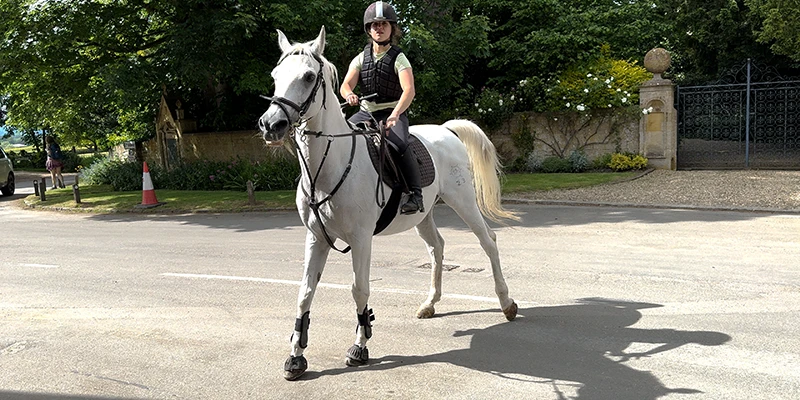
A horse and rider may pass without ceremony, the rider in helmet and riding boots, the horse unconcerned by the occasional car — Stanton is the kind of place where horses still share the road with vehicles, and neither finds it remarkable.
.webp)
The walk through Stanton begins at the lower end of the village, where a stone-mullioned cottage sets the architectural tone immediately. The local Cotswold limestone, a warm honey color that turns nearly gold in afternoon sun, is the material of every wall, every roof tile, every garden boundary. Roofs are steeply pitched and capped with stone tiles, often with prominent gables and dormer windows. Chimneys rise tall. Windows are small and divided by stone mullions. The architecture has a remarkable consistency — not because it was planned that way, but because the village was built and rebuilt over several centuries using the same local stone in the same regional vernacular, and because nothing has been added since to break the pattern.
.webp)
Walking up the lane, the houses unfold one after another, each slightly different but unmistakably part of the same family. Roses climb walls everywhere, trained over doorways and around windows, in pinks and reds and the occasional yellow. Lavender, rosemary and clipped boxwood line the garden edges. Shrubs in vivid yellow-green sit beside hedges of dark glossy leaves. The gardening here is meticulous but never showy — the goal is not display but harmony with the stone. A wooden bench sits on a small patch of lawn outside one of the houses, weathered silver-gray, positioned in the shade of climbing white and red roses. There is no plaque, no information board. Visitors are simply trusted to enjoy what they see and move on.
.webp)
A wayside cross stands partway up the lane, an ancient stone column with steps at its base, dating from the medieval period when such crosses marked village centers and provided a focal point for community life. It still serves that role visually, drawing the eye and giving the lane a sense of axis. A handful of cottages around it carry small name plaques — Stanton Cottage, Stone Cottage, Cross Cottage — each set into the stone wall in cast iron, nineteenth-century in style. House numbers are simple painted figures on doors. The Stanton Cottage sign hangs beside a doorway nearly buried in pink climbing roses and yellow shrubs, the kind of corner that draws every passing camera.
.webp)
From here, the lane curves gently and a thatched cottage comes into view — one of the village's most photographed buildings, with a heavy thatched roof sweeping low over yellow-rose-covered walls. A second thatched property sits nearby. Most of Stanton's houses are roofed in stone tile, but these thatched survivors give the village a deeper layer of antiquity, a glimpse of how all such villages once looked before stone tile became the regional standard. Further along, the village opens up briefly with views of the Cotswold escarpment rising behind the houses.
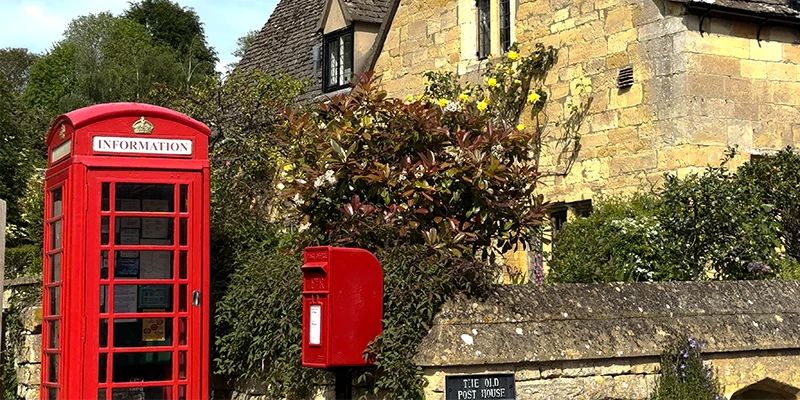
About midway up the lane, the red village telephone box stands proudly, another reminder of simpler days before mobiles ruled the world. Like many British phone boxes it has taken on a new function as a sheltered bulletin board for travelers and the community, and perhaps a place to duck out of the rain. But on this day, we found glorious sunshine and comfortable temperatures in the middle of May.
.webp)
The parish noticeboard stands in the phone booth behind glass — a window into the small workings of village life. Notices for the Stanton Parish Council, service times for St. Michael & All Angels Church (services at 11:15 a.m. on the first Sunday of the month, with shared services at neighboring Snowshill on other Sundays), a map of village footpaths, taxi services from nearby towns, and announcements for occasional events such as Gardens Open day in early summer. Local businesses advertise their services on small cards: jewelry making workshops, window cleaning, electrical work, garden maintenance. The Mount Inn — Stanton's only pub, located up the hill at the top end of the village — posts its opening times. There is no commercial center here at all, but the noticeboard reveals a community that quietly continues the small business of village life.
.webp)
Toward the upper end of the lane, the houses thin slightly and the gardens grow larger. A stone-fronted house wrapped in climbing hydrangea presents a deep green facade against the honey stone. Topiary in tight spirals frames a wooden front door. The road narrows and begins to climb. Walkers continuing on the Cotswold Way head past the church and up toward the wooded slopes above the village. Visitors who have come only to see Stanton itself usually turn back at this point and retrace their steps down the lane, which offers an entirely different experience in the opposite direction — the same houses, the same gardens, but now with the village opening downward and the broader landscape coming back into view.
.webp)
The whole walk through Stanton can be completed in twenty or thirty minutes if hurried, but the village rewards a slower pace. There are benches to sit on, gardens to look into, details of stonework to notice — the way a window lintel has been cut, the worn step of a doorway, the patina of lichen on an ancient roof tile. Allow an hour, more if the weather is fine. There is no entrance fee, no opening time, no guided tour. The village itself is the attraction, and it is open whenever the road is open.
.webp)
Departing Stanton, most visitors continue to the next Cotswold village on their itinerary. Snowshill lies a short drive to the east, Broadway a short drive north, and the larger market town of Chipping Campden somewhat further. For those traveling by car, Stanton fits naturally into a half-day route through the northern Cotswolds combining several small villages.
.webp)
For walkers on the Cotswold Way, Stanton is one stage among many, and the trail leads onward through fields and woods toward the next village along the route. Either way, Stanton is the kind of place that lingers in memory long after the visit — a quiet ribbon of golden stone, pink roses, and the unhurried life of an English country lane.