Moreton-in-Marsh — Cotswolds Market Town with Train Connections
.webp)
While Moreton-in-Marsh is not as rural or quaint as many of the smaller Cotswold villages, it is filled with the same beautiful honey-colored limestone buildings and offers some important attractions of its own. A number of quality hotels in historic buildings give Moreton an authentic atmosphere that makes it a strong candidate for a home base while exploring the wider Cotswolds region. And unlike most Cotswold towns, Moreton has direct rail service from London, Oxford and beyond — making it one of the easiest places in the region to reach by public transport.
.webp)
The town is laid out along a single broad street, the historic Fosse Way, which the Romans built more than two thousand years ago as one of the main roads of Britain, running from Exeter in the southwest to Leicester in the Midlands. The Romans drove the road in straight lines wherever possible, and at Moreton they pushed it directly through what was then a marsh — hence the second half of the town's name. The "Moreton" itself goes back to Anglo-Saxon settlement on a slight rise just above the bog. The civil engineering challenge of building a Roman road through a marsh must have been considerable, and a small Roman encampment likely existed here during construction.
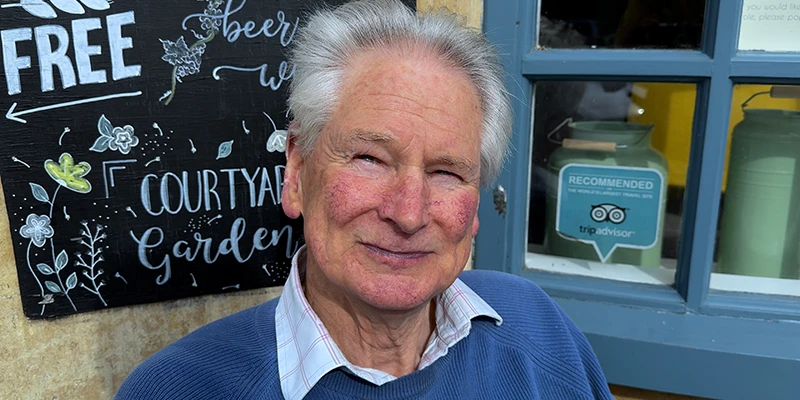
A local gentleman, encountered on a bench along the High Street, offered some of the town's history first-hand: "We used to be the borders of four different counties — Gloucestershire, Oxfordshire, Worcestershire and Warwickshire. The Four Shire Stone is just down the road, and that's where they used to meet. Moreton was given a license to have a market — I can't tell you exactly when. We still have a market on Tuesday, but it's clothing and food now, not livestock. You can visualize the scene a couple of hundred years ago — the High Street heaving with cattle and sheep and pigs. Sheep farms all around the area were very important. That's all there was. No industry in those days. Just wool, and cattle and pigs and chickens. We were quite well known for the dairy around here. We still produce Cotswold cheese."
.webp)
That market tradition continues every Tuesday, when the broad central strip of the High Street fills with stalls. The town received its market charter in 1227, and the weekly market has been held in essentially the same location for nearly eight centuries. Today's offerings have shifted from livestock to clothing, food, household goods, and crafts, but the energy of a working market town remains.
.webp)
The central strip of High Street is unusually wide — broad enough for the medieval livestock markets of centuries past — and is lined on both sides by the town's mix of shops, restaurants, hotels and pubs. Small parks and benches break up the streetscape, and broad sidewalks make the central area pleasant for walking despite the busy main road that runs through it. A war memorial stands prominently in the central area, commemorating local men who died in the First World War, with their names carved into the honey-colored limestone base — a sober counterpoint to the activity around it.
.webp)
Honey-colored limestone is the unifying material throughout the town. Three- and four-story buildings line the High Street, many dating from the 17th and 18th centuries, with the characteristic Cotswold combination of warm stone walls, slate or stone-tiled roofs, sash windows, and ornate iron sign brackets. The architectural consistency is striking even in a region known for it. Shop fronts are tucked into ground floors of historic buildings, and signage tends toward traditional hand-painted styles rather than corporate branding.
.webp)
The shopping mix is varied — independent boutiques, antique dealers, gift shops, butchers, a fishmonger, classic-cottages holiday rental agencies, art galleries, charity shops, and the inevitable Cotswold-themed stores selling local cheeses, jams, and crafts. The Cotswold Cheese Company carries on the dairy tradition the local gentleman mentioned. The Moreton Gallery and Astley House Fine Art represent the town's small but active art scene.
.webp)
Hotels and inns are a particular strength. The Redesdale Arms — a privately-owned 17th-century coaching inn — sits prominently along the High Street with its heraldic shield and traditional hanging sign advertising the hotel, restaurant and bar. The building has thirty-four en-suite rooms, a bar and conservatory restaurant, and a courtyard garden. The Bell Inn, named for the prominent bell hanging above its entrance, offers food, cask ales and a beer garden in another historic stone building. The Swan Inn, on the corner of Bourton Road, is another well-preserved coaching inn with afternoon cream teas and a beer garden. The White Hart Royal Hotel — a "Historic Royalist Hotel" by its plaque — is another option, with its courtyard restaurant.
.webp)
These hotels make Moreton a good home base for exploring the Cotswolds. From here, day-trips by car or organized tour can reach Bourton-on-the-Water, Stow-on-the-Wold, Chipping Campden, Broadway, Bibury and the rest of the famous villages within twenty to thirty minutes. Several Cotswold tour companies start their day-trips from Moreton specifically because of the rail connection — visitors can travel up from London Paddington in about an hour and forty-five minutes, meet the tour, do the day's sightseeing, and return to London the same evening.
.webp)
For visitors meeting a tour here, it's worth allowing a couple of hours to explore Moreton itself before the tour begins, or staying on after the tour to walk the High Street properly. The town doesn't reward a quick glance — the architecture, the small details of stone carving, the ironwork, the names on old shop fronts all reveal themselves slowly. A leisurely lunch or coffee stop adds context.
.webp)
Cafés and tearooms are scattered along the High Street. Lynwood & Co Café offers a contemporary take with serious coffee and an extensive pastry counter — the kind of place you might find in a London neighborhood transposed to a Cotswold town. Martha's, set in the historic Sheraton House, leans more traditional, with afternoon teas served in a centuries-old building. Both styles have their following.
.webp)
A note on the town's geography — Moreton sits at the edge of the Cotswold escarpment, technically just below the steep limestone ridge that defines the region. Some locals will tell you, half-jokingly, that the town is "not really in the Cotswolds" — meaning it's not perched up on the high wolds with the picturesque sheep-grazing villages. Practically speaking, though, Moreton is firmly part of the Cotswold experience, and tourist boards include it without question. The distinction matters mainly to those who live here.
.webp)
Continuing the local's commentary: "The Romans had a hell of a job building the road as they came through here. They went in straight lines and they went straight through this bog. Moreton is a bit of a dormitory town now. People go into Birmingham from here. Stratford-upon-Avon is just down the road, which is great for tourism. Most of the farms around here now are continuous cereal production. Not very efficient. They're quite small farms, and it's not that productive a land. It used to be mostly livestock, but livestock doesn't pay. So people have huge machinery now and we have continuous cereals which scrapes the living. Farming in the region is still pretty important, but we only have light industry — no big factories. A lot of office work, clerical work, paper-pushing — which farmers have contempt for."
.webp)
That last comment captures something of the friendly directness visitors find in Moreton. People here say hello. Conversations on benches lead naturally into local history. The pace allows for it. A traveler with an hour or two to spare and a willingness to stop and chat will come away knowing more about the town than any guidebook can convey.
.webp)
The railway station sits at the eastern edge of the town, just a few minutes' walk from the High Street. Great Western Railway operates regular service from London Paddington — about one hour and forty-five minutes each way — and trains connect direct to Oxford (32 minutes)and Reading (1 hr). Commuters from Moreton make the daily run to those cities, and the station handles a steady flow of tourist traffic on weekends. For visitors arriving by train, the walk from station to High Street takes ten minutes. A small green sign at the corner of High Street points toward Oxford on the A44, the Cotswold Business Village, and Chipping Norton — a useful orientation for those continuing onward.
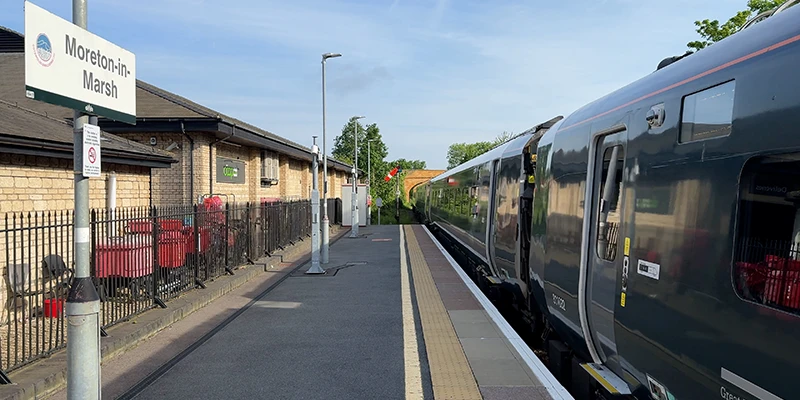
Whether you come for a few hours between tours, a single overnight stay, or a week-long base for exploring the wider Cotswolds, Moreton-in-Marsh rewards the visit. It is a working town rather than a museum, with all the ordinary life that implies — traffic, commerce, residents going about their day — but the historic fabric is intact and the welcome is genuine.