Broadway
A Cotswold Village Worth Lingering In
.webp)
Broadway is the kind of place that makes visitors want to extend their visit. Honey-colored stone glows in the afternoon sun, chestnut trees shade a wide green at the heart of the village, and the High Street invites a slow drift past independent shops, tea rooms, and historic coaching inns. Ironically, you might think of Broadway as a wide, busy boulevard with theaters and tall buildings, but here we find the opposite.
.webp)
The atmosphere is casual, where conversations drift between strollers while aroma of coffee and warm pastry wafts onto the pavement. Window boxes line most of the street with geraniums and trailing lobelia, and small gardens behind low stone walls show tended roses and lavender.
.webp)
Most visitors take in Broadway the same way: a slow walk up one side of the High Street and back down the other. The full circuit is roughly a kilometer, but it can easily fill two or three hours with stops at the windows. Antique dealers and art galleries occupy several of the older buildings. Independent clothing shops, a deli, a couple of bakeries, and a cluster of tea rooms sit along the way. The two sides of the street feel distinct enough that the walk back doesn't repeat sights of the walk out.
.webp)
People sit on benches eating ice cream. Dogs trot past on leads. The pace is unhurried, the architecture is consistently beautiful, and the sense one gets walking in for the first time is simply this is a place worth lingering in.
.webp)
Cars move slowly because pedestrians cross the road wherever they like, and no one seems to mind the wait. Even at peak times the noise level stays low — no traffic roar, no amplified music, no real sense of urgency anywhere on the street.
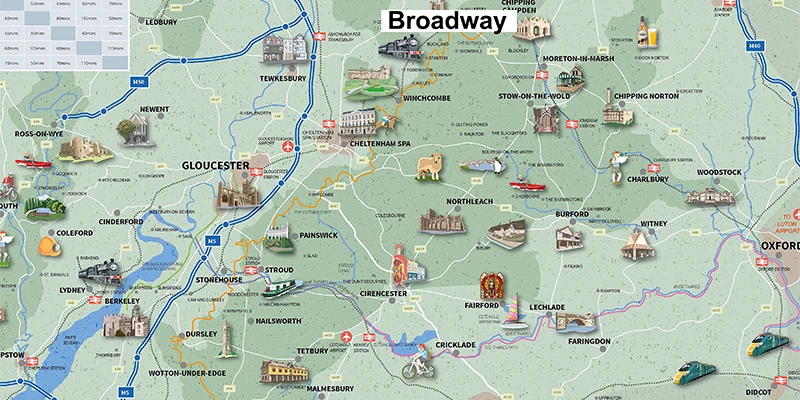
Broadway sits at the northern edge of the Cotswolds, about twenty minutes' drive from Stratford-upon-Avon and roughly half an hour from Cheltenham. The village has long been a stopping point for travelers crossing the limestone uplands of Worcestershire and Gloucestershire, and that role has shaped what visitors find today: a wide, gently curving main street lined with honey-colored stone buildings, an unusually high concentration of hotels and restaurants for a place this size, and a steady flow of day-trippers who come to walk, shop, eat, and look. It is one of the most visited villages in the Cotswolds, and one of the more rewarding ones to spend an unhurried afternoon in.
.webp)
The center of village life is the broad green that runs alongside the High Street, anchored at one end by a tall stone war memorial cross. Benches under mature chestnut trees give visitors a place to sit and watch the slow rhythm of the place. Dogs trot past on leads, retired couples share an ice cream, walkers in boots stop to compare maps. There is little hurry. The pace is set by people who have come specifically to slow down.
.webp)
The High Street itself runs roughly east to west along the lower edge of the green. The buildings are remarkably uniform in material — almost everything is built from the local Cotswold limestone, which weathers to that distinctive honey-colored tone, varying from pale cream to deep gold depending on the angle of the light. The architecture spans roughly four hundred years, from late medieval cottages with steeply-pitched stone roofs to handsome Georgian and Victorian houses, but the consistent stone gives the whole street a visual coherence that is rare in English villages.
.webp)
While most visitors come to Broadway on a daytrip through the Cotswolds, you might be tempted to stay for a night or two and spend leisurely time enjoying this special place. In the evening when the town settles down you will have it much to yourself. There are several excellent hotels to choose from.
.webp)
The most famous building in Broadway is The Lygon Arms, a historic coaching inn on the High Street that has been welcoming travelers since the 14th century. The current honey-stone facade dates largely from the 16th and 17th centuries, with three distinctive gabled bays and an ornate carved porch over the main entrance. Charles I is said to have stayed here before the Battle of Worcester in 1651; Oliver Cromwell reportedly stayed here too, on a separate occasion. The hotel today is a four-star country house property with about eighty rooms, a spa, fine-dining restaurant, and what is probably the most photographed courtyard in the village.
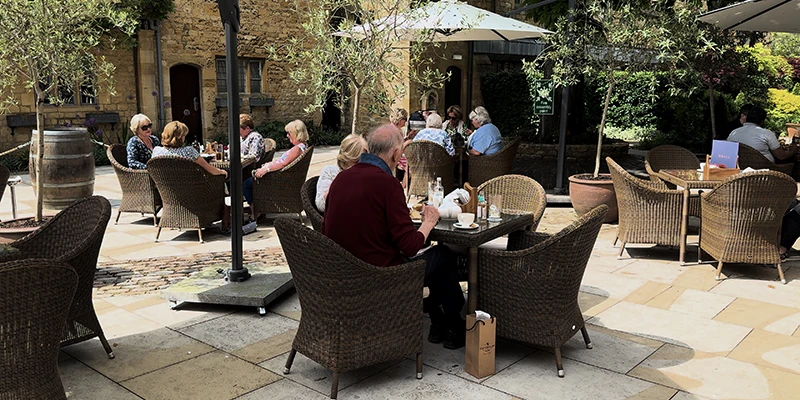
The Lygon Arms courtyard is open to the public for lunch and afternoon tea, not just hotel guests. Stone barrels serve as table bases, cream umbrellas shade the wicker chairs, and a mature chestnut throws dappled light over the patio. On a warm afternoon every table is taken, and the conversation hum is a mix of British and American accents.
.webp)
While the outdoor terrace is lovely, the inside bar has a cozy character: dark wood paneling, a brass-edged counter, low pendant lamps, and the softened light of a building with thick stone walls and small leaded windows. The hotel preserves the original beamed ceiling of the medieval inn in some of its older rooms. It is the sort of place where a single drink can stretch into an hour.
.webp)
The Lygon is not the only historic hotel in Broadway. The Swan Hotel sits a short walk further along the High Street, with its own outdoor dining terrace looking out toward the green. The Broadway Hotel and the more modern Lygon's Tavern (operated by celebrity chef James Martin) round out a hotel scene that gives Broadway an unusually wide range of overnight options for a village of perhaps three thousand residents. Smaller B&Bs and self-catering cottages fill in the rest.
.webp)
The Broadway Hotel itself, with its half-timbered Tudor wing visible from the green, is a three-star country hotel that has been operating in some form since the 15th century. Its outdoor terrace is a popular spot for lunch and afternoon coffee.
.webp)
For those not eating at a hotel, Broadway has a strong cluster of independent cafes and tea rooms. Tisanes Tea Rooms, in a cream-painted building tucked into a row of stone shops, is one of the village standards: full afternoon tea with sandwiches and scones, a small tea garden out the back, and the kind of patient service that takes your order without rushing. Sassy & Boo next door sells women's clothing and accessories; Tea Ink occupies an arched doorway in the same row, selling stationery and gifts.
.webp)
The Cotswold Pantry, further along the High Street, advertises lunches, cakes, pastries, and fresh coffee through bow-window panes. Hand-lettered chalkboards list the day's specials. Like Tisanes, it is the work of independent owners rather than a chain, which is broadly true of the eating places along the High Street.
.webp)
Shopping in Broadway runs heavily to the kind of independent operations that survive in well-heeled villages with steady tourist traffic. Broadway Deli, with its black-and-orange sign and crates of fresh produce out front, sells charcuterie, cheeses, local ales, and ready-to-eat lunch supplies. It is a popular stop for picnickers heading out to walk on the Cotswold Way, the long-distance footpath that passes through Broadway on its 102-mile route between Chipping Campden and Bath.
.webp)
The Goldsmithy is a working jewelers' shop, with a hand-painted shopfront sign declaring "jewellery designed and made in our workshop." Pieces in the window are largely the proprietor's own designs in gold and silver, often incorporating semi-precious stones cut on the premises.
.webp)
Broadway Cookshop sells cookware, knives, aprons, and kitchen tools. Wicker baskets sit outside in good weather and the shop occupies a small stone cottage with a leaded bay window and a display apron pinned in the glass.
.webp)
Blandfords of Broadway is the village bookshop, an independent occupying two adjoining shopfronts. One bay window holds adult titles, the other children's books. Stuffed animals and floral displays soften the interior. The shop has been a Broadway institution for decades.
.webp)
The Edinburgh Woollen Mill is an exception to the independent-shop pattern — it is part of a national chain — but its Broadway branch occupies a handsome old stone building and stocks the kind of British wool jumpers, tweed jackets, and tartan goods that are part of the village's tourist appeal.
.webp)
Broadway has its share of quirkier spots too. The Man Cave, a shop selling vintage signs and motoring memorabilia, has a life-sized rearing horse sculpture made entirely from automotive parts standing guard outside. It is a frequent stop for photographs, particularly when local dogs walk past on leads and stare it down.
.webp)
For those interested in the village's deeper history, the Broadway Museum & Art Gallery sits at the eastern end of the High Street in a tall stone Tudor building. Its collection covers local archaeology, the village's role as a coaching stop, and works by artists associated with the late-19th-century Broadway colony — a group that included John Singer Sargent, Henry James, and Mary Anderson, who gathered here for summer working holidays.
.webp)
The Cotswold Way and several shorter walks fan out from the village. A popular two-mile climb leads up to Broadway Tower, an early 19th-century folly built on a hilltop above the village; on a clear day the view from the top takes in twelve counties. Walkers can also follow easier paths north toward Willersey or south through farmland to the smaller villages of Buckland and Stanton.
.webp)
A day in Broadway typically goes something like this: a morning coffee in a tea room, an hour or two browsing the shops, lunch at one of the hotel courtyards or pub gardens, an afternoon walk along the green or out toward Broadway Tower, and a final cup of tea before driving on.
.webp)
For those who can stay longer, the village makes a comfortable base for exploring the broader Cotswolds — Chipping Campden is a short drive north, Stow-on-the-Wold and Bourton-on-the-Water are within easy reach to the south, and the great houses of Sudeley Castle and Snowshill Manor are both within twenty minutes. Two days here would not be too much.
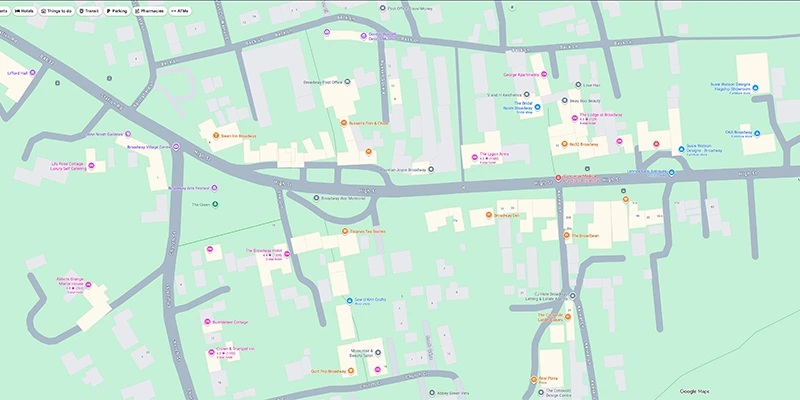
The town is compact, about 800 meters, or half-mile, end to end, easily explored on foot, as you see on this Google Map. Getting to Broadway is straightforward. Drivers come up the A44 from Oxford and Cheltenham, or down the A46 from Stratford-upon-Avon. The nearest train station is Honeybourne (about four miles away, with services from London Paddington and Worcester); a heritage steam railway, the Gloucestershire Warwickshire Steam Railway, runs into Broadway itself from Cheltenham Racecourse via Winchcombe. Several bus services connect Broadway with Evesham, Cheltenham, and other Cotswold villages, though service is infrequent on Sundays. Most visitors arrive by car or as part of a coach tour.
.webp)