Snowshill — A Cotswold Hamlet
.webp)
Snowshill is a small Cotswold hamlet tucked into a hidden valley about five miles south of Broadway, a quiet stop along the way for travelers exploring the region. The village has no through-traffic, no large hotels, and no shopping streets — just a sloping green, a row of honey-colored stone cottages, a parish church, and a single pub. For visitors making a daytrip through the Cotswolds, Snowshill rewards an hour spent on foot, walking the lane that loops past the church and back.
.webp)
The set piece of the hamlet is the church of St Barnabas, sitting on slightly elevated ground above the green and visible from every approach. The honey-colored Cotswold limestone of its walls turns nearly gold in afternoon sun, matching every cottage and garden wall in the village. The building dates from 1864, but in style and stone it belongs to the same architectural tradition as the cottages clustered below.
.webp)
The view down from the lane that runs above the church takes in the whole arrangement of the hamlet at once: the row of cottages on the far side of the green, the churchyard in the middle distance, and the wooded hillsides rising beyond. It is a scene that has changed remarkably little since the cottages were built.
.webp)
The cottages along the green show classic Cotswold features: walls of dressed honey limestone, steeply pitched roofs covered in thick stone slates, dormer windows breaking the rooflines, and hooded doors set close to the lane. Most date from the 17th and 18th centuries, when wool money paid for solid stone construction throughout the region. Many are now private homes; a few operate as holiday lets.
.webp)
A second cluster of cottages sits along the lane that climbs out of the village to the south. The line of buildings follows the curve of the road exactly, each cottage attached to the next, with small front gardens spilling lavender and cottage flowers over low stone walls.
.webp)
In late spring, several of the houses are spectacular with wisteria. One cottage near the green has a mature plant climbing the entire south face of the building, with pale lavender flower clusters hanging like grape bunches from every horizontal stem. The wisteria typically flowers in May and lasts perhaps two weeks before the petals drop.
.webp)
Smaller cottages are scattered along the lanes leading out of the green. A particularly photogenic example sits near the end of the upper lane, with two dormer windows tucked under a steeply-pitched stone roof and roses climbing the front. Cottages of this character regularly appear in calendars and travel articles about the Cotswolds.
.webp)
The Snowshill Arms is the village's only pub, set just across the churchyard from St Barnabas. The two-story stone building has been a public house for well over a century, occupying what was once a farm building.
.webp)
The signs outside announce its essentials: bar meals, large beer garden, Sunday roast, and traditional Donnington ales. Donnington Brewery, founded in 1865 and based at a watermill near Stow-on-the-Wold, is one of the oldest still-operating family breweries in England. Its three core ales — BB, Gold and SBA — are served at the Snowshill Arms, supplied directly from the brewery rather than through a national distributor.
.webp)
Inside, the pub has the low timber-beam ceiling, exposed stone walls, and well-worn wood floors of an old English country pub. A chalkboard on the wall describes each of the Donnington ales, with tasting notes in handwritten script. Locals and walkers mingle at the bar; on weekends the dining tables fill for Sunday roast.
.webp)
Returning to St Barnabas after a pub stop, visitors can walk the path that runs along the south side of the building to the porch, normally open during daylight hours. The church was built in Gothic Revival style with a square crenellated tower and pointed-arch windows, replacing an earlier medieval church that had stood on the same site. A small cemetery surrounds the building, with weathered headstones arranged loosely on the sloping ground — some markers date back several centuries, others recent enough to show that the village still uses its churchyard.
.webp)
The west end of the church holds a particularly fine traceried window with a quatrefoil rose at its peak. Lichen has spread across the stonework over the decades, softening the edges and adding a warm green tint to the limestone.
.webp)
The interior is simple and uncluttered, in keeping with a small parish church. Wooden pews flank a central aisle leading to the altar, which sits beneath a stained-glass east window depicting a religious scene in red, blue and gold. Pendant lights hang from the timber ceiling. The space holds perhaps a hundred worshippers at most.
.webp)
A weathered stone cross stands in the churchyard, of a type common to old Cotswold villages — a slim shaft on a stepped base, the cross-piece itself worn down by centuries of weather. Beyond the dry-stone wall enclosing the churchyard, the open Cotswold landscape rolls away toward the horizon.
.webp)
Among the village's holiday cottages is Broughwood Cottage, a beautifully presented luxury self-catering property well suited to couples seeking a quiet rural escape. The cottage combines traditional Cotswold character with thoughtful modern touches and sits within easy reach of Broadway, Chipping Campden and the wider North Cotswolds.
.webp)
The graveyard slopes gently away from the church, with headstones in varying states of weathering scattered across the grass. Many of the older markers have lost most of their inscriptions to lichen and erosion, leaving only the rough outlines of names and dates — a quiet reminder of how long the village has been settled in this fold of the hills.
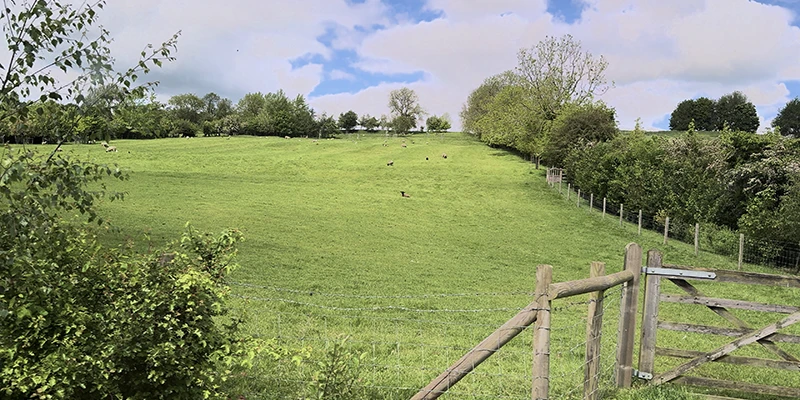
Beyond the village in every direction, sheep graze on Cotswold pasture, the same landscape that produced the wool trade that built the region's wealth six centuries ago. In May, fields of rapeseed bloom yellow on the hillsides. The Cotswold Way long-distance footpath passes nearby, and walkers tackling the route often divert into Snowshill for a pub lunch before continuing south toward Stanton or north toward Broadway.
The village is also home to Snowshill Manor, a Tudor manor house once owned by the eccentric collector Charles Wade, who filled it with an extraordinary 22,000-piece collection of craftsmanship from around the world — samurai armor, musical instruments, bicycles, toys, clocks. The house is now managed by the National Trust and remains substantially as Wade left it. The surrounding lavender fields, on a separate property nearby, bloom in mid-summer and are one of the region's most photographed sights when in full color.
.webp)
For visitors making the drive from Broadway, the road passes through several miles of open pasture and woodland before dropping into Snowshill's hidden valley. The hamlet is small enough that an hour covers everything, but the setting — the church and its cross on rising ground, the cottages curving around the green, the pub with its Donnington ales, the pastures stretching to the horizon — captures the essential character of the Cotswolds in concentrated form.