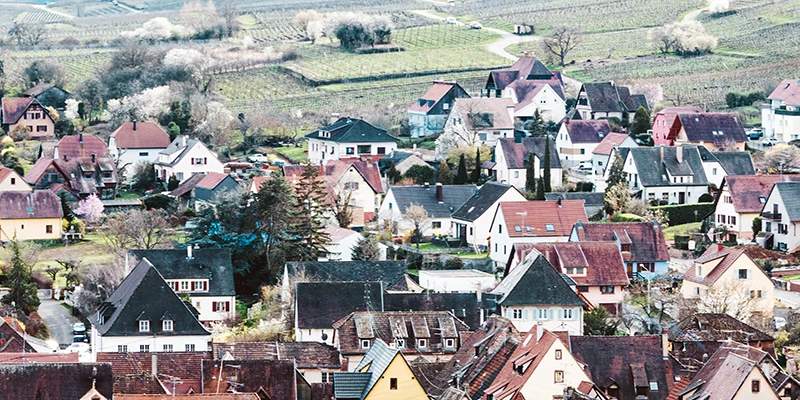
Riquewihr, France
Riquewihr is the one everybody remembers. A walled village of about twelve hundred people, it packs forty-six protected historic monuments into a few hundred meters of street, nearly as many as Colmar manages with fifty times the population. Local guides call it the pearl of the vineyard, and on the architectural evidence it is hard to argue.
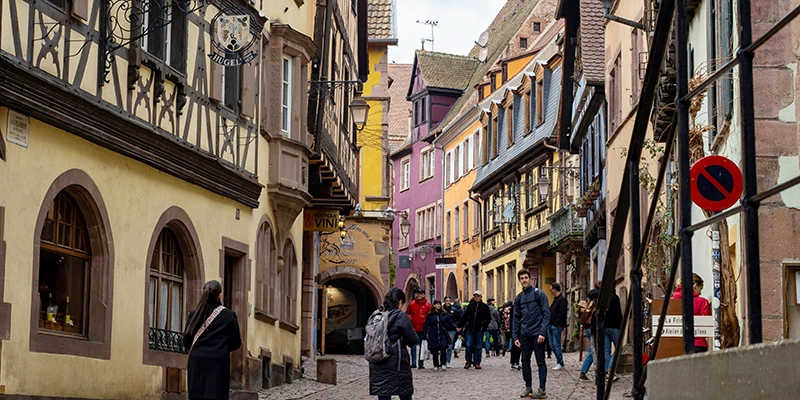
The Second World War passed over it almost without damage. The houses lining the main street are not restorations or reconstructions but originals, built between the fifteenth and eighteenth centuries and standing where they were put, which is unusual anywhere in this part of France and rare in Alsace in particular.
The Main Street
The village sits about twelve kilometers north of Colmar on the Route des Vins, midway between Kaysersberg and Ribeauvillé, with vineyards climbing the slope directly behind it. Most visitors arrive on a day trip covering two or three villages, by coach tour, public bus or car, and vehicles are left outside the walls.
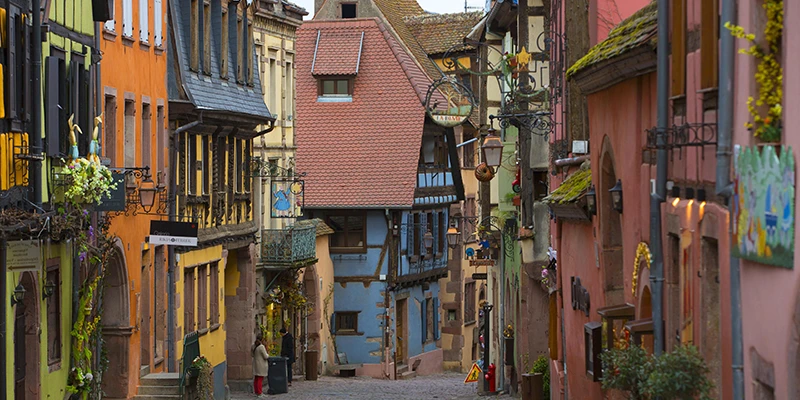
There is only one significant street, the Rue du Général de Gaulle, which runs uphill from the lower gate to the Dolder at the top. Walk up, look into the courtyards and side lanes on either side, and walk back down. The village is small enough that getting lost is not a realistic possibility.
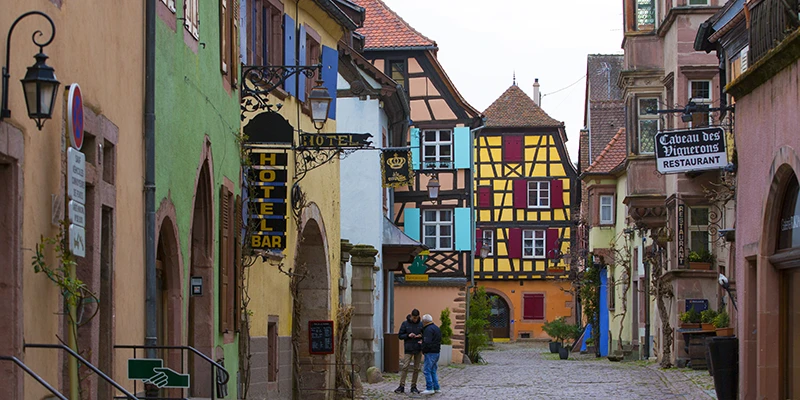
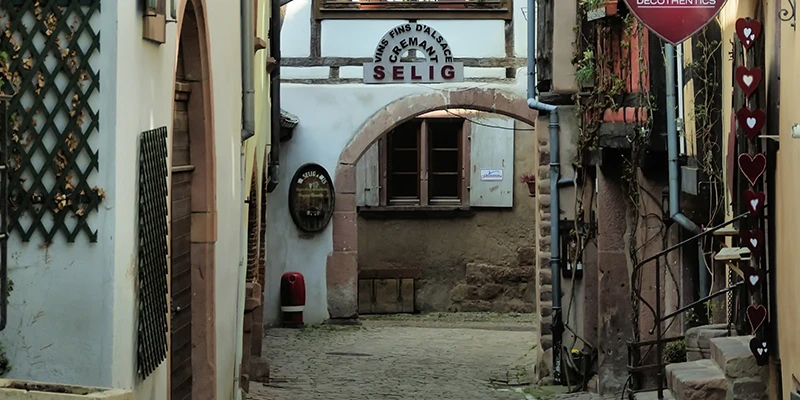
The side lanes are worth the detour. They are narrow, cobbled and mostly empty even when the main street is busy, and the courtyards behind the houses hold the stair towers, wells and cellar doors that go with a village built on wine.
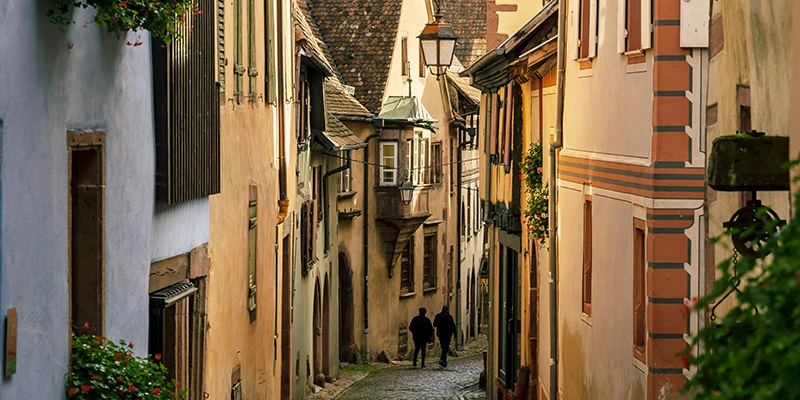
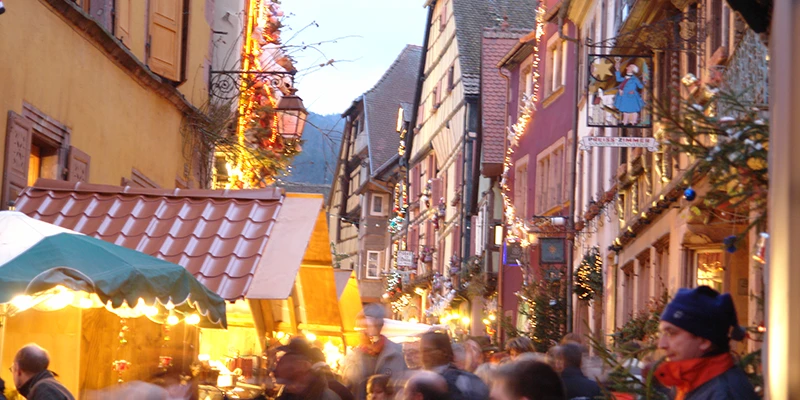
Wrought-iron trade signs hang over the lanes advertising bakers, wine growers and restaurants, several of them old enough to predate general literacy and shaped to be read at a glance. Vines and hearts are worked into most of them.
The Dolder and the Walls
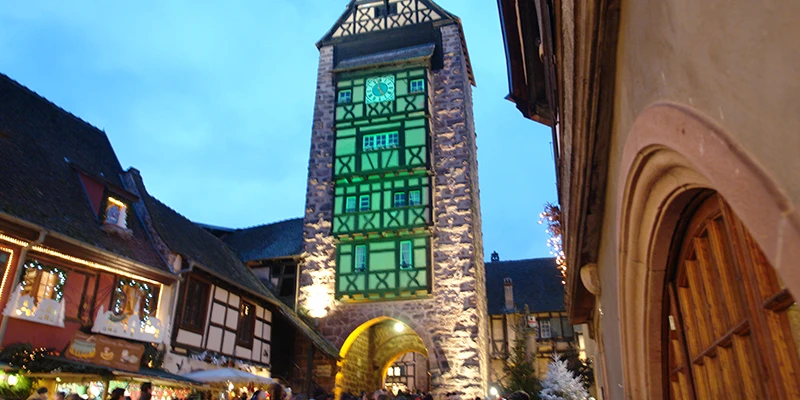
The Dolder is the landmark. It is the upper gate tower of the village, built in 1291 as part of the original ring wall, twenty-five meters high, with a bell stage, a clock face and a half-timbered upper story sitting on a stone base. It is one of the oldest surviving fortifications in Alsace.
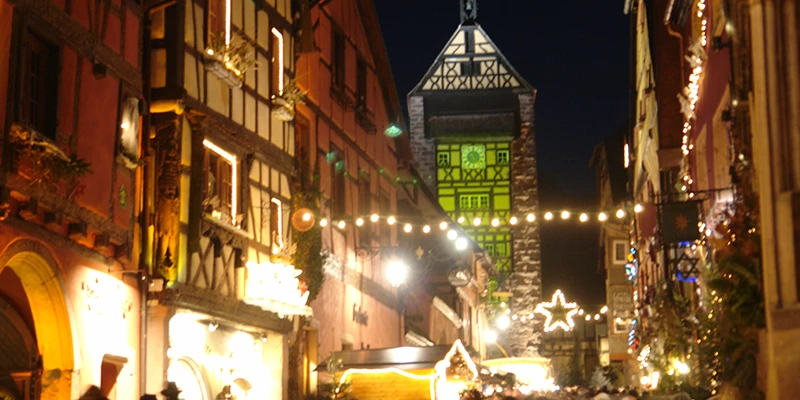
With the lights on and the sky gone deep blue behind it, the Dolder at the head of the street is the image that sells Riquewihr. A small museum inside covers the village's defenses, reached by a stair through the tower, and the upper windows look straight back down the length of the main street.
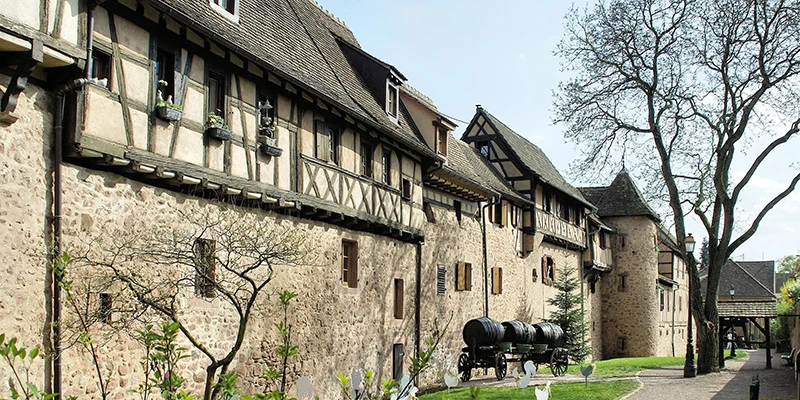
The wall it belongs to still runs around much of the village, a long stretch of masonry with the backs of buildings built into it and open ground outside. A second tower stands behind the main street, the Tour des Voleurs or Thieves' Tower, which contains a preserved guardroom and torture chamber, and an adjoining winemaker's house of the sixteenth century is open with it.
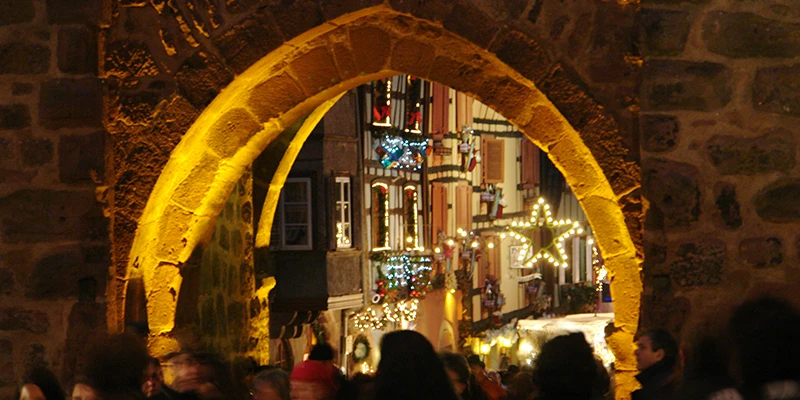
Stone gate arches mark where the fortified line crossed the street, and at night they frame the market stalls and the lit facades beyond. The masonry is unfaced and rough, in contrast with the painted and timbered houses on either side of it.
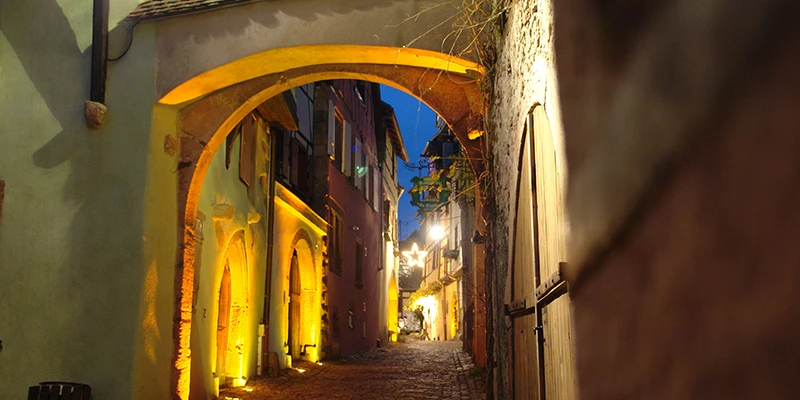
After dark the lanes off the main street are lamplit and almost empty. The cobbles hold the light, the upper floors lean in overhead, and the noise of the market drops away within a few steps.
Wine and Wealth
Riquewihr prospered on wine. Vines were planted here under the Romans, production was well established by the eighth century, and by the fourteenth the vineyards had spread across essentially the whole acreage they occupy now. The village passed to the counts of Württemberg in 1324 and stayed in that family until the Revolution.
That long stretch of stable ownership shows in the building stock. Trade in Riquewihr wine reached across Europe during the sixteenth century, and the wealth that came back produced the tall, dense, decorated houses that fill the walls today. Several carry their construction dates on the facade, and the courtyards behind them held the presses.
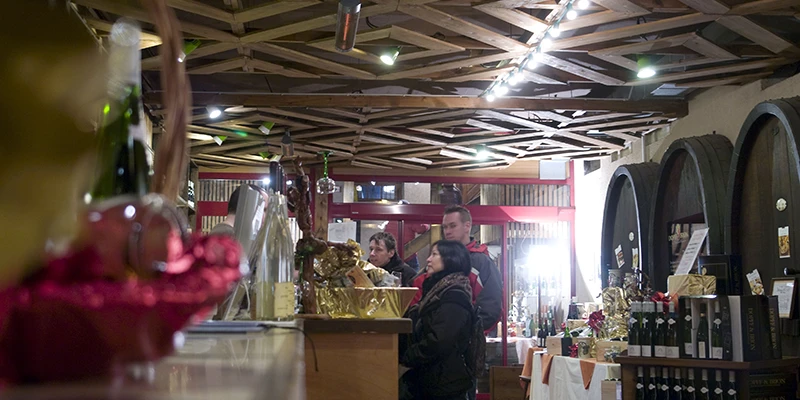
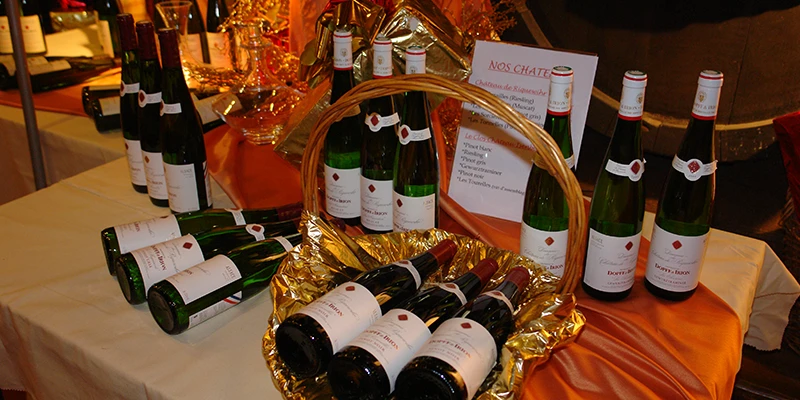
The vineyards immediately above the village include two grands crus, Schoenenbourg and Sporen, both long established and both planted mainly to Riesling. Wine tasting is the main indoor activity, and there are more cellars and tasting rooms per square meter here than anywhere else on the route. Alsatian whites are drier than their German counterparts across the Rhine and carry more alcohol, around twelve to twelve and a half degrees against eight or nine, with the Riesling running to citrus and a distinct mineral edge from the slopes.
The Christmas Market
The Christmas market is the largest of the wine-road villages and the reason the crowds thicken through December. Wooden chalets line the main street selling ornaments, carved wood, textiles and food, and the stalls run under the gate arches and along the lanes off the main street.
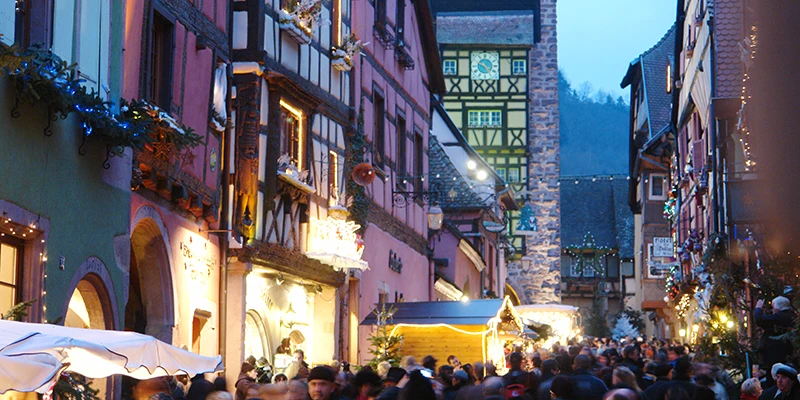
The best hour is late afternoon into evening, when the daylight goes and the lamps and strings of lights come on against the facades and the Dolder at the head of the street.
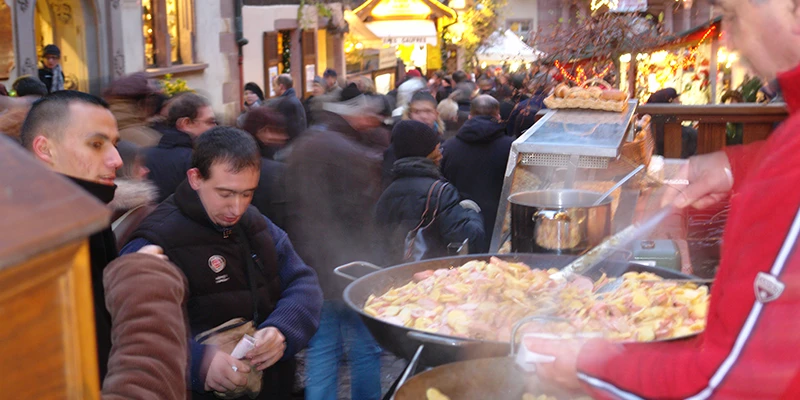
Food stands work through the afternoon and evening. Alsatian market food is substantial rather than delicate, running to sausage, cheese, potatoes fried with onions and bacon, tarte flambée and hot wine, and the queues are longest once the light goes.
By full dark the whole street is lit, the chalets glowing under the overhanging upper floors and the crowd moving slowly uphill and back down again. It is the busiest the village gets all year.
Museums and Visiting
The village keeps three small museums besides the Dolder. The Hansi Museum holds the work of Jean-Jacques Waltz, the illustrator who signed himself Hansi and whose drawings of storks, red-cheeked children in Alsatian costume and gabled villages fixed the popular image of Alsace in the early twentieth century. The others cover postal history and the stagecoach era.
Riquewihr is on the official list of the most beautiful villages of France and it draws accordingly, so the middle of a summer afternoon or a December Saturday can be uncomfortably full. Early morning and the last hour before the stalls close are noticeably better. It rewards a slow visit despite its size, mostly in the details above eye level: the carved beams, the dated lintels, the wells and stair towers in the courtyards, and the wrought-iron shop signs. Ribeauvillé is a few kilometers north and can be reached on foot through the vineyards in about an hour, Kaysersberg lies south, and the fortress of Haut-Koenigsbourg stands on the ridge above them all.