Ribeauvillé, France
Three ruined castles stand on the wooded ridge above Ribeauvillé, and the town below them is one of the most comfortable stops on the Alsace wine road. It is larger than the villages on either side of it, with a long main street of painted half-timbered houses, a thirteenth-century tower straddling the road at its midpoint, and enough width to absorb a crowd.
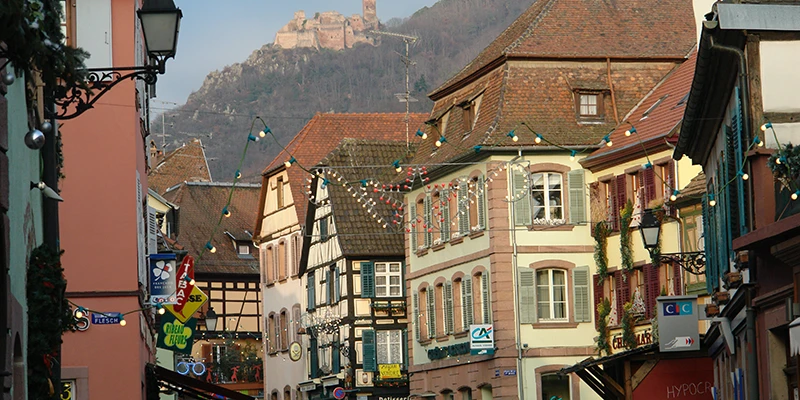
The castles are visible from inside the town, which is unusual and is the thing most people notice first. Look up the street in the right direction and the ruins sit on the skyline directly above the roofs, close enough to pick out the towers.
Getting There
Ribeauvillé lies about fifteen kilometers north of Colmar, at the foot of the Vosges where the vineyards run right up to the last houses. It is usually visited as part of a day along the Route des Vins, paired with Riquewihr a few kilometers south and often with the fortress of Haut-Koenigsbourg on the ridge to the north.
Coach tours from Colmar make the circuit through the Christmas season, and public buses connect the villages for anyone traveling independently. The walk between Ribeauvillé and Riquewihr through the vineyards takes about an hour on marked paths and is the better option in good weather.
The Grand Rue
The Grand Rue runs the length of the old town and carries nearly all of the activity. Its houses date from the fifteenth century onward, painted in the deep ochres, reds, blues and greens characteristic of Alsace, with shutters, window boxes, carved corner posts and stone door frames.
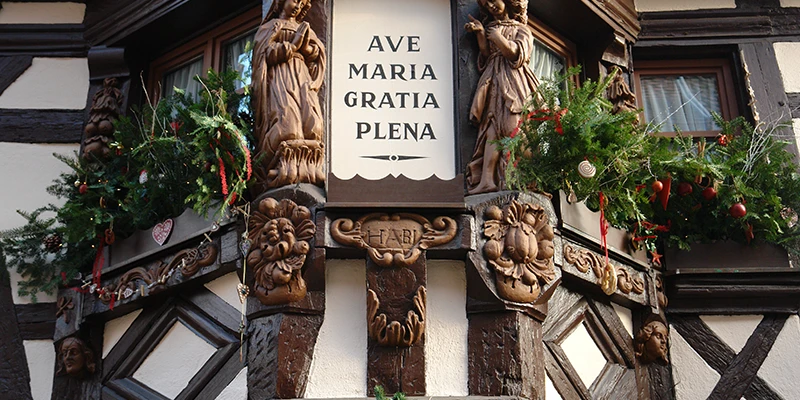
Look above the shopfronts and the detail multiplies. One facade carries a carved oriel with a Latin inscription reading Ave Maria Gratia Plena, flanked by figures, the sort of private devotional statement that a prosperous merchant could afford to build into the front of his house.
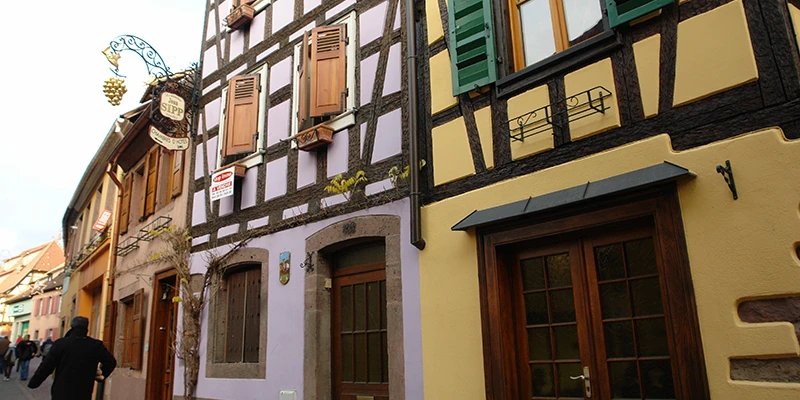
Others carry trade signs instead. Wrought-iron brackets project over the street advertising bakers, wine merchants and restaurants, several of them in shapes that predate literacy as a general condition and were meant to be read at a glance.
The Butchers' Tower
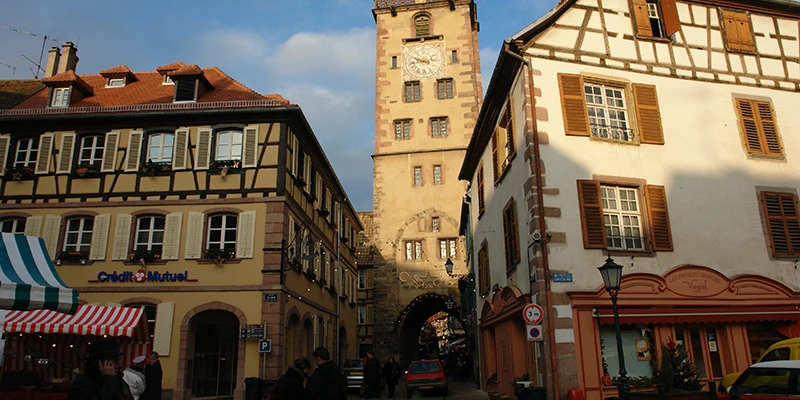
The Tour des Bouchers divides the town in two. It began as a thirteenth-century belfry in the town wall, was raised to its present height in 1536, and the road now passes beneath it through an arch, separating the Upper Town from the Middle Town.
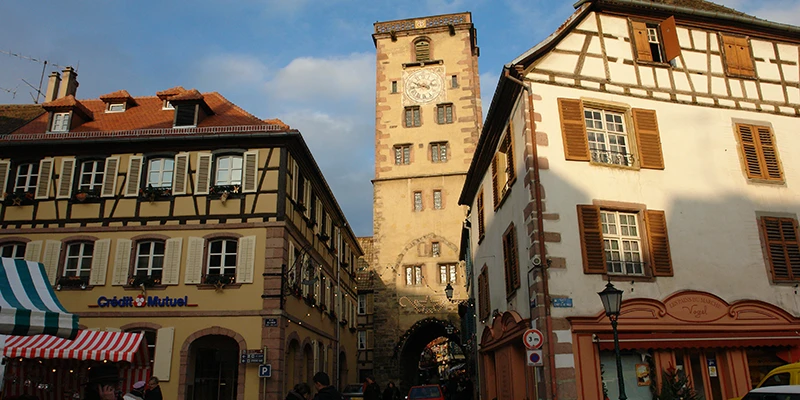
Its clock face and stepped gable make it the most photographed thing in Ribeauvillé after the castles. From the north side the tower stands clear of the roofline with the houses stepping away from it down the street.
From the other approach the tower closes the view entirely, with the arch beneath it framing the continuation of the street. The lower stages are plain masonry and the upper ones are worked, which is the usual sign of a defensive structure later rebuilt for show.
Farther along, a second stone gate arch marks where the wall once closed the street off. Passing under it the town changes character, from the wide market end to something narrower and quieter.
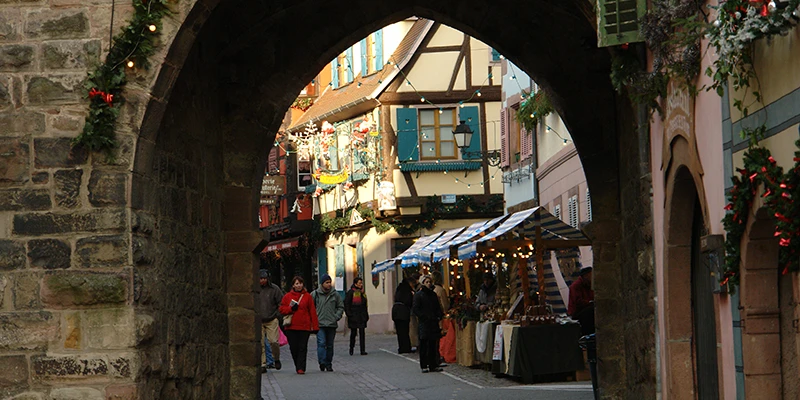
The arches are worth stopping under for the framing alone. Each one lines up on a run of painted facades, and in December the decorations and stalls appear through them in a way that no straight-on view of the street achieves.
The Town Hall and the Square
The town hall stands on the main square, an eighteenth-century building whose collection of medieval and Renaissance silver-gilt drinking tankards is displayed inside. During the market the square in front of it fills with stalls under striped awnings.
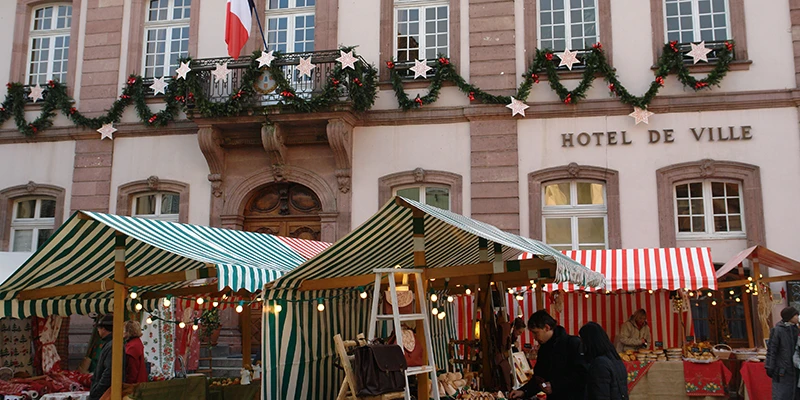
The stalls run the length of the square and up against the building itself, so the market and the town hall read as one composition. The awnings are red and green and the facade behind them is pale pink, which is either a happy accident or a very old habit.
The Castles Above the Town
Ribeauvillé was the seat of the lords of Ribeaupierre, one of the most powerful families in Alsace, and the three castles above the town were theirs. Saint-Ulrich is the largest and best preserved, with a Romanesque hall still standing. Girsberg sits on a narrow spur beside it, and Haut-Ribeaupierre is higher and further back.
All three are ruins, reached by a marked footpath that climbs steeply out of the town, a walk of about an hour and a half for the full circuit. From the vineyard edge on the north side they line up along the ridge, which is the view in most photographs of the place.
The Ribeaupierre lords held a peculiar hereditary office. They were the official protectors of the traveling musicians of Alsace, and the fiddlers' guild assembled here every year to pay its respects. The tradition survives as the Pfifferdaj, held on the first Sunday of September, with a costumed parade and free wine from the town fountain. It is the oldest festival in Alsace.
Wine
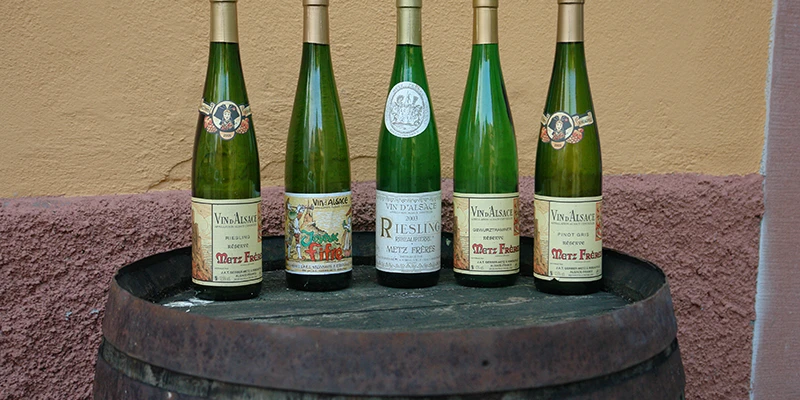
Wine is the working economy. The slopes immediately above the town produce three grands crus, Geisberg, Kirchberg de Ribeauvillé and Osterberg, planted mainly to Riesling, and the cellars along the main street are open through the day for tasting.
Bottles are set out on barrels at the cellar doors, which is both advertising and an accurate description of what is inside. Alsace bottles its whites in the tall green flute, a shape fixed by regional law, so a row of them is recognizable from across the street.
The vine motif turns up all over the town as decoration. Bunches of grapes are worked into ironwork, painted on signs, carved on lintels and set into the planting boxes along the street, a reminder that everything here rests on the slope behind the houses.
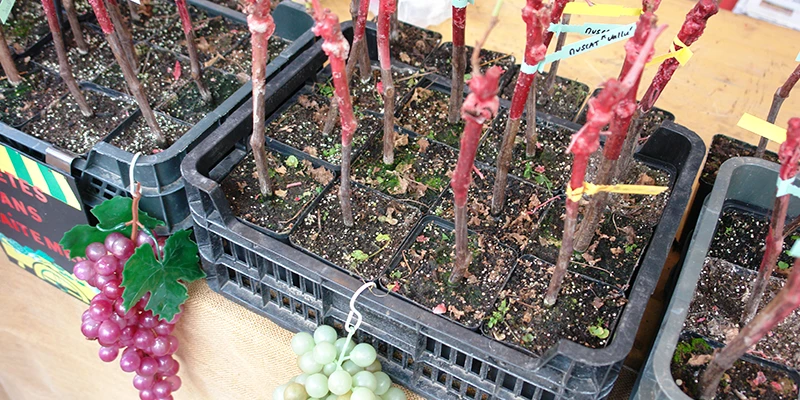
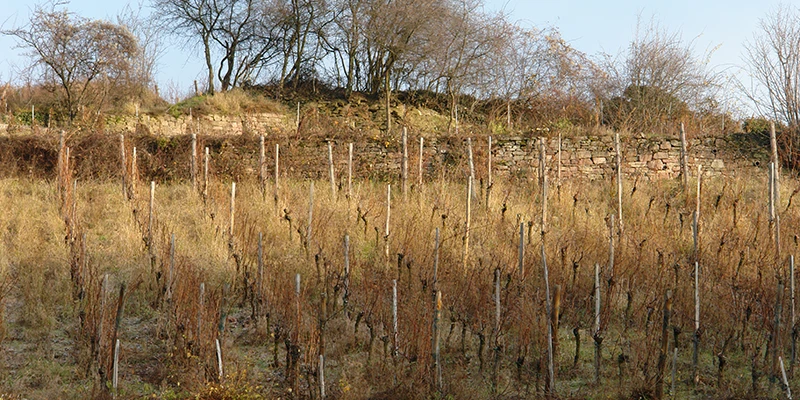
In December the vineyards themselves are cut back and bare, dark rows of stakes running up the hillside behind the roofs. It is not the picturesque season for the vines, but it is when the pruning happens and when the wine from the previous vintage is ready to sell.
Bakeries and Food
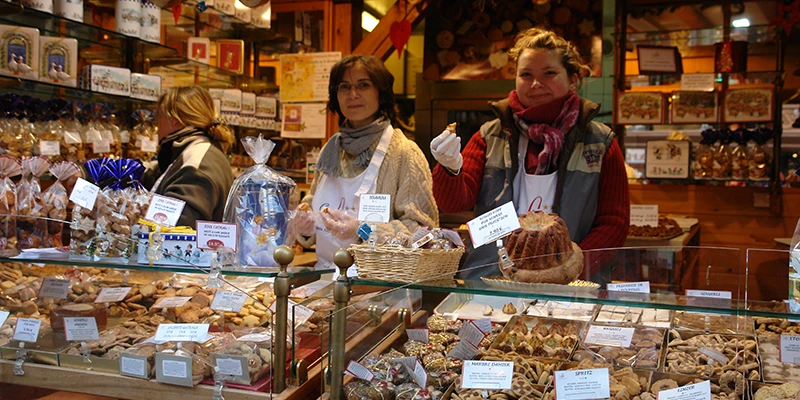
Bakeries are a large part of the pleasure of the town. Alsatian baking combines French and German traditions, so the same shop will sell baguettes alongside dense dark loaves with thick crusts and nuts baked through them.
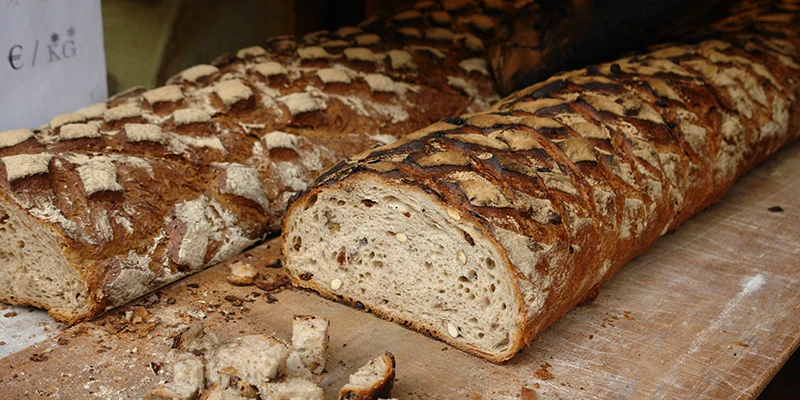
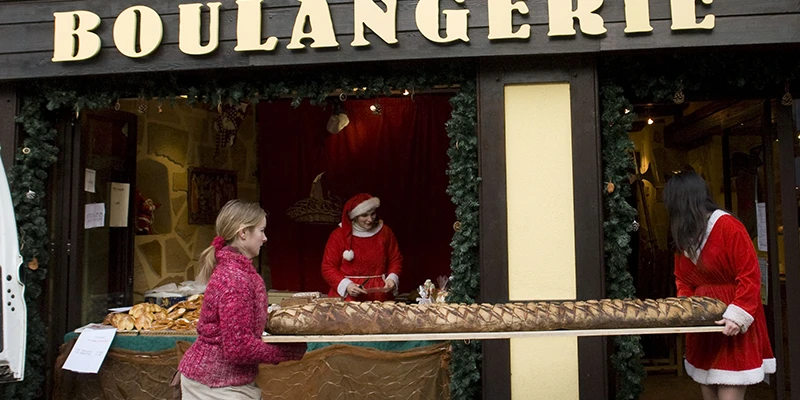
During the market weeks the bakeries produce on a scale to match the crowds. A single loaf several feet long is carried in fresh from the oven and set out across the shopfront, which is not a stunt so much as arithmetic.
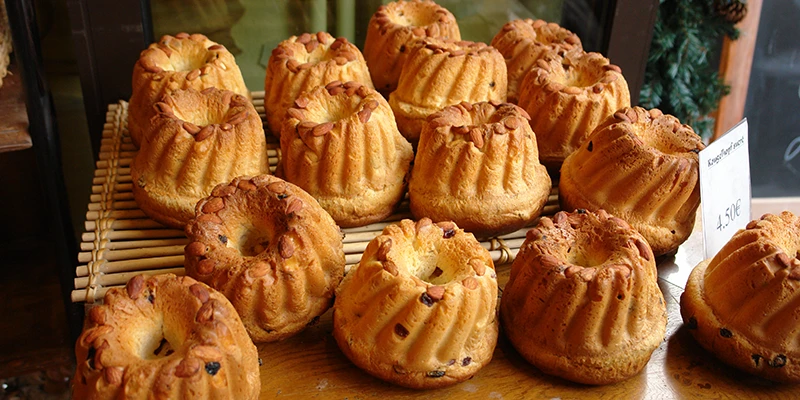
The regional cake is kougelhopf, a fluted ring of yeasted dough with raisins and almonds baked in a glazed earthenware mold. It is sold plain for breakfast and in a savory version with bacon and walnuts to go with wine.
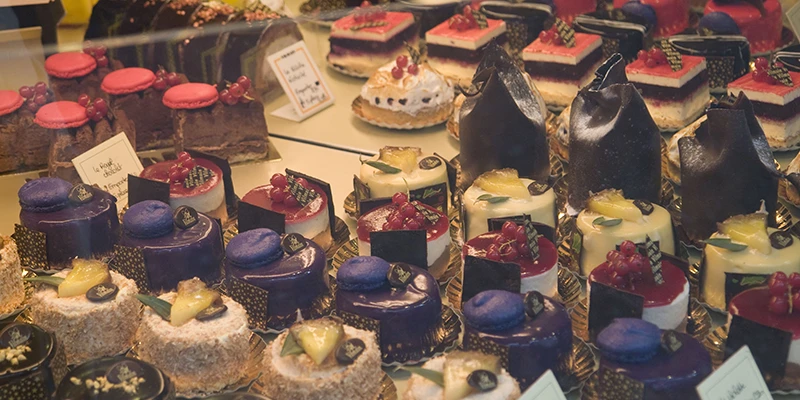
The pastry counters run to Christmas colors through December, with small iced cakes and spiced biscuits stacked by the dozen. Alsatian households bake bredele by the tin through Advent and the shops compete with them.
The Medieval Christmas Market
The Christmas market here is deliberately different from the others on the wine road. It runs as a Marché de Noël Médiéval over two weekends, with stallholders in period costume, torches, jugglers and musicians in the streets, and mulled wine served from cauldrons.
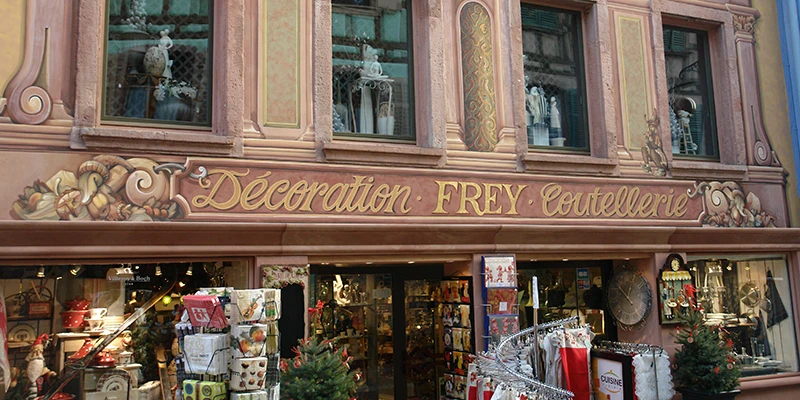
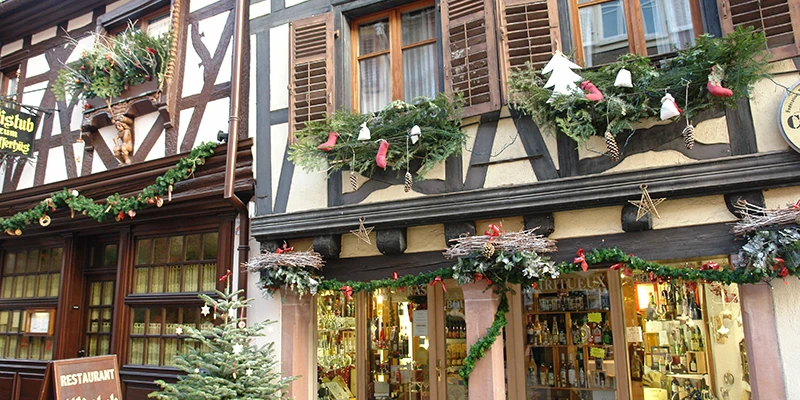
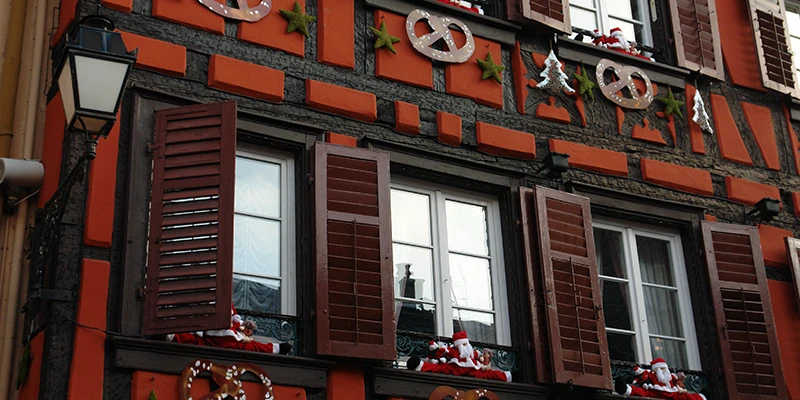
The shops decorate to match. Whole facades are turned over to the season, with garlands, figures and lit windows, and several of the specialist Christmas shops stay open year-round on the strength of it.
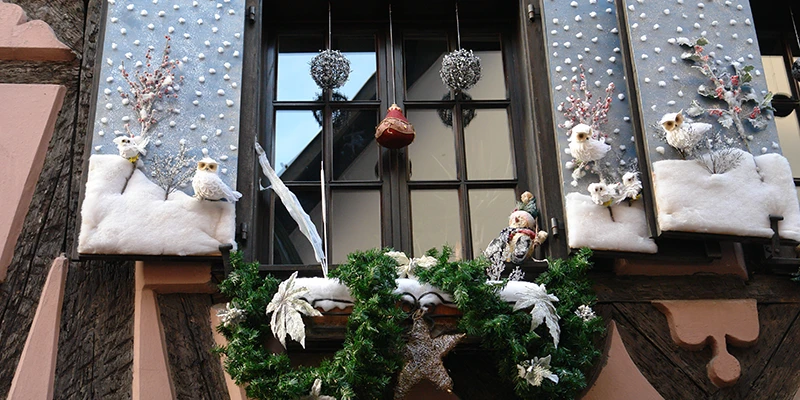
Individual windows are worth a look on their own account. Snowmen, straw stars, carved figures and fir sprays are arranged behind the glass and along the sills, and the arrangements change from house to house down the street.
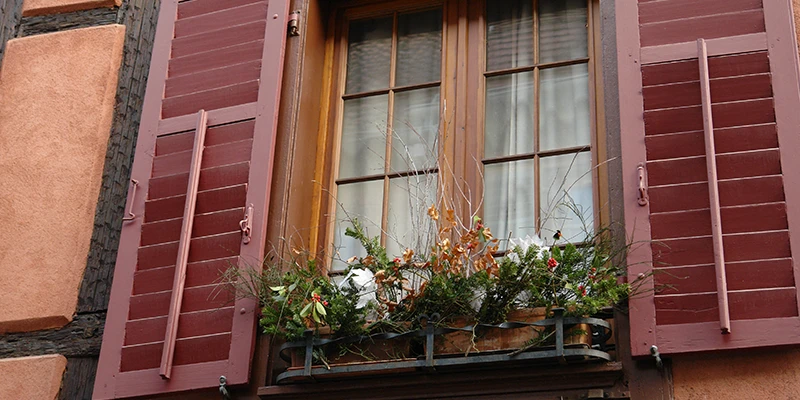
The rest of the year the same sills carry geraniums. Window boxes are close to universal in Alsace and are a matter of some local competition, with the reds and pinks set against shutters painted to contrast.
The Back Lanes
Away from the Grand Rue the town empties out quickly. The back lanes are residential, with parked cars and closed shutters, and they give a better sense of the size of the place than the market street does.
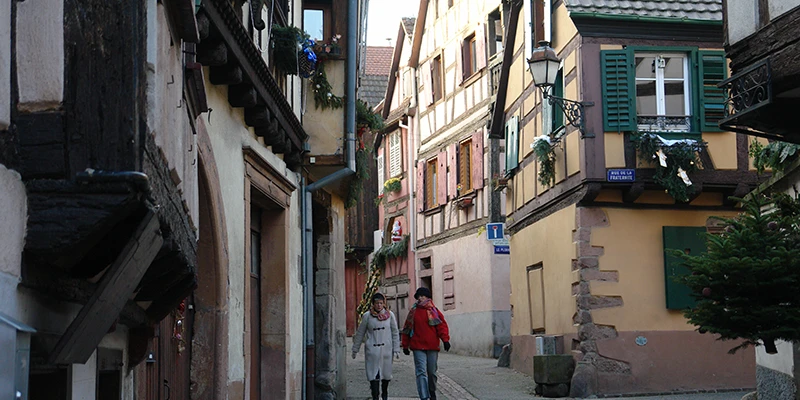
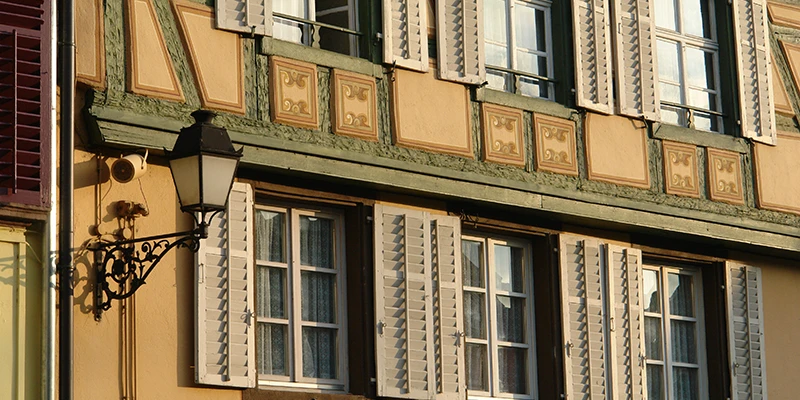
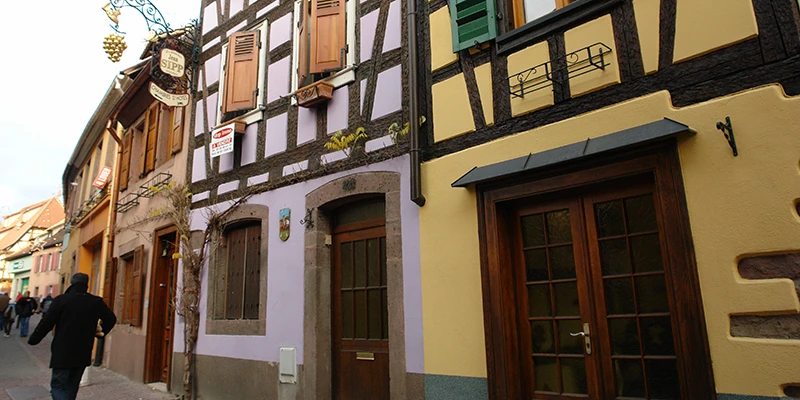
The paintwork is what holds the attention there. Facades in blue, green, ochre and rose sit next to each other without any apparent scheme, and the half-timbering is picked out in a contrasting color on most of them.
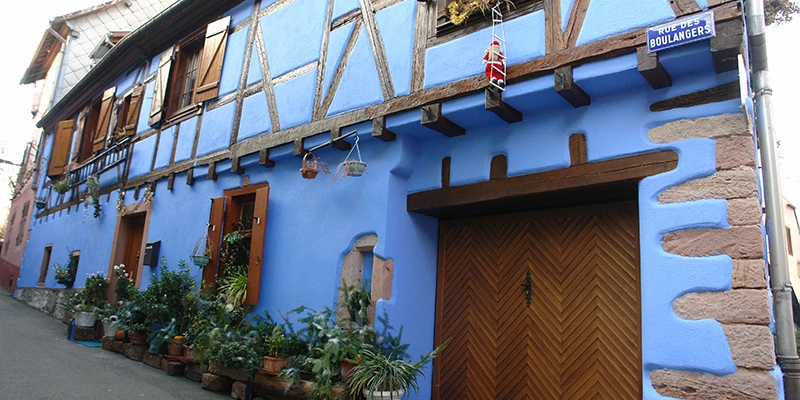
Some of the framing is genuinely elaborate, with curved braces, crossed struts and carved corner posts, all of it structural before it was decorative. The dates on the lintels put most of it in the sixteenth and seventeenth centuries.
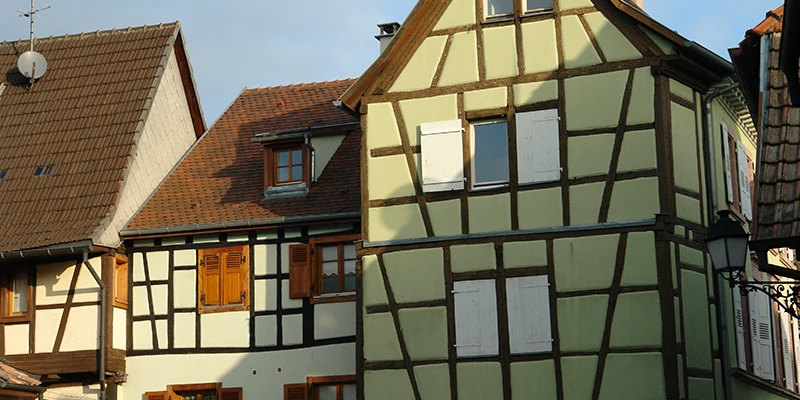
The upper floors overhang the lower ones in the medieval fashion, so the lanes narrow as they rise. On the wider streets the effect is lost, but in the back lanes the houses lean toward each other overhead.
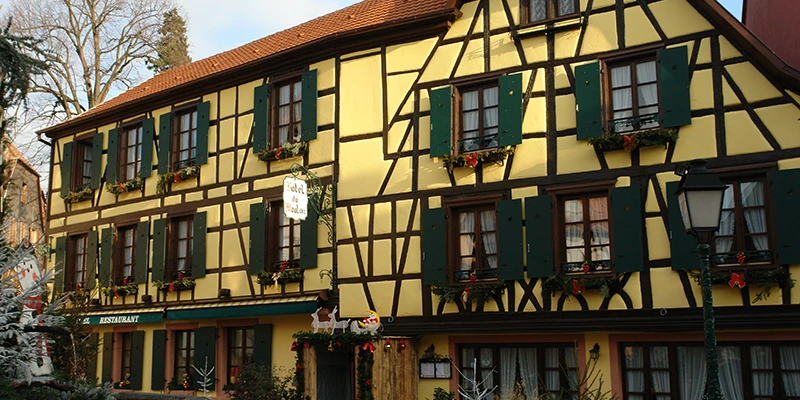
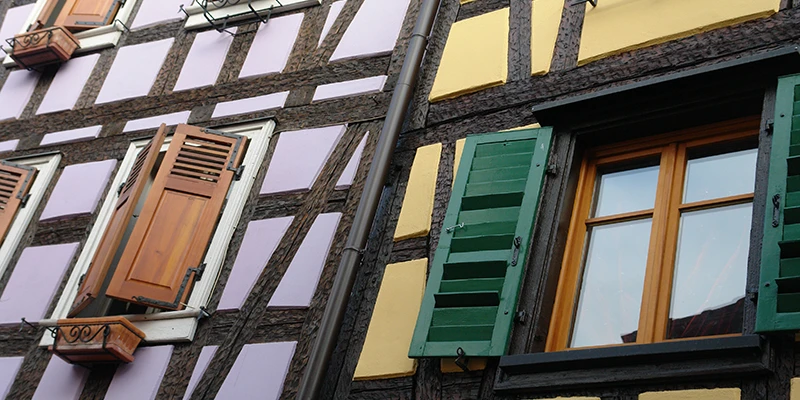
Closer still, the joinery is the point. Pegged joints, chamfered edges and painted infill panels are visible from the street on almost every building, and none of it is reconstruction.
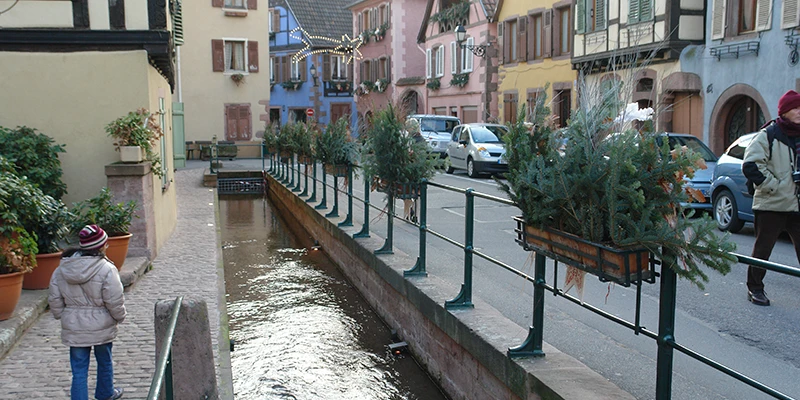
A stream runs along one edge of the old town, channeled between stone walls with a walkway beside it and houses backing onto the water. It is a short stretch and easy to miss, but it is the quietest corner of Ribeauvillé.
Beyond the Market Season
Ribeauvillé is worth a stop outside December as well. It has a mineral spring bottled and sold across France, a casino, and more hotel and restaurant capacity than its neighbors, which makes it a practical base for several days on the wine road rather than a two-hour visit. The stork park at Hunawihr is a couple of kilometers south, Riquewihr is close enough to walk to, Kaysersberg lies beyond it, and Haut-Koenigsbourg stands on the ridge to the north.