Vienna Day Two: Schönbrunn Palace and the Old Town
.webp)
Day Two begins with a visit to Schönbrunn Palace, the Habsburg summer residence, then returns to the old town for a walking tour of the hidden lanes and pedestrian streets behind the cathedral. The day ends with an evening at a Heuriger wine tavern in the vineyard villages on Vienna's outskirts.
Getting Around Vienna
Vienna has an excellent public transport system with five U-Bahn (metro) lines, an extensive tram network, and buses running until late evening. A single-fare ticket costs a few euros and includes free transfers within about an hour. The 24-hour, 48-hour, and 72-hour passes give unlimited travel and are worth the cost for convenience. The Vienna City Card bundles unlimited transit with discounts at around 200 museums, sights, and restaurants.
For Day Two, take the U4 metro line from Karlsplatz to Schönbrunn station — the journey takes about ten minutes. The palace entrance is a short walk from the station exit.
Schönbrunn Palace
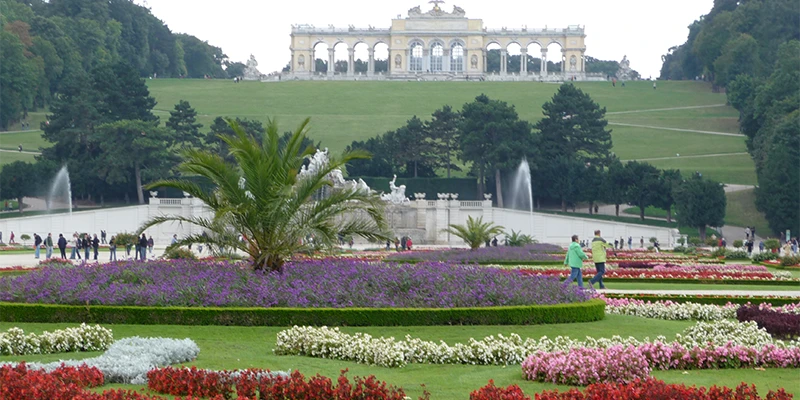
The summer palace of the Habsburg emperors, Schönbrunn is one of Europe's finest Baroque ensembles and a UNESCO World Heritage Site. The palace has 1,441 rooms, of which 40 are open to visitors. Two tour options are available: the Imperial Tour covers 22 rooms including the apartments of Franz Joseph and Empress Elisabeth (Sisi); the Grand Tour adds 18 more rooms including the Hall of Mirrors where the six-year-old Mozart performed for Maria Theresa.
The palace began as a hunting lodge in the 1560s. After the Ottoman siege of 1683, Leopold I commissioned Johann Bernhard Fischer von Erlach to rebuild it as an imperial residence rivaling Versailles. Maria Theresa later expanded and remodeled it to its present form, adding the distinctive yellow façade — "Schönbrunn Yellow" — that became the official color of imperial buildings throughout the empire.
copy.webp)
The gardens behind the palace extend for over a mile, with manicured flowerbeds, tree-lined allées, fountains, and statues. Walk up the hill to the Gloriette, a colonnaded arcade built in 1775 to commemorate Maria Theresa's military victories. The café inside offers panoramic views across the palace, gardens, and Vienna beyond. Other garden features include the Neptune Fountain, the Roman Ruins (an 18th-century folly), and the Palm House — a massive iron-and-glass greenhouse from 1882.
Allow at least two hours for the palace interior, longer if you want to explore the gardens thoroughly. The Tiergarten (zoo), the world's oldest, is in the palace grounds and worth a visit if you have time. A café in the former Orangery serves Viennese pastries.
Hidden Lanes Behind the Cathedral
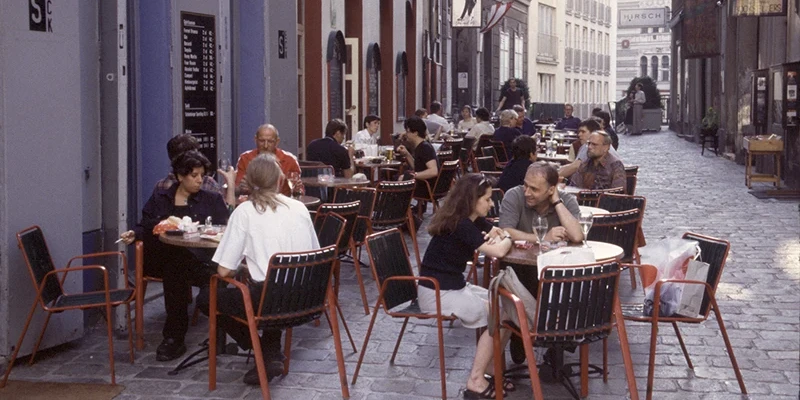
Return to the city center by U-Bahn and begin a walking tour of the quiet lanes behind Stephansdom. This neighborhood, once home to the medieval town's artisans and merchants, retains its intimate scale and cobblestone charm. Start at the Domgasse, where Mozart lived from 1784 to 1787 — the apartment is now a small museum. Continue to the Blutgasse, a narrow passage whose name recalls a medieval massacre, then emerge onto the Schönlaterngasse (Beautiful Lantern Lane), one of Vienna's most photographed streets.
.webp)
A block away, the Jesuitenkirche (Jesuit Church) has one of Vienna's most spectacular Baroque interiors. The ceiling fresco by Andrea Pozzo creates an illusion of an immense dome — but stand in the wrong spot and the perspective collapses. The church was built between 1623 and 1631, and Pozzo added his trompe-l'œil masterpiece in the 1700s.
Continue to Dr.-Ignaz-Seipel-Platz, a small square flanked by the Academy of Sciences and the church, with a good view of the Jesuit façade. From here, wander through the lanes to emerge at Hoher Markt, Vienna's oldest square, where you can watch the Ankeruhr — an Art Nouveau clock from 1911–1914 whose mechanical figures parade across its face at noon.
Graben, Kohlmarkt, and the Pedestrian Heart
copy.webp)
Walk toward the Graben, the grand pedestrian boulevard that runs from Stephansplatz to the Kohlmarkt. The Graben takes its name from the moat (Graben) that once ran along the Roman camp's southern wall. Today it is lined with Baroque façades, expensive shops, and outdoor cafés. At its center stands the Pestsäule (Plague Column), a Baroque pillar erected in 1693 to commemorate the end of the Great Plague of 1679.
.webp)
The side streets off the Graben reward exploration. Petersplatz holds the Peterskirche (St. Peter's Church), a small Baroque gem modeled on St. Peter's in Rome. The Naglergasse and Tuchlauben lead to Am Hof, Vienna's largest enclosed square, site of the former mint and the Church of the Nine Choirs of Angels.
The Kohlmarkt continues from the Graben to Michaelerplatz and the entrance to the Hofburg. This elegant street has been the address of Vienna's finest shops since the 18th century. At No. 14, Demel is the most famous of Vienna's traditional pastry shops — former purveyor to the imperial court, rival to Café Sacher, and still serving elaborate cakes and confections in a setting of chandeliers and mirrored walls.
copy.webp)
Coffee-House Tradition
Vienna's coffee-house culture is UNESCO-listed intangible heritage. The traditional Kaffeehaus serves as living room, reading room, and meeting place — guests linger for hours over a single coffee, reading newspapers mounted on wooden holders. Beyond Demel, other classics include Café Central (where Trotsky played chess before the Revolution), Café Sperl (wood-paneled and unchanged since 1880), and Café Hawelka (haunt of artists and writers). Order a Melange (similar to cappuccino), an Einspänner (espresso with whipped cream in a glass), or a Kleiner Brauner (small coffee with milk on the side).
Freyung and Minoritenkirche
From Am Hof, continue to the Freyung, another historic square. The name means "sanctuary" — fugitives who reached the Schottenkirche (Scottish Church) on its north side gained immunity from arrest. Today the square hosts a farmers' market on weekends and Christmas markets in December. The Palais Ferstel arcade, on the square's south side, connects to Herrengasse and the Café Central mentioned above.
(02)copy.webp)
A block away, the Minoritenkirche (Church of the Friars Minor) contains a full-scale mosaic copy of Leonardo's Last Supper, commissioned by Napoleon and completed in 1814. The original is in Milan; this reproduction, made of millions of tiny stones, preserves the composition without the damage that has plagued the original. The Gothic church itself dates from the 1270s.
Evening at a Heuriger
End the day with an evening at a Heuriger — a wine tavern in one of the vineyard villages on Vienna's northern outskirts. Grinzing is the most famous, accessible by tram 38 from Schottentor (about 25 minutes). Other villages include Nussdorf, Heiligenstadt, and Neustift am Walde — each with its own character and less tourist traffic than Grinzing.
A Heuriger serves new wine (Heuriger means "this year's") from the tavern's own vineyards, along with a cold buffet of meats, cheeses, spreads, and bread. Seating is at long wooden tables, often in courtyards or gardens with views of the vine-covered hills. Many Heurigen have live Schrammelmusik — the folk music of Vienna, played on violin, accordion, and guitar. Look for a pine branch (Buschen) above the door — the traditional sign that the tavern is open and serving new wine.