Vienna Day One: The Historic Center
The historic center of Vienna is a UNESCO World Heritage Site. Hopefully you are staying at a convenient hotel in the center of town and will be able to have a nice breakfast, then easily walk to Stephansplatz to begin the day. There is also a U-Bahn stop here. Several pedestrian streets meet at this focal point, flanked by the great cathedral, many shops, and a stark postmodern structure — the Haas House — containing a small shopping mall and, upstairs, a trendy restaurant with a fine view over the heart of town.
Stephansdom
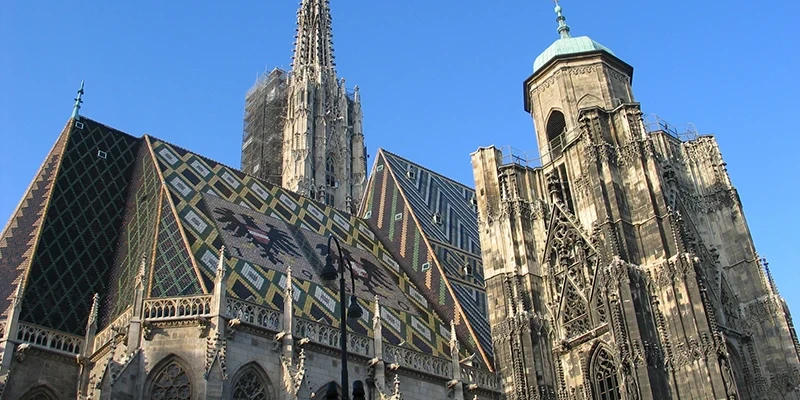
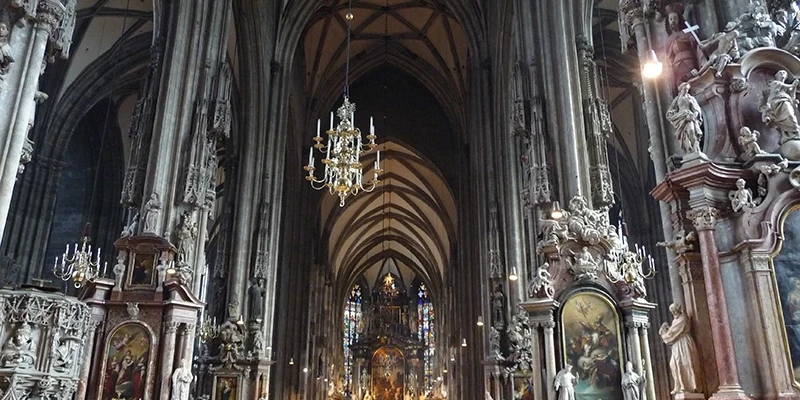
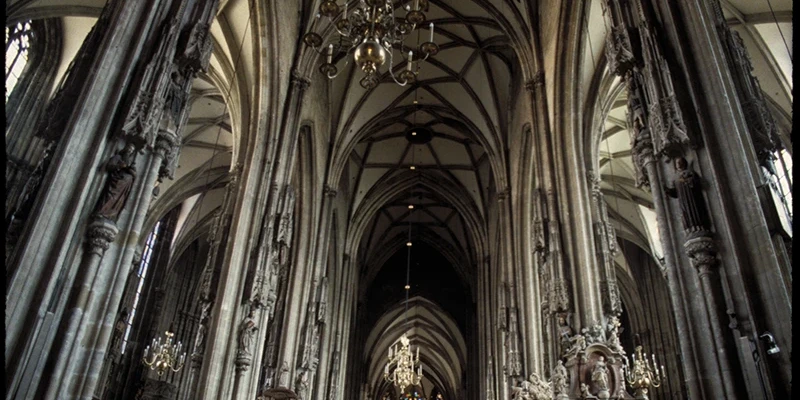
St. Stephen's Cathedral, the symbol of Vienna, was first constructed in the 12th century. It is so ancient that the façade is older than the Gothic and dates back in style to the Romanesque. After a great fire in 1258 destroyed most of the original structure, Gothic reconstruction began and the church continued to evolve during the next four centuries as different styles gained favor, culminating in the elaborate Baroque high altar finished in 1647. Unlike many purely Gothic churches, the interior is bright, with light through large clear windows revealing the artistic treasures within.
Stairs will bring you to a viewing platform partway up the 449-foot south tower, or you can take an elevator about 200 feet up the north tower for a panoramic look across the inner town and a view of the cathedral's multicolored, zigzag pattern of glazed roof tiles.
Kärntnerstrasse
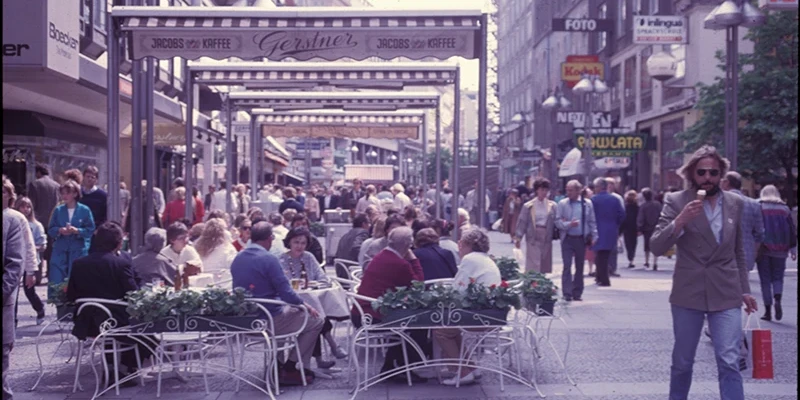
Kärntnerstrasse is the major pedestrian shopping mall in town. Heading toward the Opera on the Ringstrasse you will find many shops in the mid-price range and outdoor cafés for nearly the entire length.
Detour one block to the Neuer Markt to visit the Kapuzinergruft — the Imperial Crypt beneath the Kapuzinerkirche — only if you must see the final resting place of the Habsburgs, with 138 members including 12 emperors and their families, minus their hearts, which are kept elsewhere. Otherwise, the Neuer Markt square itself is mostly a few old buildings around a fountain.
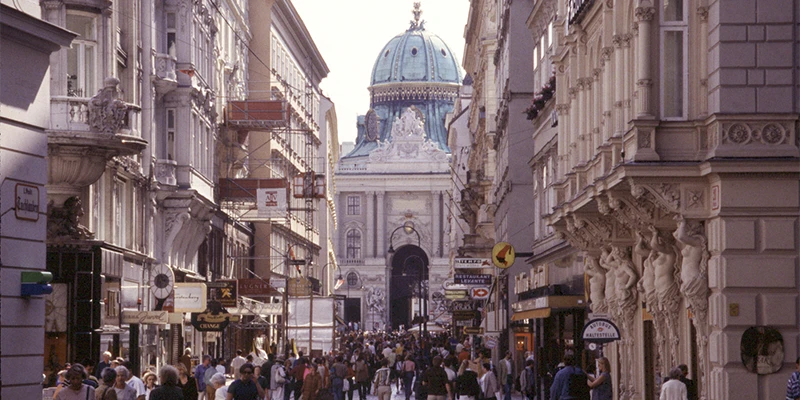
One of the reliable inexpensive eateries in this neighborhood is Rosenberger Markt, just around the corner on Maysedergasse — a large self-service basement buffet with a wide assortment of fresh foods, open most of the day and evening. Save some dining experiences for the more authentic taverns and gourmet restaurants that abound in this culture capital. Consider returning to Kärntnerstrasse after 5 p.m., when street musicians show up to entertain the crowds.
From Kärntnerstrasse, turn right on Philharmonikerstrasse, the street just behind the Opera, to reach the famous Hotel Sacher — a five-star deluxe property in the center of town. For most visitors the appealing part is Café Sacher, where you can get Original Sachertorte, the world's most famous chocolate cake, served with a dab of whipped cream. The café also serves apple strudel and other pastries, but the reason to come is the cake, and to enjoy the opulence of the lobby and public rooms.
.webp)
When Kärntnerstrasse meets the Ringstrasse you will have arrived at the Vienna State Opera House, one of the world's leading opera venues. A grand building constructed between 1861 and 1869, the Staatsoper is among very few opera houses to present a different performance nearly every night of the year, except July and August. It is an extremely busy place, with thousands of staff moving scenery and putting on top-quality performances. Tickets can be expensive and hard to get, but you can usually obtain standing-room space inexpensively right before the performance begins. Check with the box office or the Opera's website in advance. See the Music and Wine page for more on concert and opera options.
Karlsplatz
A convenient shopping gallery beneath the 200-foot-wide Ringstrasse at this intersection offers fast food, tourist information, and an express underground route of two blocks directly to Karlsplatz, where you can gaze at Karlskirche, one of the town's most impressive creations. Fischer von Erlach built this Baroque church from 1716 to 1740 in a rich mix of styles based on several important buildings in Rome. The columns flanking the façade are interpretations of Trajan's Column, updated to tell the story of the patron saint, Charles Borromeo. The church borrows elements from Sant'Agnese in Agone on Rome's Piazza Navona (Von Erlach was inspired by Borromini), the Pantheon, and St. Peter's.
If you would like to see the Naschmarkt, Vienna's largest outdoor food market, it is a few blocks behind Karlskirche, with about 120 stalls of gourmet and take-out items. On Saturdays a sprawling flea market sets up at its western end, drawing crowds in its own right.
Another important building across from Karlsplatz is the Musikverein, Vienna's celebrated concert hall — reputedly with the finest acoustics of any venue in this musical town — so this would be an excellent choice for a night out, especially for one of the regular Mozart concerts with performers in historic costumes. The New Year's Day Concert by the Vienna Philharmonic, televised worldwide, is broadcast from here.
A block away on the other side of the square you can see the golden dome of the Secession Building, built in 1898 by the Vienna Secession — the Art Nouveau rebellion led by Gustav Klimt and others. Inside, Klimt's Beethoven Frieze, a 34-meter mural cycle from 1902, is one of the great works of Vienna Jugendstil and worth the admission on its own.
Karlsplatz is the main focal point of Vienna's transit system, where multiple U-Bahn lines and surface trams converge. Two original Otto Wagner metro pavilions from 1898 still stand at the square — one restored as an exhibition space about Wagner himself. This would be an excellent place to take a break or catch a train, but your next stops are just a few blocks away on the Ring, so keep walking. You are also close to the Hotel Imperial on the Kärntner Ring, the grandest of Vienna's top hotels, with one of the city's great lobbies if you want a look.
Walking west for six blocks along the Ringstrasse, you are heading for the Kunsthistorisches Museum, but first cross to have a look at the marble statue of Mozart in the Burggarten, a pleasant park in the Hofburg's back yard. Wolfgang spent the last ten years of his life in Vienna, producing most of his famous works while moving house at least every year. The park also holds notable statues of Goethe and Kaiser Franz Joseph.
Kunsthistorisches Museum
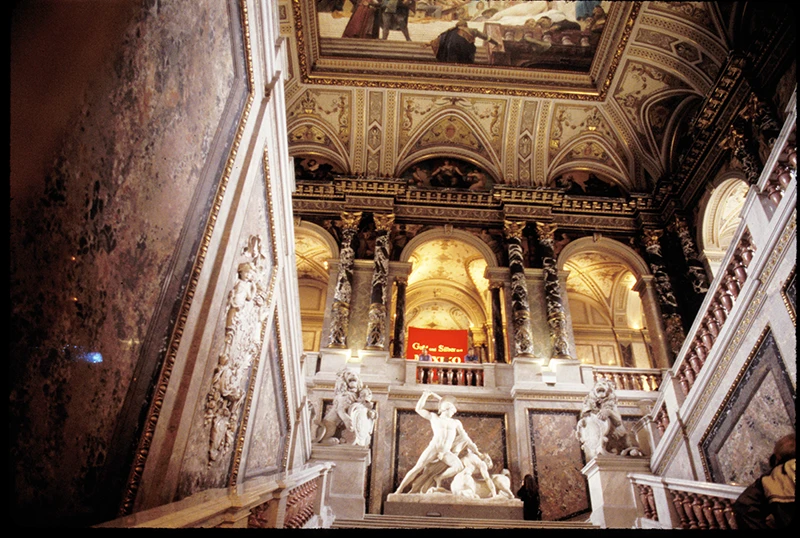
Cross back over the Ring to the Kunsthistorisches Museum for the main event of the afternoon. This grand museum holds one of the world's great picture galleries, with particular strength in the Old Masters. Entering the front door you meet the elaborate lobby and staircase leading up to the main galleries. Stand for a minute at the foot of the stairs to take in the multicolored marble walls rising to a ceiling fresco by Mihály Munkácsy depicting the great figures of art history. At the stairway mid-point stands a huge marble statue by Canova — a taste of what is to come.
You will see important works by Caravaggio, Rembrandt, Mantegna, the largest Velázquez collection outside Spain, Vermeer's greatest masterpiece The Art of Painting, Van Eyck, Titian, Raphael, Giorgione, El Greco, Dürer, Cranach, Rubens, Bernini, Cellini, Bellini, twelve Bruegels (a high point of the museum), and much, much more.
copy.webp)
This collection was built up over a 500-year period, especially during the 17th century when the Habsburg dynasty had many important connections throughout Europe. The Habsburgs were married into the royal family of Spain, ruled the Netherlands, and controlled most of Germany and northern Italy, so they were in position to acquire the great masters of that time. The collection was made accessible to the public in stages from 1781 onward, and the current building on the Ringstrasse opened in 1891. Thomas Hoving, former director of New York's Metropolitan Museum, called this "the world's best collection of Western paintings."
If you need a break from so much stimulation, have a seat in the café in the central rotunda, surrounded by multicolored marble floor, walls, columns, and ceiling. The building is about 130 years old. You could easily spend a full day exploring this museum, so if you are a major art lover, divide your time over two half-day visits. After too many hours in a row, no one can properly appreciate an overdose of so much beauty.
Coming out of the museum you will face a pleasant square with a larger-than-life statue of Maria Theresa at its center. Across the square is another museum building identical to the Kunsthistorisches, holding the Naturhistorisches Museum (Natural History Museum), for fans of the genre. Its displays have been lovingly preserved rather than modernized, which lends them a certain old-fashioned charm.
Ringstrasse
copy.webp)
Now you are on the Ringstrasse, which you can explore with a round-trip tram ride along its entire length. Vienna has an excellent public transport system, with an extensive network of U-Bahn, surface trams, and buses. All you really need to get around this compact town is comfortable shoes, but the tram is fun. Rolling on steel rails along the Ring, it gives you a smooth ride with an excellent view. One ticket covers free transfers and round-trips within about an hour.
The Ringstrasse was laid out as a coordinated imperial project beginning in 1857, with each building styled in an architectural mode considered "appropriate" to its function — Gothic for the Rathaus (city hall), Greek revival for the Parliament, Renaissance for the museums and the University, Baroque for the Burgtheater. The effect, called historicism, unlocks what a tourist is looking at on the tram ride: not a random jumble but a deliberate open-air gallery of European architectural history. The route passes the State Opera House, the Parliament, the City Hall, the Hofburg, the twin museums, and the University. Vienna also runs a dedicated Ring Tram with audio commentary for a flat fare — convenient if you want commentary, though Lines 1 and 2 cover the same ground on regular fares.
By now you should be ready for dinner, perhaps followed by a concert. Vienna offers a wide range of evening music — see the Music and Wine page for a full rundown of venues from the Staatsoper to visitor-oriented Mozart concerts to Heuriger-evenings with Schrammelmusik.