Salzburg: The City of Mozart and Do Re Mi
Introduction
Salzburg is a picturesque small city that rewards slow travel. Its setting — tucked into the Alpine foothills of north-central Austria, hemmed in by cliffs and the Salzach River — gave it a compact, walkable old town of baroque squares, arcaded lanes, and hillside churches that has changed remarkably little in four centuries. A medieval fortress sits on the cliff above, one of the largest and best-preserved in Europe. Across the river, formal gardens open onto the views that made the city a film set. The old town is a UNESCO World Heritage Site, and the whole place is small enough to cross on foot in twenty minutes.
Watch the perfect-day-in-Salzburg video →
Travelers come for different reasons. Some come for the architecture and the churches, built on salt-trade wealth by ruling prince-archbishops. Some come for the music — the city is Mozart's birthplace and hosts one of the world's major summer music festivals. Some come for the scenery of the surrounding Salzkammergut, the lake and mountain district a short drive away. Many come because of The Sound of Music, filmed here in 1964, and find that the locations are genuine. The town accommodates all of these visits without strain.
.webp)
At the center of town is the Getreidegasse, a narrow pedestrian street lined with medieval facades that shelter modern shops and leads past Mozart's house toward the great Cathedral, a masterpiece of the Italian Baroque. Above it all on a hilltop sits the castle that looms over the history of the city. Across the river are the flower gardens of Mirabell Palace and further sights. Salzburg's charms are well known, so expect large crowds in peak season at midday. Following the tips below avoids much of the congestion.
Three-Day Itinerary
Staying for three days allows time for each of these threads: a day in the old town and up at the fortress, a day on the right bank with the gardens and an afternoon excursion into the lakes, and a day for the churches, museums, and a second day-trip into the countryside. Squeezed to one or two days, the same material works as a faster itinerary. The one caveat is the midday crowd: Salzburg draws about seven million visitors a year, and the Getreidegasse fills with bus groups between roughly 11 a.m. and 4 p.m. Early mornings and evenings are quieter, and the tips below are built around that pattern.
Day One at a glance
- Residenzplatz, the Salzburg Cathedral, and Mozartplatz
- Getreidegasse and its side alleys
- Mozart's Geburtshaus (birthplace)
- Hohensalzburg Fortress via the Festungsbahn funicular
- Evening: Mozart Dinner Concert at Stiftskeller St. Peter
Day Two at a glance
- Kapuzinerberg viewpoint for the morning panorama of the old town
- Mirabell Gardens and Palace, Cherub Staircase
- Mozart Dwelling House and Church of the Holy Trinity
- Afternoon Lakes and Mountain tour: St. Wolfgang, boat across the lake, St. Gilgen
Day Three at a glance
- Cemetery of St. Peter and St. Peter's Church
- Franciscan Church and Collegiate Church
- University Square food market
- Mönchsberg lift to the Winkler Terrace panorama
- Afternoon: Sound of Music tour, Bavarian Mountain tour, Eagle's Nest tour, or Salt Mines tour. Hellbrunn Palace as an alternative.
Day One: Old Town walking tour and castle visit
The center of town is given over to pedestrians, so a good look around is simply a matter of walking. Wear comfortable shoes. There is considerable history to absorb here in museums, castles, and palaces, but the ambience of the town itself — lanes, courtyards, shops, gardens, and little squares — is the most rewarding part of the Salzburg experience.
Start just after breakfast. Before 10 a.m., the day-trippers have not arrived, and you nearly have the town to yourself.
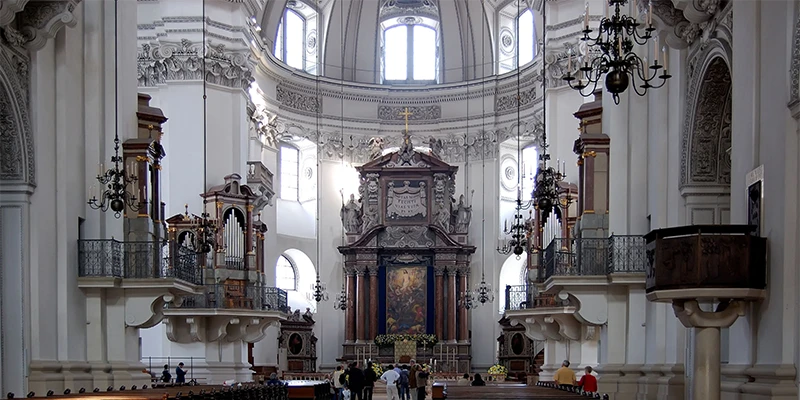
Cathedral
Begin at the largest square in the city, the Residenzplatz, flanked by the majestic Salzburg Cathedral and the Residenz Palace, a museum that was formerly the seat of the archbishops. In the center of the square is the huge Baroque Residenz Fountain — four marble horses streaming water, topped by three tiers of marble figures spouting more. Built between 1659 and 1661, it is one of the largest Baroque fountains in the world and photographs well if you get in close with the Cathedral towers framed behind it.
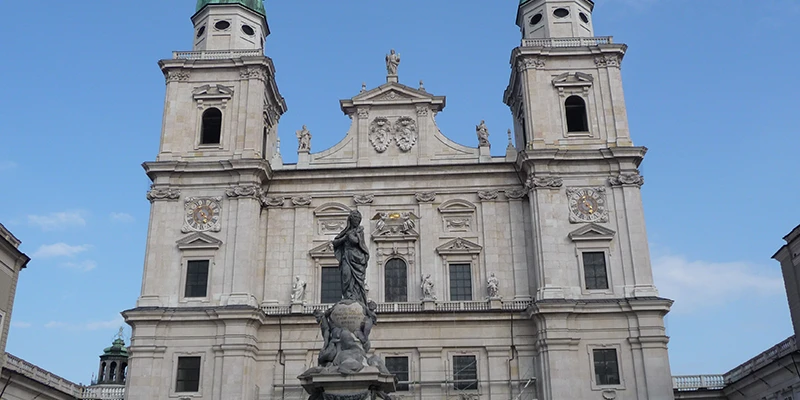
More than most European towns, Salzburg was founded and nurtured by the Catholic Church and was ruled by bishops rather than secular nobility, so the Cathedral is magnificent. Considered the finest early Baroque church north of the Alps, it was built in the early 1600s after a fire destroyed the previous cathedral. It was designed by Italian architects on the model of Il Gesù in Rome. Interior artwork — ceiling murals, statues, stucco — was largely added in the following century.
Real horses appear in Residenzplatz as well, the main station for the fiaker, the traditional Austrian horse carriages; return later for a ride if you like. Just a block away on the southeast edge of the Old Town is Mozartplatz, with a statue of its namesake in the center, looking at Café Glockenspiel, where the composer spent many hours.
copy.webp)
An outdoor terrace on Mozartplatz is a good spot for a Wiener schnitzel or a casual meal.
Mozartplatz leads into Salzburg's most interesting pedestrian lane, one of Europe's best promenades. The charming medieval road is lined with ancient buildings housing modern shops, with antique wrought-iron signs jutting out from old facades. Only about 600 yards long, it can easily be stretched to a mile by probing side alleys. Starting as the Judengasse and changing names to the Getreidegasse, it is the street on which Mozart was born. Avoid it between about 11 a.m. and 4 p.m., when it fills with bus-tour day-trippers.
Pedestrian Lanes
.webp)
Start at the Judengasse end, which 500 years ago was the Jewish neighborhood. The lane begins at a small square called Waagplatz, the main square in the Middle Ages. A café in front of the Hotel Altstadt is a good spot to take in the atmosphere. The Altstadt has been a traveler's inn since 1377, now modernized into one of Salzburg's deluxe hotels; no two rooms are alike.
The lane narrows and curves into the old town center. Side streets and covered arcades lead off the main route, making this an adventurous walk for anyone willing to take detours. A few hundred feet along Judengasse, on the left, is the broad Alter Markt ("Old Market") square, still a marketplace today selling postcards, candy, toys, and T-shirts. A fountain stands in the center, and among the pastel Baroque stucco facades is Café Tomaselli, in operation for more than three centuries. Bear left at the end of the square and swing back around through Goldgasse and Brodgasse to return to the main lane, which at this point has become the Getreidegasse.
Watch the Salzburg alley walk video →
Getreidegasse
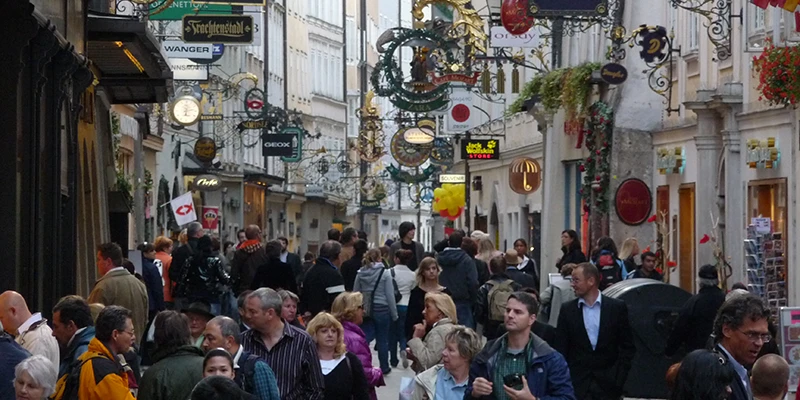
The maze of alleys and courtyards here developed over many centuries through an organic process that produced one of the most pleasing pedestrian environments in Europe. It began in the Middle Ages as a row of shops with homes upstairs and yards in the rear. Later, a second strip of buildings was constructed behind the yards, and gradually the front and rear structures grew into each other and formed small enclosed courtyards and covered walkways — Durchhäuser ("through-houses") — which are now the shopping arcades. Every part of town was handmade, so each building is unique, with very few straight lines or plain surfaces. The old town has three main pedestrian lanes running parallel: the Getreidegasse in the middle, the Griesgasse toward the river, and the Universitätsplatz on the other side.
Between the Getreidegasse and the Universitätsplatz, about a dozen short alleys run perpendicular, each with its own name, each about one block long. Entrances to these side alleys are sometimes inconspicuous and easy to overlook from the Getreidegasse itself, but most of them contain shops, restaurants, display cases, or small courtyards, and several open up into the 300- to 400-year-old enclosed courtyards formed when the front and rear buildings grew together. The upper floors remain residential, occupied by students and long-time residents in a mix of rental and owner-occupied properties. Detouring through these alleys is a core Salzburg experience: turn left, walk a block, turn right onto the parallel lane, then back. An hour of zigzagging covers most of them.
The advantage of staying in Salzburg for several days is that you can walk the same streets repeatedly. They take on a different character in the early evening with the warm glow of twilight and few people, so come back then.
copy.webp)
Midway down the lane, on the right, is the Old Town Hall with its little square, another outdoor café, and a portable stage with occasional performances. The small size of the town hall, compared to the massive castle on the hill, indicates where the real power lay.
A block further is a major attraction, the Mozart Geburtshaus, the composer's birthplace and childhood home. The museum contains none of the original furniture, but it offers a glimpse into the structure of an old house and displays Mozart's childhood violin, concert violin, clavichord, pianoforte, and family portraits and correspondence.
Hohensalzburg Fortress
The citadel above the city is claimed to be the largest and best-preserved medieval castle in Europe. Looking up at it from below is not enough — go up and walk the grounds, and consider paying admission for the guided interior tour.
Watch the Hohensalzburg Fortress video →
Access is via the Festungsbahn, a funicular that carries visitors to the top in a few minutes. It is located one block from the Cathedral, along the right side of Kapitelplatz, another open space with a Neptune fountain and a horse-watering pool. The walking path up zigzags to the top and is a significant climb; the funicular is the recommended option. The castle sits atop a 400-foot cliff, a natural fortification first used by the Romans nearly two thousand years ago.
.webp)
Two viewpoints stand out: the Reck watchtower, with a panorama of the Alps and peaks reaching 6,000 feet, and the Kuenburg bastion, with a view over the bell towers and domes of the old town. The vantage helps you take stock of where you have been.
The existing Hohensalzburg Fortress was begun in the 11th century as a refuge for archbishops allied with the Pope in church battles against the princes of south Germany. These archbishops ruled Salzburg for about a thousand years, using the wealth mined from nearby salt deposits to build a city of churches, palaces, and mansions designed by the leading architects of each era.
The castle was repeatedly enlarged and remodeled, becoming a comfortable residence. Construction was largely complete by the end of the 17th century. The complex took about six hundred years to build.
copy.webp)
Hohensalzburg is large enough to feel like a walled medieval village, with courtyards, neighborhoods, and buildings of different types. One of the most interesting perspectives is along the inner dry moat, which never held water; it runs like a cobbled lane, with crenellated towers rising above stone walls. The moat leads to a salt depot where the precious cargo — called "white gold" — was stored. Salzburg literally means "salt city." The large salt deposits in a nearby mountain were mined for nearly two thousand years and formed the economic basis of the region. Before refrigeration, salt was the primary means of preserving food. The Celts were the first known people to work these deposits, part of a broader Celtic region extending south to the Tyrol; they shipped salt down the Salzach River and onward toward the Black Sea. The mines closed a little over a century ago, but they can still be visited a few miles outside town.
With vertical cliffs all around it and fortified walls lined with cannons, Hohensalzburg was impregnable. Its large food stores and water well allowed the occupants to withstand any siege, and the castle was never taken. The cannons defended against foreign aggressors but also kept the townspeople below in check. The battlements also include older features — gun slits and mounts for sling stones — which predate the widespread use of gunpowder. Internal intrigue, however, brought down more than one archbishop. Even Archbishop Wolf Dietrich, who initiated the Cathedral, the Residenz, and Mirabell Palace, was deposed and imprisoned in his own fortress for his final five years following a dispute with his nephew over salt-mining revenues.
The castle museum has exhibits on the archbishops and the region, with plans and prints showing Salzburg's growth, and a military museum with armor and weapons. Inside are the intricate Gothic wood-carvings and ornamental painting of the Golden Hall and Golden Chamber. Evening chamber music concerts take advantage of the Princess Room's acoustics and small size.
copy.webp)
An outdoor terrace café at the castle offers local draft beer or coffee with a panoramic view south across the plain to the mountains. The castle visit takes between one and three hours, depending on interest. Back down, the same funicular ticket carries you to town. The Stieglkeller beer garden, just to the right as you exit the funicular, has another good view of the Cathedral and old town.
By late afternoon, the day's itinerary ends with a quieter stroll along the Getreidegasse and its side alleys, now less crowded as the bus groups depart. Twilight — when the sun fades and the lights come on — is the most atmospheric time on the lane, and it is when most travelers are back at their hotels. Return to the Getreidegasse before sunset.
In the evening, Salzburg offers a variety of concerts. A recommended option is the Mozart Dinner Concert at Stiftskeller St. Peter, in a restaurant founded in the 9th century. Musicians in period costume perform Mozart pieces while dinner is served by candlelight, sets of music alternating with traditional courses in a Baroque dining hall.