Nîmes
Nîmes, in the south of France, is an attractive small city with several of Europe's best ancient Roman sites and a charming downtown of pedestrian lanes, a cathedral and a lively market square. It is a comfortable half-day visit in its own right and makes a natural stop on a longer trip through Provence.
Nîmes is easy to reach by train on a day trip from Avignon — 40 minutes each way, with several departures a day. Trains leave Avignon as early as 6:38 am and 7:26 am, putting you in the heart of the city before the shops open, when the streets are quiet and the light is best on the old stone facades.
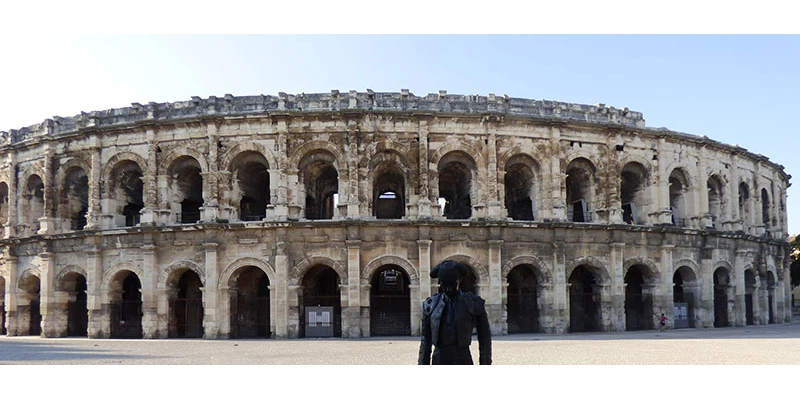
Les Arènes — Roman Amphitheater
Exit the train station and walk a few blocks along Avenue Feuchères through a shady park. At the end stands the star attraction of the city — the world's best-preserved Roman amphitheater, Les Arènes. It is similar in age and appearance to the Colosseum in Rome but half the size, seating 24,000. It is still in active use for concerts and for the French style of bullfighting, in which the bull chases the matadors out of the ring and is not killed.
-04.webp)
The Pedestrian Zone
A pedestrian zone of shops and cafés extends from the arena, with the main lane Rue de l'Aspic running ten blocks through its center. Most shops open at 10:00 am, so early arrivals get quiet, shuttered streets with only locals walking to work.
Watch the Nîmes pedestrian lanes video →
Stroll six blocks along Rue de l'Aspic and turn left on Rue Général Perrier to reach the other great Roman monument of Nîmes, the Maison Carrée.
-04.webp)
Maison Carrée
The Maison Carrée — "square house" — is France's best-preserved Roman temple, resembling a smaller Parthenon with tall Corinthian columns and a classic triangular pediment. The 2,000-year-old temple is said to have been built by General Agrippa in honor of two grandsons of Emperor Augustus, Caius and Lucius, who became joint rulers of the Nîmes area. Statues of the two grandsons stand two blocks away in the greenery of Square Antonin.
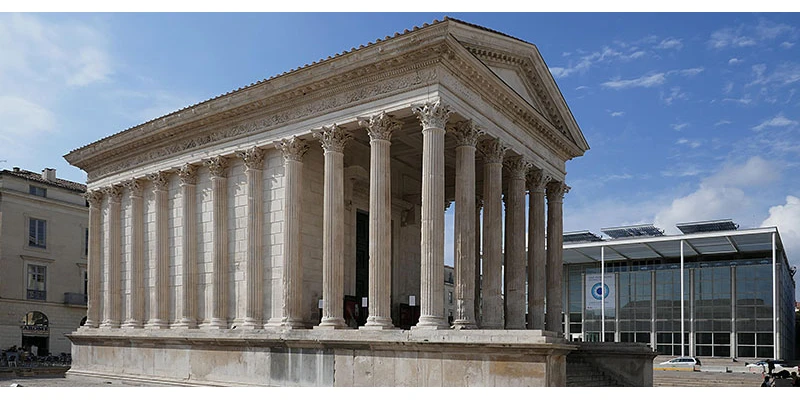
Across the street is a striking modern building by the British architect Sir Norman Foster, in steel and glass, which houses the Carré d'Art museum of contemporary art. It is one of several major modern structures built in Nîmes during the 1990s under the progressive mayor Jean Bousquet, set in deliberate dialogue with the ancient temple opposite.
-04.webp)
Jardin de la Fontaine
Walk along the Quai de la Fontaine next to a tree-lined canal that flows from the Jardin de la Fontaine a few blocks away. This was where the local water source sprang from the ground in Roman times. As the settlement grew the supply became inadequate and was supplemented by a major aqueduct system, including the Pont du Gard outside the city.
-04.webp)
This shady stretch of the canal passes several of Nîmes's nicest hotels, including the four-star Imperator Concorde — a good place to stop for a leisurely breakfast or lunch after an early start.
-04.webp)
Old Town
Watch the Nîmes Roman sites video →
Watch the combined Nîmes & Pont du Gard video →
Walk back to the Maison Carrée and continue east along the pedestrian Rue de l'Horloge to Place aux Herbes, a scenic square that is the setting for the 11th-century Cathédrale Notre-Dame, with a Romanesque frieze across its façade. Two blocks northeast stands the Porte d'Auguste, a small triumphal arch honoring Emperor Augustus and built in 15 BC. History-minded visitors can continue to the Musée Archéologique two blocks south of the arch.
-04.webp)
Retrace your steps along Rue de l'Aspic, which by now is fully alive with open shops and cafés. Near the arena, Place du Marché has a pretty crocodile fountain — a symbol of Roman victories in Egypt, marked here because veterans of that campaign retired in the Nîmes area.
Continuing to Pont du Gard
Nîmes pairs naturally with a visit to the Pont du Gard, the great Roman aqueduct 15 miles away. Reaching it by public transit is awkward — the bus from Nîmes takes about an hour each way, with limited service that requires close attention to the return schedule. For most travelers a package day trip from Avignon or a rental car is the more practical way to combine the two sights. See the Pont du Gard page for details.