Lisbon, Portugal
.webp)
Lisbon is built across a set of steep hills above the mouth of the Tagus, and the shape of the land explains almost everything about the city. Streets climb, stop at staircases, and open without warning onto terraces with a view across the whole estuary. It is a capital that has to be walked, and one where you are constantly looking down at your own route from above.
.webp)
The city is compact enough to cross in about an hour, and its districts are strikingly unlike one another. The Alfama on its hill is a medieval tangle. The Baixa below it is a strict eighteenth-century grid. Bairro Alto on the opposite slope is something else again. All three are within walking distance of each other, which is a large part of what makes Lisbon such a satisfying place to spend several days.
You can also see this video on a separate video page.
.webp)
The Tagus here is wide enough to look like an inland sea, spanned by the long red suspension bridge that carries traffic to the southern bank. Lisbon is a working seaport as well as a cruise terminal, and there is nearly always something moving on the water below whichever terrace you happen to be standing on.
Alfama, the Old Town
.webp)
The Alfama is the oldest section of Lisbon and the single best experience the city offers a visitor. It runs from the castle at the top of the hill down to the Cathedral of Sé and the waterfront below, a maze of narrow lanes, staircases and tiny squares that has kept the same street plan since the Middle Ages.
.webp)
This is a real residential neighborhood rather than a preserved district. Families have lived here for generations, laundry hangs across the gap between one side of the street and the other, and doors stand open in warm weather. Most of the ground floors are homes rather than businesses.
.webp)
It is generally a pedestrian zone. A few motor scooters and mopeds get through, and the tram tracks run along one or two of the wider streets, but most of these lanes are too narrow and too steeply cobbled for anything else. That makes them ideal for strolling and difficult for anything else.
.webp)
The best time to come is late afternoon or early evening, when people are out socializing, visiting and shopping. That is when the neighborhood is most itself. It is safe, it is friendly, and on our walk we saw almost no other visitors on these streets at all.
.webp)
You do not have to walk up the hill to begin. The old trams run from the heart of downtown right up the slope and set you down near a panoramic terrace looking out over the rolling hillside of old buildings with the waterfront below. From here you can see the church of São Vicente across the rooftops, one of the few fixed points once you are down among the lanes.
.webp)
A major staircase street leads from the terrace straight down into the heart of Alfama. The largest of them extends down from Portas do Sol and changes its name several times on the way before reaching the bottom of the hill. Dozens of smaller staircases branch off it, some only six or eight steps connecting one lane to another.
.webp)
Everybody here climbs steps constantly, at every age. The stone is worn smooth in the middle of each tread from centuries of use, and residents have claimed the edges with potted plants. Walking straight downhill from the castle to the river takes only fifteen or twenty minutes, but that would miss the point of being here.
.webp)
Bring a map for general reference but do not try to follow it closely. Alfama is a place to wander and turn whichever way looks best at each corner. It is a small district and you cannot get very lost — as long as you head generally downhill you will come out at the bottom eventually.
.webp)
Because the roads wind and bend, almost every house faces a different direction. The plan today is the plan of the Middle Ages: houses were rebuilt on exactly the footprint of the ones before them, so the shape of the streets has never changed even where the buildings have.
.webp)
The details are worth slowing down for. Iron lamps bracketed off the walls, tiled facades, balconies painted in strong colors, house numbers set in ceramic. Very little of it is restored for show. It is simply what has accumulated on a street where people have lived continuously for several hundred years.
.webp)
Most of the homes are small, so people gravitate outside — to chat, to hang laundry, to linger in the little markets, to catch up on stories. The lanes work as outdoor living rooms, and the generations mix without effort. The isolation typical of modern cities is simply not present here.
.webp)
Everybody knows everybody. Residents are so used to talking with each other that they are unusually easy to approach, though English is not much spoken up here. Say bom dia rather than hello and you will get a genuine welcome.
.webp)
There are shops scattered through the lanes, but this is mostly a place for locals rather than a commercial strip. Residents find everything they need inside this one small area — the food store, the neighbors, the bar — and there is no real need for a car, since public transit reaches the rest of the city easily from here.
.webp)
Restaurants come in every form: outdoor tables spilling across a small plaza, holes in the wall with four seats, and bars where you simply stand. Some of the small bars keep big jugs of wine for refilling customers' bottles straight from the barrel, which costs very little and is perfectly drinkable.

Music is never far away. Alfama is the traditional home of Fado, the Portuguese song form, and many restaurants here offer it in the evening — a guitarist and a singer in a room of thirty people is the way to hear it. Out on the streets you will find other traditions too, including musicians from Portugal's former colonies.
We stayed at a small hotel near the top of the hill, a block from the castle, which made a good base: you are inside the neighborhood rather than commuting into it. There are only a handful of hotels in Alfama and they are small, so book well ahead if you want to be up here.
São Jorge Castle
.webp)
The castle crowns the hill above Alfama, and the walls you see are largely Moorish work. The site has been fortified since well before that, but the present castle dates from the Muslim period and was taken by Afonso Henriques in 1147, in the campaign that established Portugal as a kingdom.
.webp)
Inside the walls there is not a great deal of building left — this was a royal residence for centuries but the 1755 earthquake and long neglect took most of it. What survives is the circuit of walls and towers, which you can walk, and the ground they enclose.
.webp)
The castle museum includes a model of the medieval city that is genuinely useful for understanding what you have been walking through. It shows how small Lisbon was when it was confined inside its walls, and how the Alfama filled the whole slope between the castle and the water.
The Cathedral of Sé
.webp)
The Sé sits at the bottom of the Alfama hill and marks the boundary of the old neighborhood. It was begun in 1147, immediately after the reconquest of the city, and its heavy twin-towered west front looks more like a fortress than a church, which is roughly what it was intended to be.
.webp)
Lit at night it is one of the better sights in the city, and the tram passes directly in front of it, which is why the building appears in so many photographs of Lisbon whether or not the photographer intended it.
.webp)
The interior is Romanesque and plain, with heavy round arches and very little decoration. Earthquakes have shaken it repeatedly over the centuries and each rebuilding has stripped something away, which is why the inside feels older and barer than most cathedrals of comparable importance.
.webp)
Behind the altar the ambulatory runs around the east end, and this is the part of the building most worth walking slowly. The Gothic work here is later than the nave and considerably more refined.
.webp)
The cloister has been under archaeological excavation for years, since the ground beneath it holds Roman and Moorish remains stacked one on top of the other — a fair summary of the city's history in a single dig.
.webp)
Entry to the church itself is free; the cloister and the treasury charge a small admission. It takes half an hour, and it sits naturally at the end of a walk down through Alfama.
Riding the Trams
.webp)
Lisbon's trams are not a heritage attraction bolted onto the city; they are working transit, and on the steepest routes they are the only vehicle that fits. The small yellow cars date from the 1930s and are kept running because nothing modern would get around the corners.
.webp)
Route 28 is the famous one, climbing from the Baixa up through Alfama and on toward Graça, and it is worth riding end to end at least once. Go early or late — in the middle of the day it fills with visitors and you will spend the trip standing.
.webp)
The interiors are wooden, polished by decades of use, with brass fittings and windows that slide open. Riding one is a period experience, though the driver is doing a demanding job in traffic that has grown considerably since the cars were built.
.webp)
The best seats are at the front and the back where you can see along the line of the street. On the tighter turns the car passes within inches of the buildings, close enough to look into ground-floor windows.
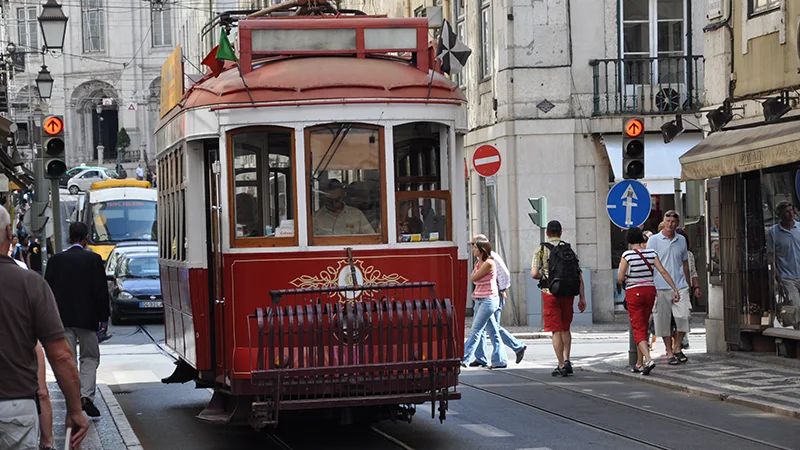
Alongside the yellow cars you will see red ones, which are the tourist circuits running fixed sightseeing routes at a higher fare. They are comfortable and they include commentary, but the yellow cars are the real thing and cost a fraction as much.
The Baixa
.webp)
Below Alfama lies the Baixa, the flat heart of the city between the two hills. Where Alfama grew without any plan at all, the Baixa was laid out deliberately in the 1750s on a strict grid of wide straight streets — one of the earliest examples of large-scale rational city planning in Europe.
.webp)
Several of the main streets are pedestrian now, paved in the black-and-white patterned stone that Lisbon uses everywhere. They run straight from the riverfront square up to Rossio, and walking them is the easiest orientation exercise in the city.
.webp)
This is the shopping district and always has been. The original plan even assigned trades to particular streets, and some of the street names still record that — the goldsmiths, the shoemakers, the silversmiths — though the businesses on them have long since changed.
.webp)
The iron tower rising out of the middle of the district is the Santa Justa lift, built in 1902 to carry people from the low ground of the Baixa up to the Chiado, which sits at the top of a cliff behind it. It looks like something Eiffel would have built, and the engineer had in fact trained in that tradition.
.webp)
The city has several funiculars as well, short steep cable cars climbing hills too severe for a tram. They cover only a couple of hundred yards each but they save a serious climb, and they are covered by the same transit passes as the trams.
.webp)
The Baixa buildings are uniform by design, four and five stories with regular windows and iron balconies, and they were among the first structures anywhere built to resist earthquakes. A timber cage was assembled inside each one to hold the masonry together if the ground moved again.
.webp)
Ground floors hold shops, bars and cafés almost without exception, and a good many of them have been in the same premises for a century or more. The tiled fronts and painted signs are worth looking at even when you have no intention of going in.
.webp)
The old cafés and pastelarias are an institution. Marble counters, mirrors, gilt, and a queue of people standing to drink a coffee in two minutes rather than sitting. Order a bica for an espresso and a pastel de nata alongside it — the custard tart is the national pastry and Lisbon is where to eat it.
.webp)
Restaurants in the Baixa run from serious to tourist-trap, and the difference is usually visible from the street. Places with a printed menu in six languages and someone standing outside to greet you are aimed at visitors; the ones with a short handwritten list and a crowd of locals at lunchtime are the ones to try.
.webp)
Port is the obvious thing to bring home, and shops throughout the Baixa carry a range far wider than anything you will find abroad, including tawnies of considerable age. The wine comes from the Douro valley in the north, but Lisbon is where most visitors buy it.
.webp)
For all the visitors, the Baixa remains a place where people work and meet. Groups of older men stand talking on the corners in the late morning, the same conversation continuing day after day, entirely undisturbed by the crowds moving around them.
.webp)
Color is used without restraint here, on buildings, on tiles and on the awnings. It is one of the things that separates Lisbon visually from the other southern European capitals, along with the quality of the light coming off the water.
.webp)
Street performers work the main pedestrian streets — living statues, musicians, card players. The standard varies but the audiences are good-natured, and the performers are part of the reason these streets stay lively into the evening.
.webp)
Souvenir shopping is easy and inexpensive. Printed cloth, embroidered linen, cork goods, ceramics and above all tiles — modern reproductions of the traditional blue-and-white azulejo patterns, which pack flat and survive the trip home better than most things.
.webp)
Kiosks sell the smaller items along with postcards, tram magnets and painted roosters. The rooster is the Galo de Barcelos, a folk emblem from the north that has somehow become the standard souvenir of the whole country.
Rossio and the Squares
.webp)
Rossio is the main square of the Baixa and has been the center of Lisbon life for six hundred years. The neoclassical building along its north side is the Dona Maria II National Theatre, put up in the 1840s on the site of a palace that had been the seat of the Inquisition.
.webp)
Two bronze fountains stand at either end of the square, cast in France in the 1880s. Between them the ground is paved in the wave pattern that has become the visual shorthand for Lisbon, laid by hand in small black and white stones.
.webp)
The cafés around the edges have tables out most of the year, and this is a reasonable place to stop and watch the square work. Prices are higher here than a block away, which is the standard trade for the location.
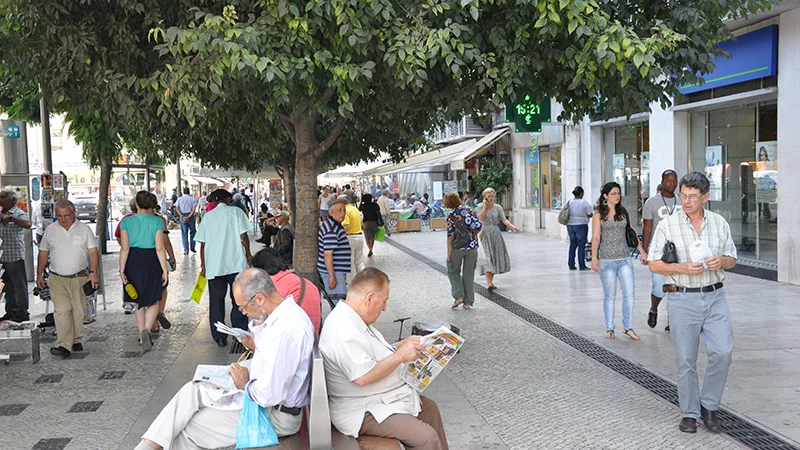
The square functions as a crossroads. Streets from every direction empty into it, the metro runs beneath it, and the pattern of people moving across it changes completely between the morning commute, the afternoon and the evening.
.webp)
Around the fringes are the small permanent fixtures — kiosks, shoeshine stands, seating — that have been part of the square for generations and give it a settled quality that most central squares in European capitals have lost.
.webp)
At one corner stands Rossio railway station, whose front is a piece of theatrical revivalism from 1890: two enormous horseshoe arches in the Manueline style, imitating the decorative stonework of Portugal's Age of Discovery four centuries earlier. The trains to Sintra leave from inside it.
.webp)
A short walk away is Praça da Figueira with its bronze equestrian statue of João I, a quieter square than Rossio and a better place to sit. The two together, with Praça do Comércio on the river, form the set of public spaces the Baixa was planned around.
.webp)
At night the squares change character entirely. The monuments are lit, the traffic thins, and the restaurants around the edges take over the pavements. Lisbon eats late by northern European standards, so nine o'clock is a normal hour to start looking for a table.
Views Over the City
.webp)
Because the city is built on hills, it has a set of formal viewpoints — miradouros — laid out as small terraces with railings, benches and usually a kiosk selling drinks. There are a dozen or more, and finding them is a good way to organize a day's walking.
.webp)
From above, the roofs are an unbroken field of terracotta tile, and you can read the different districts by their street patterns alone — the straight lines of the Baixa against the tangle of everything around it.
.webp)
The best light is late in the afternoon, when the sun comes in low from the west across the river and the whole city turns the color of the roofs. Sunset from a miradouro is a standing local habit as much as a tourist one.
Bairro Alto and Chiado
.webp)
On the hill opposite Alfama is Bairro Alto, laid out on a grid in the sixteenth century but a very different place from the Baixa below. By day it is quiet and residential. In the evening it becomes the center of the city's nightlife, and the same narrow streets fill with people.
.webp)
The streets are narrow and straight, crossed by tram wires, and most of them are barely wide enough for one car. Bars occupy ground floors that were shops or workshops, often with no more than a counter and a doorway, and the drinking happens outside in the street.
.webp)
It remains genuinely residential, which produces an ongoing tension between the people who live here and the crowds who arrive at eleven at night. Laundry still hangs across the street above the bars.
.webp)
The buildings are plainer than in the Baixa, three or four stories with small windows and iron balconies, and many are in visibly poor repair. Restoration has been steady over the last decade but a great deal of the district is still waiting for it.
.webp)
Details reward attention here more than the buildings as a whole — a curtain hung across a doorway, a lamp bracketed off a wall, a tiled panel above a shop. The district repays walking without a destination.
.webp)
Fado houses are concentrated here as well as in Alfama, and the Bairro Alto versions tend to be more commercial — dinner and a show, with a fixed price. The Alfama ones are generally smaller and less staged.
.webp)
The streets drop steeply toward the river on the western side, and the views open up suddenly between buildings. Walking down is easy; walking back up is the reason the funiculars exist.
.webp)
Tram 28 passes along the edge of the district, and the Glória funicular climbs to it from the Avenida da Liberdade below. Either one saves the climb, and both are part of the ordinary transit system.
.webp)
The church of São Roque, on the edge of the district, has a plain facade concealing one of the most extravagant interiors in Portugal. Its Chapel of St John the Baptist was built in Rome in the 1740s, blessed by the Pope, dismantled and shipped to Lisbon — reportedly the most expensive chapel in Europe at the time.
Belém
.webp)
Belém sits four miles west of the center, out where the ships left from, and it holds the two monuments most associated with Portugal's Age of Discovery. The Tower of Belém was built between 1514 and 1520 as a fortress guarding the river approach, and it stood in the water rather than on the bank when it was new.
.webp)
The Monument to the Discoveries nearby is far more recent, put up in 1960 for the anniversary of Henry the Navigator's death. It takes the form of a ship's prow with a procession of figures along both sides — navigators, cartographers, missionaries and kings.
.webp)
In the pavement in front of it is an enormous compass rose with a map of the world, marking the dates Portuguese ships reached each place. It was a gift from South Africa, and it is the most photographed piece of paving in the country.
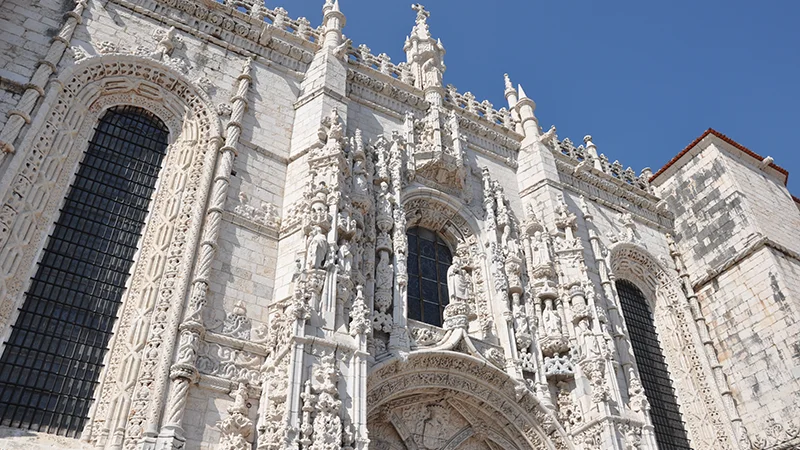
The Jerónimos Monastery a short walk inland is the greatest building in Lisbon and the fullest expression of the Manueline style. It was begun in 1501, funded by the tax on the spice trade that Vasco da Gama's route to India had opened, and it took most of the century to complete.
.webp)
The Manueline style is essentially late Gothic with a maritime vocabulary grafted onto it — ropes, anchors, coral, armillary spheres, knots carved in stone. It exists nowhere but Portugal and it lasted only about forty years, which makes the surviving examples all the more worth seeing.
The church is entered separately from the cloister and admission is free. Vasco da Gama is buried just inside the west door, opposite the poet Luís de Camões, whose epic on the voyages is the national poem.
.webp)
The nave is the extraordinary part. Six slender columns carry a single unbroken vault across the whole width of the church, an engineering feat for 1500, and one that survived the 1755 earthquake intact when most of Lisbon did not.
.webp)
Every surface of those columns and ribs is carved. Stand under the vault and look straight up for a while; the photographs never convey the scale of it, and the light changes through the day as the sun moves across the south windows.
.webp)
The cloister is the other reason to come, two stories of arcades around a square garden, each arch filled with tracery and no two carvings the same. It charges admission and is worth it.
.webp)
Come early if you can. The monastery is on every tour itinerary and the queue at the cloister entrance can run to an hour in high season, though it moves faster than it looks.
.webp)
The upper level gives the better view down into the garden and across the carved stonework at close range. It also thins out the crowd, since a good many visitors never go up.
.webp)
The monastery also houses the national archaeology museum and the maritime museum in its later wings, either of which will absorb another couple of hours if the weather turns.
.webp)
A few hundred yards away is the pastry shop that has been making pastéis de Belém since 1837 to a recipe from the monastery itself. The queue is long, it moves quickly, and the tarts are served warm with cinnamon and powdered sugar on the side.
Queluz Palace
.webp)
Half an hour outside the city is Queluz, an eighteenth-century royal summer palace built for the Portuguese court in deliberate imitation of Versailles. It is a rococo building in pink stucco, low and wide rather than tall, set in formal gardens with clipped hedges and statuary.
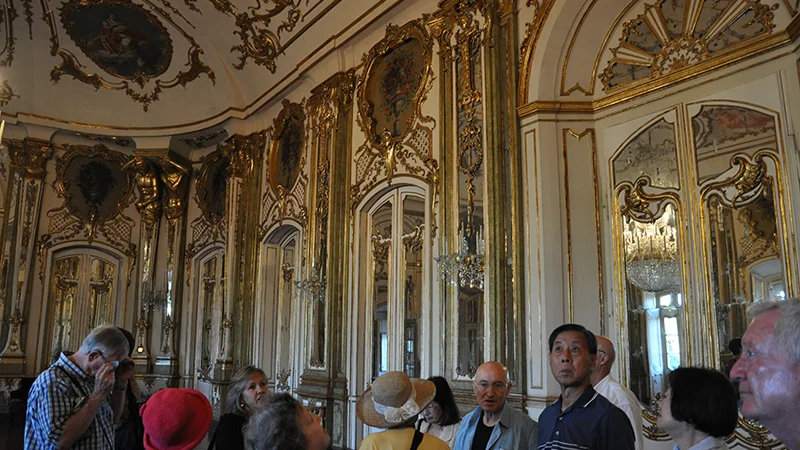
The interiors are the reason to come. The palace was in use through the period when Brazilian gold was flowing into Portugal and the decoration reflects it, room after room of gilding, mirrors, painted ceilings and inlaid floors.
.webp)
The Throne Room is the most extravagant of them, with chandeliers, mirrored walls and a painted ceiling. Concerts are still held here, and the acoustics are the ones the room was designed for.
.webp)
Look up throughout. The ceilings carry as much of the decorative program as the walls, and in several rooms they are the only original surfaces left after later restorations.
.webp)
The palace was badly damaged by fire in 1934 and much of what you see is careful reconstruction, done from photographs and inventories. It is honest about this, and the restoration work is documented in the rooms themselves.
.webp)
The chapel is among the oldest parts of the building and survived the fire, so its painted and gilded surfaces are original eighteenth-century work rather than reconstruction.
.webp)
The Hall of Mirrors and the Ambassadors' Room were where the court conducted its ceremonial business, and they are laid out to impress a visitor arriving on foot from the entrance — a sequence that still works if you walk it in order.
.webp)
Queluz gets a fraction of the crowds that Sintra does, which makes it a considerably more pleasant visit. It works well as a stop on the way out to Sintra, since the train line passes through.
Sintra
Sintra sits in wooded hills fifteen miles northwest of Lisbon, cooler and greener than the city, and it has been the summer retreat of Portuguese royalty and aristocracy for centuries. The whole cultural landscape is a UNESCO World Heritage Site, and it is the standard day trip out of Lisbon.
.webp)
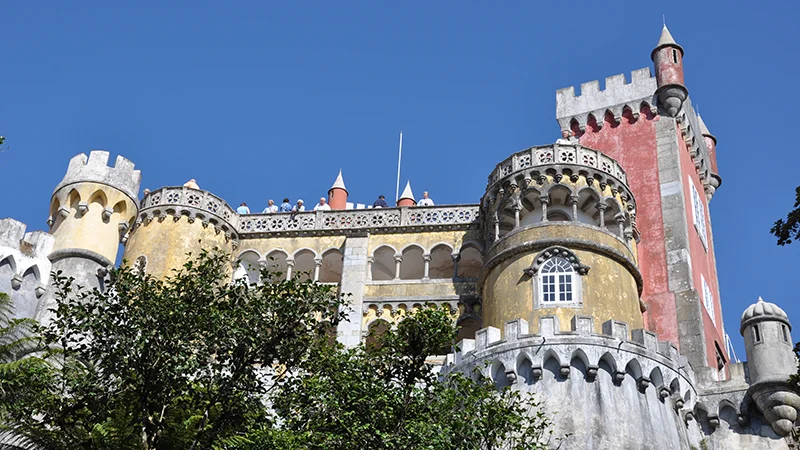
Pena Palace is the one everybody comes for, a hilltop fantasy in yellow, red and blue built in the 1840s for Ferdinand II on the ruins of a monastery. It is Romanticism at full volume, borrowing Moorish, Gothic and Manueline motifs without much concern for consistency.
.webp)
The stonework is where the borrowing shows most clearly — studded arches, twisted columns, coral and rope carved in the Manueline manner four centuries after the style had died out. The result is not authentic to any period and was never meant to be.
.webp)
The palace is built directly onto the granite boulders of the summit, and in several places the rock is left exposed as part of the structure. Terraces and ramparts run around the outside with views over the surrounding forest and, on a clear day, all the way to the Atlantic.
.webp)
Down in the town below is the National Palace, much older and far more restrained, recognizable at a distance by two enormous white conical chimneys rising from its kitchens. It was the royal residence from the fifteenth century onward and its interiors are among the best preserved in the country.
.webp)
The town itself is small, built on a slope, and its streets are lined with cafés, restaurants and shops. It gets extremely crowded in summer, and the practical advice is to come early, do the palaces first, and walk the town in the afternoon when the tour buses have gone.
.webp)
Shops sell ceramics, cork, embroidery and the local sweet pastries, and prices are higher than in Lisbon. The lanes are attractive and worth walking regardless, particularly the ones climbing away from the main street where the crowds thin out immediately.
.webp)
Sintra is steep. Staircases connect the levels of the town and the walk up to the castle and Pena is a serious climb through the woods. Buses run up the hill, and taking one up and walking down is the sensible arrangement.
.webp)
Cafés fill the small squares and the wider spots in the lanes. This is a good town to stop and sit in — the temperature is several degrees cooler than Lisbon in summer, which is precisely why the court came here in the first place.
.webp)
Portuguese restaurants bring bread, olives, cheese and cured ham to the table before you order. These are not free — they appear on the bill as couvert — and you can send them back if you do not want them, though at these prices most people do not.
.webp)
The tourist office in the town center is worth a stop for a map and current opening hours, since the palaces keep different schedules and several of them close one day a week. Trains from Rossio station in Lisbon run every twenty minutes and take about forty minutes.
Cascais and Estoril
.webp)
West of Lisbon the coast runs out to Cascais, a fishing port that became a resort when the royal family began summering there in the 1870s. The harbor still works, and the fish landed in the morning turns up in the restaurants along the front the same day.
.webp)
Beaches run along this stretch of coast, backed by hotels and villas, with the neighboring town of Estoril and its casino a mile away. The train from Cais do Sodré follows the water the whole way and takes about forty minutes, which makes it an easy half-day out of the city.
Where to Stay and Getting Around
.webp)
Accommodation covers the full range, from small guesthouses in the old districts to large business hotels along the Avenida da Liberdade. Prices are noticeably lower than in the other western European capitals, and that value extends to food and shopping as well.
.webp)
The modern city spreads north and east of the historic center in office districts and residential neighborhoods that most visitors never see. The airport sits close in, about fifteen minutes from the center by metro, which is unusually convenient for a capital.
.webp)
The Avenida da Liberdade runs north from the Baixa to the roundabout where the Marquis of Pombal stands on a column, looking back down over the city he rebuilt. The avenue is a mile of wide pavements, plane trees and expensive shops, and it makes an easy walk in either direction.
The 1755 Earthquake and the Rebuilding of Lisbon
On the morning of November 1, 1755, an earthquake now estimated at magnitude 8.5 or higher struck off the coast. It was All Saints' Day and the churches were full of candles. The shaking brought down much of the city, fire followed in the ruins, and a tsunami came up the Tagus into the lower town. Estimates of the dead run from ten to forty thousand.
The king's minister, the Marquis of Pombal, took control of the response and then of the rebuilding. His instruction on what to do with the dead and the survivors was reportedly brief: bury the one and feed the other. Within a month he had surveyors measuring the ruins.
.webp)
The Baixa you walk through today is the result: a grid of standard buildings on standard plots, earthquake-braced with internal timber frames that were tested by marching troops around a model. It was one of the first attempts anywhere to plan a city for a known hazard, and the approach was studied across Europe.
The earthquake also changed European thought more broadly. That a devout city should be destroyed on a holy day while it was at prayer forced a public argument about providence and natural disaster that ran through Voltaire, Rousseau and Kant, and is generally taken as one of the beginnings of modern seismology.