Amboise
``` [cite_start]The town of Amboise sits on the banks of the Loire River, 27 kilometers east of Tours[cite: 1, 2]. [cite_start]Once home to the French royal court, it is today a small market town with a well-preserved historic center[cite: 3]. [cite_start]Its former name was Ambacia, derived from the old name of the river and marsh known as the Amasse[cite: 4].

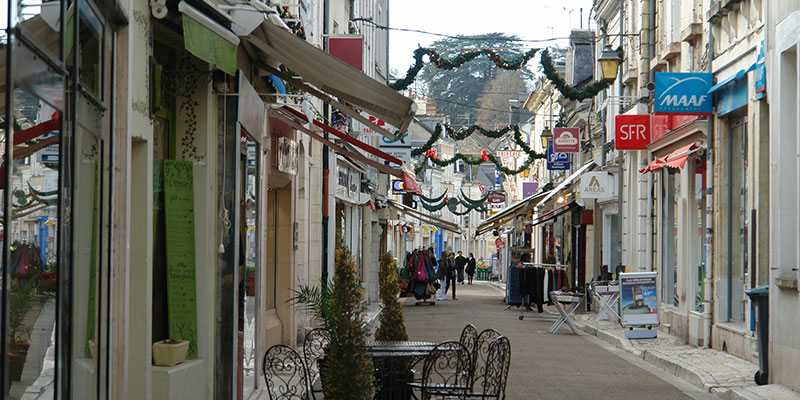
Amboise is widely regarded as having the most Italian character of all the Loire Valley towns, a legacy of the Renaissance connections that defined it five centuries ago[cite: 5]. [cite_start]The old town is compact and sits directly beside the château, making it easy to explore on foot[cite: 6]. [cite_start]The narrow streets contain good examples of timbered housing, a pedestrian shopping zone, and several restaurants[cite: 7]. [cite_start]The city hosts one of the largest outdoor markets in the region every Friday and Sunday morning, held in a square marked by a 19th-century fountain by John Oswald depicting a turtle topped by a teddy bear figure[cite: 8].

The Château d'Amboise
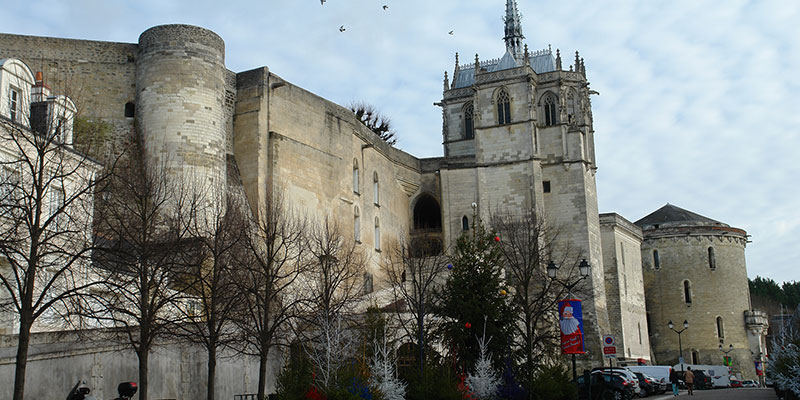
[cite_start]The Château d'Amboise occupies a plateau above the town that was used in succession by Gallic, Roman, and feudal structures, though no building visible today predates the 15th century[cite: 9, 10]. [cite_start]The plateau forms a high terrace supported by massive walls, with a round tower at one angle and two enormous towers at each end, both of which contain winding ramps wide enough for horses and carriages to ascend to the summit[cite: 11]. [cite_start]The overall character is that of a fortified medieval castle with a refined interior, and the elevated position offers clear views down over the town and the Loire[cite: 12].

A proper visit includes the Chapelle Saint-Hubert, a small but accomplished example of late Gothic architecture commissioned by Charles VIII[cite: 13]. [cite_start]The chapel's facade faces the garden and the apse projects beyond the ramparts[cite: 14]. [cite_start]On the exterior, the lintel over the doorway carries a triple high-relief depicting the Vision of St. Hubert, the Legend of St. Christophe, and St. Antoine[cite: 15]. [cite_start]Above, in the tympanum, the Virgin appears between figures of Charles VIII and Anne of Brittany[cite: 16]. [cite_start]The steeple is decorated with gilded stag-horns arranged in the form of a crown[cite: 17]. [cite_start]The colored window panes date from the reign of Louis Philippe[cite: 18].

The château formerly contained a second chapel, larger than the Saint-Hubert, dedicated to St. Florentin[cite: 19]. [cite_start]It was in this chapel that Leonardo da Vinci was buried in 1519[cite: 20]. [cite_start]Several years before 1869 some bones and fragments of a stone grave were found on the site and believed to be Leonardo's remains and tomb[cite: 20]. [cite_start]The government erected a small monument with a bust of Leonardo on the spot in 1869, and in 1874 the discovered bones were enclosed in a lead casket and placed under the flagstones of the Chapelle Saint-Hubert, where they remain[cite: 21]. [cite_start]The château is open to visitors throughout the year, with hours varying by season[cite: 22]. [cite_start]It is operated by the Fondation Saint-Louis and charges an admission fee[cite: 23]. [cite_start]Guided tours are available in French and English[cite: 23]. [cite_start]The site is accessible from the town center on foot via a short climb, and the main entrance is on the plateau level[cite: 24].

Clos Lucé and Leonardo da Vinci
[cite_start]The city is equally famous for the Clos Lucé manor house, where Leonardo da Vinci lived and died, situated just 500 meters from the Château d'Amboise[cite: 25, 26]. [cite_start]At the beginning of 1516, Francis I had the small manor put into thorough repair in preparation for Leonardo's arrival[cite: 27]. [cite_start]Leonardo, then over sixty years old, consented to leave Italy and place his talents as painter, engineer, and architect at the king's service[cite: 28]. [cite_start]He had been in declining health for some time before making the journey and lived only three years after arriving in Amboise, dying in 1519[cite: 29]. [cite_start]Visitors can walk through Leonardo's bedroom and study and see the desk at which he worked[cite: 30].

He is known to have brought with him the Mona Lisa and several other paintings, which eventually passed into the French royal collection and are now held in the Louvre[cite: 31]. [cite_start]Scale models of many of his inventions, reconstructed from his notebooks, are on display in various rooms of the house[cite: 32]. [cite_start]The building has lost some original fabric over the centuries but remains standing and commands a fine view over the gardens and the town below[cite: 33]. [cite_start]The grounds include a large park where additional full-scale reproductions of Leonardo's mechanical designs are installed outdoors, including a proto-tank, a swing bridge, and an aerial screw[cite: 34]. [cite_start]Clos Lucé is open daily and charges a separate admission from the château[cite: 35].

A Brief History
[cite_start]The site has been inhabited since antiquity[cite: 36, 37]. [cite_start]Clovis I (c. 466–511) and the Visigoths signed a peace treaty of alliance with the Arvernians here in 503, which contributed to his defeat of the Visigothic kingdom at the Battle of Vouillé in 507[cite: 37]. [cite_start]Joan of Arc passed through in 1429 on her way to Orléans and the Battle of Patay[cite: 37].

The Amboise conspiracy of 1560 was an attempt by Condé and the Huguenots against Francis II, Catherine de' Medici, and the Guises, and the Edict of Amboise, signed in 1563, conceded the free exercise of Protestant worship[cite: 38]. [cite_start]Francis I, having spent part of his youth at Amboise, continued to use it during the early years of his reign and made extensive additions to bring the castle to a near-finished state[cite: 39]. [cite_start]He was succeeded by his son Henry II, who was in turn succeeded by his son Francis II[cite: 40]. [cite_start]When Francis II was sixteen he became the nominal king of France, and he and his young bride Mary Stuart were brought to Amboise from Blois out of fear of the Protestant Huguenot rising[cite: 41].

Mary Stuart had in fact already spent much of her early life at the château, having arrived from Scotland in 1548 at the age of six to be raised at the French court of Henry II[cite: 42]. [cite_start]Francis II ascended the throne, and Mary found herself queen of two kingdoms, England and France[cite: 43]. [cite_start]Within a year he was dead, leaving his young queen a widow, and she returned to her native Scotland, sailing up the Firth of Forth to Edinburgh on 15 August 1561[cite: 44]. [cite_start]In the seventeenth century the château was converted into a state prison; the most notable prisoner held there was Nicolas Foucquet, the Superintendent of Finance under Louis XIV, who had used embezzled funds to build the magnificent Château de Vaux-le-Vicomte[cite: 44, 45].
The Town Center and Getting There
[cite_start]The old town occupies a small area directly beside the château and is straightforward to navigate on foot[cite: 46, 47]. [cite_start]The esplanade along the Loire offers a pleasant riverside walk, and the pedestrian streets in the center contain a range of shops and restaurants[cite: 48]. [cite_start]The outdoor market on Friday and Sunday mornings draws visitors and locals alike to the central square[cite: 49]. [cite_start]Amboise is reached easily from Tours by car, taxi, or regional train[cite: 50]. [cite_start]The SNCF rail line connects Tours and Amboise with several services daily, and the journey takes around twenty minutes[cite: 51]. [cite_start]From Paris, the most practical approach is to take a TGV to Tours and continue by regional train or car[cite: 52]. [cite_start]The town itself is compact enough that a car is unnecessary once you arrive[cite: 53].
The Château d'Amboise and Clos Lucé can both be visited in a single day without difficulty[cite: 54]. [cite_start]The historic Château de Chenonceau, situated on the Cher River near the village of Chenonceaux, is approximately 18 kilometers from Amboise and makes a natural addition to a visit to the area[cite: 55]. [cite_start]The Loire Valley has a temperate climate, and the most comfortable months for visiting are May through September, when daylight hours are long and outdoor areas can be enjoyed fully[cite: 56]. [cite_start]July and August bring the largest crowds[cite: 57]. [cite_start]Spring and early autumn offer a quieter experience with generally reliable weather[cite: 57].
```